


Here's a statistic that should make you pause: over 80% of retail traders lose money.

David van der Merwe
Emerging Markets Trader ·  South Africa
☕ 10 min read
What you'll learn:
- 1Why Most Trading Books Are Garbage (And How to Spot One)
- 2The Non-Negotiable Foundation (Start Here)
- 3Understanding the Engine: Market Mechanics & Price Action
- 4For the Systematically Minded: Risk & Quantitative Approaches
- 5Save Your Money: Books to Avoid Completely
- 6Reading with a South African Lens
- 7Your Personal Reading & Action Plan

Here's a statistic that should make you pause: over 80% of retail traders lose money. Yet, the shelves (both physical and digital) are overflowing with books promising the opposite. The truth is, most trading books are written to sell copies, not to create profitable traders. They're filled with hindsight bias, oversimplified strategies, and motivational fluff that evaporates the moment real money is on the line. After 12 years and blowing up my first two accounts, I learned that the right book at the right time is worth more than any indicator. This isn't a list of bestsellers. It's a curated list of the top forex books that provided genuine, actionable insight for a trader operating from South Africa, dealing with rand volatility, local broker quirks, and the psychological toll of trading while the rest of the country sleeps.
Let's get this out of the way first. The majority of trading books follow a predictable, profitable (for the author) formula. They present a neat, back-tested system that looks infallible on paper. The author will have a catchy title, often involving 'secrets' or a specific number like 'The 10-Minute Forex Millionaire.' They'll show you perfect chart examples where the strategy worked flawlessly. What they won't show you is the 47 other times it failed, the months of drawdown, or the soul-crushing boredom of waiting for a setup that never comes.
I bought them all early on. I spent thousands of rands on books that promised a 'approach shift.' The real shift happened when I realized I was being sold a fantasy. A good trading book doesn't give you a fish; it teaches you how to handle a fishing rod in a storm. It focuses on process over outcome, risk management over reward chasing, and psychology over prediction.

Warning: Be deeply skeptical of any book that claims high win rates (like 90%) without extensive discussion of risk-to-reward ratios. A strategy with a 40% win rate can be wildly profitable if its average winner is three times its average loser. Most books ignore this math because it's less sexy.
Look for books that talk openly about losing. If the author only shares glorious victories, close it. The value is in understanding their worst trades, how they handled a margin call, and what they did when their confidence was shattered. That's the stuff you won't find in free online articles.
“Most trading books are written to sell copies, not to create profitable traders.”
You can't build a house on sand, and you can't build a trading career on Instagram signals. These two books form the unshakeable bedrock. Ignore them at your own financial peril.
Trading in the Zone by Mark Douglas
This isn't a strategy book. It's a psychological mirror. Douglas forces you to confront the fact that the market is fundamentally uncertain - a 'random distribution of outcomes.' Your job isn't to be right; it's to manage risk so that being wrong doesn't destroy you. This book changed everything for me. I read it after a brutal week where I was right on direction but got stopped out on volatility before the move. I was furious at the market. Douglas showed me I was furious at myself for not accounting for volatility in my position size calculator. For a South African trader, this mindset is critical when the ZAR pairs (like USD/ZAR) are gapping at market open due to global commodity news.
The Disciplined Trader by Mark Douglas
Consider this the prequel. It digs into why we self-sabotage. Douglas argues that becoming a successful trader requires developing a new personality, one that can act without internal conflict. It's heavy, but it explains why you'll close a winning trade early 'just to lock in profit' or let a loser run 'hoping it comes back.' I must have re-read Chapter 5 on 'The Dynamics of Commitment' a dozen times during my first profitable year. It's that important.

Pro Tip: Read these books with a notepad. Don't just highlight passages. Write down the specific, stupid things you do that the book describes. That list is your personal roadmap for improvement.

💡 Winston's Tip
A library of 100 trading books is a monument to confusion. Master three: one for your mind, one for the market, one for your money.
“The value is in understanding their worst trades, how they handled a margin call, and what they did when their confidence was shattered.”
Once your head is on straight, you need to learn how the machine works. These books move from why you lose to how the market moves.
Market Wizards Series by Jack D. Schwager
Forget strategy. This series is a masterclass in trader psychology and diversity of approach. Schwager interviews legendary traders (both fund managers and individuals), and their stories are gold. You'll see that some trade fundamentals, some trade tape reading, some use systems. The universal thread is their obsessive focus on risk. One interview saved me R15,000. A trader discussed 'surviving your learning curve' by trading micro lots until you have six consecutive profitable months. I was trading standard lots trying to make back losses. I switched to 0.01 lots on a demo, then a live account, for five months. It was boring but it built real, unshakeable skill. It's the best business biography you'll ever read.
Japanese Candlestick Charting Techniques by Steve Nison
This is the textbook. Price action is the language of the market, and candlesticks are its alphabet. Nison doesn't just show you patterns; he explains the psychology behind them - what the battle between bulls and bears looks like in a single bar or a three-bar pattern. Understanding a bullish engulfing pattern or a shooting star at a key level is more valuable than any lagging indicator. I use this knowledge every day, especially on the EUR/USD guide and XAU/USD guide where price action at technical levels is king.
| Book | Core Lesson | Best For |
|---|---|---|
| Market Wizards | There are a million ways to succeed; risk management is the only constant. | Inspiration & philosophical foundation. |
| Candlestick Charting | Reading the raw sentiment and momentum shifts in price itself. | Practical chart analysis & entry/exit timing. |

“You'll see that some trade fundamentals, some trade tape reading, some use systems. The universal thread is their obsessive focus on risk.”
This is where you go from a gambler to a business owner. If you're inclined towards rules, back-testing, and cold, hard statistics, these are your top forex books.
The Handbook of Portfolio Mathematics by Ralph Vince
This is a university course in one volume. It's not easy. It's math-heavy. But it contains the single most important concept for a systematic trader: Optimal F (the Kelly Criterion for traders). It mathematically defines how to size your positions based on your edge to maximize long-term growth while avoiding ruin. My biggest 'aha' moment was realizing that even with a positive edge, using too large a position size guarantees blow-up. Vince proves it. After reading this, I rebuilt my entire position size calculator from scratch, incorporating my strategy's historical win rate and average win/loss ratio. My equity curve smoothed out dramatically.
Trading Systems 2nd Edition by Urban Jaekle & Emilio Tomasini
This is the practical implementation guide. It takes you step-by-step from idea, to programming (in MetaTrader's MQL), to back-testing, to walk-forward analysis, to live execution. It teaches you how to properly evaluate a system - not by its profit, but by its Sharpe Ratio, maximum drawdown, and stability. It killed my love for over-optimized, curve-fit systems. I once spent three months building a gorgeous scalping strategy that had 85% win rate in back-tests. This book showed me the test was worthless because I hadn't accounted for realistic spread definition and slippage. It failed in a week live.

Example: If your strategy has a 50% win rate, and your average winning trade is R200 while your average loser is R100, you have an edge. Your average profit per trade is (0.5 * R200) - (0.5 * R100) = R50. Vince's math helps you determine what percentage of your capital to risk on each trade to grow it fastest without excessive risk of a catastrophic drawdown.
💡 Winston's Tip
If a book doesn't make you uncomfortable by exposing a flaw in your thinking, it's not worth the paper it's printed on. The best lessons feel like a personal attack.

“You'll see that some trade fundamentals, some trade tape reading, some use systems. The universal thread is their obsessive focus on risk.”
Being told what to read is half the battle. Knowing what to ignore saves you time, money, and prevents you from learning bad habits. Here are three types to run from.
- The 'Get Rich Quick' Memoir: Any book where the primary narrative is how the author went from zero to hero in 12 months. These are often entertainment, not education. They survive on survivorship bias. For every one person it 'worked' for, 10,000 blew up trying to copy it. They never discuss the years of foundational knowledge that likely preceded their 'overnight' success.
- The Overly Complicated System Seller: The book is just a long-form sales pitch for a proprietary software, indicator suite, or expensive course. The strategy described is vague on purpose, forcing you to buy the 'next piece.' If the core rules can't be fully explained in the book, it's a marketing tool.
- The Pure Indicator Guide: Books that promise profitability by just combining the RSI indicator and MACD indicator in a certain way. They teach you to rely on lagging derivatives of price, not price itself. I have a shelf of these. They create reactive, confused traders who are always a step behind. Price leads, indicators follow. A book that reverses this relationship is teaching you to drive by looking in the rear-view mirror.
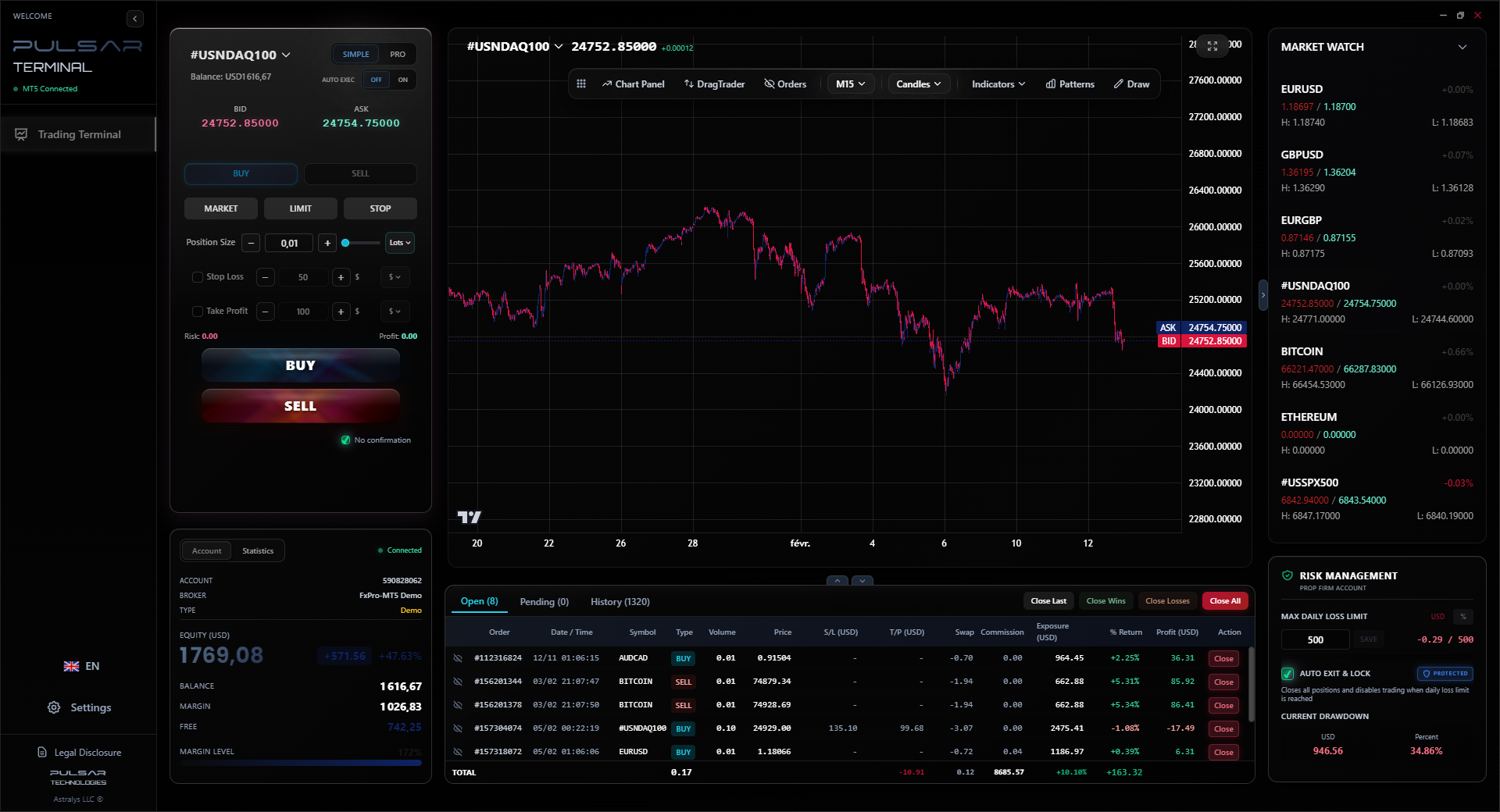
Once you have a solid strategy from these books, executing it without emotional interference is the next challenge. Tools like Pulsar Terminal automate your trade management—setting multi-level take-profits, trailing stops, and breakeven points—directly on your MT5 chart, so you stick to the plan your book-learning built.
Pulsar Terminal
The all-in-one MT5 companion: drag-and-drop orders, multi-TP/SL, trailing stop, grid trading, Volume Profile, and prop firm protection. Used by 1,000+ traders daily.
“It killed my love for over-optimized, curve-fit systems.”
Books are global, but your trading isn't. You need to translate their lessons into your local context. Here’s how.
Trading Hours & Liquidity: Many books assume you're trading the London/New York overlap. When you're trading USD/ZAR or even EUR/USD from SA, you need to understand the liquidity profiles of the Asian session (late SA night) and the SA morning (when Europe comes online). A swing trading approach often fits our timezone and lifestyle better than frantic scalping.
The ZAR Factor: Books won't discuss the unique volatility of the rand. It's a commodity currency that can be rocked by local politics, Eskom news, or global risk sentiment. Your risk management on USD/ZAR must be wider, and your position sizing more conservative, than on a major pair like EUR/USD. A 50-pip stop loss on EUR/USD is standard; on USD/ZAR, it's often a rounding error.
Broker Reality: Concepts like slippage and requotes are theoretical in books. In SA, using international brokers like IC Markets review or Pepperstone review, or local CFDs, you must test execution during volatile news events (like SARB rate announcements). Does your broker hold you to the quoted price, or do you get slipped? This real-world friction can turn a theoretical profit into a real loss. Always paper-trade a strategy with your actual broker before going live.
💡 Winston's Tip
Your trading journal should be thicker than any book on your shelf. Your own data is the only text that truly matters.
“The mistake is separating knowledge from action. The books provide the map, but you still have to walk the path.”
Don't just read. Absorb and implement. Here's a step-by-step plan.
- Phase 1: The Mindset (Weeks 1-4). Read Trading in the Zone and The Disciplined Trader. Your only trading task during this phase is to journal your thoughts and identify your worst psychological tendencies. No live trading.
- Phase 2: The Language (Weeks 5-8). Study Japanese Candlestick Charting Techniques. Go to your charts and label every single candlestick pattern you see for the past month. Use a demo account to practice identifying setups, but don't worry about a full system yet.
- Phase 3: The Business (Weeks 9-12). Dive into Market Wizards for inspiration, then tackle the concepts in The Handbook of Portfolio Mathematics. Start building a simple, rule-based strategy. Define your entry, stop loss, and take profit rules. Use your demo account to track every trade in a spreadsheet: entry, exit, pip definition gained/lost, reason for entry.
- Phase 4: The Synthesis (Ongoing). After 3 months of consistent demo trading with a positive, statistically significant result, start live trading with the smallest possible position size. Your first goal is not profit. Your goal is to execute your plan with the same discipline you had in the demo. This is where 90% fail. The books gave you the knowledge. Now you have to build the character.
Pro Tip: Create a 'Trading Bible' notebook. From each book, write down the 3-5 most crucial lessons in your own words. Review this notebook before every trading session. It grounds you in first principles when the market gets chaotic.
FAQ
Q1I'm a complete beginner in South Africa. What's the single first book I should buy?
Put down your credit card. Don't buy a strategy book first. Get Trading in the Zone by Mark Douglas. Read it twice. It will save you more money than any other investment you'll ever make in trading. It teaches you the game is 90% psychology and risk management, which is true whether you're in Johannesburg or New York.
Q2Are books about Warren Buffett or stock investing useful for forex trading?
For mindset and business philosophy, absolutely. Buffett's focus on margin of safety is just good risk management. But for technical skills and market mechanics, no. The forex market is a decentralized, 24-hour, high-use momentum game. A book on long-term value investing won't help you handle a stop hunt on the GBP/USD during the London fix. Stick to books focused on leveraged, technical, or macro-driven trading.
Q3How do I practice the concepts from these books without risking money?
Open a demo account with a reputable broker that offers real market conditions (like Exness review or XM review for MT4/5 platforms). But here's the key: treat the demo money as if it's real. Give yourself a finite amount (e.g., R50,000) and do not reset it. Your goal is to practice the processes from the books - planning trades, calculating position size, executing, journaling - not to get a high score. The moment you start revenge trading on a demo, you've learned nothing.
Q4What's the biggest mistake South African traders make after reading these books?
They intellectualize the concepts but don't internalize them. They understand Optimal F mathematically but then risk 5% of their account on a USD/ZAR trade because they 'have a strong feeling.' They know about candlestick patterns but ignore a clear reversal signal because they're already in a losing trade and are hoping. The mistake is separating knowledge from action. The books provide the map, but you still have to walk the path, and that path is paved with discipline.
Q5Do I need to read all of these books to be successful?
No. But you need to master the core categories: Psychology (Douglas), Market Mechanics (Schwager/Nison), and Risk Math (Vince). You could just read Trading in the Zone, Market Wizards, and the key chapters on position sizing from Vince, and you'd be ahead of 95% of traders who own libraries of 50 books. Depth beats breadth every time.
Q6Are older trading books still relevant in today's markets?
The foundational ones are more relevant than ever. Reminiscences of a Stock Operator (1923) is still the best trading book ever written. Why? Because human psychology - fear, greed, hope, ego - has not changed. The ticks move faster, but the players are the same. Books focused on timeless principles of risk and psychology age well. Books focused on specific software or 1990s chart patterns do not.
Prof. Winston's Lesson
Key Takeaways:
- ✓Psychology books like Douglas's are more valuable than 100 strategy guides.
- ✓Your trading system's win rate is meaningless without its average risk-to-reward ratio.
- ✓Always test strategies with your actual broker's spreads and execution.
- ✓Spend 10x more time reviewing your trades than reading new books.
How useful was this article?
Click a star to rate
Weekly Trading Insights
Free weekly analysis & strategies. No spam.
About the Author
David van der Merwe
Emerging Markets Trader
Johannesburg-based trader with 11 years in emerging market currencies. Specializes in ZAR pairs, FSCA-regulated trading, and South African market analysis.
Comments
Risk Disclaimer
Trading financial instruments carries significant risk and may not be suitable for all investors. Past performance does not guarantee future results. This content is for educational purposes only and should not be considered investment advice. Always conduct your own research before trading.
You Might Also Like

Cara Trading Forex Sukses: 7 Prinsip dari Trader Profesional
Cara trading forex sukses dengan 7 prinsip trader pro: manajemen modal, disiplin, journal trading, backtest. Data nyata, bukan janji profit palsu.
Jam Trading Forex Terbaik untuk Trader Indonesia: Panduan Lengkap dengan Tabel Waktu
Panduan jam trading forex untuk trader Indonesia. Tabel 4 sesi dunia, jam emas 20:00-00:00, sesi mana yang harus dihindari. Data akurat + tips dari trader berpengalaman.
Top 5 Sàn Forex Uy Tín Nhất 2026: Review Jujur dari Trader Indonesia
Top 5 sàn forex uy tín 2026 untuk trader Indonesia. Review jujur: spread, deposit, withdraw, dukungan lokal. Exness, XM, IC Markets & lebih.
Get Pulsar Terminal
All these calculators are built into Pulsar Terminal with real-time data from your MT5 account. One-click position sizing, automatic risk management, and instant calculations.
Get Pulsar Terminal