


Let's be honest, most lists of 'top forex traders in Nigeria' are just a collection of Instagram influencers who sell courses, not trading results.

Olumide Adeyemi
West African Trading Pioneer ·  Nigeria
☕ 10 min read
What you'll learn:
- 1What a Top Nigerian Trader Actually Looks Like
- 2The Strategies That Actually Work in Nigeria
- 3Broker Selection: The Make-or-Break Decision
- 4Risk Management: How to Survive the Volatility
- 5The Tech & Tools They Use (Beyond MT5)
- 6Prop Firms: The Real Path to Bigger Capital
- 7Mentorship vs. Real Community
- 8The Tax Reality Nobody Talks About
Let's be honest, most lists of 'top forex traders in Nigeria' are just a collection of Instagram influencers who sell courses, not trading results. The real top traders aren't the ones with the flashiest cars on social media. They're the quiet professionals who've consistently made money through the Naira crashes, banking restrictions, and market chaos. I've been trading from Lagos for over a decade, and I'll show you the actual profiles, strategies, and broker setups that define success here. Forget the hype, we're talking about real P&L.
The image is all wrong. The top forex traders in Nigeria aren't 22-year-old 'gurus' with rented Lamborghinis. The ones I know and respect, the ones with seven-figure portfolios, share a specific profile. They're often between 35 and 50. They have a primary career - engineering, law, medicine, or business - and treat trading as a serious secondary business, not a get-rich-quick scheme. They're not on TikTok.
Their edge doesn't come from a secret indicator. It comes from a deep understanding of liquidity and market timing specific to our timezone. They trade the London open (10 AM our time) and the London/New York overlap (3 PM to 5 PM our time). These are the most liquid windows, crucial for getting in and out of trades without getting ripped off by slippage. They've also mastered the art of funding and withdrawing from international brokers despite our ever-changing banking policies, a skill as important as any chart pattern.

Warning: If someone's primary product is a mentorship program costing ₦300,000 a month, they are a marketer, not a trader. A real trader's primary product is their trading performance.
I learned this the hard way early on. I blew a $2,000 account trying to copy the aggressive style of a popular 'mentor.' His style required holding trades through high volatility, which was fine for his six-figure account, but my smaller account got margin called on a routine retracement. My mistake was copying the person, not understanding the strategy's risk parameters. Now, I use a position size calculator for every single trade, no exceptions.

💡 Winston's Tip
A 'top trader' is defined by their worst trade, not their best. How they manage a loss tells you everything.
Price Action & Key Levels
This is the bedrock. Top traders here are masters of reading raw price charts. They identify clear support and resistance levels, trend lines, and chart patterns like triangles and flags. They don't clutter their screens with 20 indicators. The logic is simple: in a market where internet connectivity can be unstable, you need a strategy that doesn't rely on real-time indicator calculations. A support level drawn yesterday is still a support level today, even if your data feed lags for a second.
Swing Trading the Majors
Day trading the exotic pairs is a surefire way to burn capital on spreads and weird volatility. The consistent winners I know are swing traders. They hold positions for days or weeks, focusing on major pairs like EUR/USD, GBP/USD, and USD/JPY. They're not trying to catch every 10-pip move. They're waiting for a clear setup on the 4-hour or daily chart, placing the trade, and managing it patiently. This fits perfectly with a full-time job. You check your trades in the morning and evening, not every minute. If you're interested in this approach, our guide on swing trading breaks down the exact process.
Gold (XAU/USD) as a Hedge
This is a uniquely Nigerian play. When there's political uncertainty or Naira volatility, gold often moves. Many top traders keep a portion of their portfolio in XAU/USD trades, not just forex. It's a different beast - more volatile, with larger spreads - but it doesn't always correlate with currency moves. Understanding how to trade gold is a key part of the toolkit here.
“Your broker's withdrawal processing time is as important as their spreads.”
Your broker is your lifeline. With local CBN authorization limited and our banks blocking international transactions, choosing the right international broker is critical. The top forex traders in Nigeria prioritize three things: regulation, deposit/withdrawal methods, and execution quality. They don't chase the broker with the highest use ad.
Here’s a breakdown of what matters, based on real use:
| Broker Consideration | Why It Matters in Nigeria | The Top Trader's Priority |
|---|---|---|
| Regulation | Safety of funds. You want a broker overseen by a reputable body (not just an offshore license). | High - Non-negotiable. |
| Deposit Methods | Can you fund with your Nigerian card or bank transfer? Do they accept local e-wallets? | Critical - If you can't fund it, it's useless. |
| Withdrawal Speed | How many days to get your profit back to your Nigerian account? | Critical - Cash flow is king. |
| Spreads on Majors | The cost of trading. A 2-pip spread vs. a 0.5-pip spread destroys profits over time. | High - They compare live spreads, not advertised ones. |
| use | The ability to control larger positions. | Medium - They use low use (1:10 to 1:30) for swing trades. |
| Platform | MT4/MT5 reliability. | High - Must be stable on mobile and desktop. |
Based on my experience and that of peers, brokers like IC Markets and Pepperstone are popular for their raw spreads and reliable execution. Exness is widely used for its variety of local deposit options. XM has a strong local presence and educational support. I personally split my capital between two brokers for redundancy. In 2023, during a period of intense Naira volatility, one broker had temporary withdrawal delays. Because I used two, my cash flow wasn't completely choked.

Pro Tip: Before depositing real money, open a demo account and test the broker's execution during the London open (10 AM WAT). Place market orders on EUR/USD and watch for slippage. That's when you'll see their real quality.
💡 Winston's Tip
In Nigeria, your broker's withdrawal processing time is as important as their spreads. Test it with a small profit first.
This is where legends are made and accounts are destroyed. Nigerian markets can be wild. News about fuel subsidies or election results can cause gaps and insane volatility. Top traders have iron-clad rules.
The 1% Rule is Gospel: They never risk more than 1% of their account on a single trade. On a $10,000 account, that's $100. This means their stop loss distance and position size are calculated together. If their stop is 50 pips away on EUR/USD, they'll only trade a position size where 50 pips of loss equals $100. This simple math has saved me more times than I can count.
They Use Stop Losses Religiously: No 'hoping' the market comes back. A stop loss is an admission that your analysis might be wrong, and that's okay. I once watched a trade on GBP/JPY go 30 pips against me, hit my pre-set stop, and then reverse 200 pips in my original direction. It hurt, but I lived to trade another day. Without that stop, I would have been facing a margin call.
They Understand use is a Double-Edged Sword: Just because a broker like Exness offers 'unlimited' use doesn't mean you use it. The smartest traders I know use use to reduce their margin requirement, not to maximize position size. They might trade a 1-lot position with 1:100 use (requiring ~$1000 margin) instead of 1:10 use (requiring ~$10,000 margin), but they still treat that 1-lot position as risking 1% of their capital. The use just frees up capital for other opportunities.
“Paying for a 'one-on-one mentorship' from an Instagram star is almost always a scam.”
It's not just about having MT5 installed. The top guys use tools to gain a structural edge and save time.
Advanced Charting Software: Tools like TradingView are used for analysis and drawing ideas, even if execution happens on MT5. The drawing tools and scripting capabilities are superior.
Economic Calendars: They know when major US, EU, and UK data is coming out (like Non-Farm Payrolls). They either avoid trading during these events or have specific strategies to trade the volatility. They don't get caught off guard.
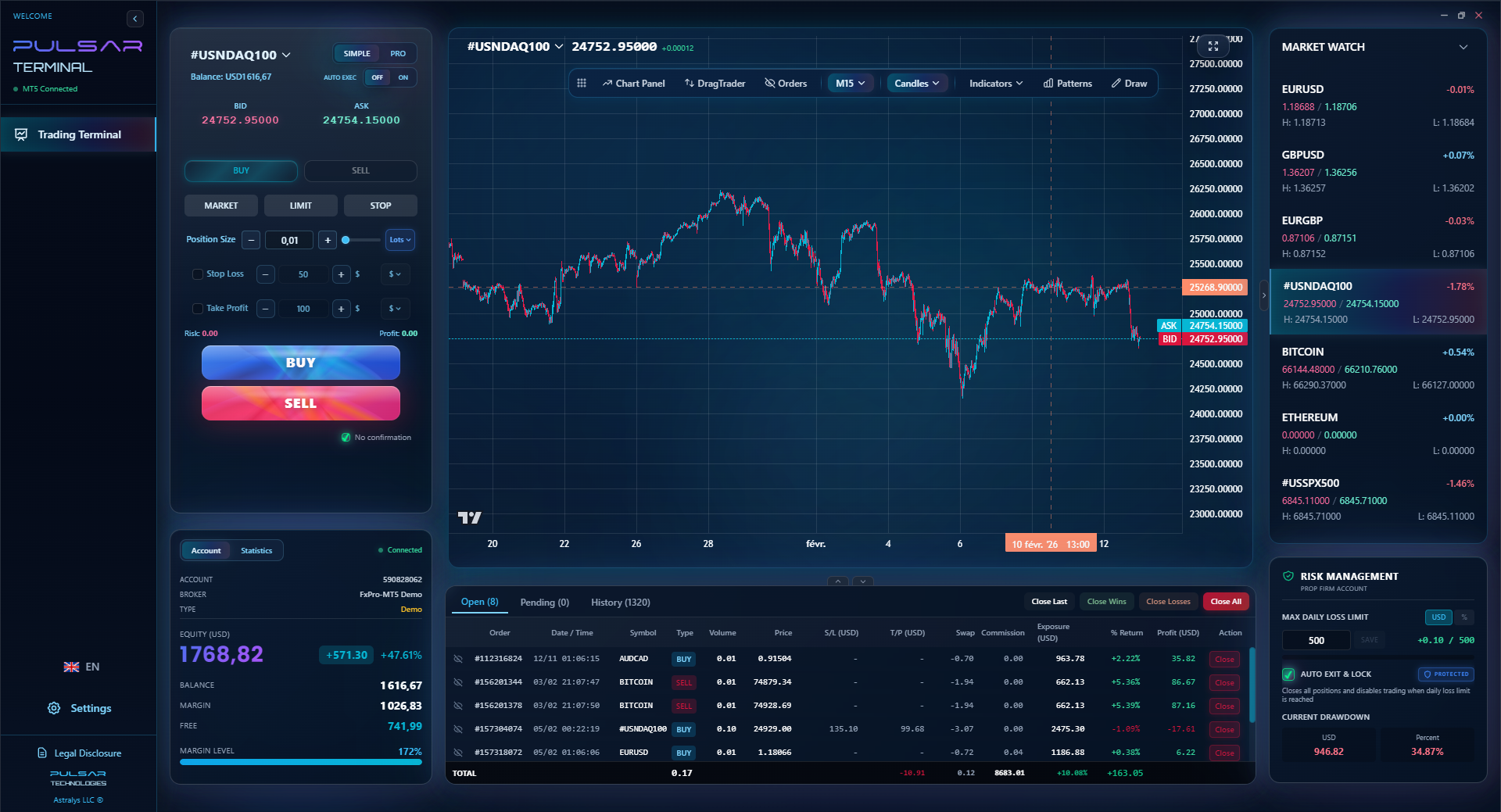
MT5 Enhancers: This is a game-changer for professional workflow. A tool like Pulsar Terminal sits on top of your MT5 and lets you manage trades in ways the standard platform can't. You can set a trailing stop that automatically moves, or place a grid of orders for a range-bound strategy, or set multiple take-profit levels to scale out of a winner. Doing this manually on a laggy connection is a nightmare. Automation is key to executing a complex plan perfectly.
VPNs: A reliable VPN is standard equipment. It ensures a stable connection to broker servers and can sometimes improve execution speed during local network issues.
Managing complex trades with multiple take-profit levels and trailing stops is what separates amateurs from pros, and Pulsar Terminal automates this directly on your MT5 platform.
Pulsar Terminal
The all-in-one MT5 companion: drag-and-drop orders, multi-TP/SL, trailing stop, grid trading, Volume Profile, and prop firm protection. Used by 1,000+ traders daily.
This is one of the biggest open secrets among top forex traders in Nigeria. They don't just trade their own $5,000 account forever. They use proprietary trading firms to trade with the firm's capital and keep a large share of the profits (often 80-90%).
How it works: You pay an evaluation fee (say, ₦60,000 for a $100,000 challenge). You have to hit a profit target (e.g., 10%) without violating strict drawdown rules. If you pass, you get a funded account. Your risk is limited to the evaluation fee; the firm's capital is at risk in the live account.

Example: You pass a $100,000 challenge. You make a 5% profit ($5,000) in your first month. At an 80% profit split, you earn $4,000. Your initial risk was just the evaluation fee.
The key is that these firms enforce the discipline top traders already have: strict stop losses, daily loss limits, and no over-leveraging. The evaluation is just proving you can follow your own rules. For a trader with a solid strategy but limited personal capital, this is the most legitimate way to scale up. The smart ones treat the evaluation like a real job, not a gamble, often using a conservative scalping strategy or their proven swing method to pass.
“Thinking like a business owner is what separates a pro from a hobbyist.”
Let's clear this up. Paying ₦200,000 for a 'one-on-one mentorship' from an Instagram star is almost always a scam. However, being part of a real trading community is useful.
The difference? A mentor sells you a dream. A community provides peer review. In the good communities I've been in (often small Discord or Telegram groups), no one is selling anything. Traders post their charts before they enter a trade and explain their reasoning. Others ask tough questions: 'Why is your stop loss there?' 'Did you check the weekly level?' 'The MACD indicator is showing divergence, are you sure?'
This process of defending your trade idea exposes flaws in your logic before you risk money. I've avoided dozens of bad trades because someone in my group pointed out a fundamental news event I missed or a higher-timeframe resistance level. This is how you learn. Not from a pre-recorded video course, but from real-time, collaborative analysis. Find a group of serious traders at a similar level and grow together. It's free and more effective than any expensive mentorship.
💡 Winston's Tip
If you can't explain your trade setup in one sentence, you don't have a setup. You have a hope.
Here's the final hallmark of a top trader: they are compliant. According to Nigerian law, profits from forex trading are subject to Capital Gains Tax at 10%. Yes, even profits made with an international broker.
The top traders I know keep immaculate records. They track every trade, every deposit, every withdrawal. At the end of the year, they calculate their net profit (total withdrawals minus total deposits) and set aside 10% for tax purposes. They consult with an accountant who understands financial trading.
Why? Because building a sustainable, long-term career in trading means being legitimate. You don't want your first major success story to be followed by a problem with the tax authorities. It also forces incredible financial discipline. You're not just trading for a fancy car; you're running a business with expenses (data, power, equipment) and tax liabilities. Thinking like a business owner is what separates a pro from a hobbyist with a lucky streak.
FAQ
Q1Is forex trading legal in Nigeria?
Yes, forex trading is legal for individuals in Nigeria. There's no law against you opening an account with an internationally regulated broker and trading. However, Nigerian brokers offering these services need authorization from the Central Bank of Nigeria (CBN). The key point is that your income from trading is subject to a 10% capital gains tax.
Q2Which broker is best for Nigerian traders?
There's no single 'best' broker. It depends on your needs. For tight spreads and fast execution, look at IC Markets or Pepperstone. For ease of local deposits and withdrawals, Exness and XM have strong local support. Always prioritize brokers with top-tier regulation (like ASIC, FCA, CySEC) over those with only offshore licenses, and test their platform with a demo account first.
Q3How much money do I need to start forex trading in Nigeria?
You can technically start with as little as $10. But to trade properly with sensible risk management, a realistic starting amount is between $500 and $1,000. This allows you to use appropriate position sizes without being forced to use dangerously high use to see meaningful profits. Start small, preserve your capital, and grow it steadily.
Q4Who is the richest forex trader in Nigeria?
The truly richest traders are almost certainly unknown. They value privacy and don't market themselves on social media. Public figures often make more money from selling courses and signals than from actual trading. Focus on developing your own skills rather than idolizing individuals whose real track record you cannot verify.
Q5How do I fund my forex trading account from Nigeria?
Funding methods change as bank policies shift. Common methods include using Naira debit cards (Visa/Mastercard), bank wire transfers to the broker's international account, and funding through local e-wallets or payment processors that the broker supports. Always check your broker's 'Deposit' page for the current options available for Nigerian residents.
Q6What is the best forex trading strategy for beginners in Nigeria?
Start with swing trading on the major currency pairs (like EUR/USD) using the 4-hour and daily charts. This strategy doesn't require you to stare at screens all day. Learn basic price action - support and resistance, trend lines, and candlestick patterns. Avoid complex indicators and exotic pairs at the beginning. Our guide on swing trading is a perfect starting point.
Q7Are prop firms like FTMO worth it for Nigerian traders?
Yes, they can be an excellent path to trading larger capital, but only if you already have a proven, disciplined strategy. They are not a shortcut. You must be able to pass their challenge, which tests your risk management and consistency. Treat the evaluation fee as the cost of a professional exam, not a lottery ticket. If you pass, the opportunity to trade six-figure accounts with the firm's capital is very real.
Prof. Winston's Lesson
Key Takeaways:
- ✓Risk a maximum of 1% of your capital per trade.
- ✓Swing trade majors, don't scalp exotics.
- ✓Use use to free margin, not amplify risk.
- ✓Set aside 10% of net profits for tax.
How useful was this article?
Click a star to rate
Weekly Trading Insights
Free weekly analysis & strategies. No spam.
About the Author
Olumide Adeyemi
West African Trading Pioneer
One of Nigeria's most active forex trading educators. 8 years of experience trading from Lagos. Specializes in low-capital strategies and prop firm challenges for African traders.
Comments
Risk Disclaimer
Trading financial instruments carries significant risk and may not be suitable for all investors. Past performance does not guarantee future results. This content is for educational purposes only and should not be considered investment advice. Always conduct your own research before trading.
You Might Also Like

Cara Trading Forex Sukses: 7 Prinsip dari Trader Profesional
Cara trading forex sukses dengan 7 prinsip trader pro: manajemen modal, disiplin, journal trading, backtest. Data nyata, bukan janji profit palsu.
Jam Trading Forex Terbaik untuk Trader Indonesia: Panduan Lengkap dengan Tabel Waktu
Panduan jam trading forex untuk trader Indonesia. Tabel 4 sesi dunia, jam emas 20:00-00:00, sesi mana yang harus dihindari. Data akurat + tips dari trader berpengalaman.
Top 5 Sàn Forex Uy Tín Nhất 2026: Review Jujur dari Trader Indonesia
Top 5 sàn forex uy tín 2026 untuk trader Indonesia. Review jujur: spread, deposit, withdraw, dukungan lokal. Exness, XM, IC Markets & lebih.
Get Pulsar Terminal
All these calculators are built into Pulsar Terminal with real-time data from your MT5 account. One-click position sizing, automatic risk management, and instant calculations.
Get Pulsar Terminal