


Everyone's looking for the 'best' platform, but here's the hard truth I learned the expensive way: the perfect platform doesn't exist.

Olumide Adeyemi
West African Trading Pioneer ·  Nigeria
☕ 13 min read
What you'll learn:
- 1The Nigerian Forex Reality Check
- 2What Actually Makes a Platform 'Top' for Us?
- 3Detailed Breakdown: The Major Players for Nigerian Traders
- 4The Hidden Costs That Eat Your Profits
- 5MT4 vs. MT5 vs. Proprietary Platforms: What's Best?
- 6My Personal Platform Mistakes (So You Don't Make Them)
- 7Your Action Plan: How to Choose and Start
Everyone's looking for the 'best' platform, but here's the hard truth I learned the expensive way: the perfect platform doesn't exist. I spent years and lost money chasing low spreads, only to get hammered by withdrawal fees and terrible slippage during Lagos power cuts. The real question isn't which platform is 'top,' but which one fits your specific Nigerian reality - your budget, your internet, and how you actually trade. Let's cut through the marketing hype and I'll show you what really matters, based on 12 years of trading from Abuja and Port Harcourt.
Before we talk platforms, you need to understand the ground you're standing on. Trading from Nigeria isn't like trading from London or New York. We have unique challenges that will make or break your choice of broker.
The biggest myth? That forex trading is illegal here. It's not. The Central Bank of Nigeria (CBN) and the Securities and Exchange Commission (SEC) allow it. The CBN controls how money moves in and out, and the SEC warns against unregulated platforms. The real issue is the lack of specific, strong regulation for the online retail space. That's why you won't find many local Nigerian brokers. We're mostly using international firms.
This creates our first major hurdle: funding and withdrawals. I remember trying to deposit $500 using my naira card back in 2018. The transaction failed three times, my bank flagged it for 'suspicious international activity,' and I spent two hours on the phone with customer service. Many banks have limits or outright blocks on international card payments for forex trading. That's why brokers that offer local deposit methods - like direct bank transfers in NGN or partnerships with Nigerian payment processors - are worth their weight in gold.
Then there's the 10% capital gains tax. Yes, on all gross profits. It's easy to forget when you're counting pips, but the taxman doesn't. Factor that into your profit targets from day one.

Warning: Don't get lured by platforms offering 'Naira accounts' if they aren't properly regulated elsewhere. A Naira account with an unregulated offshore entity is a fast track to losing everything. Always prioritize international regulation from bodies like the UK's FCA or Cyprus's CySEC first.
The Association of Online Forex Trading Agents in Nigeria is trying to set local standards, but for now, your safety net is an international license. This landscape means our criteria for a top platform shifts. Reliability during our unstable internet, affordable funding methods, and responsive support that understands 'network issues' aren't just excuses - they're daily life.
“The perfect platform doesn't exist, but the right one for your Nigerian reality does.”
Forget the generic 'low spreads' talk. Here’s my personal checklist, forged from expensive lessons.
Execution & Slippage: The Silent Account Killer
A platform can advertise 0.0 pip spreads all day. But what happens when the CBN makes a surprise announcement and liquidity dries up? I was trading GBP/USD on a supposedly 'top' platform in 2020 when Brexit news hit. My stop-loss at 1.3200 got filled at 1.3175. That's 25 pips of slippage. On a 2-lot trade, that was a $500 lesson. Execution speed and how a broker handles volatile news (common with our oil-dependent economy) are critical. Look for brokers with true ECN/STP models, not market makers who trade against you.
The Funding & Withdrawal Litmus Test
This is non-negotiable. A platform is useless if you can't get money in or out smoothly. The best platforms for Nigerians offer multiple local channels: direct bank transfer in Naira, USSD, or integrations with local payment gateways. Withdrawal times are another tell. I once waited 14 business days for a withdrawal from a broker. Never again. Now, I only consider platforms that process withdrawals in 24 hours or less. Instant is becoming the new standard.
use: A Double-Edged Sword
Yes, Nigerian traders often have access to high use (1:500, 1:1000, even 1:2000). It’s tempting when you start with a small account. My first major blow-up was due to misusing high use. I turned $200 into $1,200 in a week, felt like a genius, then lost it all in one afternoon trade. High use amplifies both gains and losses. A top platform should offer flexible use you can adjust down, not just max out.
Localized Support
Can you call a Lagos or Abuja number and speak to someone who gets it? When you have a margin call because 'UP NEPA' took out your internet for an hour, you need support that understands. English tickets are fine, but local phone support during our business hours is a massive advantage.
Your position size calculator is your best friend here. No matter the platform's use, your risk per trade should never exceed 1-2% of your account. That’s the rule that saved me after that early blow-up.

💡 Winston's Tip
Your first withdrawal is more important than your first deposit. If a platform makes it difficult to get your money out, nothing else matters.
“A platform is useless if you can't get money in or out smoothly.”
Here’s my honest, experience-based take on the platforms you hear about most. I’ve traded on most of these.
| Broker | My Experience & Key Fit | Minimum Deposit (Realistic) | Big Pro for Nigeria | Big Caution for Nigeria |
|---|---|---|---|---|
| Exness | I use them for scalping. Their raw spreads are genuine, and execution is fast. | $10 (but start with $50+) | Instant withdrawals are a game-saver. Local agent network helps. | Very high use can be dangerous for new traders. Requires serious discipline. Read our full Exness review for details. |
| HFM (HotForex) | Great for beginners. Their educational resources are solid. | As low as ₦4,000 | Has a physical office in Nigeria and strong local support. Welcome bonus can boost a small account. | Spreads on standard accounts are wider than raw ECN brokers. You pay for the support. |
| FXTM | My go-to for years. Reliable and very Nigeria-focused. | $500 for best account | NGN accounts, local seminars, and deposit methods. They understand our market. | The $5/month inactivity fee after 6 months can nibble at dormant accounts. |
| IC Markets | My choice for pure, low-cost ECN trading. | $200 | Some of the lowest, most consistent spreads I've seen. True institutional pricing. | Less Nigeria-specific hand-holding. You need to know what you're doing. Our IC Markets review covers this. |
| XM | Excellent for micro-account practice. | $5 | No requotes policy saved me during high volatility. Huge variety of account types. | Spreads on the standard account aren't the cheapest. Better for swing traders than ultra-HFT scalpers. |
| AvaTrade | The platform variety king. Good if you like options. | $100 | Fixed spreads available. Helpful during major news when variable spreads widen. | Not the absolute lowest costs. Suits traders who value stability over ultra-low variable spreads. |

Pro Tip: Don't just open an account with the 'big name.' Match the broker to your style. Are you a scalping strategy trader? You need Exness or IC Markets with raw spreads. A swing trading beginner? FXTM or HFM with more educational support might be better.
“A platform is useless if you can't get money in or out smoothly.”
This is where I got burned early on. You see a 0.1 pip spread on EUR/USD and think, 'That's cheap!' But the real cost of trading is a multi-headed beast.
Commissions: ECN accounts charge them. It's usually $3-$7 per standard lot (100k units), per side. So a round turn (open and close) costs $6-$14. On a $10,000 account trading 1 lot, that's a significant chunk. You must win enough pips just to cover commissions.
Swap Rates (Overnight Financing): If you hold a position past 5 PM EST, you pay or earn swap. For Nigerian traders, this is crucial if you're holding trades for days. Long positions on currencies with high-interest rates (like ZAR or MXN) can have punishing negative swaps. I once held a USD/ZAR trade for a week. I made 80 pips, but the swap fees ate 45 of them. Always check the swap calculator before entering a swing trade.
Inactivity Fees: As mentioned, brokers like FXTM charge if you don't trade for 6 months. Others start at 3 months. If you're taking a break, withdraw your money.
Currency Conversion Fees: If you deposit in Naira but trade USD-denominated accounts, the broker converts it. Their rate is often 1-2% worse than the interbank rate. That's an instant loss on your deposit. Some brokers now offer true NGN-denominated accounts to avoid this.
The Internet Tax: This isn't a broker fee, but it's a real cost. Reliable, fast internet in Nigeria isn't free. Budget ₦8,000–₦15,000 monthly for data. Trading on public WiFi or a shaky mobile connection is asking for a disconnected trade and a margin call.

Example: Let's say you take 20 trades a month, 1 lot each, on an ECN account with a $5 commission per side. Commission Cost: 20 trades * $10 (round turn) = $200/month. Add data costs (₦12,000 ≈ $8), potential conversion fees, and swap costs. You need to make well over $208 a month just to break even on costs. This forces you to be a profitable trader, not just a busy one.
💡 Winston's Tip
Never trust a broker's 'typical' spread screenshot. Check the live spread yourself at 3 PM Lagos time (when London is active). That's the real cost.
“I lost $800 in two weeks chasing a low spread, blind to horrific execution.”
The platform software itself is just as important as the broker. Most brokers offer MetaTrader 4 or 5. Here's my take.
MT4: The old faithful. It's everywhere, it's stable, and every indicator or Expert Advisor (EA) you can imagine has been built for it. For pure forex trading, it's still fantastic. Its simplicity is its strength. I used MT4 exclusively for my first 8 years. The charting is solid, and placing orders is intuitive. However, it's getting long in the tooth. It doesn't handle other asset classes (like stocks) natively as well.
MT5: The successor. It's faster, allows more pending order types, and has a better backtesting engine. It's built for trading forex, stocks, and futures all in one. The downside? The community and EA library aren't as vast as MT4's. Some classic indicators feel different. I switched to MT5 in 2022 and won't go back. The depth of market (DOM) feature and economic calendar integration are worth the switch alone.
Proprietary Platforms (AvaTradeGO, FXTM App, etc.): These are brokers' own apps. They're usually sleek, user-friendly, and packed with educational content. They're brilliant for monitoring your account on the go and for beginners. But for serious chart analysis and custom indicators, they often fall short. I use the FXTM app to check my positions, but I do all my analysis on MT5.
My advice? Start with MT4 if you're a complete beginner. Its ubiquity means you'll find endless free tutorials. But plan to graduate to MT5 within a year. It's the future, and the hedging capabilities (holding buy and sell positions on the same pair) are more flexible, which can help with certain risk management strategies.
Having the right tools on your MT5 platform can make all the difference. For instance, managing multiple take-profit levels on a single trade manually is a hassle. Tools that let you drag and drop orders and set partial closures automatically remove emotion and human error from the process.
“I lost $800 in two weeks chasing a low spread, blind to horrific execution.”
I need to be honest about my failures. This isn't just theory.
Mistake 1: Chasing the Lowest Spread, Blindly. In 2017, I signed up with an offshore broker advertising '0.0 pips on all majors!' The spread was indeed low. But the commission was $15 per lot round turn, and the slippage was horrific. I was scalping the EUR/USD guide, aiming for 5-pip profits. The spread was 0.1, but my market orders consistently filled 2-3 pips away from where I clicked. I was losing on winning trades. I lost about $800 in two weeks before I realized the execution quality was trash.
Lesson: The 'all-in' cost (spread + commission + slippage) is what matters. Test a demo account during your most active trading hours and London/New York overlap to see real execution.
Mistake 2: Ignoring the Withdrawal Process. My first profitable month, I made $1,200 with a new broker. I requested a withdrawal. They asked for a utility bill, my ID, a selfie with my passport, and a bank statement. The process took 3 weeks. Then they only allowed withdrawals back to the original payment method - my naira card. The bank's conversion rate clawed back another 3%. My $1,200 profit became about $1,100 landed in my account.
Lesson: Before you deposit a single dollar, research the withdrawal policy. Read Nigerian user reviews specifically about withdrawals. Contact support and ask: 'What documents do Nigerians need for withdrawal? What local methods do you offer?'
Mistake 3: Overlooking Platform Stability. I was in a great gold (XAU/USD guide) trade during a major Fed announcement. My proprietary web platform froze. Completely. By the time I logged in on my phone, my 30-pip profit had turned into a 15-pip loss. The platform had buckled under the volume.
Lesson: For critical trading, especially around news, use a strong, installed platform like MT4/MT5, not a web-based one. Ensure your computer and internet can handle it. A platform isn't 'top' if it crashes when you need it most.
💡 Winston's Tip
Write down your broker's support number and your account ID. Keep it by your trading desk. When the internet fails mid-trade, your phone is your lifeline.
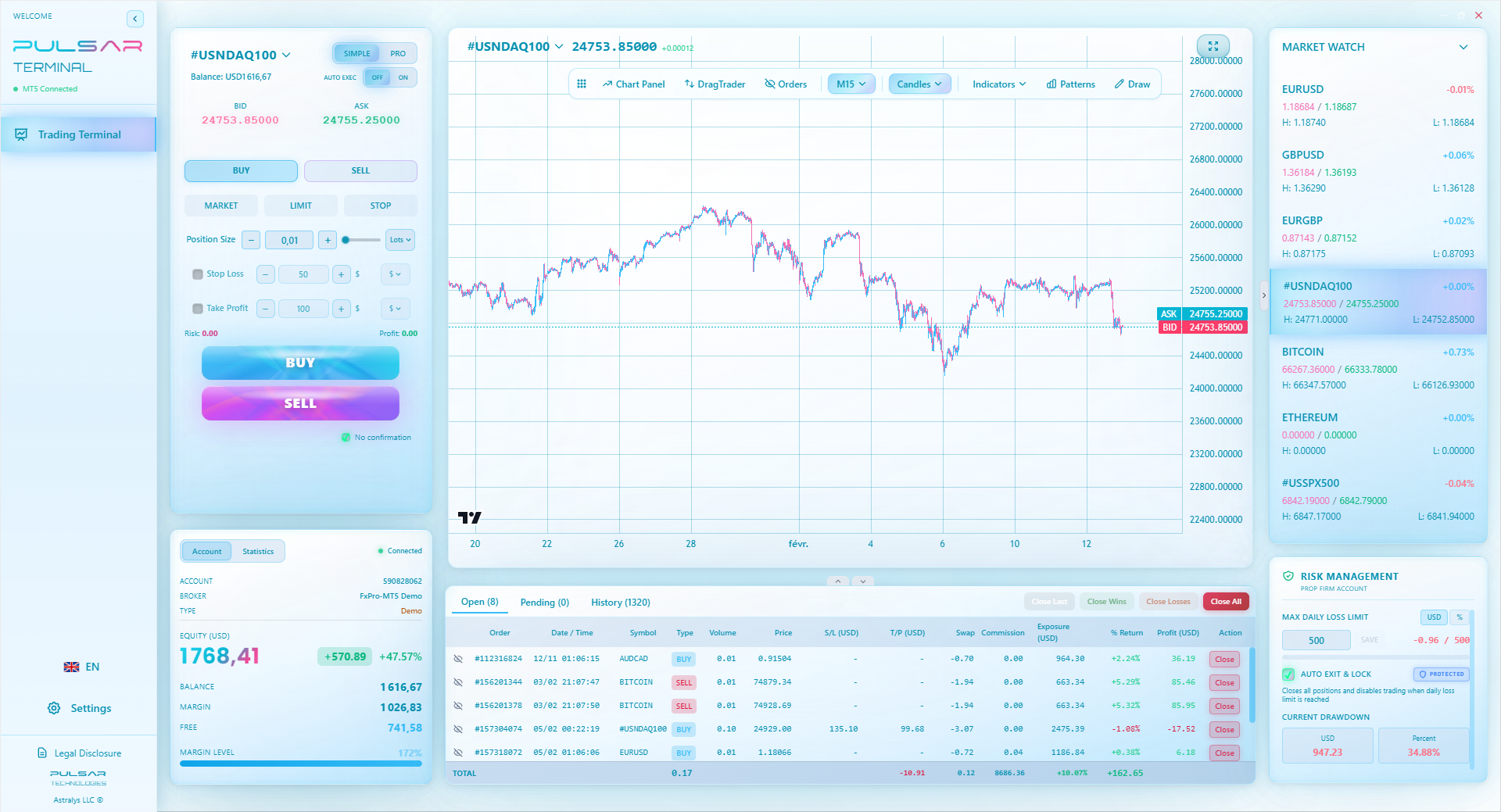
Managing complex trades with multiple take-profit levels is where manual errors happen; a tool that automates partial closures and trailing stops directly on MT5 can lock in profits systematically.
Pulsar Terminal
The all-in-one MT5 companion: drag-and-drop orders, multi-TP/SL, trailing stop, grid trading, Volume Profile, and prop firm protection. Used by 1,000+ traders daily.
“Your first withdrawal is the ultimate test of a broker.”
Let's make this practical. Here's your step-by-step plan for the next week.
- Define Your Profile: Are you a scalper, day trader, or swing trader? What's your realistic starting capital? (If it's under ₦75,000, focus on micro accounts or save more. Trust me.)
- Shortlist 3 Brokers: Based on your profile, pick three from the table above. For example: a scalper might look at Exness, IC Markets, and Pepperstone (check our Pepperstone review).
- Open Demo Accounts: Not for one hour. For a full week. Trade your usual strategy on all three. Pay attention to:
- The speed of order execution.
- The actual spread at 9 AM and 3 PM Lagos time.
- How the platform feels. Is it intuitive?
- Test Customer Support: Send a ticket or call each broker's support. Ask a specific question like, 'What is your withdrawal processing time for Nigerian bank transfers?' Gauge their speed and knowledge.
- Start Small for Real: Once you choose, open a live account with the minimum deposit required for the account type you want. Do not deposit more. Trade for one full month with real, but very small, positions. The goal is to test funding, execution, and withdrawal with real money, not to get rich.
- Withdraw Your Profits: After that first month, even if you only made $10, initiate a withdrawal. This is the ultimate test. If it's smooth, you've likely found a good partner.
Remember, a broker is a tool. Your success depends 90% on your psychology, risk management, and strategy. The best top forex trading platforms just give you a reliable, fair environment to execute your plan. They won't make you a profitable trader. Only you can do that.
FAQ
Q1Is forex trading legal in Nigeria?
Yes, it is legal for individuals to trade forex with their own funds. The Central Bank of Nigeria (CBN) and the Securities and Exchange Commission (SEC) oversee aspects of the market. However, there is no specific, strong regulation for online retail forex brokers within Nigeria, which is why most successful traders use internationally regulated brokers.
Q2What is the minimum amount I need to start forex trading in Nigeria?
Technically, some brokers allow you to start with as little as $1. Practically, I don't recommend it. To properly manage risk and avoid being wiped out by a few bad trades, a more realistic minimum is ₦75,000 to ₦150,000 (approx. $50-$100). For serious growth, aim for $500 or more. Always use a position size calculator to ensure you're not over-leveraging a small account.
Q3How do I fund my forex trading account from Nigeria?
The best brokers for Nigeria offer local funding methods. Look for options like direct Naira bank transfers, USSD codes, or integrations with Nigerian payment processors (e.g., Flutterwave, Paystack). Funding with international debit/credit cards is possible but often comes with lower limits and may be blocked by your bank.
Q4Do I pay tax on my forex trading profits in Nigeria?
Yes. Nigerian residents are required to pay a 10% Capital Gains Tax on gross profits from forex trading, even when using an international broker. It is your responsibility to declare this income and pay the tax.
Q5Which is better for Nigerian traders, MT4 or MT5?
For complete beginners, MT4 is simpler and has more free learning resources. For more serious traders, MT5 is superior - it's faster, allows more order types, and is built for trading multiple asset classes. Most top forex trading platforms offer both. I recommend starting on MT4 but planning to transition to MT5 within your first year.
Q6What is the biggest mistake Nigerian traders make when choosing a platform?
Focusing only on the advertised spread or use. The hidden costs - commissions, swap fees, currency conversion rates, and poor execution during volatility - are what destroy accounts. Always test a platform with a demo account and research real user experiences with withdrawals before depositing real money.
Prof. Winston's Lesson
Key Takeaways:
- ✓Prioritize withdrawal ease over deposit bonuses.
- ✓Test execution with a demo during peak volatility.
- ✓Calculate the 'all-in' cost: spread + commission + slippage.
- ✓10% capital gains tax applies to all gross profits.
How useful was this article?
Click a star to rate
Weekly Trading Insights
Free weekly analysis & strategies. No spam.
About the Author
Olumide Adeyemi
West African Trading Pioneer
One of Nigeria's most active forex trading educators. 8 years of experience trading from Lagos. Specializes in low-capital strategies and prop firm challenges for African traders.
Comments
Risk Disclaimer
Trading financial instruments carries significant risk and may not be suitable for all investors. Past performance does not guarantee future results. This content is for educational purposes only and should not be considered investment advice. Always conduct your own research before trading.
You Might Also Like

Cara Trading Forex Sukses: 7 Prinsip dari Trader Profesional
Cara trading forex sukses dengan 7 prinsip trader pro: manajemen modal, disiplin, journal trading, backtest. Data nyata, bukan janji profit palsu.
Jam Trading Forex Terbaik untuk Trader Indonesia: Panduan Lengkap dengan Tabel Waktu
Panduan jam trading forex untuk trader Indonesia. Tabel 4 sesi dunia, jam emas 20:00-00:00, sesi mana yang harus dihindari. Data akurat + tips dari trader berpengalaman.
Top 5 Sàn Forex Uy Tín Nhất 2026: Review Jujur dari Trader Indonesia
Top 5 sàn forex uy tín 2026 untuk trader Indonesia. Review jujur: spread, deposit, withdraw, dukungan lokal. Exness, XM, IC Markets & lebih.
Get Pulsar Terminal
All these calculators are built into Pulsar Terminal with real-time data from your MT5 account. One-click position sizing, automatic risk management, and instant calculations.
Get Pulsar Terminal