


I was staring at the NQ chart on a Tuesday morning, my funded account with a major prop firm just $200 from a daily loss limit.

James Mitchell
Senior Trading Analyst
☕ 11 min read
What you'll learn:
I was staring at the NQ chart on a Tuesday morning, my funded account with a major prop firm just $200 from a daily loss limit. I’d gotten cocky after two good weeks. The 8:30 AM CPI print hit, volatility spiked, and my tight stop on a micro contract got taken out for a $450 loss. Just like that, I was in violation. That’s the reality of this game. It’s not about getting rich quick; it’s about navigating a minefield of rules, fees, and your own psychology to get a slice of someone else’s capital. Let’s cut through the marketing hype and look at what the top futures prop firms actually offer, what they cost, and whether they’re worth your time.
Forget the fancy websites. A futures prop firm is a company that uses its own money (its proprietary capital) to let you trade. You don't deposit your life savings. Instead, you pay them a fee - usually called an evaluation or challenge fee - to prove you can follow their rules. If you pass, they give you access to a simulated account that behaves like real money. When you make profits in that sim, they pay you a percentage. If you lose, they blow up the sim account and you’re out the fee.
It’s a performance-based audition. The firm’s business model banks on most traders failing the evaluation or blowing the funded account quickly. The fees from all those failures pay for the profits of the few who make it. It’s a harsh system, but it’s the only game in town if you have skill but no serious capital.

Warning: Don't confuse this with a brokerage. You're not a client; you're a contractor being evaluated. Your rights are different, and the regulatory oversight is... murky, which we'll get into.

💡 Winston's Tip
Your first funded account? Trade 1 micro contract only for the first month. Prove you can follow the rules before you try to make real money. The goal is survival, not glory.
Everyone looks at the upfront evaluation cost. That's your first mistake. The real cost of trading with a futures prop firm has layers, and if you don't account for them, your profit split becomes a joke.
The Upfront Fees
You'll see ads for "$50,000 accounts for $73!" That's the hook. For major firms, evaluation fees range from about $35 on a deep sale to over $400 for larger account sizes. But here’s the catch: many have an activation fee you pay after you pass. Think $85 to $160. Some firms like My Funded Futures or Tradeify skip this, which is a point in their favor.
The Monthly Bleed
This is the silent killer. You need real-time market data to trade futures. The CME data feed alone is $10-$15 per month. Add CBOE for indices, and you're at $20+. Some firms bundle this; others make you pay your broker directly. Platform choice matters hugely here.
Firms using Tradovate (like Topstep or Tradeify) often have cheaper, all-inclusive data. Firms on Rithmic or NinjaTrader can cost you an extra $60+ per month in data and platform licenses. I learned this the hard way early on. I passed a challenge with a Rithmic-based firm, celebrated, then got a $87 monthly bill from NinjaTrader before I'd even placed a trade. That comes out of your pocket, not your profits.
Commissions & Resets
Every contract you trade has a commission, usually $0.50 to $2.00 per side. It's deducted before your profit split. Then there are reset fees - $70 to $100 - if you breach a rule and need to restart your challenge. These add up fast.

Example: Let's say you buy a $150 evaluation. You pass, pay a $100 activation fee. You trade for 3 months, paying $25/month for data. You need one reset ($80). Your total sunk cost before your first profitable trade is: $150 + $100 + ($25*3) + $80 = $405. You need to make that back before you see a dime of real profit.
“Only about 7% of traders who get funded ever receive a payout. The firms publish this data. It's not a conspiracy; it's math.”
This is where they get you with big numbers. "Keep up to 100% of profits!" Yeah, read the fine print.
Most top futures prop firms offer splits between 80/20 and 90/10 in your favor. Some have a nice gimmick: keep 100% of the first $10,000, then it drops to 90/10 or 80/20. That's a legit good deal if you can get there.
The key is understanding the payout threshold. You usually need to hit a minimum profit level before you can request a withdrawal (e.g., $1,000). Payout speed is a major differentiator now. Some firms promise within 24 hours; others can take 5-7 business days. I've used firms on both ends. Getting a profit hit my PayPal in under 4 hours feels amazing. Waiting a week while the market moves is agonizing.
But here’s the brutal statistic from the industry: only about 7% of traders who get funded ever receive a payout. Let that sink in. The firms publish this data sometimes. It’s not a conspiracy; it’s math. Most people cannot handle the psychological shift from a demo to a "funded" account with real payout rules. The pressure changes everything.
A firm like Apex Trader Funding has paid out over $300 million. That’s real money going to real traders. But for every one of them, there are a dozen who blew up. Your job is to be in that 7%. It requires a ironclad scalping strategy or disciplined swing trading plan, and a ruthless approach to your position size calculator.
This is the core of the evaluation. You're not just trading; you're trading under a microscope with specific, often brutal, constraints.
The Two Main Rule Sets:
- Daily Loss Limit: This is your circuit breaker. Hit it, and your trading day is over. For a $50,000 account, this might be $1,000. It's there to prevent revenge trading.
- Maximum Drawdown (Overall Loss Limit): This is your total account risk limit. It can be static (a fixed dollar amount) or trailing (it moves up as you make profits, locking them in). Trailing drawdowns are tougher.
My personal blow-up story? It was with a firm using a trailing drawdown. I was up $2,800 on a $100k account. The drawdown trailed up, locking in $1,500 of profit. I got sloppy, took a bad trade on the EUR/USD futures, and let it run against me. I lost $2,200 in one session. Because the drawdown had trailed, my starting equity for the loss calculation was higher. I violated the max drawdown rule by a mere $90. Account suspended. All that work, gone. I didn't respect the rules as the primary market.

Pro Tip: Your first goal is not to make money. Your first goal is to not hit a rule. Trade tiny size - even micro contracts - until the rules are second nature. The capital is a privilege, not a right.
You also have to watch for consistency rules, minimum trading days, and restrictions on news trading. Some firms will shut you down if you hold through major economic releases.
💡 Winston's Tip
Calculate your all-in monthly cost (data, platform, any fees) and divide it by 20 trading days. That's your daily overhead. Your trading needs to cover that before it's real profit. Treat it like a business.
“Your first goal is not to make money. Your first goal is to not hit a rule.”
Your trading platform is your cockpit. You can't afford lag, disconnections, or clunky order entry. Most top futures prop firms partner with one of a few major brokers/platforms.
| Platform | Typical Prop Firm Partners | Key Consideration |
|---|---|---|
| Tradovate | Topstep, Tradeify, My Funded Futures | Often all-inclusive pricing. Clean, modern interface. Good for beginners. |
| NinjaTrader | Apex Trader Funding, Elite Trader Funding | Incredibly powerful for charting & automation. But you often pay extra for market data & platform license. |
| Rithmic | Various firms via NinjaTrader or other front-ends | Professional-grade, low-latency data. Can be complex and costly to set up. |
I prefer NinjaTrader for its charting and DOM, but I trade with a Tradovate-based firm because the all-in cost is lower. It's a trade-off. You also see firms offering Sierra Chart, CQG, or even TradingView integration. The platform affects your edge. If you're a pure price action trader, you need good charts. If you're an order flow trader, you need a good DOM and footprint charts.
The tech is advancing fast. Some firms are integrating AI tools to monitor for erratic behavior or to offer volatility alerts. But the basics - execution speed, reliability, and data cost - are what matter most for your bottom line. A great review of a broker's raw capabilities can be found in our IC Markets review, though note they are a CFD broker, not a direct futures prop firm partner.
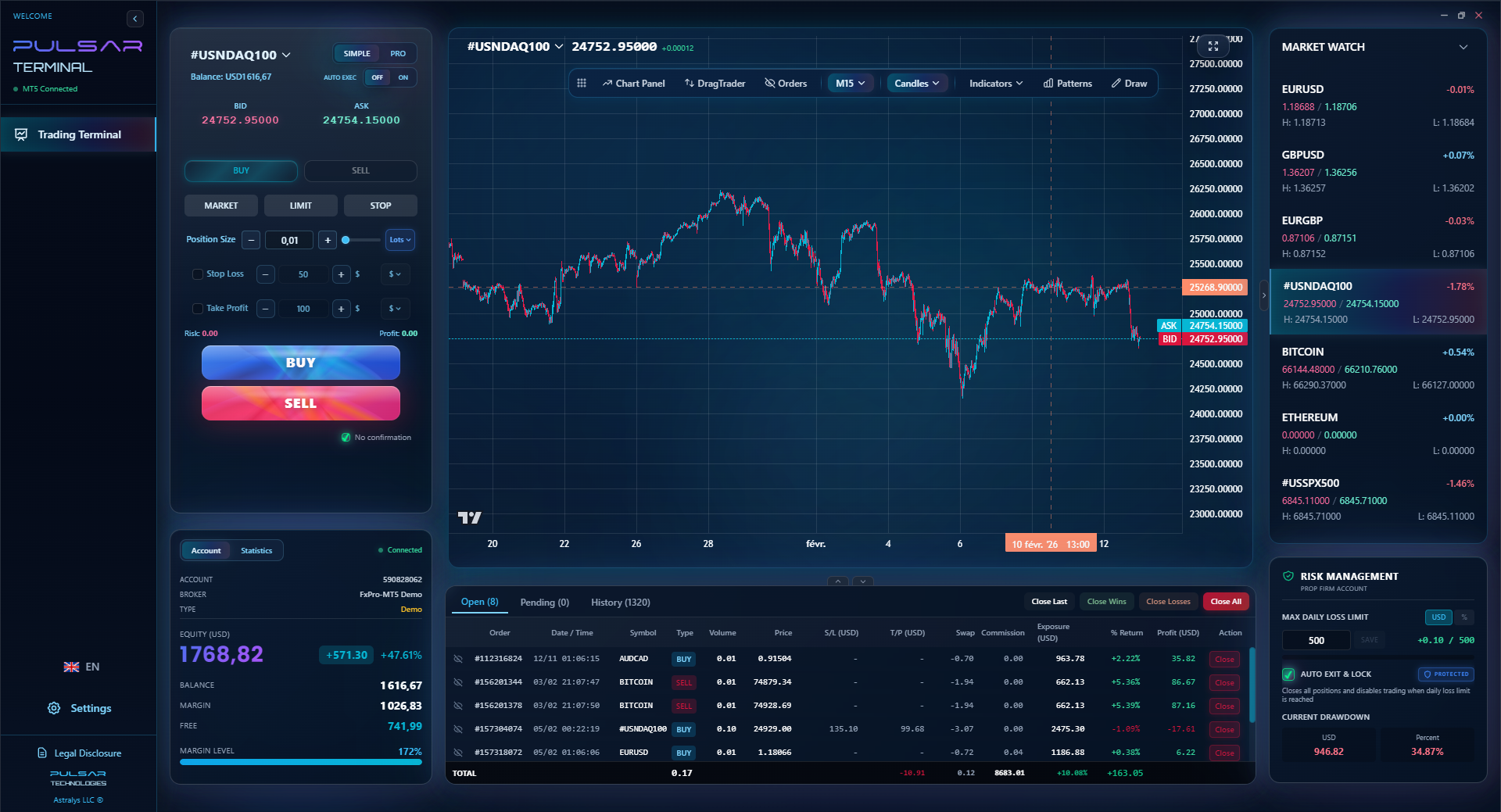
Managing prop firm rules like daily loss limits is stressful; Pulsar Terminal's prop firm daily loss protection feature can automate this monitoring and even close trades for you on MT5.
Pulsar Terminal
The all-in-one MT5 companion: drag-and-drop orders, multi-TP/SL, trailing stop, grid trading, Volume Profile, and prop firm protection. Used by 1,000+ traders daily.
Here's the big, looming question mark over the entire US futures prop industry: regulation. As of now, most prop firms operate as "educational" or "evaluation" services. This lets them sidestep being registered as Commodity Trading Advisors (CTAs) with the CFTC and NFA.
That's changing. The CFTC has been making noises. They're questioning whether firms charging fees and sharing profits should be regulated as CTAs. If that happens, everything could change: stricter capital requirements for the firms, formal risk disclosures, mandatory registration. It could wipe out the smaller, shakier firms and increase costs for the survivors.
What does this mean for you in 2026? Two things:
- Prioritize US-based firms with a long track record. A firm like Topstep, based in Chicago and deeply embedded in the futures world, is more likely to navigate regulatory shifts than an offshore entity. They have lawyers and compliance teams.
- Don't treat a prop account as your retirement plan. The regulatory environment is fluid. Have a backup plan. The capital access could, in a worst-case scenario, be altered or paused.
This uncertainty is a real risk. It's why I diversify my trading. I have a prop account, but I also trade a smaller personal account with a tight position size calculator at a regulated broker like Pepperstone for other markets.
“The 'top futures prop firms' are the ones that make you feel like a business partner, not a mark.”
Futures prop trading isn't for everyone. It's a specific tool for a specific problem.
You might be a good candidate if:
- You have a proven, written trading strategy with a positive expectancy, but less than $10k in risk capital.
- You are psychologically disciplined. You don't revenge trade, and you can stick to a daily loss limit.
- You understand futures markets - the use, the contract specs, the expiry cycles.
- You view the evaluation fees as a necessary cost of business, like a licensing exam fee.
You should probably avoid this if:
- You're a beginner hoping the prop firm will "teach" you to trade. They won't. You'll just donate your fee.
- You have a gambling mentality. The use will destroy you.
- You can't afford to lose the evaluation fee multiple times. It often takes a few tries.
- You need immediate income. This is a long-term capital-building game, not a paycheck.
The best trader for a prop firm is someone who treats it like a job. They show up, follow their process, protect the capital, and grind out gains. They use tools like the RSI indicator or MACD indicator not as magic signals, but as context within their broader plan. They know that a margin call in the prop world means game over, not just a top-up request.
💡 Winston's Tip
When choosing a firm, search '[firm name] + payout complaint' and '[firm name] + withdrawal problem' on forums. Look for patterns, not one-off rants. The real reviews are in the payout consistency.
I don't do "top 5" lists because your needs are different from mine. Instead, here are the factors I weigh, in order of importance to me:
- Total Cost of Ownership: Evaluation + Activation + Monthly Data/Platform fees. I calculate my breakeven point before I buy.
- Payout Speed & Consistency: If they pay on time, every time, without drama. This is non-negotiable.
- Rule Clarity & Fairness: Are the rules simple, transparent, and applied consistently? No gotchas.
- Platform & Data: Do they offer a platform I like at a reasonable all-in cost?
- Profit Split Model: 80/20 is fine, but a scaling plan or a 100% first-payout bonus is better.
- Customer Support: Can I get a real person on chat or email when I have a rule question?
Based on this, I've had good experiences with firms that use the Tradovate model for its cost predictability. I've also appreciated firms that offer a clear path to scale the account size after consistent performance. The "top futures prop firms" are the ones that make you feel like a business partner, not a mark. They have clear terms, fast payouts, and don't hide fees. In the current climate, that points towards the larger, more established US-based players, even if their challenge fees are a bit higher. It's worth paying for stability.
Remember, this is a marathon. Your goal isn't to pass one challenge. It's to build a sustainable income stream from a firm's capital. That requires treating the rules as sacred, managing your spread definition and commission costs, and never, ever risking a blow-up over one trade.
FAQ
Q1What's the main difference between a forex and a futures prop firm?
The underlying market and the rules. Futures prop firms focus on exchange-traded contracts (like the E-mini S&P 500 /ES or Micro Gold /MGC). The rules often involve daily loss limits and are built around the high use and volatility of futures. Forex prop firms typically offer more flexible, 24/5 trading on currency pairs with different drawdown models. Futures also have set trading hours and expiry dates.
Q2Can I trade 24/7 with a futures prop firm?
No. Futures have specific trading sessions. For example, the CME's equity index futures trade nearly 24/6, but there's a daily break. Agricultural or commodity futures have shorter hours. You trade when the exchange is open, not whenever you want.
Q3Are prop firm payouts taxed?
Yes, in the United States, prop firm payouts are considered taxable income. The firm will likely issue you a 1099 form. You are responsible for reporting this as self-employment or business income. Consult a tax professional.
Q4What happens if I have a winning trade but my platform disconnects?
This is a nightmare scenario. Reputable firms have policies for documented platform outages. They may nullify trades made during the outage or adjust balances. The key is to immediately screenshot the error and contact support. This is a reason to use firms with stable, professional-grade technology partners.
Q5Is it better to go for one large account or multiple smaller ones?
Start with one smaller account. Master the rules and get consistent payouts first. Multiple accounts increase your monthly fees and complexity. Once you have a solid process, scaling up to a larger single account is usually more capital-efficient than managing several small ones, unless you're specifically diversifying across different firms' rules.
Q6Do prop firms look at my personal credit or trading history?
Generally, no. They don't run credit checks. Your "history" with them is defined solely by your performance in their evaluation and funded accounts. Your personal brokerage account history is irrelevant to them.
Prof. Winston's Lesson
Key Takeaways:
- ✓Total cost includes data fees: add $20-$80/month.
- ✓Payout speed is a key firm differentiator in 2026.
- ✓CFTC regulatory changes are the biggest industry risk.
- ✓Trade micro contracts first to learn the rules.
- ✓Calculate your daily overhead before trading.
How useful was this article?
Click a star to rate
Weekly Trading Insights
Free weekly analysis & strategies. No spam.
About the Author
James Mitchell
Senior Trading Analyst
Based in New York with over 9 years of trading experience. Focuses on major USD pairs, prop firm challenges, and the US regulatory landscape.
Comments
Risk Disclaimer
Trading financial instruments carries significant risk and may not be suitable for all investors. Past performance does not guarantee future results. This content is for educational purposes only and should not be considered investment advice. Always conduct your own research before trading.
You Might Also Like

Cara Trading Forex Sukses: 7 Prinsip dari Trader Profesional
Cara trading forex sukses dengan 7 prinsip trader pro: manajemen modal, disiplin, journal trading, backtest. Data nyata, bukan janji profit palsu.
Jam Trading Forex Terbaik untuk Trader Indonesia: Panduan Lengkap dengan Tabel Waktu
Panduan jam trading forex untuk trader Indonesia. Tabel 4 sesi dunia, jam emas 20:00-00:00, sesi mana yang harus dihindari. Data akurat + tips dari trader berpengalaman.
Top 5 Sàn Forex Uy Tín Nhất 2026: Review Jujur dari Trader Indonesia
Top 5 sàn forex uy tín 2026 untuk trader Indonesia. Review jujur: spread, deposit, withdraw, dukungan lokal. Exness, XM, IC Markets & lebih.
Get Pulsar Terminal
All these calculators are built into Pulsar Terminal with real-time data from your MT5 account. One-click position sizing, automatic risk management, and instant calculations.
Get Pulsar Terminal