


Here's a stat that made me pause: the global prop trading industry hit a $12 billion market value in 2025.
Sarah Collins
Trading Strategist ·  Australia
☕ 10 min read
What you'll learn:
- 1How Prop Firms Actually Work (And Where ASIC Fits In)
- 2The Real Costs, Fees, and What You Actually Keep
- 3My Take on the Top Firms for Australian Traders in 2026
- 4Platforms, Payouts, and Getting Paid in AUD
- 5My Biggest Mistakes (And How You Can Avoid Them)
- 6How to Choose the Right Firm for Your Strategy
- 7The Future & Is It Worth It?
Here's a stat that made me pause: the global prop trading industry hit a $12 billion market value in 2025. For years, I thought these firms were just a gimmick. Then, in 2023, I funded a $100k account with one and watched my trading psychology completely shift. No longer was I risking my own mortgage payment on a bad EUR/USD trade. The pressure was different. This guide isn't a fluffy listicle. It's my raw take on the top prop funded trading firms that actually work for us in Australia, the real costs, the regulatory grey areas, and the brutal lessons I learned the hard way.
Let's clear up the biggest confusion first. Most of the top prop funded trading firms you'll use aren't Australian companies. They're international outfits that happily accept Aussie traders. They're legal, but they operate in a specific niche that, so far, sits just outside ASIC's direct grip.
ASIC regulates entities that handle client money for investment. Prop firms are cleverly structured. You pay an evaluation fee for a chance to trade their capital. If you pass, you're a contractor sharing profits. They're not managing your investment; you're proving your skill to access their wallet. ASIC confirmed in 2024 they're watching this space closely, but as of March 2026, no legitimate firm has been shut down.
The 2021 ASIC use caps (30:1 on majors, etc.)? Those apply to retail CFD brokers like IC Markets or Pepperstone. Prop firms can offer different use because you're trading their simulated capital, not depositing your own as a retail client. I've seen firms offer up to 1:100. It's a crucial distinction.

Warning: This doesn't mean it's a free-for-all. If a 'prop firm' asks you to deposit trading capital directly with them, that's a massive red flag. You should only ever pay a one-time evaluation or monthly account fee. The trading capital is always theirs.
This is where dreams get priced. Forget the 'funded account' size flashed on the website. Your journey starts with the evaluation fee. I've paid everything from $49 to $650 for a shot.
Evaluation Fees & Account Sizes
Fees scale with the account size you're trying to unlock. For a $25,000 account, you might pay $150. For a $200,000 challenge, expect $500-$1,000. Some firms run constant promotions. I snagged a 50% off deal for a $50k challenge once, paying just $89. Always check for coupon codes.
Account sizes typically range from $10k to $300k for standard programs. A few elite firms offer scaling plans up to $1 million or more, but you need to prove yourself first.
The All-Important Profit Split
This is your cut. The industry standard used to be 70-80% for the trader. Now, competition has pushed it to 80-90%, even 100% for some special promotions. My current primary firm offers a 90% split. That means on a $5,000 profit month, I get $4,500 paid out. They keep $500. When you're trading large capital, that 90% versus 70% is a life-changing difference.

Example: A $100,000 account making a 10% profit ($10,000).
- At 70% split: You earn $7,000.
- At 90% split: You earn $9,000. That's a $2,000 difference for the same trading performance. The split matters.
The Hidden 'Fee': The Profit Target & Drawdowns
Your evaluation has a profit target, usually 8-10% across one or two phases. You also have a maximum daily loss (often 5%) and a total drawdown limit (often 10%). These aren't fees, but they're the rules of the game. Violate them, and you fail. I failed my first two challenges by hitting the daily loss limit. I was used to my personal account where I could just wait it out. Prop firm rules enforce discipline, fast.
You need a solid position size calculator to navigate these limits. A 5% daily loss on a $50k account is $2,500. One reckless trade can blow that.

💡 Winston's Tip
Never view the evaluation fee as a ticket to a lottery. View it as tuition for the most intense risk management course you'll ever take. The capital comes after you've aced the exam.
“Passing a prop firm challenge is more about risk management than genius trade entries.”
I've traded with, or thoroughly vetted, dozens of firms. Here are the ones that stand out for reliability, terms, and service for Aussies. This isn't sponsored. It's based on payout receipts and support ticket responses.
| Firm | What I Like | What to Watch For | Best For |
|---|---|---|---|
| Funded Trading Plus | Scaling plan to $2.5M, no time limits on challenges, good support. | Higher evaluation fees for top tiers. | Traders who want a clear, long-term scaling path. |
| Apex Trader Funding | Huge selection of account sizes, profit split starts at 90%, often has sales. | Primarily focused on futures (E-mini, etc.) rather than Forex. | Futures traders and those who like frequent discount offers. |
| FundedNext | Flexible Stellar model with no daily drawdown, good for swing trading. | Some account models have consistency rules. | Swing traders and those who want drawdown flexibility. |
| The5%ers | Very trader-friendly profit targets (6% in evaluation), slow-and-steady approach. | Smaller maximum account sizes compared to some competitors. | Newer prop traders and conservative strategies. |
| DNA Funded | Australian-founded, offers accounts up to $600k, includes a free retry if you fail near the target. | Relatively new, so long-term track record is still building. | Aussies wanting to support a local-founded operation. |
A special note on crypto: If that's your game, firms like HyroTrader are crypto-only, offering funding in USDT. Given the volatility of something like Bitcoin, their risk parameters are built for that market.
My personal workhorse for Forex has been a firm similar to FundedNext. Their 90% split on a $200k account has funded my last two car registrations. But I passed that challenge on my third try. The first two fails cost me $398 in total evaluation fees. That's the real cost of education here.
You're not locked into one platform. Most top prop funded trading firms let you choose.
- MetaTrader 4/5 (MT4/MT5): The most common. If you're already set up with indicators and EAs, this is seamless. I run my entire MACD indicator and divergence setup on MT5 through my prop account.
- cTrader: Gaining popularity for its cleaner execution and transparency.
- DXtrade & TradeLocker: Web-based platforms often used by firms partnered with specific brokers like Eightcap.
Getting Paid: This is critical. Payouts are usually bi-weekly or monthly. Most firms process withdrawals in USD via Crypto (USDT, Bitcoin), Wise, or Bank Wire. I always withdraw via USDT to my local exchange, then convert to AUD. It's faster and often cheaper than an international bank wire. My first payout from a $100k account was $2,800. It hit my crypto wallet in 12 hours, and I had it in my bank account in AUD within two days.

Pro Tip: Before you commit to a firm, google '[Firm Name] payout review'. Look for video proof on YouTube or threads on trader forums. A firm's reputation is built on timely, hassle-free payments.
💡 Winston's Tip
Your first goal in a challenge isn't the profit target. It's to survive 10 trading days without touching the daily drawdown limit. Survival first, growth second.
“The evaluation fee is a cost of business. It's cheaper than blowing a $10,000 personal account.”
I want you to skip the expensive lessons I learned.
Mistake 1: Trading Like It Was My Money. On my personal $10k account, a 50-pip stop loss on EUR/USD was normal. On a $100k prop account, that same 50-pip stop was a $5,000 risk with their 1% max risk rule. I blew the daily loss limit on my second trade. The fix? Recalculate your position size for the new capital. Every. Single. Time.
Mistake 2: Ignoring the Daily Drawdown. This is the killer. Your account can be up $3,000 for the week, but if you lose more than 5% in a single day, you're out. I got liquidated on a Friday afternoon during the US session. I was up for the week, got greedy, took a late trade on XAU/USD, and a news spike took me out. The rule is absolute. The solution? Use a tool that can automatically enforce a daily stop-out. Or, be brutally disciplined: once you're down 3% in a day, you stop. Full stop.
Mistake 3: Chasing the Profit Target. In a 30-day challenge, needing 10% feels urgent. I started overtrading, taking low-probability setups just to be 'active.' It never works. The best challenge I ever passed was the one where I took only 7 trades in 20 days. Quality over quantity. Treat it like a business performance review, not a casino sprint.
These rules exist for a reason. They force a level of discipline that most retail traders (including me, back then) desperately lack. Passing a challenge is more about risk management than genius trade entries.
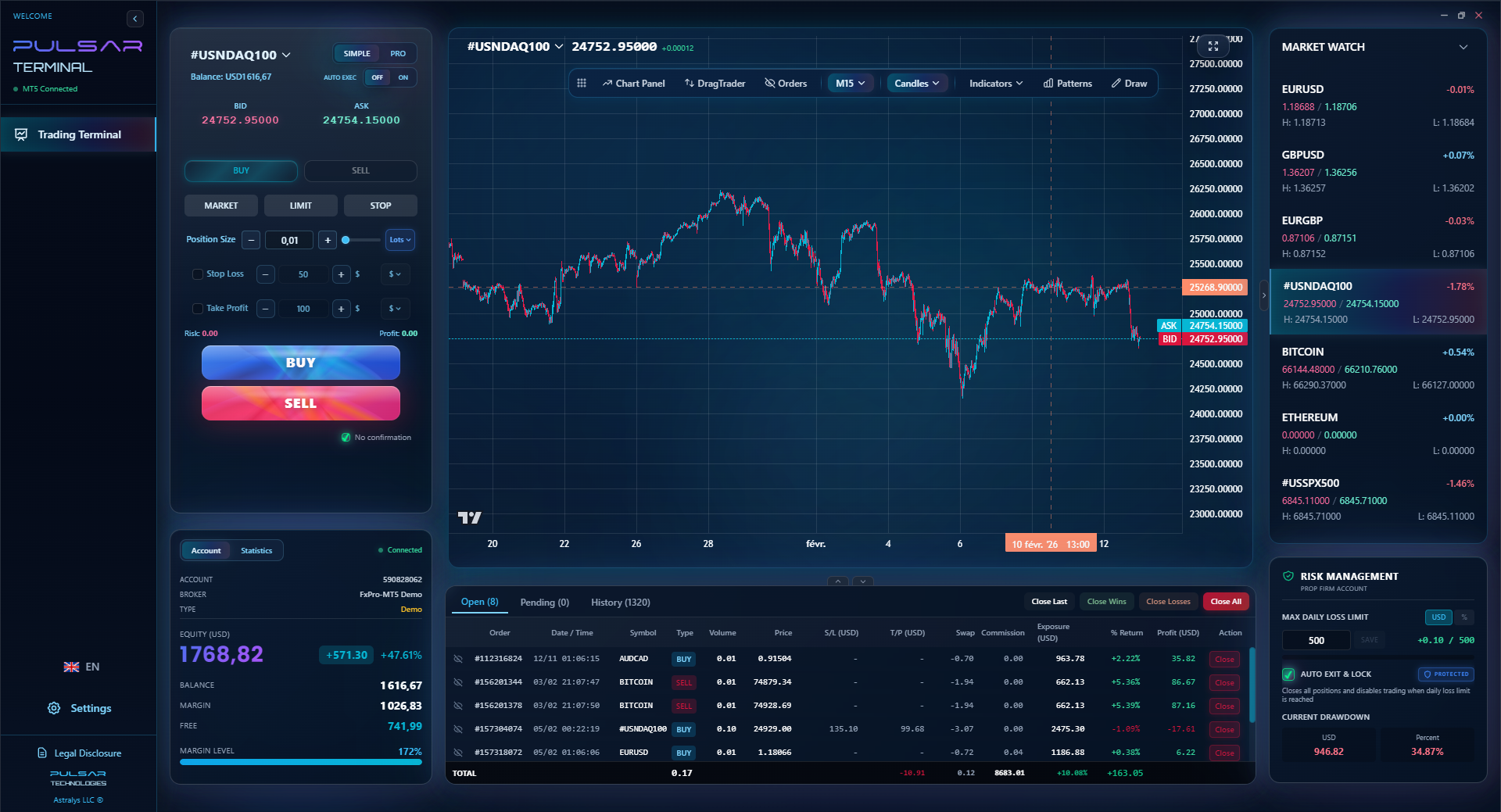
Managing a prop firm's strict daily loss limit is a constant mental battle, which is why I use Pulsar Terminal's dashboard to see my daily P&L in real-time and set alerts before I ever get close to the edge.
Pulsar Terminal
The all-in-one MT5 companion: drag-and-drop orders, multi-TP/SL, trailing stop, grid trading, Volume Profile, and prop firm protection. Used by 1,000+ traders daily.
Don't just pick the firm with the biggest advertised account. Match the firm's rules to your personality and strategy.
- Are you a scalper? You need a firm with low spreads (check their broker partner), no rules against news trading, and a platform with fast execution. A firm with a 5% daily drawdown might be too tight if you take many trades. Look for ones with no daily drawdown, only overall.
- Are you a swing trader? You need a firm with no minimum trading days, generous overall drawdown (10%+), and preferably no time limit on the evaluation. Firms with 'free retries' if you fail near the target are a godsend for swing traders, as one long drawdown can be recovered.
- Do you trade crypto or indices? Make sure the firm offers these instruments with reasonable spreads. Some are Forex-focused and have poor conditions for the AUS200 or Bitcoin.
Also, consider the scaling plan. Do you want to grow from $50k to $200k quickly? Or are you happy with a steady $100k account? Read the scaling rules carefully. Some require you to hit a profit target within a month to scale up, which again encourages overtrading.
Finally, test support. Send a pre-sales email with a technical question. See how fast and helpfully they respond. If they're slow before they have your money, they'll be glacial when you need a payout.
💡 Winston's Tip
When comparing profit splits, always do the math on your realistic monthly return. The difference between 80% and 90% on a $5,000 profit is $500. That pays for a lot of evaluation retries.
“The psychology of trading with someone else's capital is completely different. It exposed flaws in my discipline I never saw coming.”
ASIC's surveillance will continue. The good firms have nothing to fear. The shady ones will get weeded out. This makes the industry more legitimate for serious traders.
Is it worth it? For me, absolutely. The evaluation fee is a cost of business. It's cheaper than blowing a $10,000 personal account. The capital access is transformative. But it's not a lottery ticket. It's a performance-based job interview.
Start small. Don't go for the $200k challenge first. Buy a $10k or $25k evaluation. The goal isn't the payout from that small account. The goal is to prove your process under their rules. The psychology is everything. When I finally passed, it wasn't because I became a better analyst. It was because I finally learned to respect the risk limits.
The top prop funded trading firms are a tool. A powerful one that can provide use to your skill. But the tool only works if the trader holding it has the discipline to use it properly. Build your strategy first, master your risk, then use their capital to amplify results you're already confident you can achieve.
FAQ
Q1Are prop trading firms legal in Australia?
Yes, they are legal. Most operate as international entities offering evaluation services, not as ASIC-licensed financial services providers handling client money. ASIC monitors them but, as of 2026, their business model operates within a legal niche. Always ensure a firm is reputable by checking independent reviews and payout proofs.
Q2How much does it cost to start with a prop firm?
You pay a one-time evaluation fee, not a deposit. These range from around $50 for a small account ($5k-$10k) to over $1,000 for large challenges ($200k+). This fee buys you the opportunity to trade for a funded account. There is no risk to personal trading capital beyond this fee.
Q3What's the catch with prop firms?
The 'catch' is the strict rule set you must trade under: profit targets (e.g., 10%), daily and maximum loss limits (e.g., 5% daily). These rules are designed to filter for disciplined, profitable traders. If you violate them, you fail the evaluation. It's a test of consistent risk management, not just making money.
Q4Can I use my own trading strategy and indicators?
Absolutely. You use platforms like MT4/MT5 or cTrader, so you can install your own indicators, EAs, and trade your usual strategy. The only restrictions are against fraudulent practices like arbitrage or latency exploitation. Normal technical or fundamental analysis is completely fine.
Q5How and when do I get paid?
Once funded, you request a payout (usually bi-weekly or monthly) of your share of the profits. Most firms pay out via Crypto (USDT/BTC), Wise, or Bank Wire. Payouts are often processed within 1-5 business days. You are responsible for any tax implications in Australia.
Q6What happens if I lose money on a funded account?
You can lose up to the maximum drawdown limit (e.g., 10% of the starting balance). If you hit that limit, the funded account is typically closed. You do not owe the firm any money for the losses. Some firms offer a 'second chance' or a discounted re-evaluation.
Q7Is the use different with a prop firm compared to an ASIC broker?
Often, yes. ASIC retail broker use is capped (e.g., 30:1 on major forex). Prop firms, because you're trading their simulated capital, may offer higher use, such as 50:1 or 100:1. Always check the specific firm's use schedule for each instrument.
Prof. Winston's Lesson
Key Takeaways:
- ✓Start with a small evaluation (≤$100). Prove your process first.
- ✓Recalculate position size for the new capital. Every. Single. Time.
- ✓The daily drawdown limit is your new worst enemy. Respect it absolutely.
- ✓Choose a firm whose rules match your trading style (scalping vs. swing).
- ✓90% profit split is the new competitive benchmark. Aim for it.
How useful was this article?
Click a star to rate
Weekly Trading Insights
Free weekly analysis & strategies. No spam.
About the Author
Sarah Collins
Trading Strategist
London-based trading strategist with 12 years in financial markets. Former analyst at a City of London brokerage. Covers GBP pairs, European markets, and FCA-regulated trading.
Comments
Risk Disclaimer
Trading financial instruments carries significant risk and may not be suitable for all investors. Past performance does not guarantee future results. This content is for educational purposes only and should not be considered investment advice. Always conduct your own research before trading.
You Might Also Like

Cara Trading Forex Sukses: 7 Prinsip dari Trader Profesional
Cara trading forex sukses dengan 7 prinsip trader pro: manajemen modal, disiplin, journal trading, backtest. Data nyata, bukan janji profit palsu.
Jam Trading Forex Terbaik untuk Trader Indonesia: Panduan Lengkap dengan Tabel Waktu
Panduan jam trading forex untuk trader Indonesia. Tabel 4 sesi dunia, jam emas 20:00-00:00, sesi mana yang harus dihindari. Data akurat + tips dari trader berpengalaman.
Top 5 Sàn Forex Uy Tín Nhất 2026: Review Jujur dari Trader Indonesia
Top 5 sàn forex uy tín 2026 untuk trader Indonesia. Review jujur: spread, deposit, withdraw, dukungan lokal. Exness, XM, IC Markets & lebih.
Get Pulsar Terminal
All these calculators are built into Pulsar Terminal with real-time data from your MT5 account. One-click position sizing, automatic risk management, and instant calculations.
Get Pulsar Terminal