


I remember watching the EUR/USD chart on October 3rd, 2025, as it ripped through 1.0650.

Olumide Adeyemi
West African Trading Pioneer ·  Nigeria
☕ 11 min read
What you'll learn:
I remember watching the EUR/USD chart on October 3rd, 2025, as it ripped through 1.0650. My trade was in profit, but my broker's platform froze on the refresh. By the time it came back, half my gains were gone. That moment wasn't about analysis; it was about infrastructure. The platform you choose isn't just software, it's your connection to the market. For Nigerian traders, that choice is complicated by regulation, payment methods, and a flood of marketing nonsense. Let's cut through it. Based on real trading, client feedback, and the brutal reality of our market, here are the top ten forex trading platforms that actually work for us.
Before we talk platforms, we need to talk facts. Trading forex as an individual in Nigeria is legal. Full stop. But how you fund your account and who regulates your broker has changed. The Central Bank of Nigeria (CBN) doesn't want banks using official FX windows for speculative trading. That's why your Naira card often gets declined on international broker sites. The real game-changer was the Investments and Securities Act of 2025 (ISA 2025). It finally made it illegal for digital asset and online forex platforms to operate here without SEC registration. This is good - it weeds out the outright scams. But here's the practical truth most "gurus" won't tell you: the top international brokers serving Nigerian clients are still primarily regulated offshore (CySEC, FSCA, ASIC). They comply with international standards, which is what actually protects your deposit. Your main concerns should be: can I deposit/withdraw Naira easily, are the spreads decent during Lagos trading hours, and will the platform survive a volatile news event? Everything else is secondary.

Warning: Any profit you make from trading is subject to a 10% Capital Gains Tax by the FIRS. You're supposed to declare it. I know most don't, but the legal obligation is there. Keep your records straight.
Your trading capital dictates your options. Starting with $50 (about ₦80,000) is a world apart from starting with $5,000. The platforms on this list cater to both ends, but I'll tell you which are which.

💡 Winston's Tip
Your first platform should feel boring and reliable, not exciting. Excitement comes from your trades, not from the software glitching.
Forget fancy logos and sponsored YouTube deals. We ranked these platforms on criteria that hit your P&L and your sanity.
1. Naira-Friendly Operations: This is non-negotiable. Does the broker accept direct bank transfers in NGN? Do they support Opay, Paga, or Moniepoint? How long do withdrawals take? A broker with zero-deposit fees but a 7-day withdrawal time is useless. 2. Platform Stability & Execution: This is where the rubber meets the road. Slippage during CBN announcements or platform lag when Brent Crude moves can cost you real money. We look for proven reliability on MT4/MT5 and the broker's own platforms. 3. Cost Structure: The spread is the price of admission. We break down the typical cost for a standard lot on EUR/USD, including any commissions. We also check swap rates (overnight fees), which matter if you're into swing trading. 4. Regulatory Backing: While local SEC registration is new, we prioritize brokers with strong, recognizable international regulation. This is your safety net if things go wrong. 5. use & Account Types: Nigerian traders often start with smaller capital, so access to cent accounts or micro lots is a huge advantage. use is a tool, not a goal, but having the option matters.
Here’s a quick comparison of the key specs you care about:
| Broker | Min. Deposit (Approx. in NGN) | Avg. EUR/USD Spread | Best For |
|---|---|---|---|
| Exness | ₦1,600 ($1) | 0.1 - 0.3 pips | Beginners, Low Capital |
| XM | ₦8,000 ($5) | 0.6 - 1.0 pips | Education, Micro Lots |
| HFM | ₦0 ($0) | 0.0 - 1.2 pips | NGN Accounts, Local Support |
| Pepperstone | ₦160,000 ($100) | 0.0 - 0.6 pips | Serious Scalpers, ECN |
| IC Markets | ₦160,000 ($100) | 0.0 - 0.6 pips | Raw Spreads, High Volume |
“A broker with zero-deposit fees but a 7-day withdrawal time is useless.”
1. Exness: The Accessibility King
I’ve funded an Exness account with ₦5,000 via Opay. It reflected in 12 minutes. That’s the appeal. Their minimum deposit is laughably low ($1), making it the easiest on-ramp for new traders. They offer MT4, MT5, and their own app. Spreads on the Raw Spread account are tight, but watch for commissions. Their unlimited use is a double-edged sword; it’s how I turned $200 into $1,500 in a week, and then back to $50 in one bad trade. Use their position size calculator religiously.
2. XM: The Educator
XM doesn’t have the tightest spreads, but they are consistent. Where they shine is for the absolute beginner. Their $5 minimum gets you a micro lot account, and their educational webinars are genuinely useful. I learned about the MACD indicator divergence from one of their sessions. Execution is solid, and they have local support staff who actually answer the phone.
3. HFM (HotForex): The Local Giant
HFM has a physical office in Lagos. That matters for trust. They offer actual NGN-denominated accounts, so you see your balance in Naira, which simplifies psychology. Deposits and withdrawals are free and fast. Their Zero Account offers spreads from 0.0 pips, perfect for a scalping strategy. They’re a complete, reliable package for the intermediate trader.
4. Pepperstone: The Professional’s Choice
When I graduated from demo trading and had a real $5,000 strategy, I moved to Pepperstone. Their Razor account (ECN) gives you raw spreads from 0.0 pips. The commission is worth it for the execution speed. During the last US NFP report, my order on XAU/USD filled with 0.3 pips of slippage when other platforms were showing 2-pip requotes. This is for traders who understand costs and need institutional-grade flow. Check our full Pepperstone review for more.
5. IC Markets: The Volume Monster
Similar to Pepperstone, IC Markets is a beast for high-volume traders. Their True ECN account is legendary for its liquidity. If you’re trading 10+ lots a month, the savings on the spread add up. They support cTrader alongside MT4/MT5, which is a nice alternative. Funding can be trickier for Nigerians, often requiring a intermediary wallet like Skrill.
6. AvaTrade: The Set-and-Forget Broker
AvaTrade is less about raw spreads and more about user-friendly stability. They offer fixed spreads, which is great if you hate your cost fluctuating. They also have a huge suite of platforms, including their own AvaTradeGO and access to automated social trading. It’s a fantastic choice if you’re not a scalper but more of a swing or position trader who values predictability over ultra-low cost.
7. FBS: The Contender
FBS is popular across Africa for a reason. They have a very low minimum deposit, offer a 100% deposit bonus (be careful, bonuses come with terms!), and have local bank transfer options. Their spreads are middle-of-the-road, but they are reliable. I’ve used them as a secondary account for testing new strategies without risking my main capital.
8. OctaFX: The Simplified Option
OctaFX has made a name for itself with a clean, simple platform and copy trading features. Their commissions are built into the spread, which makes cost calculation easy for beginners. They are regulated by CySEC and have won awards for their client service. A solid, no-fuss option for the trader who doesn’t want to geek out over platform specs.
9. Capital.com: The CFD Specialist
While they offer forex, Capital.com’s strength is in its massive range of CFD instruments - stocks, indices, commodities, and crypto. If you want to trade Tesla or the NGX 30 alongside your forex pairs, this is your platform. Their own app is intuitive and big on education. Spreads are competitive, and they are heavily regulated.
10. XM (Again) & Deriv: The Bonus Entries
I’m putting XM here twice because their XM Zero account deserves its own mention for low-cost trading. Deriv is a wildcard. They offer synthetic indices (volatility and crash/boom indices) which are hugely popular for short-term trading. Their platform, DTrader, is unique. It’s not for everyone, but if you want something different from MT4, it’s worth a look.

Pro Tip: Don't just open one account. Fund a small live account with your top two choices. Trade the same setup on both for a week. The difference in execution and platform feel will tell you more than any review.
💡 Winston's Tip
Test a broker's withdrawal process with a small amount before you deposit your full capital. If they drag their feet getting money out, imagine what they'll do when you're profitable.
This is the biggest hurdle. The CBN's restrictions mean your standard Visa/Mastercard from a Nigerian bank will often fail for international broker deposits. Here’s what works, from best to worst:
- Direct Local Bank Transfer (NGN): The holy grail. Brokers like HFM and Exness have local payment partners. You get Naira account details, transfer from your bank app, and it's converted and deposited. Usually fee-free and fast (minutes to a few hours).
- E-Wallets (OPay, Paga, Moniepoint): Increasingly supported. Similar process to bank transfer. Exness excels here.
- International E-Wallets (Skrill, Neteller): Reliable but involves a double conversion: NGN > USD (in wallet) > USD (in broker). You lose on two spreads and pay wallet fees. I use Skrill only for brokers like IC Markets that don't have direct NGN options.
- Cryptocurrency (USDT): Surprisingly efficient. Buy USDT on a local P2P platform, send to broker's crypto wallet. Fast, avoids banks, but exposes you to crypto volatility during the transfer. Ensure your broker explicitly supports it.
- Debit/Credit Cards: Hit or miss. Try it, but have a backup plan. When it works, it's instant.

Example: To deposit $100 on Pepperstone via Skrill: You buy $102 worth of USD in Skrill (to cover fees) with your Naira card (at your bank's rate + fee). You send $100 to Pepperstone (Skrill may charge ~1%). You've already lost 3-4% in fees before placing a trade. A direct NGN transfer to HFM costs you just the broker's conversion spread, often under 1%.
“Your first platform should feel boring and reliable, not exciting.”
Choosing a platform is just the first step. Here’s how Nigerians mess it up.
Chasing Bonuses: A 100% deposit bonus sounds great. But they always come with turnover requirements (e.g., trade 10 lots before withdrawal). You often end up over-trading just to unlock your own money, blowing your account in the process. I did this in 2021. Ignore the bonus; focus on the raw spread and execution.
Ignoring Swap Rates: If you hold trades for days or weeks, the overnight financing charge (swap) matters. Buying a high-yielding currency vs. a low-yielding one can earn you a small credit. Doing the opposite costs you. These fees compound. Check the broker's swap sheet before holding a swing trading position over Wednesday night (when triple swaps are charged).
Platform Hopping: You see a slightly lower spread advertised and jump ship. The hassle of new verification, learning a new interface, and transferring funds isn't worth 0.1 pip. Find a reliable broker from this top ten forex trading platforms list and stick with them for at least a year. Master their tools.
Not Understanding use: A margin call is a brutal teacher. Just because Exness offers ‘unlimited’ use doesn’t mean you should use it. On a $100 account, 1:500 use gives you $50,000 in buying power. A 0.2% move against you wipes you out. Start low (1:10 or 1:20) until you're consistently profitable.
Underestimating Mobile Trading: You will need to check or manage a trade from your phone. Test the mobile app for your shortlisted brokers. Is it stable? Can you easily set stop-losses? The XM and Exness mobile apps are particularly good.
💡 Winston's Tip
The 'best' platform is the one you stop thinking about. When it becomes an invisible tool that just executes your plan, you've found the right one.
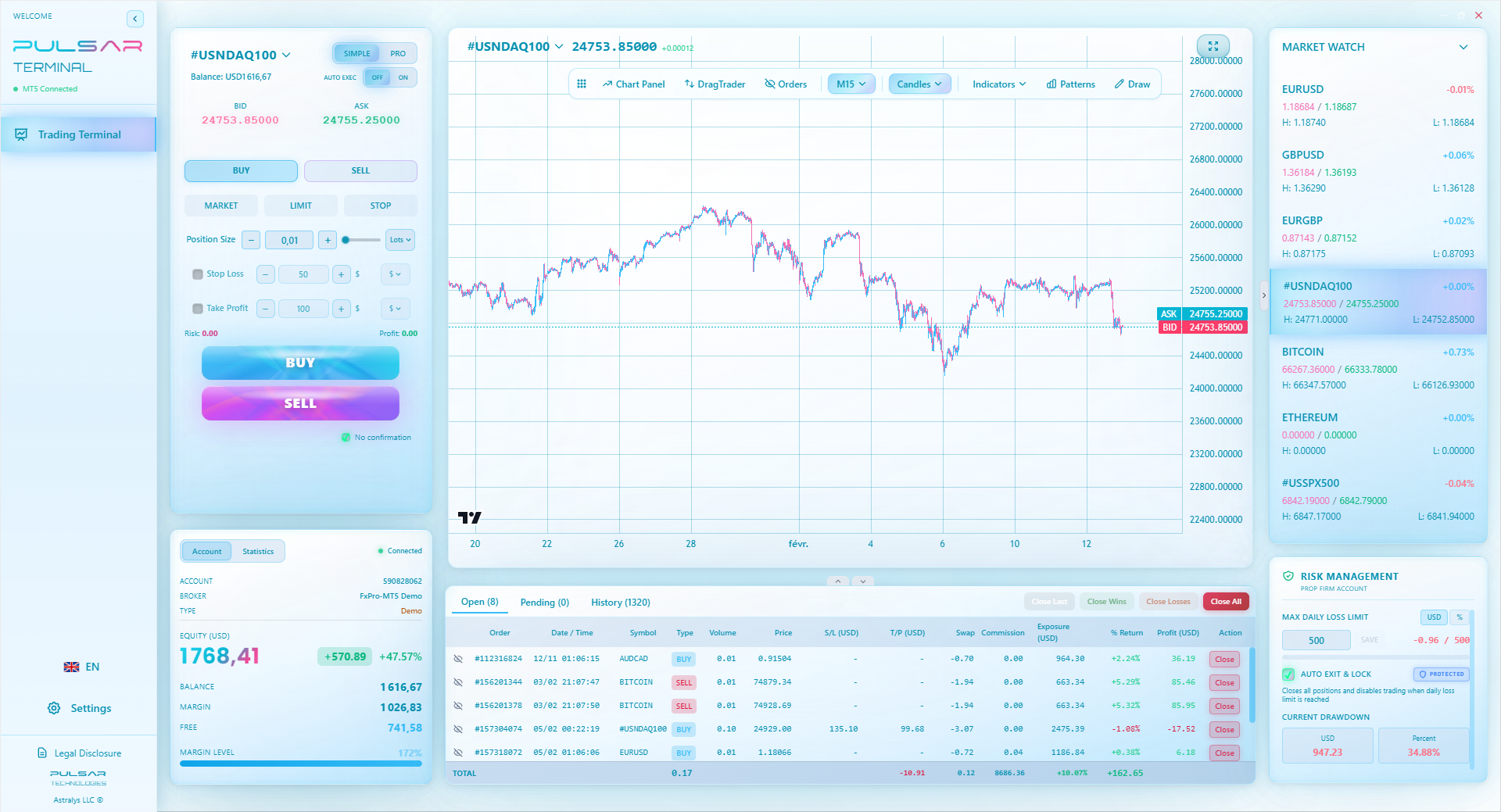
Managing multiple trades and setting advanced stops is a hassle on standard MT5, which is why tools like Pulsar Terminal that add one-click trailing stops and multi-TP/SL orders are game-changers for efficient trade management.
Pulsar Terminal
The all-in-one MT5 companion: drag-and-drop orders, multi-TP/SL, trailing stop, grid trading, Volume Profile, and prop firm protection. Used by 1,000+ traders daily.
So, which one should you choose? It depends entirely on who you are as a trader.
- For the Absolute Beginner in Nigeria: Start with Exness. The ultra-low minimum deposit lets you learn with real money without significant risk. The funding is easiest. Move on once you have a strategy.
- For the Serious Nigerian Trader (₦500k+ Capital): Pepperstone or IC Markets. The raw ECN pricing and stellar execution will save you money and improve your fills. The higher minimum deposit is a worthwhile barrier to entry.
- For the Trader Who Wants Local Support & NGN Accounts: HFM is the clear winner. The local office and Naira accounts provide a layer of comfort and simplicity that’s hard to beat.
- For the Trader Who Also Wants Stocks & Crypto: Capital.com offers the most seamless all-in-one experience for multi-asset trading.
My main account for the past two years has been with Pepperstone. The execution on their MT5 platform via their Razor account is, in my opinion, the best balance of cost and reliability available to us. But I keep a small HFM account for quick Naira withdrawals when needed.
The bottom line? All ten platforms on this list are credible. Your job is to match one to your trading style, your capital, and your need for convenience. Open a demo account, test the platform, then fund it with an amount you can afford to lose. The best top ten forex trading platforms list is useless if you don't take the first step.
FAQ
Q1Is forex trading legal and taxable in Nigeria?
Yes, and yes. Trading forex as an individual is legal. However, any profit you make is technically subject to a 10% Capital Gains Tax by the Federal Inland Revenue Service (FIRS). The legal responsibility to declare this income is yours.
Q2Why do my Nigerian debit card deposits keep failing?
Due to Central Bank of Nigeria (CBN) restrictions, Nigerian banks are often blocked from processing international transactions for speculative forex trading. Use the broker's local Naira deposit options (bank transfer, Opay, Paga) or fund an international e-wallet like Skrill first.
Q3What is the safest forex broker for Nigerian traders?
Safety comes from strong international regulation (like ASIC, FCA, CySEC) combined with a proven track record of serving Nigerian clients reliably. From our list, Pepperstone, IC Markets, and HFM are exceptionally well-regulated. HFM's local office adds an extra layer of tangible presence.
Q4What is a pip and why does the spread matter?
A pip definition is the smallest price move a currency pair can make. The spread definition is the difference between the buy and sell price, which is your immediate cost to enter a trade. A lower spread means you start with less of a deficit to overcome. On a major pair like EUR/USD, a 0.5 pip spread is excellent, 1.5 is average, and 3.0 is expensive.
Q5Can I use MetaTrader 4 (MT4) with all these brokers?
Almost universally, yes. MT4 is the industry standard, and every broker on this list supports it. Many also offer the more advanced MT5. Some, like Capital.com and Deriv, also have their own proprietary platforms which can be very good.
Q6What use should I use as a beginner?
Start low. Seriously. Use 1:10 or 1:20 maximum. High use (like 1:500) amplifies both gains and losses. It's the fastest way to blow up a small account. Your goal is to learn and preserve capital, not to make 100% returns in a day.
Q7How do I know if a broker is a scam?
Red flags: promises of guaranteed profits, pressure to deposit large amounts immediately, lack of clear regulatory information on their website (license numbers you can verify), and customer support that only uses WhatsApp or Telegram. Stick to the established names on reputable lists like this one.
Prof. Winston's Lesson
Key Takeaways:
- ✓Prioritize Naira-friendly deposits & withdrawals above all else.
- ✓Test platform stability during high volatility before committing capital.
- ✓For serious trading, raw ECN accounts save you money long-term.
- ✓use above 1:20 is a risk accelerator, not a skill tool.
- ✓Always verify international regulation (ASIC, FCA) on the broker's site.
How useful was this article?
Click a star to rate
Weekly Trading Insights
Free weekly analysis & strategies. No spam.
About the Author
Olumide Adeyemi
West African Trading Pioneer
One of Nigeria's most active forex trading educators. 8 years of experience trading from Lagos. Specializes in low-capital strategies and prop firm challenges for African traders.
Comments
Risk Disclaimer
Trading financial instruments carries significant risk and may not be suitable for all investors. Past performance does not guarantee future results. This content is for educational purposes only and should not be considered investment advice. Always conduct your own research before trading.
You Might Also Like

Cara Trading Forex Sukses: 7 Prinsip dari Trader Profesional
Cara trading forex sukses dengan 7 prinsip trader pro: manajemen modal, disiplin, journal trading, backtest. Data nyata, bukan janji profit palsu.
Jam Trading Forex Terbaik untuk Trader Indonesia: Panduan Lengkap dengan Tabel Waktu
Panduan jam trading forex untuk trader Indonesia. Tabel 4 sesi dunia, jam emas 20:00-00:00, sesi mana yang harus dihindari. Data akurat + tips dari trader berpengalaman.
Top 5 Sàn Forex Uy Tín Nhất 2026: Review Jujur dari Trader Indonesia
Top 5 sàn forex uy tín 2026 untuk trader Indonesia. Review jujur: spread, deposit, withdraw, dukungan lokal. Exness, XM, IC Markets & lebih.
Get Pulsar Terminal
All these calculators are built into Pulsar Terminal with real-time data from your MT5 account. One-click position sizing, automatic risk management, and instant calculations.
Get Pulsar Terminal