


I lost $1,200 in a single afternoon because of a forex bot.

Miguel Reyes
Forex Analyst ·  Philippines
☕ 11 min read
What you'll learn:
- 1What Exactly Is a Forex Trading Bot?
- 2The Legal & Regulatory Reality in the Philippines
- 3The Real Costs: Spreads, Commissions, and Hidden Fees
- 4Picking a Broker That Won't Hate Your Bot
- 5The Big Decision: Building a Bot vs. Buying One
- 6Testing and Deploying: Don't Skip the Hard Part
- 7Common Pitfalls and the Right Mindset
- 8Your First Steps and Real Resources
I lost $1,200 in a single afternoon because of a forex bot. Not mine - a friend's. He'd bought a 'guaranteed profit' EA from a Facebook ad, set it up on his MT4, and walked away. When he came back, his account was nearly empty. The bot had opened 14 consecutive losing trades on EUR/USD, ignoring every sign of a ranging market. That moment taught me more about trading forex bots than any course ever could. In the Philippines, where promises of passive income from automation are everywhere, knowing the real deal is survival.
Let's cut through the marketing fluff. A forex bot, or Expert Advisor (EA), is just a set of instructions you plug into your trading platform, usually MetaTrader 4 or 5. It tells the software when to buy, when to sell, and when to get out, based on rules you (or its creator) set. Think of it like a very specific, very obsessive assistant that never sleeps.
There are two main types. The first is the commercial 'black box' bot you buy online. You install it, but you have no real idea how it makes decisions. The second, which is where I've found real success, is the custom bot. You either code it yourself (if you're into MQL4/MQL5) or work with a programmer to build a system based on your own trading strategy. This is the key difference: one is a mystery product, the other is your strategy on autopilot.

Warning: No bot, no matter how expensive, can predict the future. It can only execute a pre-defined plan. If the plan is flawed, the bot will lose money with terrifying efficiency.
I made the switch to custom bots after that $1,200 lesson. My first successful one was a simple grid bot for XAU/USD. It wasn't fancy, but it automated my manual process of placing limit orders during consolidation phases. The bot didn't make me smarter; it just removed my emotion and hesitation.

💡 Winston's Tip
A bot's only job is to remove emotion. If your strategy is emotional to begin with, you've just built a faster way to go broke.
This is the part most gurus gloss over. Here's the straight talk: trading forex through international brokers is generally not illegal for you as an individual Filipino trader. However, and this is a massive however, the Securities and Exchange Commission (SEC) does not license any local brokers to offer retail forex or CFDs. They've issued repeated warnings about the risks and about unregulated platforms.
What does this mean for your bot? The bot itself isn't regulated. There's no BSP circular titled 'Rules for Expert Advisors.' The bot's legality is tied to the broker you use it on. Since you'll almost certainly be using an overseas broker like Exness or IC Markets, you are operating outside of Philippine regulatory protection. If the broker has an issue with your bot (say, it's flagged as latency arbitrage), their terms - not Philippine law - will govern the outcome.
Your protection comes from choosing a broker regulated in a strong jurisdiction like the UK's FCA or Australia's ASIC. I only run my bots on brokers with top-tier regulation. It's my first filter. The local warning is clear: the SEC advises against this activity because you have no local recourse. Your safety net is the broker's home regulator.
On Taxes and Reporting
There's no specific tax on forex bot profits. Profits from trading fall under general income tax rules. If trading is your primary income, you should be declaring it. I know many who don't, but that's between you and the BIR. The practical point is this: keep careful records. Your bot's trade history is your perfect ledger.
“Your protection comes from choosing a broker regulated in a strong jurisdiction like the UK's FCA or Australia's ASIC.”
Forget the 'start with $50' hype. Running a bot profitably means understanding every cent that comes out of your account. Bots trade frequently, so costs get magnified.
Let's break down a real example from my trading last month. I ran a scalping bot on an ECN account with Pepperstone. The bot made 47 trades on EUR/USD.
| Cost Type | Detail | Impact on Bot |
|---|---|---|
| Spread | Avg. 0.2 pips on Razor account | Low cost, but on 47 trades, it adds up. |
| Commission | $3.50 per side, per lot. ($7 round turn) | The big one. 47 trades * $7 = $329 in commissions alone. |
| Swap Fees | Charged for positions held overnight. | My bot closed all trades daily, so this was minimal. |
| Payment Fees | GCash deposit was free. Withdrawal to my BDO account: $0 fee from broker, but BDO's forex conversion had a ~1.5% spread. | A hidden cost on your profits when converting USD to PHP. |
The bot's net profit was $890. After commissions and the rough bank conversion, my actual take-home was closer to $520. You must factor this in. A bot that looks profitable in a backtest can be a loser once live costs hit.

Pro Tip: Always test your bot on a demo account that has realistic commissions enabled. Most demos have zero commission, which paints a completely false picture. A good position size calculator that includes commission is non-negotiable.
Also, watch for inactivity fees. Some brokers charge $50+ per month if you don't trade. If your bot goes dormant during a quiet market, you could still be paying.
Not all brokers are bot-friendly. Some will throttle your connection or ban certain strategies. For Filipino traders, you need an international broker with three things: low latency, clear EA policies, and reliable PHP funding.
Based on my experience and community chatter, here’s the lay of the land:
- IC Markets: My top pick for heavy bot use. Their raw spreads are consistently tight, and they're built for automation. I've run multiple EAs simultaneously with no issues. Minimum deposit is $200, which is reasonable. IC Markets review.
- Pepperstone: Excellent execution speed. Their Razor account is perfect for high-frequency bots. Support is knowledgeable about EAs. Pepperstone review.
- Exness: Huge with Pinoy traders because of the $1 minimum deposit and instant GCash withdrawals. Good for testing a bot cheaply. Be aware that some advanced EAs might face restrictions. Exness review.
- XM: Super beginner-friendly and offers a $30 no-deposit bonus. Fine for simple, low-frequency bots. Not ideal for ultra-low latency scalping strategy bots. XM review.
The funding part is critical. I use GCash for 90% of my deposits because it's instant. Brokers that support it directly (like Exness) get a lot of love here. For larger withdrawals, a direct bank transfer (PHP) is better, even with the conversion fee.
Always, always check the broker's FAQ for 'Expert Advisor' or 'Algorithmic Trading' policies before you deposit.
💡 Winston's Tip
The most important line of code in any bot is the one that says 'Stop Trading.' Define your max daily loss and make it non-negotiable.
“Automation doesn't mean absence. You are a systems manager, not a tourist.”
This is the crossroads. Buying a bot is easy. Building one is work. But one path leads to understanding, the other often leads to that $1,200 mistake I mentioned.
Buying a Commercial Bot: The market is 90% scams. You'll see ads with fake profit curves. If a seller says 'guaranteed profits' or 'no loss possible,' run. Legitimate sellers exist, but they're rare. They should provide a verified Myfxbook track record over years, not months. Expect to pay $100 to $5000. You are buying a 'black box.' When it stops working (and it will, as markets change), you have no idea how to fix it.
Building Your Own Bot: This is where you gain an edge. You start with a manual strategy that actually works. I mean, you can consistently demo trade it for 3 months and be profitable. Then, you codify it.
Here was my process for my first bot:
- Strategy: A simple mean reversion using RSI indicator and support/resistance on the 1-hour chart.
- Rules: I wrote down every single rule. Entry: RSI < 30, price at a defined support level. Exit: Take profit at 1:1.5 risk-reward, stop loss below the recent swing low. No trading during major news (I used an economic calendar filter).
- Coder: I hired a freelancer from Upwork who specialized in MQL5. I paid $400 for the initial build. I gave him my exact rules document.
That bot didn't make me rich, but it made a 12% return in 4 months with a 35% win rate. More importantly, I understood every trade it took. When it lost, I knew why. I could tweak it.

Example: The cost difference. Buying a 'Miracle EA' for $1,000 that blows your account in a week: total loss $1,000 + your capital. Building a custom bot: $400 coder fee + your time. You keep the code, the knowledge, and the control.
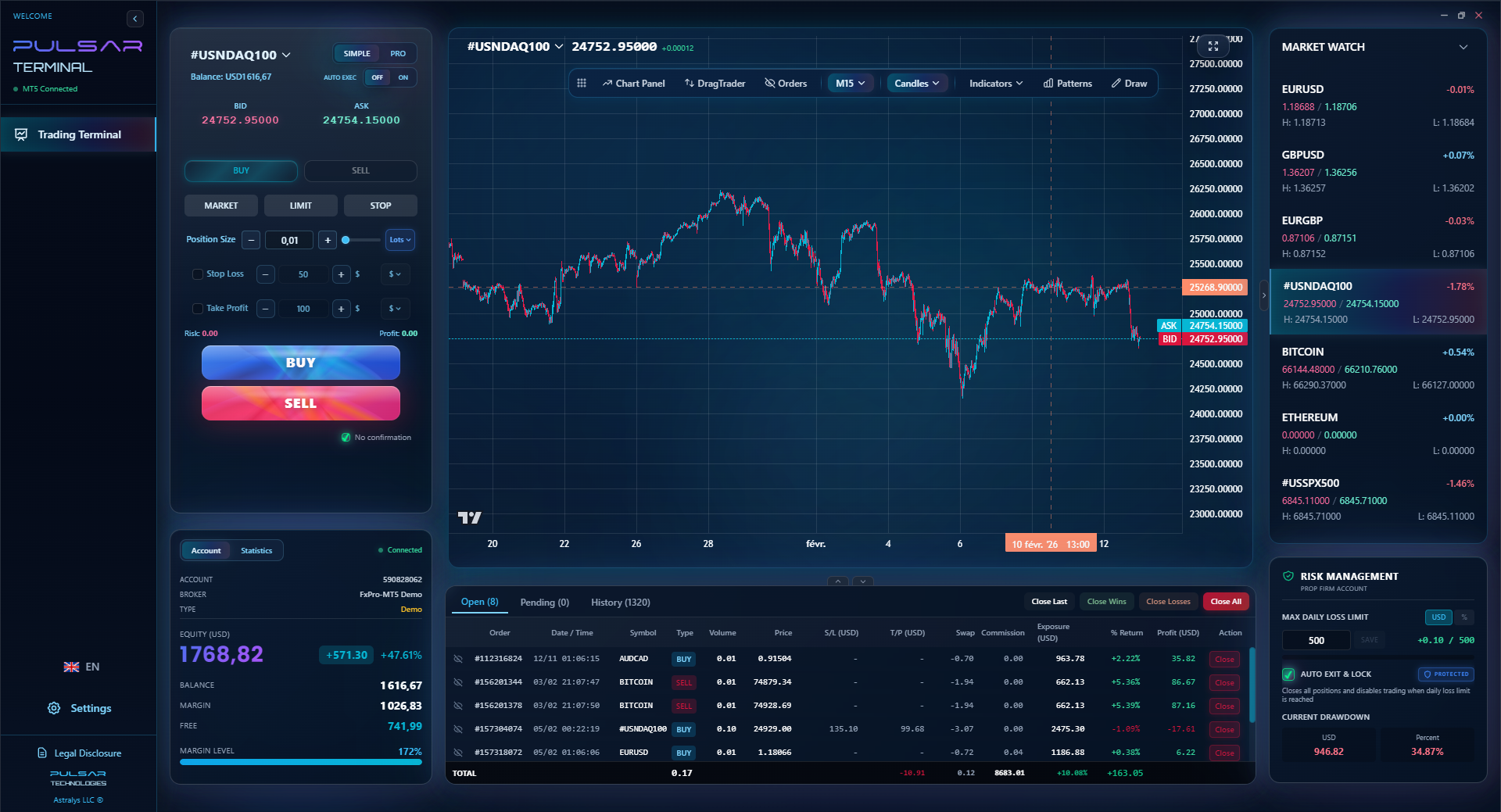
Managing multiple take-profit levels and trailing stops for a grid bot is complex, but Pulsar Terminal lets you set and automate these rules directly on your MT5 chart.
Pulsar Terminal
The all-in-one MT5 companion: drag-and-drop orders, multi-TP/SL, trailing stop, grid trading, Volume Profile, and prop firm protection. Used by 1,000+ traders daily.
Throwing a bot live on your hard-earned money is a recipe for disaster. You need a deployment pipeline.
Step 1: Strategy Tester (Backtesting) MT4/MT5 has a built-in backtester. It's okay, but flawed. It uses historical data, but that data often doesn't include the real spread you paid. It assumes perfect execution, which never happens. Use it to see if your logic is fundamentally broken, not to predict future profits. I once backtested a bot that showed a 400% return. Live, it lost 60%. The difference was slippage and spread.
Step 2: Forward Testing (Demo) This is non-negotiable. Run the bot on a demo account for at least one full market cycle - 2 to 3 months minimum. The demo must have live data and, if possible, simulated commissions. Compare its performance to your manual trading during the same period. Does it follow the rules? Does it crash?
Step 3: Live, But Small Your first live run should be on the smallest possible lot size. I use a micro account (0.01 lots) with just $200. The goal isn't to make money; it's to confirm the bot behaves the same way it did on demo with real money and real latency. Monitor it like a hawk for the first week.
Step 4: Scaling and Monitoring Only after a successful small live run do you scale up. And you never 'set and forget.' I check my bots daily. I have alerts set for any margin call warnings or if the bot goes inactive. Automation doesn't mean absence.
“The dream of passive income is possible, but the path is paved with careful work, not magic buttons.”
Trading with a bot changes the game, but your psychology is still the main player.
Pitfall 1: Over-Optimization (Curve Fitting) This is the killer. You tweak your bot's parameters until it's perfect for past data. It makes amazing profits on the backtest. Then the market shifts slightly, and it fails catastrophically. My rule: if a parameter change doesn't make logical, fundamental sense (e.g., changing an RSI level from 30 to 31.5), don't do it. You're fitting noise.
Pitfall 2: Ignoring Market Context Bots are dumb. A scalping strategy bot will try to scalp during a high-impact news event like an NFP report, resulting in huge slippage. You need to be the brain. I have a checklist: before Monday open, I check the economic calendar. If there's major news, I often disable my bots for that session.
Pitfall 3: Chasing the 'Holy Grail' You will lose trades. Your bot will have losing weeks. The temptation is to scrap it and buy the next shiny bot. This is a cycle of doom. Treat your bot like an employee. Give it clear KPIs (max drawdown, risk per trade) and a probation period. If it fails the KPIs after a reasonable time, fire it. But don't fire it for a single bad week.
The right mindset? You are a systems manager, not a trader. Your job is to manage the system (the bot), ensure its environment (broker, VPS) is stable, and intervene only when the rules say you should. Your emotion is the biggest bug in the code.
💡 Winston's Tip
Spend 90% of your time validating your strategy and 10% coding it. A perfect execution of a bad plan is still a loss.
Ready to start? Don't buy a bot. Don't hire a coder yet. Do this first.
- Nail a Manual Strategy: Pick one pair, one time frame, and one simple strategy. Could be a moving average crossover on EUR/USD. Trade it manually on a demo for 100 trades. Journal every single one. You need a proven rule set to automate.
- Learn the Basics of MT4/MT5: Know how to place orders, set stops, and read the market. You can't automate what you don't understand.
- Find Your Community (Carefully): Facebook groups are full of shills. Better places are dedicated forex forums or the MQL5 community. Look for discussions about coding specific logic, not profit screenshots.
- Consider a VPS: For any serious bot, a Virtual Private Server (like from ForexVPS) is worth the $15-$30/month. It keeps your bot running 24/7 with ultra-low latency to the broker's server. No more worrying about your internet or PC crashing.
Remember, a forex bot is a tool, not a strategy. It's a hammer. You can use it to build a house or smash your thumb. The difference is in the skill and plan of the person holding it. Start small, learn relentlessly, and manage your risk above all else. The dream of passive income is possible, but the path is paved with careful work, not magic buttons.
FAQ
Q1Is it legal to use a forex trading bot in the Philippines?
There's no specific law against using a forex bot as an individual. However, you'll be using it on an international broker, which operates outside direct Philippine SEC regulation. The legality of your activity is tied to the broker's terms of service. The SEC warns against the risks of forex trading in general, so you have no local regulatory protection if something goes wrong.
Q2How much money do I need to start trading with a forex bot?
Technically, some brokers like Exness let you start with $1. But realistically, to properly test and run a bot without being wiped out by a few losses, you need enough capital to manage risk. I'd say an absolute minimum is $500 for a micro account (0.01 lots). This allows for sensible position sizing and covers costs. Remember, bots often trade frequently, so commissions will eat a small account alive.
Q3What's the best trading platform for forex bots in the Philippines?
MetaTrader 4 (MT4) and MetaTrader 5 (MT5) are the undisputed standards. Almost every international broker offers them, and the MQL4/MQL5 language is what 99% of bots (Expert Advisors) are written in. They're stable, widely supported, and have massive communities for help. cTrader is another excellent platform with C#-based bots, but it's less common than MT4/5.
Q4Can I really make passive income with a forex bot?
It's possible, but 'passive' is a misnomer. It's more like 'automated active' income. A successful bot requires ongoing monitoring, occasional updates for changing market conditions, and management of the technical setup (broker, VPS). You are not on a beach ignoring it. You are a system manager. Many bots fail, and most sold online are scams. Real success comes from automating your own proven strategy.
Q5What's the biggest risk when using a forex bot?
Aside from losing capital, the biggest risk is a lack of understanding. Using a 'black box' bot you bought means you have no idea why it trades. If it starts losing, you can't fix it. The other major risk is over-optimization - creating a bot that works perfectly on past data but fails in live markets. Finally, technical failures (internet drop, platform crash) can cause missed trades or worse.
Q6Do I need to know how to code to use a forex bot?
No, you don't need to code to use a pre-made bot. But to truly succeed in the long run, you need to understand the logic behind it. To build or modify a bot, you'll need to learn MQL4/5 or hire a reliable coder. I strongly recommend learning the basics even if you hire out; it lets you communicate effectively and spot bad code.
Q7Are there any good free forex bots?
You can find many free EAs on forums like MQL5.com. Some are simple, useful tools (like a trade copier). Very few are profitable long-term trading systems. Be extremely careful. Free bots can contain malicious code ('trojan horses') that can trade against you or steal your account info. Always test any bot, free or paid, on a demo account first.
Prof. Winston's Lesson
Key Takeaways:
- ✓Test bots for 3 months on demo with real commissions.
- ✓Never risk more than 2% of capital on any bot's single trade.
- ✓Choose brokers with Tier-1 regulation for bot trading.
- ✓Factor in all costs: spread, commission, and bank conversion fees.
How useful was this article?
Click a star to rate
Weekly Trading Insights
Free weekly analysis & strategies. No spam.
About the Author
Miguel Reyes
Forex Analyst
Trading forex part-time from Manila since 2020, now full-time. Focuses on USD/PHP and major pairs during the Asian session. Former BPO worker who learned trading through free YouTube courses and demo accounts.
Comments
Risk Disclaimer
Trading financial instruments carries significant risk and may not be suitable for all investors. Past performance does not guarantee future results. This content is for educational purposes only and should not be considered investment advice. Always conduct your own research before trading.
You Might Also Like

Cara Trading Forex Sukses: 7 Prinsip dari Trader Profesional
Cara trading forex sukses dengan 7 prinsip trader pro: manajemen modal, disiplin, journal trading, backtest. Data nyata, bukan janji profit palsu.
Jam Trading Forex Terbaik untuk Trader Indonesia: Panduan Lengkap dengan Tabel Waktu
Panduan jam trading forex untuk trader Indonesia. Tabel 4 sesi dunia, jam emas 20:00-00:00, sesi mana yang harus dihindari. Data akurat + tips dari trader berpengalaman.
Top 5 Sàn Forex Uy Tín Nhất 2026: Review Jujur dari Trader Indonesia
Top 5 sàn forex uy tín 2026 untuk trader Indonesia. Review jujur: spread, deposit, withdraw, dukungan lokal. Exness, XM, IC Markets & lebih.
Get Pulsar Terminal
All these calculators are built into Pulsar Terminal with real-time data from your MT5 account. One-click position sizing, automatic risk management, and instant calculations.
Get Pulsar Terminal