


You're staring at the charts, wondering which of these squiggly lines actually means something, right? I was there too.

David van der Merwe
Emerging Markets Trader ·  South Africa
☕ 12 min read
What you'll learn:
- 1Why Patterns Matter (And Why Most Guides Get It Wrong For Us)
- 2The Patterns That Actually Pay in the ZAR Market
- 3Why Your Broker & Execution Make or Break the Pattern
- 4My Step-by-Step Process for Trading a Pattern
- 5The Mistakes That Cost Me Real Money (So You Don't Have To)
- 6Essential Tools & Platforms for South African Pattern Traders
- 7Putting It All Together: Your Path Forward
You're staring at the charts, wondering which of these squiggly lines actually means something, right? I was there too. In South Africa, with our unique market hours and the Rand's wild swings, copying generic 'forex pattern' strategies from the internet is a sure way to lose money. This isn't about memorising textbook shapes. It's about understanding which trade patterns forex pros use here, why they work with our brokers and regulations, and how to avoid the expensive mistakes I made learning them.
Let's clear something up first. A trading pattern isn't a magic crystal ball. It's a story of market psychology playing out on your chart - a record of fear, greed, and indecision. In South Africa, this story has local flavour. Our trading day kicks off when Asia is winding down and Europe is just waking up. That overlap creates specific liquidity patterns you won't see if you're only trading textbook London or New York sessions.
I learned this the hard way. Early on, I tried trading classic head and shoulders patterns on USD/ZAR during our late afternoon. The textbooks said it was a high-probability reversal. What they didn't say was that liquidity often dries up then, leading to false breaks and whipsaws. I got stopped out three times in a week before I realised the pattern wasn't wrong; my timing was. The pattern needed the volume of the European session to be valid.

Warning: Don't fall for the 'one pattern fits all markets' trap. A double top on EUR/USD behaves differently than one on USD/ZAR. Our market is smaller, so moves can be sharper and patterns can complete faster. You need to adjust your expectations for speed and volatility.
The real value in learning trade patterns forex is consistency. It gives you a framework to read the market's mood. Instead of guessing, you're looking for repeated, measurable behaviour. This is crucial for managing risk, which is your number one job as a trader. Knowing where a pattern typically fails tells you exactly where to place your stop-loss. I use a position size calculator for every single trade, pattern or not, to keep my risk in check.
“In South Africa, a trading pattern isn't a magic crystal ball. It's a story of market psychology playing out on your chart, with local flavour.”
Forget the obscure, 15-line patterns you see in advanced books. In 12 years, I've made money consistently with about five. Here are the three that work best with South African brokers and our market quirks.
The Flag & Pennant (My Bread and Butter)
This is a continuation pattern. Think of a strong price move (the flagpole), followed by a small, sloppy consolidation (the flag). The market is just catching its breath before continuing in the same direction. I love these on GBP/ZAR and EUR/ZAR during the London session.
Here’s a real trade from last month on GBP/ZAR. Price shot up from R23.10 to R23.85 (the flagpole). It then consolidated between R23.70 and R23.80 for about 4 hours, forming a tight little pennant. The entry trigger was a break above R23.82. I entered a buy, placed my stop at R23.65 (just below the consolidation low), and rode it to R24.15. The key? The initial move was strong and news-driven. The consolidation had lower volume. It set up perfectly.
The Double Top/Bottom (The Patient Trader's Friend)
This is a reversal pattern. It screams, "The trend is exhausted." You see two similar highs (double top) or lows (double bottom) with a pullback in between. The neckline break is your signal. With USD/ZAR, these patterns often form around major psychological levels or after SARB policy announcements.
My mistake with this pattern was being too eager. I'd see the second top forming and jump in early, shorting before the neckline break. More often than not, price would test a third time, hit my stop, and then reverse. The lesson? Wait for the close below the neckline. Let the market confirm it's giving up. Patience isn't just a virtue here; it's profit.
The Ascending/Descending Triangle
These are my go-to patterns for swing trading over a few days. An ascending triangle has a flat top and rising lower trendline. It suggests buyers are getting more aggressive, and a breakout upwards is likely. I scan for these on the 4-hour charts of majors like EUR/USD that influence our crosses.
The critical part is the volume. A genuine breakout should come with a spike in volume. Many South African brokers have decent volume indicators on MT4/MT5. If the breakout is on thin volume, it's suspect. I've been faked out more times than I care to admit by low-volume triangle breaks.

💡 Winston's Tip
A pattern is just a map. The market's volume and momentum are the terrain. Never follow the map if the terrain says there's a cliff.
“Patience isn't just a virtue in pattern trading; it's profit. Wait for the market to confirm the break.”
You can spot the perfect pattern, but if your broker's execution is slow or spreads widen at the key moment, you're sunk. This is a huge local consideration.
The FSCA's 30:1 use cap for retail clients is a good thing. It forces sane risk management. But it also means you need to be picky about costs. A pattern trade often aims for a 2:1 or 3:1 risk-to-reward ratio. If your broker's spread on USD/ZAR is 15 pips normally and widens to 25 during news, that extra 10 pips can completely destroy your potential profit.
I've traded with a few. Here’s the real-world impact on pattern trading:
- Tickmill: Their Raw account is excellent for this. The spreads are tight (often under 1 pip on EUR/ZAR), but you pay a commission. For a pattern trade where you're precise about entry, paying a small commission for a razor-thin spread is worth it. It makes your pip definition of risk much cleaner.
- Khwezi Trade: A solid local option. ZAR-based accounts mean no currency conversion fees. Their spreads are competitive, and being FSCA-regulated adds a layer of security for your funds. Great for traders starting with that R5,000 - R20,000 capital.
- International Brokers (like Pepperstone or IC Markets): They often offer tighter spreads and higher use (up to 1:500) to South African clients. This is a double-edged sword. Yes, you can get a better entry price. But that higher use can tempt you to over-size on a 'sure thing' pattern trade. One bad trade can hurt.

Pro Tip: Always check the average spread on your chosen pair during the time you trade. Don't just look at the advertised 'from' spread. Use a demo account to watch how it behaves at 9 AM SAST vs. 4 PM SAST. Slippage on the pattern breakout is a silent killer.
A bad fill on your entry can turn a winning pattern into a breakeven trade or worse. This is where a platform's tools help. Having a platform that lets you set multiple take-profit levels is gold for pattern trading. You can scale out of the trade as price reaches historical resistance levels within the pattern's projected move. I review tools that help with this in my Pepperstone review.
“Patience isn't just a virtue in pattern trading; it's profit. Wait for the market to confirm the break.”
This is exactly what I do, from scan to exit. No fluff.
- The Scan (Evening, SAST): I don't sit and watch charts all day. I use the MT5 platform's built-in pattern recognition tools (like the Autochartist plugin some brokers offer) to scan the daily and 4-hour charts of my 10 favourite pairs. I'm looking for patterns in their early or mid-stages. I'll mark them on the chart and set an alert.
- The Context Check: Is the pattern forming at a key support/resistance level? On the XAU/USD guide I wrote, I show how a triangle at $2000 is very different from one at $1950. What's the overall trend? A flag in a strong uptrend is higher probability than one in a choppy range. I use the MACD indicator and RSI indicator here not for direct signals, but for confluence. Is the RSI showing divergence as the double top forms? Bullish.
- Planning the Trade (The Night Before): This is non-negotiable. I calculate everything.
- Entry: Precisely where will I enter? (e.g., A close above the flag's high).
- Stop-Loss: Where is the pattern invalidated? (e.g., Below the flag's low). That's my SL. No debate.
- Take-Profit: I use the pattern's measured move. For a flag, it's roughly the length of the flagpole projected from the breakout point. I set two TP levels: one at 50% of the target, one at 100%.
- Position Size: I plug my SL distance in pips, my account risk (never more than 1%), and my account balance into my position size calculator. It tells me the exact lot size. I write it down.
- Execution & Management: When the alert hits, I check volume on the breakout candle. If it's good, I enter the pre-calculated trade. I then move my stop to breakeven once price reaches my first TP level. The rest runs risk-free. I don't watch it. Emotion is the enemy.
This process took me from inconsistent to consistently profitable. It removes the guesswork.
💡 Winston's Tip
Your first loss is your best loss. If a pattern breaks against you, take the small, planned exit immediately. Hoping it'll come back is how small losses become account-ending ones.
“The FSCA's 30:1 use cap isn't a limitation for pattern trading; it's a guardrail that keeps you alive.”
Let's get vulnerable. Here’s where I've blown up accounts and learned painful lessons.
Mistake 1: Chasing the Pattern. You see a beautiful head and shoulders that's already broken its neckline and moved 50 pips. FOMO kicks in. You jump in late. What happens? The move is exhausted, it reverses, and you're left holding a bag. I did this on EUR/ZAR in 2019. The pattern target was 200 pips. I entered 80 pips late. It reversed 90 pips later. I lost 1.5% of my account chasing a move that was already over.
Mistake 2: Ignoring the Higher Timeframe. You see a perfect bullish flag on the 15-minute chart. But the daily chart shows price is crashing into a massive, multi-year resistance level. Which story wins? The daily, every time. The 15-minute pattern will fail. I've been steamrolled by the higher timeframe trend more times than I can count.
Mistake 3: Overcomplicating It. Early on, I'd see a pattern, then add 5 different indicators, look for Fibonacci confluence, and wait for a news catalyst. By the time my "perfect setup" was aligned, the trade was long gone. Now, I keep it simple: Clean pattern + key level + volume confirmation. That's it. The scalping strategy I sometimes use is even more stripped back.
Mistake 4: Not Accounting for Spread & Slippage. This is a silent account drain. You plan a trade with a 30-pip stop and a 60-pip target. But your entry gets 3 pips of slippage, and the spread is 5 pips. Suddenly, your risk is 38 pips to make 52. Your reward-to-risk ratio is destroyed. Always add your broker's typical spread + a slippage buffer to your risk calculation.

Example: Planned Trade: Buy Stop at 18.5000, SL at 18.4700 (30 pip risk). With a 5-pip spread and 2-pip slippage, your real entry might be 18.5007. Your real SL is still at 18.4700. Your risk is now 37 pips, not 30. Your position size must adjust accordingly, or you're over-leveraged.
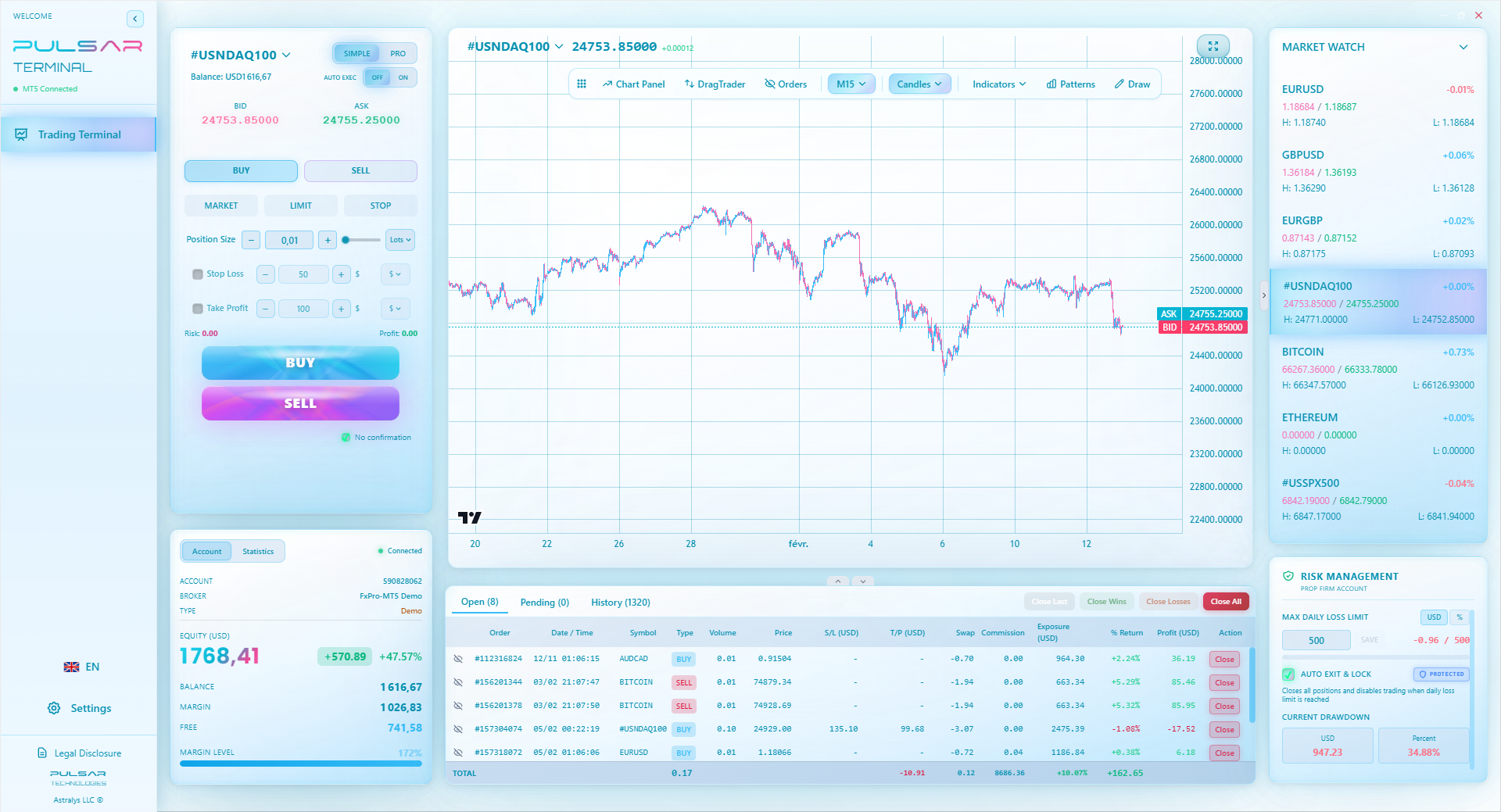
Managing multiple take-profit levels and moving stops to breakeven manually is stressful and error-prone, which is why I use tools that automate this directly on my MT5 platform.
Pulsar Terminal
The all-in-one MT5 companion: drag-and-drop orders, multi-TP/SL, trailing stop, grid trading, Volume Profile, and prop firm protection. Used by 1,000+ traders daily.
“The FSCA's 30:1 use cap isn't a limitation for pattern trading; it's a guardrail that keeps you alive.”
You don't need expensive software, but you do need the right basics.
MetaTrader 4 & 5: Still the king in South Africa. Why? Familiarity, stability, and most local brokers support it. MT5 is better for pattern traders because it has more timeframes and built-in economic calendar. The drawing tools are essential for marking up your patterns.
TradingView: I use this for my analysis and scanning. The social aspect can be a distraction, but their charting and pattern recognition is top-notch. I'll often find a pattern on TradingView, then execute the trade on my broker's MT5 platform.
An Economic Calendar: The SARB interest rate decisions, South African CPI data, and US Non-Farm Payrolls can all obliterate a technical pattern in seconds. You must know when high-impact news is due. Never hold a pattern trade into a major news event unless you're intentionally trading the volatility.
A Reliable Internet Connection: Sounds obvious, but load-shedding is our reality. A UPS (uninterruptible power supply) for your router and computer is not a luxury; it's a trading cost. I've missed exits because of a power cut. Don't be me.
Regarding automated pattern tools: Be skeptical. The ones that claim to flash buy/sell signals on every pattern are usually garbage. The good ones are expensive and are for scanning, not thinking for you. Your brain is your best tool.
“Your brain is your best tool. Expensive software can scan, but it can't think or understand context for you.”
So where do you start? Not by trying to trade all of this tomorrow.
- Pick ONE pattern. The flag is the most forgiving. Go to your broker's platform (I suggest starting with a demo account from a broker like XM or Exness to test things) and just look for flags on the 1-hour chart of EUR/USD for a week. Don't trade. Just identify them.
- Paper trade it. When you see one, write down your plan: entry, stop, target. Follow it on the chart. See how often it works. Note the conditions when it fails.
- Add one element. Once you're good at spotting flags, add a rule: "I will only trade flags that form during the London session." Or, "I will only trade flags where the RSI is above 50."
- Go live small. When you have a documented track record of paper trades showing consistency, fund a live account with an amount you can afford to lose - that R1,500 to R5,000 range is sensible. Trade micro lots (0.01). The goal here is not to get rich. The goal is to execute your plan under real emotional pressure.
Pattern trading is a skill. It's learnable. But it requires discipline more than brilliance. It requires you to follow your plan even when you're scared, and to take the loss when the pattern fails without doubting the entire system. The market will test you. It tested me. I've had 6 losing trades in a row on patterns that "should" have worked. But because my risk was capped each time, I survived. And the 7th trade made up for all of them and more.
Start small. Be patient. Focus on the process, not the profit. The profits will come as a byproduct of doing things right. And remember, every pro trader was once a beginner staring at a confusing chart, just like you are now. The difference is they decided to learn the language the chart was speaking. You can too.
FAQ
Q1Is forex pattern trading legal in South Africa?
Yes, absolutely. Forex trading is legal for individuals in South Africa. You must use a broker that is regulated by the Financial Sector Conduct Authority (FSCA) to ensure your funds are protected under local law. The key legal point is that South African residents cannot speculate directly against the Rand for physical delivery through online brokers; all forex trading is done via CFDs or derivatives with licensed providers.
Q2What is a realistic starting capital for pattern trading in South Africa?
You can technically start with as little as R70-R150 on a micro account. But for meaningful pattern trading where you can properly manage risk across a few trades, a more realistic starting point is between R5,000 and R20,000. This allows you to trade small position sizes (like 0.01 lots) on pairs like USD/ZAR without being wiped out by a single 50-pip stop-loss or a wide spread definition.
Q3Which timeframes are best for finding reliable patterns?
It depends on your style. For higher probability, I focus on the 4-hour and daily charts. Patterns on these timeframes have more weight behind them. For more frequent opportunities (with more noise), the 1-hour chart works. I avoid anything below 15 minutes for pattern trading - it's too chaotic and spread costs eat into profits. Start with the 4-hour to learn.
Q4How do I know if a pattern breakout is real or a fakeout?
Volume is the best clue. A genuine breakout should have noticeably higher volume on the breakout candle. Also, wait for the candle to close beyond the pattern boundary. A quick spike that retreats is often a fakeout. Finally, check if the breakout aligns with the overall trend on the next higher timeframe - that adds confluence.
Q5Can I use pattern trading with the FSCA's 30:1 use limit?
Yes, and it's healthier. The 30:1 cap forces sensible position sizing. With pattern trading, you're often aiming for specific risk/reward ratios (e.g., 1:2). High use tempts you to over-size, turning a good pattern trade into a dangerous gamble. With 30:1, you can still grow an account steadily while protecting yourself from a margin call from a few bad trades.
Q6What's the most common reason a good-looking pattern fails?
Lack of context. The pattern forms in isolation, but the market is hit by a fundamental news event (like a SARB rate decision or US jobs data) that overpowers the technical picture. This is why you must always know the economic calendar. The second most common reason is that the pattern formed during low liquidity (like late afternoon SAST), making the breakout weak and prone to failure.
Prof. Winston's Lesson
Key Takeaways:
- ✓Master 3-5 core patterns, not 20. Depth beats breadth.
- ✓Always calculate position size before any trade. Risk 1% or less.
- ✓Wait for the candle close beyond the pattern line. Avoid fakeouts.
- ✓Never trade a pattern against the higher timeframe trend.
- ✓Know the economic calendar. News kills technical patterns.
How useful was this article?
Click a star to rate
Weekly Trading Insights
Free weekly analysis & strategies. No spam.
About the Author
David van der Merwe
Emerging Markets Trader
Johannesburg-based trader with 11 years in emerging market currencies. Specializes in ZAR pairs, FSCA-regulated trading, and South African market analysis.
Comments
Risk Disclaimer
Trading financial instruments carries significant risk and may not be suitable for all investors. Past performance does not guarantee future results. This content is for educational purposes only and should not be considered investment advice. Always conduct your own research before trading.
You Might Also Like

Cara Trading Forex Sukses: 7 Prinsip dari Trader Profesional
Cara trading forex sukses dengan 7 prinsip trader pro: manajemen modal, disiplin, journal trading, backtest. Data nyata, bukan janji profit palsu.
Jam Trading Forex Terbaik untuk Trader Indonesia: Panduan Lengkap dengan Tabel Waktu
Panduan jam trading forex untuk trader Indonesia. Tabel 4 sesi dunia, jam emas 20:00-00:00, sesi mana yang harus dihindari. Data akurat + tips dari trader berpengalaman.
Top 5 Sàn Forex Uy Tín Nhất 2026: Review Jujur dari Trader Indonesia
Top 5 sàn forex uy tín 2026 untuk trader Indonesia. Review jujur: spread, deposit, withdraw, dukungan lokal. Exness, XM, IC Markets & lebih.
Get Pulsar Terminal
All these calculators are built into Pulsar Terminal with real-time data from your MT5 account. One-click position sizing, automatic risk management, and instant calculations.
Get Pulsar Terminal