


Is Trade The Pool a legitimate path to trading real capital, or just another expensive challenge with hidden traps? I paid for three different evaluations over 18 months, funded two accounts, and learned the hard way what makes this U.S.

James Mitchell
Senior Trading Analyst
☕ 11 min read
What you'll learn:
- 1What Exactly Is Trade The Pool?
- 2The Real Costs: Fees, Splits, and Fine Print
- 3The Single-Phase Challenge: Rules That Will Trip You Up
- 4The TraderEvolution Platform: Love It or Hate It
- 5My Funded Account Experience: The Good, The Bad, The Payout
- 6How Does Trade The Pool Compare to Other Prop Firms?
- 7Who Should (and Shouldn't) Use Trade The Pool
- 8Final Verdict and My Hard-Earned Advice
Is Trade The Pool a legitimate path to trading real capital, or just another expensive challenge with hidden traps? I paid for three different evaluations over 18 months, funded two accounts, and learned the hard way what makes this U.S. stock-focused prop firm different. Their single-phase model sounds simple, but the devil is in the details - especially their consistency rule and platform quirks. Here’s everything I wish I’d known before I sent them my first evaluation fee.
Trade The Pool is a proprietary trading firm that gives you capital to trade U.S. stocks and ETFs. They're not a broker like Exness or IC Markets; they're a capital provider. You pass their evaluation, and they give you a funded account with their money. You keep a share of the profits, and they take the rest.
Founded in 2022, they're run by the same team behind The 5%ers, a forex prop firm. The key difference? Trade The Pool is exclusively for the U.S. equity markets. No forex, no crypto. Just stocks like Apple, Tesla, and SPY. Their whole pitch is direct market access with Level 2 data, which is a big deal if you're used to trading CFDs.
Here's the critical legal bit they stress: all trading in their evaluation is done in a simulated environment. You're not trading real money until you're funded. This is how they navigate regulations. For you, the trader, it means the fills and liquidity should mirror the real market, but as I found out, that's not always a perfect match.

Warning: Don't confuse "simulated" with "practice." The rules are brutally real. Blow your daily loss limit, and your challenge is over. You're out the evaluation fee.

💡 Winston's Tip
The consistency rule is a position sizing rule in disguise. Calculate your max allowed 'big win' first, then size every entry to ensure you can't accidentally break it, even on a runner.
Let's talk numbers. This is where I made my first, and most expensive, mistake.
You don't deposit capital. You pay a one-time evaluation fee. This ranges from $47 for a tiny $5k account to $1,475 for a $200k account. They advertise a 100% refund of this fee after your first profit payout. Sounds great, right? It is, but you have to get there first.
The Profit Split Isn't Simple
The standard split for their day trading accounts is 70/30 in your favor. But that's just the base. They offer "Enhanced Buying Power" options, which basically let you trade with more use. These come with different splits and higher fees.
| Account Type | Evaluation Fee | Profit Split (Trader/Firm) | Key Detail |
|---|---|---|---|
| Day Trade Flex ($200k) | $1,475 | 70/30 | Standard model |
| Ultimate Buying Power | $1,240 | 80/20 | Higher use, different rules |
| Swing Trade Flex | $997 | Starts at 50/50 | Can scale to 80/20 |
My error? I went for the $1,475 fee on a $200k account, thinking the bigger capital was better. I ignored the commissions. They charge $0.005 per share. On a 500-share trade, that's $2.50 each way ($5 total). If you're scalping small moves, commissions eat you alive. I had a trade where I made $120 on paper, but after commissions, my net was $68. That hurt.

Example: You buy 200 shares of MSFT at $400. Your commission is 200 * $0.005 = $1.00 to enter. You sell at $402. Your profit is (200 * $2) = $400, minus $1 entry and $1 exit = $398 net. That commission just took 0.5% off your gross gain.
Payouts start after you have $300 in net valid profit. They happen every 14 days. The refund of your evaluation fee is a nice touch, but it's a carrot that makes you trade differently - sometimes recklessly - to finally get it back.
“One emotional lapse can wipe out weeks of work in a funded account.”
Most prop firms have two phases. Trade The Pool has one. Hit your profit target without breaking the loss limits, and you're funded. Simpler? Yes. Easier? Absolutely not.
The profit target is typically 6% of your account's starting balance. For a $100k account, that's $6,000. You also have a maximum daily loss (often 2%) and a maximum drawdown (often 4%). Blow either one, game over.
The Consistency Rule (My Nemesis)
This is the rule that killed my first two attempts. Your single most profitable trade cannot account for more than 30% of your total profit target during the evaluation. On a $100k account with a $6k target, your biggest winning trade can't be more than $1,800.
Why is this brutal? Let's say you catch a perfect earnings move on NVIDIA. You ride it for a $2,500 gain. Congratulations, you've just invalidated your entire challenge, even if you're up $5,999 overall. They call it promoting consistency. I call it forcing you to avoid your best trades. It completely changes your position size strategy. You can't let any single winner run too far.
Other Gotchas
- Minimum Trading Days: You need 5 active days. No hitting your target in two lucky days.
- Minimum Position Duration: Trades must be open for at least 30 seconds. This stops hyper-scalping.
- Minimum Profit Per Share: Your winning trades must make at least $0.10 per share. This combats commission-only scalping.
- Reset Fees: Blow your daily loss but want to keep trading that day? You can pay a reset fee ($50-$250). It's a costly safety net.
I failed my first challenge because of the consistency rule. I was up $4,200, and one beautiful TSLA trade brought in $1,550. I thought I was a genius. The platform said "Challenge Failed." I hadn't even looked at that rule closely enough. A $1,475 lesson in reading the fine print.
Trade The Pool uses one platform: TraderEvolution. You can't use TradingView, MT5, or anything else. This is a major consideration.
The good? You get direct market access and real Level 2 quotes (CBOE feed). The charts are decent, and the order entry is fast once you learn it. For pure U.S. stock trading, it's professional-grade.
The bad? There's a steep learning curve. It's not as intuitive as Thinkorswim or Interactive Brokers. I spent my first three evaluation days fighting the interface instead of watching the market. Also, some users (including me, on occasion) have reported fill discrepancies. You see the bid/ask on Level 2, but your market order gets filled a penny worse. It doesn't happen often with liquid stocks like SPY, but on a mid-cap stock with lower volume, it can sting.

Pro Tip: Always use limit orders. Never use market orders on this platform, especially outside of the first and last hour of the trading day. The one time I used a market order for 100 shares of a biotech stock, I got filled $0.15 below the quoted bid. That was my profit gone.
If you're coming from forex brokers like XM or Pepperstone, this platform will feel alien. It's built for equities. You need to understand share volume, Level 2 depth, and ECN routing. It's a powerful tool, but it's not plug-and-play.
💡 Winston's Tip
Test the platform's fill quality in the first days of your eval. Place small limit orders at the bid/ask on liquid and illiquid stocks. See the slippage for yourself before risking real size.
“They call it promoting consistency. I call it forcing you to avoid your best trades.”
I finally passed a challenge on a $50k Day Trade Flex account. I paid a $497 fee, kept every single trade ridiculously small to obey the consistency rule, and grinded out the 6% ($3,000) target over 11 trading days.
Getting funded was straightforward. The rules relax slightly - the consistency rule is gone, thank goodness. But the daily loss and max drawdown remain. The profit split is the same (70/30).
The First Payout
I traded for a month in the funded account. My net profit after commissions was $2,811. My 70% share was $1,967.70. I requested a payout. It hit my Wise account in 2 business days. They also refunded my $497 evaluation fee as a separate transaction. Seeing that $2,464.70 land was incredibly validating. It works.
The Reality Check
But then I got overconfident. I had a terrible day where I revenge-traded after an early loss. I broke my daily loss limit by about $80. The account was instantly deactivated. No warning, no second chance. That funded account was gone. The $1,200 I was up for the month? Gone too. All I had was my first payout.
The discipline required doesn't end when you're funded. If anything, it's harder because the safety net is gone. You need the mental fortitude of a swing trader but the reflexes of a scalper. One emotional lapse can wipe out weeks of work.
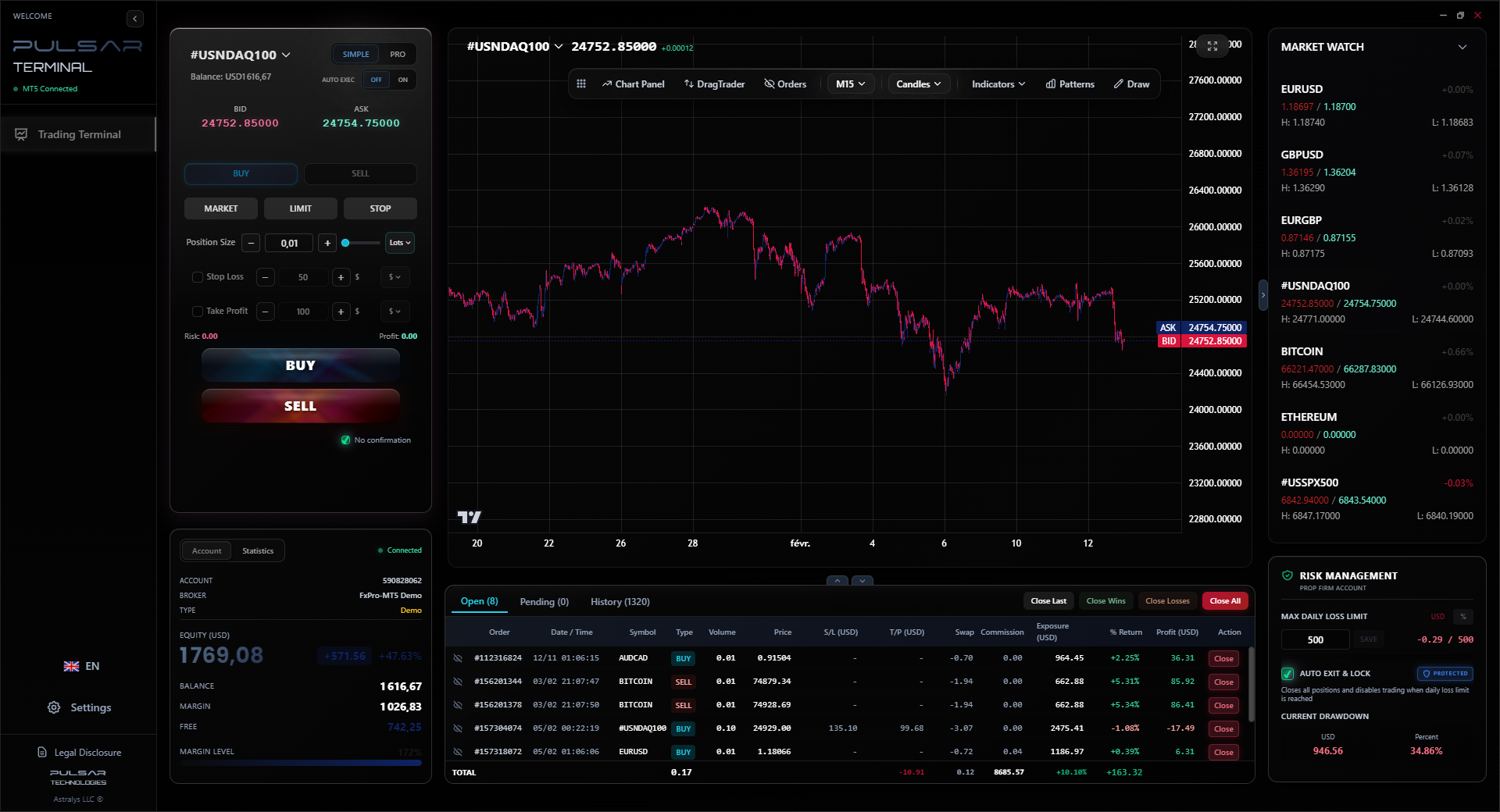
This is where a tool for strict risk management is non-negotiable. You can't be manually calculating your daily loss every second. Having software that can auto-close positions or move stops to breakeven at a defined P&L level is a lifesaver. It removes emotion from the equation right when you need it most.
Managing a prop firm's daily loss limit requires robotic discipline, which is exactly what Pulsar Terminal's account-level stop loss and equity guard features automate on MT5.
Pulsar Terminal
The all-in-one MT5 companion: drag-and-drop orders, multi-TP/SL, trailing stop, grid trading, Volume Profile, and prop firm protection. Used by 1,000+ traders daily.
Trade The Pool isn't for everyone. It's a niche product.
Vs. Forex/Crypto Prop Firms (FTMO, The 5%ers):
- Instruments: Trade The Pool is only U.S. stocks/ETFs. The others are forex, indices, commodities. If you live and breathe the NYSE open, Trade The Pool is your only real prop firm option.
- Platform: You're locked into TraderEvolution. Others often let you use MT5/MT4.
- Challenge Structure: Single-phase vs. the common two-phase. It's faster to fund but harder due to rules like the consistency rule.
Vs. Trading Your Own Capital at a Broker:
- Capital: With a prop firm, you're risking a fee, not your life savings. With your own broker account, you're risking real cash.
- Costs: At a broker, you pay commissions and maybe data fees. At Trade The Pool, you pay the evaluation fee and give up 30% of profits.
- Psychology: Trading someone else's money feels different. For some, it's less pressure. For me, the fear of losing the funded status created its own unique anxiety.
The main advantage of Trade The Pool is access. Where else can a trader with $500 get a legitimate shot at trading a $200,000 stock portfolio with direct market access? Nowhere. That's their value proposition. But you pay for it with strict rules and a share of your profits.
“Trade The Pool is a professional audition, not a lottery ticket.”
You might be a good fit if:
- You are already a profitable U.S. stock day trader using a cash account at a broker like TD Ameritrade.
- You understand Level 2, time & sales, and equity order types.
- Your strategy involves many smaller wins (to comply with the consistency rule).
- You have the discipline to treat their capital like your own and respect hard daily loss limits.
- You want to scale your trading without injecting more personal capital.
Look elsewhere if:
- You are a forex or crypto trader. This isn't your market.
- Your strategy relies on occasional home-run trades (the consistency rule will break you).
- You can't handle a proprietary, somewhat clunky trading platform.
- You're a beginner looking for a "learning experience." The fees are too high for that. Paper trade first.
- You need the flexibility of multiple platforms. You're stuck with TraderEvolution.
My biggest mistake was trying to use my forex scalping mindset on stocks. The mechanics, the commission structure, the market hours - it's a different world. I should have paper traded on TraderEvolution for a month before paying a single evaluation fee.
💡 Winston's Tip
Your first goal in a funded account isn't a payout. It's surviving 30 days without hitting the daily loss limit. Trade tiny size until the psychology feels normal.
Trade The Pool is a legitimate, professional prop firm for U.S. equities. They pay out, their platform provides real market access, and their model is clear. But it's a tough, expensive road.
My final score: 7/10. They deliver on their promise, but the path is lined with specific, easy-to-break rules.
If you decide to go for it, here's my battle plan for you:
- Start Small: Buy the cheapest evaluation ($47 or $97). Learn the rules and the platform with minimal financial risk. Your goal isn't to pass on the first try; it's to learn.
- Master the Consistency Rule: From day one, plan your trades so no single winner exceeds 25% of your profit target. Use a position size calculator religiously. If a trade gets too big, scale out.
- Factor in Commissions: In your trading journal, track net profit after commissions. If a setup doesn't have a clear $0.15-$0.20 per share potential after costs, skip it.
- Respect the Daily Loss Limit ABOVE ALL ELSE: This is the killer. The moment you're down接近 80% of your daily loss, stop trading. Close the platform. A reset fee is a penalty for poor discipline.
- Use Every Tool to Manage Risk: The stress of watching a daily loss limit is immense. Automate what you can. Use platforms that let you set hard stops based on account P&L, not just chart levels.
Trade The Pool is a tool. A very specific, powerful, and costly tool. It's not a lottery ticket. It's a professional audition. Go in prepared, treat it like a job, and it can be a viable way to trade serious size. Go in naive, and it'll be a very expensive lesson. I've been on both sides of that equation.
FAQ
Q1Is Trade The Pool a scam?
No, based on my experience, they are not a scam. They have a defined business model, provide a real trading platform with market data, and they paid me when I met their rules. However, their rules are very strict and complex, leading some traders to feel the model is unfair or designed for failure. It's a high-risk, high-cost evaluation, not a scam.
Q2What is the hardest rule in the Trade The Pool challenge?
For most traders, it's the consistency rule. Your largest winning trade cannot be more than 30% (or 50% on some accounts) of your total profit target. This forces a specific trading style of many small wins and actively punishes you for having one great trade. It's the rule that failed me twice before I adapted.
Q3Can I use my own trading platform like TradingView with Trade The Pool?
No. Trade The Pool exclusively uses the TraderEvolution platform. You cannot connect other charting or trading software to their funded accounts. You must execute all trades through their provided interface.
Q4How long does it take to get a payout from a funded account?
Payouts operate on a 14-day cycle. Once you request a withdrawal, they state processing takes 1-3 business days. In my experience, it took 2 business days to reach my Wise account. You need a minimum of $300 in net valid profit to request a payout.
Q5What happens if I break the daily loss limit in a funded account?
Your funded account is immediately and permanently deactivated. There is no reset fee or second chance for funded accounts. All unrealized profits and future trading ability are lost. Only profits that have already been accrued and are eligible for payout are safe.
Q6Are the spreads and commissions competitive?
Commissions are standard for direct market access at $0.005 per share. Spreads on highly liquid ETFs and large-cap stocks are tight. However, some traders report occasional fill discrepancies on less liquid stocks. It's not a market maker model like some forex brokers; it's direct access, so spreads are the natural market bid/ask.
Q7Should a complete beginner try Trade The Pool?
Absolutely not. The evaluation fees are too high for a learning experience. You should first be consistently profitable paper trading U.S. stocks, understand basic order types, and have a solid grasp of risk management. Otherwise, you are donating your evaluation fee.
Prof. Winston's Lesson
Key Takeaways:
- ✓The 30% consistency rule is the #1 challenge killer.
- ✓Commission of $0.005/share eats scalping profits fast.
- ✓Funded accounts have zero tolerance for daily loss breaches.
- ✓TraderEvolution platform has a 3-day learning curve.
How useful was this article?
Click a star to rate
Weekly Trading Insights
Free weekly analysis & strategies. No spam.
About the Author
James Mitchell
Senior Trading Analyst
Based in New York with over 9 years of trading experience. Focuses on major USD pairs, prop firm challenges, and the US regulatory landscape.
Comments
Risk Disclaimer
Trading financial instruments carries significant risk and may not be suitable for all investors. Past performance does not guarantee future results. This content is for educational purposes only and should not be considered investment advice. Always conduct your own research before trading.
You Might Also Like

Cara Trading Forex Sukses: 7 Prinsip dari Trader Profesional
Cara trading forex sukses dengan 7 prinsip trader pro: manajemen modal, disiplin, journal trading, backtest. Data nyata, bukan janji profit palsu.
Jam Trading Forex Terbaik untuk Trader Indonesia: Panduan Lengkap dengan Tabel Waktu
Panduan jam trading forex untuk trader Indonesia. Tabel 4 sesi dunia, jam emas 20:00-00:00, sesi mana yang harus dihindari. Data akurat + tips dari trader berpengalaman.
Top 5 Sàn Forex Uy Tín Nhất 2026: Review Jujur dari Trader Indonesia
Top 5 sàn forex uy tín 2026 untuk trader Indonesia. Review jujur: spread, deposit, withdraw, dukungan lokal. Exness, XM, IC Markets & lebih.
Get Pulsar Terminal
All these calculators are built into Pulsar Terminal with real-time data from your MT5 account. One-click position sizing, automatic risk management, and instant calculations.
Get Pulsar Terminal