


Let's cut through the hype.

James Mitchell
Senior Trading Analyst ·  Canada
☕ 10 min read
What you'll learn:
Let's cut through the hype. Every other YouTube ad seems to be pushing a 'prop firm' these days, promising you a funded account with 'no risk.' Tradeify Prop Firm is one of the newer names popping up. I'm here to tell you that 90% of traders who sign up for these challenges lose their fee before they even understand the rules. This isn't about being negative, it's about being real. I've passed challenges and I've failed them spectacularly. In this guide, I'll walk you through exactly what a firm like Tradeify is, what the real numbers look for a Canadian, and whether you should even bother.
First off, let's clear up a massive misconception. When you join Tradeify, or any similar prop firm, you are NOT a client depositing money to trade. You're a contractor auditioning for a job. You pay them a one-time fee (anywhere from $50 to over $1,000) to take a 'challenge' or 'evaluation.' This is a simulated account with their capital. If you pass their specific profit target without breaking their often-complex rules, they may offer you a 'funded' simulated account. You trade that, make profits, and then you get a cut (usually 70-90%). They keep the rest.
It's a skills-based audition, not an investment. This is a critical distinction because it's why they aren't regulated like your bank or a standard broker like IC Markets. They're selling you a test, not financial services. For a Canadian, this means you have zero regulatory protection from bodies like the CIRO if things go south. Your only recourse is the firm's own terms and conditions.

Warning: Because prop firms operate in this gray area, due diligence is everything. A flashy website means nothing. You need to dig into their payout history, user reviews, and rule clarity before you pay a single cent.
This is where they get you. The fee is just the entry ticket. The real challenge is the rulebook. Let's break down the typical structure you'd see with a firm like Tradeify.
The Evaluation Fee
You'll see options like a $50,000 challenge for $299, or a $100,000 challenge for $499. This is your sunk cost. Think of it as gone the moment you hit 'buy.' I once made the mistake of buying the biggest challenge I could afford, thinking the larger capital was the goal. I blew the $200,000 account in 3 days because my normal position size calculator settings were way too aggressive for their tight drawdown rules. I lost a $899 fee. Lesson learned the hard way.
The Profit Target & Drawdowns
Most firms require an 8-10% profit target to pass. So, on a $100,000 account, you need to make $8,000-$10,000. Sounds doable, right? Here's the catch: the maximum drawdown is usually 5% daily and 10% overall. That means if your account hits $90,000 at any point (a 10% loss from the starting balance), you're failed. Even if you're up $9,000, a single bad trade that brings your equity down too far can end it all. This forces a scalping strategy or extremely conservative swing trading.
The Hidden Killers: Consistency Rules
Some firms add 'consistency rules,' like not having a single day's profit be more than 30% of your total target. So if you get lucky and nail a huge XAU/USD move, you could fail for being too profitable too fast. Always, always read the fine print.

Example: A $100,000 Challenge
- Fee: $499
- Profit Target: 10% = $10,000
- Max Loss (Drawdown): 10% = $10,000
- Your Risk: You can only lose $10,000 of their simulated money, but you are risking $499 of your real money. The risk/reward is brutal.

💡 Winston's Tip
A prop firm challenge is a test of consistency, not brilliance. One perfect trade means nothing. Twenty boring, disciplined trades mean everything.
“Prop firms aren't a shortcut. They are an amplifier. They will amplify your skills if you have them, and they will amplify your flaws.”
Let's say you pass. Congrats! Now, how do you actually get money in your Canadian bank account?
Most prop firms pay via wire transfer, PayPal, or crypto. As a Canadian, you'll likely want a USD account to avoid conversion fees. I use a USD account with my Canadian bank for all my prop firm payouts from firms like FTMO (a major player, for comparison). The process usually takes a few business days.
Now, the big question: Is it taxable income? Absolutely, 100%. In the eyes of the CRA, the profit share you receive is self-employment income or business income. You must report it on your tax return. I keep a detailed log of every payout and the fee I paid for the challenge (which can be considered a business expense). Do not think this is 'free money.' Speak with an accountant familiar with trading income. The last thing you want is a tax headache after finally making it.
The profit split is the main attraction. Most firms offer 70% to 90% to the trader. Some, like Tradeify, might advertise a high starting split. Just remember, a 90% split of $1,000 is $900. A 70% split of $10,000 is $7,000. Focus on the rules that let you make the profit, not just the percentage.
How does a newcomer like Tradeify stack up against the established options for a Canadian? Let's compare the landscapes.
| Feature | Typical Prop Firm (e.g., Tradeify, FTMO) | Canadian-Regulated Broker (e.g., Questrade) |
|---|---|---|
| Capital | You trade the firm's capital after passing a test. | You trade your own capital. |
| Regulation | Minimal to none. Operates as a service business. | Heavily regulated by CIRO/Provincial authorities. |
| Primary Cost | Upfront evaluation fee (non-refundable). | Spread, commission, or financing fees. |
| Risk to You | Losing your evaluation fee. | Losing your entire deposited capital. |
| Profit Potential | High (large simulated capital). | Limited to your own account size. |
| Learning Curve | Very high due to strict challenge rules. | Standard market risk. |
For prop firms specifically, the big names are FTMO, The5%ers, and FundedNext. They have long track records of payouts. A new firm like Tradeify has to prove its reliability. The main advantage of a new firm can sometimes be slightly easier rules to attract customers, but the risk is their longevity.
Why would you choose a prop firm over just using a broker like XM with your own money? It's all about scale. You might be a brilliant trader but only have $5,000 saved. Passing a $100,000 challenge gives you a much larger platform. But you have to be brutally honest: are you good enough to pass their gauntlet first?
💡 Winston's Tip
Your first challenge fee is tuition, not a ticket to wealth. Budget for it to be lost. If you pass, it's a bonus. This mindset removes the desperate pressure that causes mistakes.
“Losing a $99 fee is a cheap lesson. Losing a $999 fee is a stupid tax.”
Here's my straight advice, based on blowing up my fair share of accounts.
You might be ready if:
- You have a proven, written trading plan that has been profitable in a live, personal account for at least 6 months.
- You have mastered your emotions and have a strict risk management rule (like never risking more than 1% per trade).
- You understand that the challenge is a different game. You might need to modify your strategy to fit their drawdown limits.
- You treat the evaluation fee as money you are 100% prepared to lose, like paying for an advanced trading course.
You are NOT ready if:
- You're still learning basic concepts like what a pip is.
- You think this is a 'get rich quick' scheme.
- You haven't consistently traded a demo or small live account.
- You can't afford to lose the fee without it affecting your life.
My personal approach? I use prop firm challenges as a periodic 'skills audit.' Every year or so, I'll take a small challenge (the $50,000 one for a few hundred bucks) to test my discipline under pressure. It keeps me sharp. But I don't rely on them for income. My main income comes from my personal capital at a stable broker like Pepperstone.

Pro Tip: Before you ever pay for a challenge, practice it on a demo account. Set up the account balance to $100,000. Set a hard stop at $90,000 (10% drawdown). Set a profit target at $108,000 (8% profit). Now try to hit it without blowing the drawdown. Do this three times in a row. If you can't, you're not ready for the real fee.
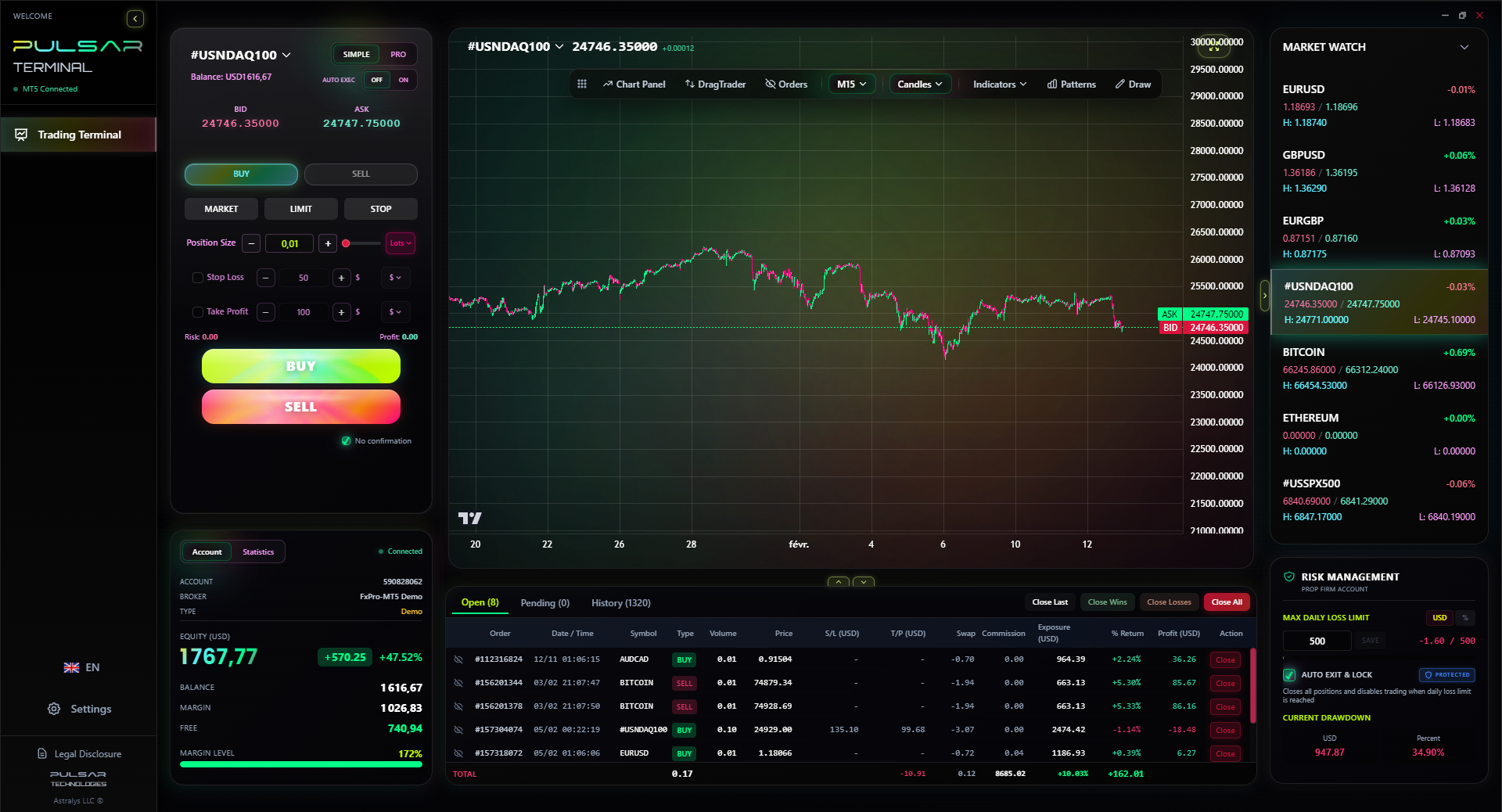
Managing the complex daily loss and drawdown rules of a prop firm challenge is stressful; Pulsar Terminal's prop firm daily loss protection feature can automate this and shut you down before you break a rule.
Pulsar Terminal
The all-in-one MT5 companion: drag-and-drop orders, multi-TP/SL, trailing stop, grid trading, Volume Profile, and prop firm protection. Used by 1,000+ traders daily.
The prop firm space has some fantastic companies and some absolute sharks. Here’s what should make you run for the hills.
- Guaranteed Funding: No legitimate firm guarantees funding. It's a skill test.
- Unrealistic Profit Splits: Anything advertising '100% profit split forever' is a major red flag. How do they make money?
- Vague or Constantly Changing Rules: If their terms of service are unclear or you hear stories of people failing on technicalities, stay away.
- No Verifiable Payout Proof: Look for real, recent payout screenshots from users on independent forums (not just the firm's website).
- Pressure to Buy 'Reset' or 'Extensions': Some shady firms design challenges to be nearly impossible to pass, then aggressively sell you $200 'resets' to try again. This is their real business model.
A firm's reputation is everything. Search '[Firm Name] + scam' or '[Firm Name] + payout review' on Google and trader forums. Look for consistent complaints. One or two disgruntled traders is normal; a pattern of people not getting paid is a deal-breaker.
For a Canadian, also check where the company is based and if they have any legal registration. While it doesn't guarantee safety, a firm registered in a country with some financial oversight (like the UK or Cyprus) is generally better than one registered in an opaque offshore jurisdiction.
💡 Winston's Tip
The market doesn't care about your drawdown limit. A firm's 10% rule is an artificial cliff. Always keep a 5% buffer from that edge, or a single volatile move in [EUR/USD](/en/guides/instruments/eurusd) will push you over.
“You're a contractor auditioning for a job, not a client making an investment. This changes everything.”
So, is Tradeify Prop Firm specifically a good idea? Without being able to audit their specific operations, I can't give a thumbs up or down. The model itself, however, is a legitimate and powerful tool for the right trader.
Here's my recommended, less-sexy strategy for a Canadian looking at prop firms:
- Build Your Foundation First: Trade your own capital, even if it's just $500. Learn real risk management. Get comfortable with the emotional rollercoaster. Use tools like the MACD indicator or RSI indicator within a solid plan.
- Choose an Established Firm for Your First Attempt: Go with a top-tier firm with a 5+ year history of payouts. Yes, their rules are tough, but you know they're real. You're paying for the legitimacy of the prize. Consider this your 'gold standard' test.
- Start Small: Buy their smallest, cheapest challenge. Your goal isn't to get funded on the first try (though that's great). Your goal is to learn the process, feel the pressure, and see if your strategy fits their framework. Losing a $99 fee is a cheap lesson. Losing a $999 fee is a stupid tax.
- Integrate Tools: If you get serious about these challenges, use technology to enforce rules. This is where a platform that can automate risk management becomes useful.
Prop firms aren't a shortcut. They are an amplifier. They will amplify your skills if you have them, and they will amplify your flaws and destroy your fee if you don't. Do the work on yourself first. The capital will follow.
FAQ
Q1Is Tradeify Prop Firm regulated in Canada?
No. Proprietary trading firms like Tradeify are not regulated by Canadian authorities like the CIRO in the same way brokers are. They operate as service businesses selling evaluations. This means you have less legal protection, so researching the firm's reputation is crucial.
Q2What is the best prop firm for Canadians?
There's no single 'best' firm. The most reputable firms with long track records include FTMO, The5%ers, and FundedNext. For a Canadian, the key factors are reliable USD payouts, clear rules, and a history of honoring payouts. Always start with the smallest challenge to test the process.
Q3How are prop firm payouts taxed in Canada?
The CRA treats profit shares from prop firms as self-employment or business income. You must report it on your tax return. The fee you paid for the evaluation can often be deducted as a business expense. Keep detailed records and consult an accountant.
Q4Can I use my normal trading strategy for a prop firm challenge?
Maybe, but you'll likely need to adapt it. The strict daily and overall drawdown limits (often 5%/10%) force extremely conservative risk management. A strategy that works for your personal swing trading might be too volatile. You must trade to avoid a margin call-style blowout from their rules.
Q5What happens if I fail a Tradeify challenge?
You lose your evaluation fee. Some firms offer a 'free retry' if you fail near the target, or sell 'reset' packages. Be wary of firms that heavily push resets, as it can indicate their model is designed for you to fail and pay again.
Q6Is trading with a prop firm riskier than using my own money?
It's a different kind of risk. With your own money at a broker, you risk your capital. With a prop firm, you risk your evaluation fee. However, the trading rules during the challenge are often much stricter, making the act of trading more psychologically challenging and prone to rule-based failure.
Prof. Winston's Lesson
Key Takeaways:
- ✓Treat your first evaluation fee as educational tuition, not an investment.
- ✓Always practice the challenge rules on a demo account three times first.
- ✓Strict drawdown limits (5%/10%) require sub-1% risk per trade.
- ✓Choose firms with multi-year payout histories over flashy new promises.
- ✓Prop firm profits are 100% taxable business income in Canada.
How useful was this article?
Click a star to rate
Weekly Trading Insights
Free weekly analysis & strategies. No spam.
About the Author
James Mitchell
Senior Trading Analyst
Based in New York with over 9 years of trading experience. Focuses on major USD pairs, prop firm challenges, and the US regulatory landscape.
Comments
Risk Disclaimer
Trading financial instruments carries significant risk and may not be suitable for all investors. Past performance does not guarantee future results. This content is for educational purposes only and should not be considered investment advice. Always conduct your own research before trading.
You Might Also Like

Cara Trading Forex Sukses: 7 Prinsip dari Trader Profesional
Cara trading forex sukses dengan 7 prinsip trader pro: manajemen modal, disiplin, journal trading, backtest. Data nyata, bukan janji profit palsu.
Jam Trading Forex Terbaik untuk Trader Indonesia: Panduan Lengkap dengan Tabel Waktu
Panduan jam trading forex untuk trader Indonesia. Tabel 4 sesi dunia, jam emas 20:00-00:00, sesi mana yang harus dihindari. Data akurat + tips dari trader berpengalaman.
Top 5 Sàn Forex Uy Tín Nhất 2026: Review Jujur dari Trader Indonesia
Top 5 sàn forex uy tín 2026 untuk trader Indonesia. Review jujur: spread, deposit, withdraw, dukungan lokal. Exness, XM, IC Markets & lebih.
Get Pulsar Terminal
All these calculators are built into Pulsar Terminal with real-time data from your MT5 account. One-click position sizing, automatic risk management, and instant calculations.
Get Pulsar Terminal