


Here's a fact that might sting a bit: over 70% of retail forex traders lose money.

Olumide Adeyemi
West African Trading Pioneer ·  Nigeria
☕ 10 min read
What you'll learn:
- 1What Exactly Is a Forex Trading Channel?
- 2How to Draw Channels Correctly (This is Where Most People Mess Up)
- 3Practical Trading Strategies Within Channels
- 4Risk Management: The Nigerian Context
- 5Best Currency Pairs & Timeframes for Nigerian Traders
- 6Common Mistakes to Avoid (I've Made Them All)
- 7Legal & Broker Considerations in Nigeria
Here's a fact that might sting a bit: over 70% of retail forex traders lose money. I was part of that statistic for my first two years. The turning point? When I stopped chasing random setups and started consistently trading one simple, powerful structure: the price channel. In Nigeria, where market access and costs are unique, mastering trading channels forex can be your ticket out of that losing majority. It's not a magic bullet, but it's the closest thing to a reliable map in a chaotic market.
Forget the complex jargon. A trading channel is just a price highway. It's when the market moves between two roughly parallel lines - one acting as a ceiling (resistance), the other as a floor (support). Price bounces between them, creating a clear, tradable range.
There are two main types you'll live with:
Ascending Channel: The highway slopes up. Each successive high and low is higher than the last. This is a bullish trend, but within a controlled corridor. Think of it as a steady climb up a hill with guardrails.
Descending Channel: The highway slopes down. Lower highs and lower lows. It's a bearish trend, but again, price respects the boundaries. Like a controlled descent.
Horizontal/Ranging Channel: This is the classic 'sideways market'. The floor and ceiling are flat. Price chops around between them, offering clear buy-low, sell-high opportunities. This is where many Nigerian traders cut their teeth, especially on pairs like EUR/NGN or during quiet market hours.

Example: Let's say you draw a channel on GBP/USD. The top line is at 1.2850, the bottom at 1.2750. That's a 100-pip channel. If price hits 1.2750 and bounces, you've got a potential long entry with a clear stop-loss just below the channel line, maybe at 1.2730. Your profit target? The top of the channel at 1.2850. That's a clean 80-pip trade (after accounting for the 20-pip stop). Simple, visual, and it takes the guesswork out.
The beauty for us here is that channels work on any timeframe. Whether you're a scalper watching the 5-minute chart or a swing trader analyzing the daily, the principle is the same. It gives structure to the madness.
I'll be honest, my early channel trades were disasters. I'd force lines to fit my bias, connecting wicks that had no business being connected. The chart looked like a toddler's scribble. Here's the method that finally worked for me.
The Three-Point Rule
You need at least three touch points to confirm a channel. Two for the initial trend line, and a third to establish the parallel line.
For an ascending channel, find two clear, rising lows and connect them. That's your support line. Then, find at least one clear high that aligns with the trend, and draw a parallel line from it. That's your resistance. Price should respect that upper line on the next test for the channel to be valid.
Do the opposite for a descending channel: connect two lower highs, then draw a parallel line from a significant low.
Let the Market Draw It
Your job isn't to invent channels, it's to discover them. Don't start drawing until you can visually see the price bouncing between two invisible rails. The lines should confirm what you're already seeing, not create a new narrative. If you're bending the line to catch an outlier wick, you're wrong. Channels are about the body of the price action, not every single spike.
Timeframe Consistency
A channel on the 1-hour chart might be just noise on the 15-minute. Decide your trading style first. For scalping strategy, you'll be on lower timeframes. For swing trading, you need the daily or 4-hour. Draw your primary channel on your chosen timeframe, then use a lower one for precise entry. I made a costly mistake once entering a 'breakout' on the 15-minute chart, only to realize it was just a retest of the channel wall on the 4-hour. I was stopped out before the real move began.

💡 Winston's Tip
A channel isn't confirmed until the third touch. The first two points draw the road; the third touch proves the market agrees to drive on it. Trading before that third touch is speculation, not analysis.
“The goal of channel trading isn't to predict every turn; it's to identify a high-probability highway and wait for the market to offer you a toll-free entry.”
Okay, you've drawn a clean channel. Now what? Here are the two core plays, straight from my playbook.
Strategy 1: The Bounce Trade (The Bread and Butter)
This is about buying near support in an ascending or horizontal channel, and selling near resistance in a descending or horizontal channel.
- Entry: Don't jump in the moment price touches the line. Wait for confirmation - a bullish pin bar, a strong engulfing candle, or the candle closing inside the channel after touching the line. Patience here saves accounts.
- Stop-Loss: Place your stop just outside the channel. If you're buying at the ascending support line, your stop goes a few pips below it. This defines your risk clearly. If the channel breaks, your thesis is wrong. Get out.
- Take-Profit: Your first target is the opposite channel line. For a better risk-reward, consider taking partial profit there (say, 50% of your position) and letting the rest run with a trailing stop.
Strategy 2: The Breakout Trade (The Home Run)
Channels don't last forever. When price breaks decisively through one of the lines, it often signals a new, strong trend. This is where bigger profits live, but also bigger traps.
- The Trap (My $500 Lesson): The fakeout. Price spikes through the channel, you jump in, and it slams back inside, stopping you out. It happens all the time.
- The Right Way: Wait for the close. A 4-hour or daily candle closing outside the channel is a much stronger signal than an intra-candle spike. Then, look for a retest. Often, price will break out, then come back to kiss the backside of the broken channel line (now flipped from support to resistance, or vice-versa). That retest is your high-probability entry. Your stop goes on the other side of the retest.
Combine these with an oscillator like the RSI indicator for extra confluence. Buying at channel support when the RSI is oversold (below 30) adds fuel to the trade.
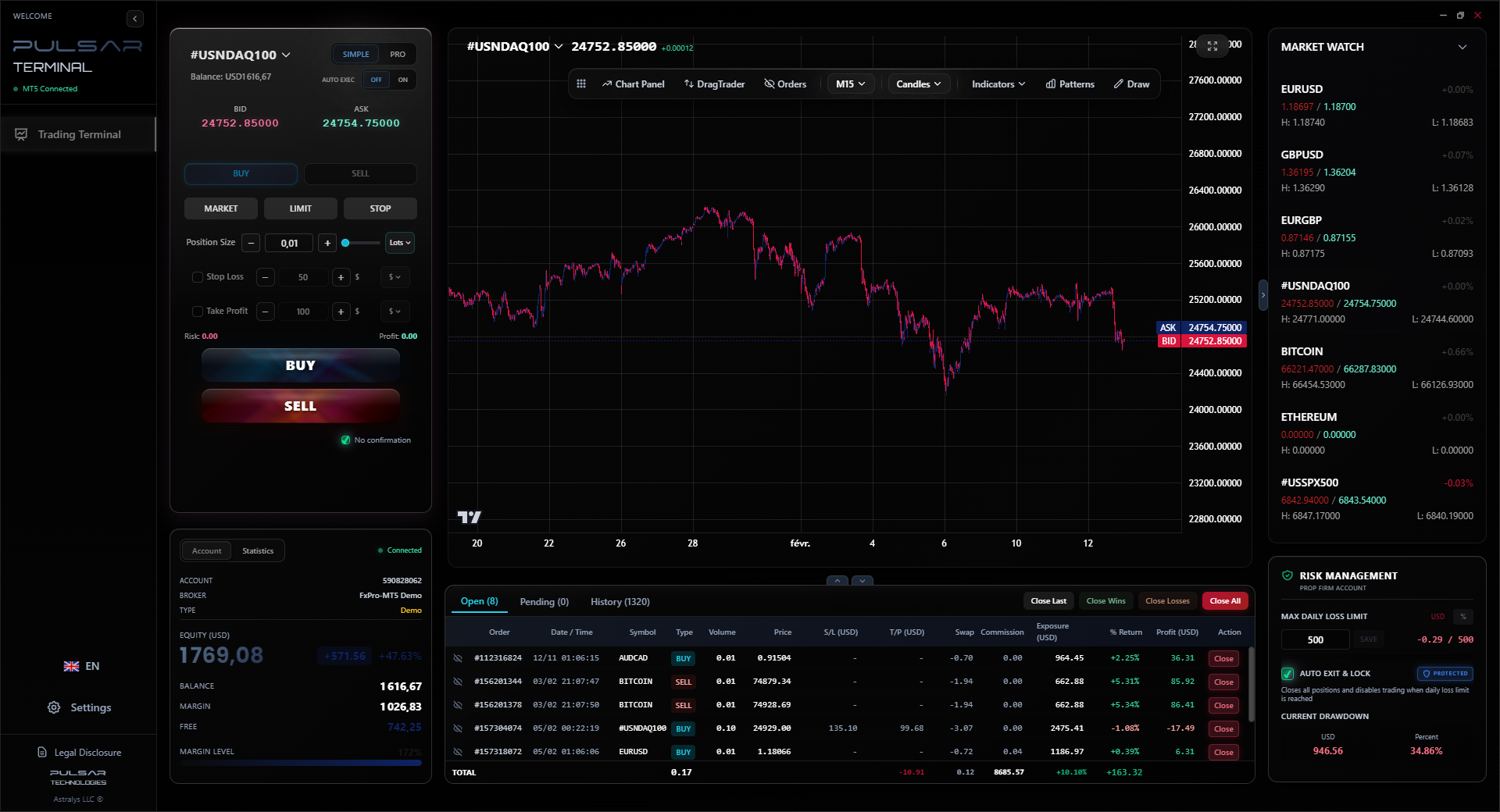
Managing multiple take-profit levels on a channel trade is key, and Pulsar Terminal lets you set them all with a simple drag-and-drop directly on your MT5 chart.
Pulsar Terminal
The all-in-one MT5 companion: drag-and-drop orders, multi-TP/SL, trailing stop, grid trading, Volume Profile, and prop firm protection. Used by 1,000+ traders daily.
This is non-negotiable. Trading channels forex without strict risk management is like driving in Lagos without brakes. Here’s how to apply it locally.
1. Position Sizing with Your Capital:
Starting with $100 because a broker like XM or Exness allows it? That's fine for learning, but be realistic. A single 20-pip stop-loss on a standard lot (0.01 is a micro lot) with $100 is a huge percentage of your account. That $500-$1000 starting capital range you hear about? It's not for showing off; it's for survival. It lets you take a 20-pip loss without it being a 10% account blow.
Always use a position size calculator. My rule: never risk more than 1-2% of my account on any single trade. On a $1,000 account, that's $10-$20 max risk per trade.
2. Accounting for Spreads & Slippage:
Your channel line might be at 1.0850, but if the spread on EUR/USD is 1.5 pips, your effective entry is worse. With brokers offering tight spreads like IC Markets (often 0.0 pips on majors) or Pepperstone, you keep more of your profit. Factor the spread into your stop-loss distance. If your stop is 10 pips away, but the spread is 2 pips, you're really only giving the trade 8 pips of room. Widen your stop accordingly.
3. The use Trap:
Yes, brokers here offer crazy use like 1:1000 or 1:2000. It's a tool, not a target. Using high use on a channel trade magnifies both profits AND losses. A small move against you can trigger a margin call faster than you can say "God abeg." I never use more than 1:50 use on channel trades, especially in a ranging market. The goal is steady growth, not a lottery ticket.
4. The Tax Man Cometh:
Remember, profits are taxable. The 10% Capital Gains Tax applies to your gross profits. Keep detailed records. It turns a 10% trading gain into a 9% net gain. Factor that into your overall profit targets.
💡 Winston's Tip
Your most important profit in channel trading isn't the money you make on a winning bounce trade. It's the money you *save* by not taking a low-probability trade in a messy, ill-defined range. Patience is a position.
“In Nigeria, your 1 PM - 6 PM WAT trading window is a gift of liquidity. Use it to find the cleanest channels on the board.”
Not all pairs channel well, and our timezone (WAT) gives us a unique advantage.
Best Pairs for Channel Trading:
- EUR/USD: The king. High liquidity, tight spreads, and it often moves in beautiful, clean channels. It's my go-to for practicing channel analysis. Check our deep dive on the EUR/USD guide for more.
- GBP/USD: Tends to have stronger, more sustained trends. When it channels, the moves can be powerful.
- XAU/USD (Gold): Surprisingly excellent for channel trading, especially on higher timeframes. It respects technical levels fiercely. Learn its quirks in our XAU/USD guide.
- USD/NGN? Be very careful. The CBN's official window is restricted, and the parallel market price (which you might see on some platforms) can be illiquid and prone to massive gaps. It's not for the faint-hearted or for clean channel strategies.
The Nigerian Timezone Advantage:
Our golden hours are 1:00 PM to 6:00 PM WAT. Why? That's when the London session is in full swing and the New York session opens. Overlap = higher volume = cleaner price action and better channel development. The market is less likely to be manipulated by weird, thin-volume spikes. Schedule your analysis and live trading around this window whenever you can. The channels you see forming at 2 PM WAT are far more reliable than the choppy mess at 4 AM.
Let me save you some money and heartache.
1. Over-trading the Channel: Just because price is in a channel doesn't mean you trade every single touch. Wait for quality setups with candle confirmation. I used to fade every touch and got chopped up by minor volatility.
2. Ignoring the Higher Timeframe Trend: A bullish channel on the 1-hour chart inside a massive bearish channel on the daily is a dangerous place to be buying. Always zoom out. The higher timeframe trend usually wins.
3. Not Adjusting Channels: Channels aren't static. As new price action develops, you may need to redraw or adjust the angle of your lines slightly. Be flexible. The channel is your servant, not your master.
4. Chasing Breakouts: This was my biggest leak. Seeing a strong breakout candle and FOMO-ing in at the worst possible price. Wait for the close. Wait for the retest. The market will give you a second chance 80% of the time.
5. Using Channels in Isolation: A channel is a fantastic tool, but it's even better with friends. Look for confluence with key Fibonacci levels, previous support/resistance, or a divergence on the MACD indicator. The more reasons the market has to respect that line, the better your odds.
💡 Winston's Tip
If you find yourself constantly redrawing your channel lines to fit new price action, the market isn't in a channel. It's in a different phase. Put the pen down and wait. The clearest channels announce themselves.
“A broken channel isn't a failure of your analysis; it's a signal to change your strategy. The best traders adapt when the market rewrites the rules.”
Trading is legal, but you have to be smart about it.
Regulation is Key: The SEC Nigeria warns against unregulated platforms. Your broker should be regulated by a reputable international body like the UK's FCA, Cyprus's CySEC, or Australia's ASIC. This protects your funds. Brokers like AvaTrade or XTB are heavily regulated across multiple jurisdictions, which is a good sign.
Funding Your Account: The CBN restricts using the official forex window for trading. So how do you fund? You'll use international payment methods via your broker: credit/debit cards (Visa/Mastercard), bank wire, or e-wallets like Skrill, Neteller, or Sticpay. They convert your Naira at the prevailing market rate. It's straightforward, but be aware of any fees your bank or the processor might charge.
Choosing a Broker: Look beyond just use. For channel trading, you want:
- Tight Spreads: Every pip counts. IC Markets and similar ECN brokers are famous for this.
- Reliable Execution: No requotes or massive slippage on your channel breakout entries.
- Good Platform: MT4/MT5 is the standard. They have the best drawing tools for channels.
- Local Support: Does the broker have a Nigerian office or support line? It helps.
Start with a demo account. Draw channels, practice your entries and exits. When you can consistently profit on demo for a few months, then go live with a small amount. This journey is a marathon for the disciplined, not a sprint for the greedy.
FAQ
Q1Is forex trading legal in Nigeria?
Yes, forex trading is legal for individuals in Nigeria. It's regulated by the Securities and Exchange Commission (SEC) Nigeria. However, the Central Bank of Nigeria (CBN) restricts using the official foreign exchange window to fund trading accounts. You'll fund your international broker account using cards or e-wallets.
Q2What is the best timeframe for trading channels?
There's no single 'best' timeframe. It depends on your personality. For active traders, 1-hour and 4-hour charts offer a great balance between signal clarity and trade frequency. Swing traders should focus on daily and weekly channels. Always analyze from the higher timeframe down to your trading timeframe for context.
Q3How much money do I need to start trading channels in Nigeria?
While some brokers allow you to start with as little as $10, I strongly advise against it. With that little, proper risk management is impossible. A more realistic and sustainable starting point is between $500 and $1000. This allows you to trade sensible position sizes and absorb a few losses without blowing your account.
Q4Do I pay tax on my forex trading profits in Nigeria?
Yes. Nigerian forex traders are subject to a 10% Capital Gains Tax on gross profits. It's your responsibility to declare this income and pay the tax. Keep detailed records of all your trades for tax purposes.
Q5What's the difference between a channel and a trend line?
A trend line connects a series of highs or lows in one direction. A channel uses two parallel trend lines - one connecting highs and one connecting lows - to show both support and resistance within a trend. A channel gives you a defined range to trade within, while a single trend line only shows one boundary.
Q6Why do my channel trades keep getting stopped out?
This is common. First, check if you're drawing the channel correctly (using bodies, not wicks). Second, you might be entering too early without candle confirmation. Third, your stop-loss might be too tight; place it just outside the channel, not right on the line. Finally, the market might be transitioning from a channeling phase to a trending phase, which requires a different strategy.
Prof. Winston's Lesson
Key Takeaways:
- ✓Use the 3-point rule to confirm a channel.
- ✓Risk a maximum of 1-2% per trade.
- ✓Trade the London-NY overlap (1-6 PM WAT).
- ✓Wait for candle confirmation, not just a touch.
- ✓A clean channel beats a complex indicator every time.
How useful was this article?
Click a star to rate
Weekly Trading Insights
Free weekly analysis & strategies. No spam.
About the Author
Olumide Adeyemi
West African Trading Pioneer
One of Nigeria's most active forex trading educators. 8 years of experience trading from Lagos. Specializes in low-capital strategies and prop firm challenges for African traders.
Comments
Risk Disclaimer
Trading financial instruments carries significant risk and may not be suitable for all investors. Past performance does not guarantee future results. This content is for educational purposes only and should not be considered investment advice. Always conduct your own research before trading.
You Might Also Like

Cara Trading Forex Sukses: 7 Prinsip dari Trader Profesional
Cara trading forex sukses dengan 7 prinsip trader pro: manajemen modal, disiplin, journal trading, backtest. Data nyata, bukan janji profit palsu.
Jam Trading Forex Terbaik untuk Trader Indonesia: Panduan Lengkap dengan Tabel Waktu
Panduan jam trading forex untuk trader Indonesia. Tabel 4 sesi dunia, jam emas 20:00-00:00, sesi mana yang harus dihindari. Data akurat + tips dari trader berpengalaman.
Top 5 Sàn Forex Uy Tín Nhất 2026: Review Jujur dari Trader Indonesia
Top 5 sàn forex uy tín 2026 untuk trader Indonesia. Review jujur: spread, deposit, withdraw, dukungan lokal. Exness, XM, IC Markets & lebih.
Get Pulsar Terminal
All these calculators are built into Pulsar Terminal with real-time data from your MT5 account. One-click position sizing, automatic risk management, and instant calculations.
Get Pulsar Terminal