


Most Nigerian traders get the trading sessions in forex completely wrong.

Olumide Adeyemi
West African Trading Pioneer ·  Nigeria
☕ 11 min read
What you'll learn:
Most Nigerian traders get the trading sessions in forex completely wrong. They think it's just about knowing when London opens, but that's only 20% of the story. The real edge comes from understanding liquidity flows, session overlaps, and how our unique timezone in West Africa (WAT) positions us perfectly for the market's most volatile hours. I learned this the hard way, blowing up two accounts by trading the wrong pairs at the wrong times. In this guide, I'll show you exactly how to structure your day around the global clock, not just to survive, but to consistently profit.
The first thing you need to get into your head is that the forex market is a 24-hour relay race. When one major financial center closes, another opens. This creates a continuous price feed from Sunday evening to Friday night, WAT. It's tempting, especially when you're starting out, to think you need to be glued to the screen all day to catch every move. I made that mistake. I'd stay up trying to trade the Sydney session, only to be exhausted and make stupid decisions when London opened - the session that actually mattered for my strategy.
The four main sessions are Sydney, Tokyo, London, and New York. Each has its own personality, driven by the banks, corporations, and funds operating in that region. For us in Nigeria, our West Africa Time (GMT+1) is the secret weapon. We're perfectly positioned to catch the tail end of Asia, the full London session, and the opening of New York without pulling all-nighters.

Warning: Trading all sessions is a direct path to burnout and blown accounts. You must pick your battles. The market will always be there; your capital won't be if you try to fight every session.
Your goal isn't to trade every session. It's to identify which 3-4 hour window aligns with your personality, strategy, and the pairs you understand best. For most Nigerian traders, that golden window is from 1:00 PM to 6:00 PM WAT. That's not a coincidence; it's when the big money moves.

💡 Winston's Tip
Your most valuable trading tool is a clock. If your strategy isn't working, check the time. You're probably trading against the session's character.
Let's get specific. Each session isn't just a time on the clock; it's a different market environment. Trading the Yen during London is a different beast from trading it during Tokyo.
The Sydney/Tokyo Session (Asian Session)
WAT Time: 11:00 PM – 8:00 AM (approx.) This is where the trading day technically begins. Liquidity is thinner, and ranges are often narrower. The stars here are the Asian currency pairs: AUD/USD, NZD/USD, and USD/JPY. I used to ignore this session, thinking it was too slow. Then I developed a simple range-bound strategy for AUD/USD that worked beautifully in the early Tokyo hours before London woke up. The key is patience; big, trending moves are less common.
The London Session (European Session)
WAT Time: 8:00 AM – 5:00 PM (approx.) This is the heavyweight. London is the world's largest forex trading hub. Volume spikes, spreads tighten, and serious trends can begin. This is the session for the major pairs: EUR/USD, GBP/USD, and EUR/GBP. My most consistent profits have come from the first two hours after the London open (8:00 AM - 10:00 AM WAT). Institutional orders flood the market, creating clear directional moves. If you're only going to trade one session, make it this one. A deep understanding of the EUR/USD guide is non-negotiable here.
The New York Session (US Session)
WAT Time: 1:00 PM – 10:00 PM (approx.) New York brings another wave of liquidity. The first hour often reacts to London's closing flows and US economic data releases. Pairs like USD/CAD, GBP/USD (again), and USD/CHF get active. This is where I learned a painful lesson about news trading. I once entered a USD/CAD trade right before a major Canadian jobs report, thinking I was clever. The spread widened from 1.5 pips to over 25 pips in a second, and I was stopped out before the price even moved in my intended direction. Know the economic calendar.
The Pacific Session
WAT Time: 10:00 PM – 11:00 PM (approx.) A brief overlap between New York's close and Sydney's open. It's quiet. Honestly, for retail traders in Nigeria, this is time off. Use it to analyze, plan for tomorrow, and sleep.
“The London-New York overlap isn't just a time on the clock; it's a different, more liquid, and more violent market.”
This is the single most important concept for Nigerian traders. The London-New York overlap, from about 1:00 PM to 5:00 PM WAT, is pure trading gold. Think about it: two of the world's biggest financial centers are fully online at the same time. What does this mean for you?
- Liquidity is at its peak. More buyers and sellers mean your orders get filled quickly and at the price you expect. Slippage is minimized.
- Volatility increases. Big money is moving, creating stronger, more reliable trends. This is where a good swing trading setup can really pay off.
- Spreads are often at their tightest. Brokers compete for business during this high-volume period. You might see the spread definition on EUR/USD drop to 0.6 pips or even lower on a good ECN account like those offered by IC Markets review or Pepperstone review.
My personal routine? I'm at my desk by 12:30 PM WAT. I review my charts, set alerts, and wait for the New York open at 1:00 PM. The first 90 minutes are often chaotic but rich with opportunity. I remember a specific trade on GBP/USD. London had pushed it down, and at 1:15 PM WAT, New York came in and bought the dip aggressively. I caught a 120-pip ride in under three hours. That trade didn't happen at 4 AM. It happened squarely in our prime time.

Pro Tip: Don't just trade blindly during the overlap. The highest volatility often leads to the sharpest reversals. Use a lower timeframe (like the 15-minute) to find entry points in the direction of the larger trend established by the London session.
Trying to scalp during the quiet Sydney session is like trying to surf on a calm lake. You need to match your tools to the environment.
| Your Strategy | Best Session(s) | Why |
|---|---|---|
| Scalping | London-New York Overlap | You need tight spreads and fast moves to capture 5-10 pips repeatedly. The liquidity here is perfect. Check out a dedicated scalping strategy built for these conditions. |
| Swing Trading | London Open or NY Open | You're looking for the initial momentum burst from a new session to carry a trade for days. The directional conviction at these opens provides cleaner trends. |
| News Trading | 30 mins before/after Major US or EU Data (During their session) | This is high-risk. You need a broker with reliable execution during news spikes. The volatility is there, but so is the danger of slippage. |
| Range Trading | Late Tokyo / Early London | When markets are consolidating, the quieter periods offer clearer range boundaries. Pairs like AUD/USD often range before London kicks in. |
I'm primarily a swing trader. My toolbox for the London open is simple: a higher timeframe trend filter (like the 4-hour chart) and a momentum indicator like the MACD indicator on the 1-hour to time my entry. During the overlap, I might use the RSI indicator on a 15-minute chart to find short-term overbought/oversold conditions within the larger trend. The session dictates the tools.
💡 Winston's Tip
The 10% tax isn't a suggestion. Calculate it into your take-profit level before you enter the trade. Trade the net profit, not the gross.
“Trying to trade every session is the surest sign you don't have an edge in any of them.”
Let's be brutally honest. Our geography is an advantage, but our habits can screw it up.
Mistake 1: Trading the Wrong Pairs in a Session. Trying to force movement out of EUR/USD during the Tokyo session is a recipe for frustration. I did it, watching paint dry for hours, only to get whipsawed by a tiny 10-pip move. If you're up early, trade the Asian proxies. Save the Euro for when Europe is awake.
Mistake 2: Ignoring Session Transitions. The market doesn't flip a switch. The handoff from Tokyo to London can be messy. I used to enter trades right at 8:00 AM WAT, thinking the "London trend" would start immediately. Sometimes it does, sometimes London traders fade the Asian move. Now, I wait 60-90 minutes for the session to establish its character. Let the institutional orders define the direction first.
Mistake 3: Overtrading the Overlap. Just because there are more moves doesn't mean you should take all of them. The 1:00 PM - 6:00 PM WAT window can feel like a candy store. I'd take a good GBP/USD trade, then immediately jump into a USD/CAD trade, then see a move in Gold. My focus was scattered, and my risk was multiplied. Now, I define my one best idea for the day during my morning prep. I trade it. If it hits my target quickly, I'm done. I don't hunt for a second helping. Greed is amplified during high volatility.
Mistake 4: Not Accounting for the 10% Tax. This is a Nigerian-specific killer. That amazing 150-pip trade? Remember, 10% of your gross profit goes to the FIRS. It changes your risk-reward math. A 2:1 reward-to-risk trade effectively becomes a 1.8:1 after tax. You must factor this into your position size calculator. Not doing so is trading with an invisible leak in your account.
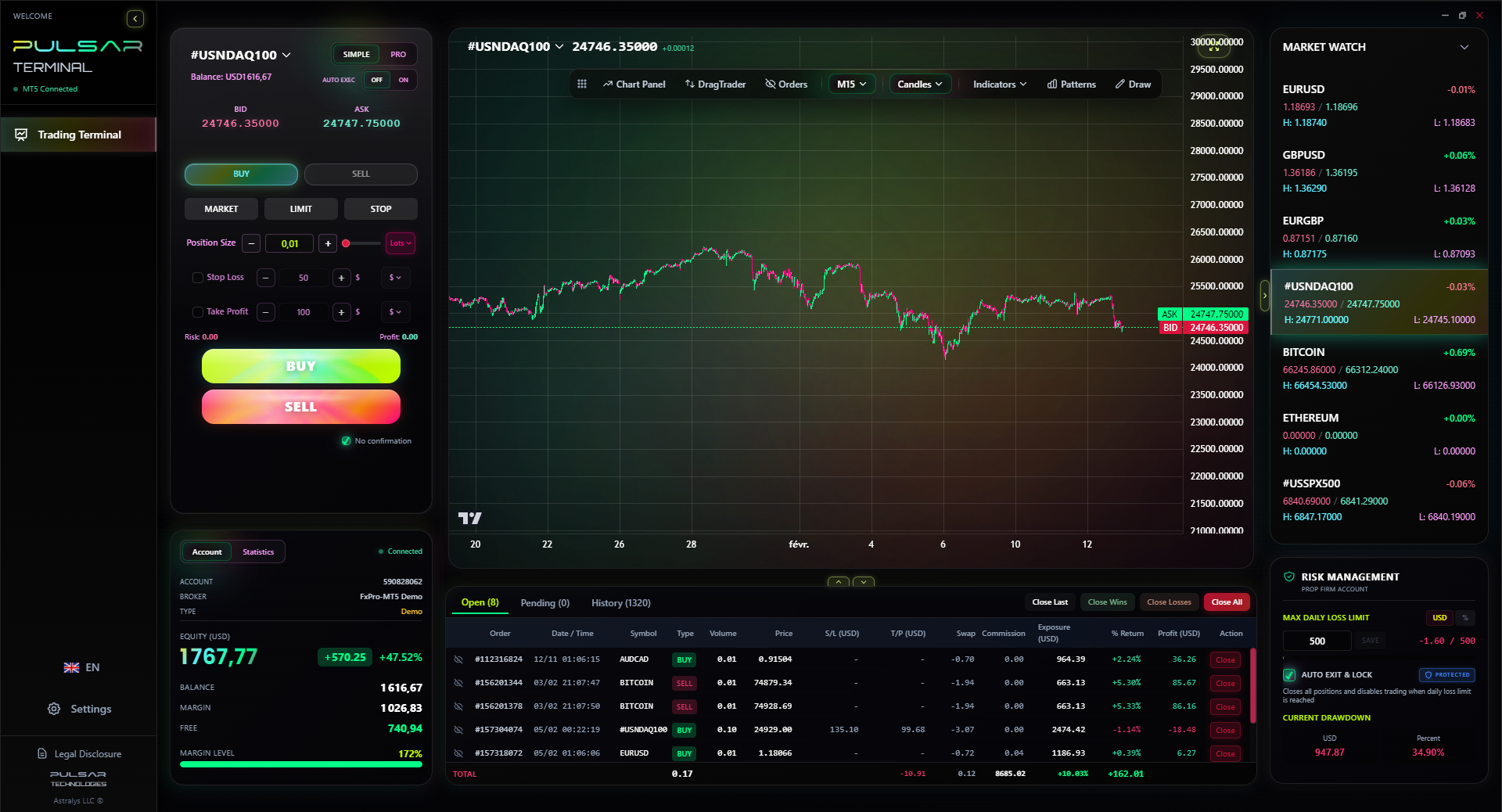
Managing multiple trades across volatile sessions is complex, but tools like Pulsar Terminal let you set multi-level take-profits and trailing stops on MT5 automatically, so you can focus on analysis, not order management.
Pulsar Terminal
The all-in-one MT5 companion: drag-and-drop orders, multi-TP/SL, trailing stop, grid trading, Volume Profile, and prop firm protection. Used by 1,000+ traders daily.
Here’s a sample framework based on a full-time job (because let's be real, most of us start here). This is similar to the schedule that finally brought me consistency.
Pre-Market (7:00 AM - 8:00 AM WAT):
- Wake up. Check the closing prices from New York's last few hours. Any major breaks?
- Scan the economic calendar. What’s due today? High-impact news at 1:30 PM WAT (US data) is a big deal.
- Do a quick scan of the 4-hour charts on my 3-4 favorite pairs. Identify key support/resistance levels.
London Session (8:00 AM - 1:00 PM WAT):
- If you have a flexible job or trade before work, this is your window. Focus on the initial London momentum (8-10 AM).
- Set potential entry alerts on your phone. Don't stare at charts if you can't trade.
- My old 9-5? I’d have a buy stop above resistance and a sell stop below support set before leaving home. Let the market take me in.
The Golden Overlap (1:00 PM - 5:00 PM WAT):
- This is your core trading time. Be prepared.
- 1:00 PM - 2:30 PM: Highly active. Manage existing trades or look for new entries fueled by New York participation.
- 2:30 PM onwards: Trends often consolidate or continue. Look for secondary entries or prepare to manage closes.
Review & Plan (5:00 PM - 6:00 PM WAT):
- Close out any day trades. Don't hold scalps overnight unless they’ve turned into swings.
- Journal your trades. What session was it? What was the liquidity like?
- Mark up your charts for tomorrow’s key levels.
Evening (10:00 PM WAT onwards):
- Optional. Only check if you’re holding swing positions. Maybe glance at the Sydney open. Otherwise, disconnect. Your brain needs to reset for tomorrow’s London open.
💡 Winston's Tip
The first 90 minutes of a new session are for watching. Let the big banks show their hand. Your job is to follow, not lead, the initial move.
“In Nigeria, your trading day doesn't start when you wake up. It starts when London opens.”
Your strategy is only as good as your connection to the market. For session trading, two things are critical: a reliable broker and a clear understanding of costs.
Choosing a Broker: You need a broker with solid execution during high volatility. During the London-NY overlap, requotes or slippage can kill a good trade. I’ve had good experiences with brokers that offer raw spread accounts for this very reason. Exness review and IC Markets review provide that raw market access, which is crucial when every pip counts. Also, ensure they are properly licensed. The CBN is clear: don't use unlicensed brokers. It protects you from outright fraud.
Understanding the Real Cost: That "0.0 pip spread" account isn't free. You pay a commission per lot. The "commission-free" account has a wider markup. You need to do the math for your trading style. As a scalper taking 10 trades a day? The raw spread + commission model is almost always cheaper. As a swing trader taking 2 trades a week? The wider spread might be simpler. Always know your total cost per pip definition.
The Tax Man: Set aside 10% of every single withdrawal for the FIRS. Create a separate savings pot for it. Do not commingle these funds. The moment you think you can "trade your way out of the tax bill," you've introduced a dangerous, emotional variable into your system.
Finally, consider a trading journal that tracks not just your P&L, but the session you traded in. Over time, you'll see clear patterns. You'll discover, as I did, that your win rate on EUR/USD trades taken between 8:30-9:30 AM WAT is 20% higher than those taken after 3:00 PM. That's actionable, session-specific intelligence.
FAQ
Q1What is the best trading session for beginners in Nigeria?
The London session (starting 8:00 AM WAT) is the best for beginners. It has high liquidity, clearer trends, and plenty of educational material focuses on it. Avoid the volatile overlap until you're comfortable with basic order execution and risk management.
Q2I have a 9-5 job in Lagos. Can I still trade forex?
Absolutely. Your prime time is the London-New York overlap from 1:00 PM WAT. Use your lunch break and the late afternoon to manage trades. Focus on swing trading or end-of-day setups, not scalping. Prep your charts in the morning (7-8 AM WAT) and set entry alerts so you're not chained to the screen.
Q3Do I pay tax on forex trading profits in Nigeria?
Yes. The Federal Inland Revenue Service (FIRS) requires a 10% Capital Gains Tax on your gross trading profits. This is a legal obligation. Factor this cost into your profit targets and risk calculations from day one.
Q4Is it safe to trade with international brokers as a Nigerian?
It can be, but you must do your due diligence. The CBN advises using licensed entities. Many top international brokers (like IC Markets, Pepperstone) are regulated by reputable authorities (ASIC, FCA). This is often safer than an unregulated "local" platform. Always check their regulatory status and client fund protection policies.
Q5What is the minimum amount I need to start trading forex in Nigeria?
While some brokers allow you to start with as little as $1 or ₦2,000, I strongly advise against it. With such a small amount, proper risk management is impossible. A realistic minimum to apply concepts like 1% risk per trade is between $500 and $1000. This allows you to survive the learning curve without being wiped out by a few losses.
Q6Why is the 1:00 PM - 6:00 PM WAT period so important?
This is when the London and New York trading sessions overlap. Two major financial centers are fully active, creating the highest liquidity and volatility of the day. This means tighter spreads, faster execution, and stronger, more reliable price trends - ideal conditions for active trading.
Q7Can I trade Gold (XAU/USD) during any session?
Gold trades 24 hours, but it's most active and directional during the London and New York sessions, just like major currencies. It often reacts strongly to US dollar news and real interest rates. For a deeper look, study a dedicated XAU/USD guide to understand its unique drivers.
Prof. Winston's Lesson
Key Takeaways:
- ✓Trade the London-NY overlap (1-5 PM WAT) for maximum liquidity.
- ✓Never trade a major pair during its regional off-hours.
- ✓Always deduct 10% FIRS tax from gross profits for real P&L.
- ✓Match your strategy (scalp/swing) to the appropriate session volatility.
How useful was this article?
Click a star to rate
Weekly Trading Insights
Free weekly analysis & strategies. No spam.
About the Author
Olumide Adeyemi
West African Trading Pioneer
One of Nigeria's most active forex trading educators. 8 years of experience trading from Lagos. Specializes in low-capital strategies and prop firm challenges for African traders.
Comments
Risk Disclaimer
Trading financial instruments carries significant risk and may not be suitable for all investors. Past performance does not guarantee future results. This content is for educational purposes only and should not be considered investment advice. Always conduct your own research before trading.
You Might Also Like

Cara Trading Forex Sukses: 7 Prinsip dari Trader Profesional
Cara trading forex sukses dengan 7 prinsip trader pro: manajemen modal, disiplin, journal trading, backtest. Data nyata, bukan janji profit palsu.
Jam Trading Forex Terbaik untuk Trader Indonesia: Panduan Lengkap dengan Tabel Waktu
Panduan jam trading forex untuk trader Indonesia. Tabel 4 sesi dunia, jam emas 20:00-00:00, sesi mana yang harus dihindari. Data akurat + tips dari trader berpengalaman.
Top 5 Sàn Forex Uy Tín Nhất 2026: Review Jujur dari Trader Indonesia
Top 5 sàn forex uy tín 2026 untuk trader Indonesia. Review jujur: spread, deposit, withdraw, dukungan lokal. Exness, XM, IC Markets & lebih.
Get Pulsar Terminal
All these calculators are built into Pulsar Terminal with real-time data from your MT5 account. One-click position sizing, automatic risk management, and instant calculations.
Get Pulsar Terminal