


Here's a statistic that should make you sit up: the South African forex market hit nearly $21.4 billion in daily volume in April 2025.

David van der Merwe
Emerging Markets Trader ·  South Africa
☕ 13 min read
What you'll learn:
- 1What Actually Makes a Pair 'Trend'? (Hint: It's Not Hype)
- 2The Top Trending Forex Pairs for South African Traders
- 3How to Spot a Trend Before Everyone Else Does
- 4Trading Strategies Built for Trends
- 5The South African Broker Reality Check
- 6Local Risks & Regulations You Can't Ignore
- 7The Top Mistakes SA Traders Make with Trends
- 8Putting It All Together: Your Weekly Trending Pairs Routine
Here's a statistic that should make you sit up: the South African forex market hit nearly $21.4 billion in daily volume in April 2025. That's not just big for Africa, it's a serious global player. Yet most local traders are still chasing the same old pairs with the same old losing strategies. Trading trending forex pairs isn't about following the herd on social media. It's about spotting the institutional money flow early, getting on board, and riding it until the wheels fall off. I've made my biggest wins and most painful losses on trends. Let's talk about how to do it right from right here in SA.
First, let's kill a myth. A trending pair isn't just one that's moving. Every pair moves. A true trend has conviction behind it - sustained directional movement driven by a fundamental story that the big banks and funds believe in. For us in South Africa, this means understanding two things: global macro and local ZAR dynamics.
A trend typically shows higher highs and higher lows in an uptrend, or lower highs and lower lows in a downtrend, over weeks or months. The key is the 'why.' Is the US Fed hiking while the SARB is cutting? That's a fundamental driver for USD/ZAR. Are commodity prices soaring? That's another. I got caught short on USD/ZAR in early 2024, thinking R18.50 was a peak. I ignored the building narrative around SA's political uncertainty and rising US yields. That mistake cost me R12,000 in a week. The trend, fueled by that fundamental divergence, didn't care about my technical analysis.

Warning: Don't confuse a short-term spike with a trend. A 200-pip move in a day on news is volatility. A consistent 30-50 pip drift in one direction daily for two weeks is a trend setting up. Learn the difference.
Your first tool should be the higher timeframes. Check the weekly and daily charts before you even glance at the 1-hour. If the weekly chart is a mess of choppy price action, there's no clear trend to trade. Wait for it. Patience here saves capital.

💡 Winston's Tip
A trend on the daily chart is a river current. Trading against it is like swimming upstream. You might make progress for a moment, but you'll exhaust yourself and drown. Always know which way the river is flowing.
We have a unique vantage point. We can trade the global majors with everyone else, but we also have a front-row seat to the ZAR's drama. Your watchlist should be split.
The Home Game: USD/ZAR & Other ZAR Crosses
USD/ZAR is our main event. It's liquid, volatile, and tells the story of SA's economy. It trends beautifully when there's a clear divergence: US interest rates up, SA rates down; global risk-off sentiment; or wild swings in gold/platinum prices. I once rode a long USD/ZAR trend from R17.20 to R18.80 over three months in 2023. The driver? A relentless hawkish Fed versus a SARB hesitant to hike as aggressively. The trend gave multiple pullback entries. Pairs like EUR/ZAR and GBP/ZAR can also trend strongly, but mind the liquidity - spreads can widen.
The Global Majors: Your Bread and Butter
EUR/USD is the most traded pair for a reason. It trends on policy divergence between the ECB and the Fed. When it gets moving, it can run for hundreds of pips. It accounts for about 24% of all daily forex volume, meaning you can get in and out easily. GBP/USD is another fantastic trending pair, though it can be spikier ("Cable whiplash" is a real thing). USD/JPY trends almost exclusively on interest rate differentials and is a favorite for carry trades.

Example: Trading EUR/USD during the London-New York overlap (3-7 PM SAST) is ideal. The average true range (ATR) expands, and if a trend is in place, you'll often see the cleanest moves. A 50-pip daily move is common in a strong trend.
Don't ignore AUD/USD and USD/CAD (the "commodity dollars"). Their trends are often tied to China's economy and oil prices, respectively. A strong, sustained uptrend in iron ore can make AUD/USD a one-way street for weeks. For a deeper look at trading gold, which often moves inversely to the USD, check out our XAU/USD guide.
“I got caught short on USD/ZAR in early 2024, thinking R18.50 was a peak. That mistake cost me R12,000 in a week.”
This is the art. You want to be early, but not too early. Here’s my practical checklist, honed from getting it wrong more times than I'd like to admit.
- Fundamental Catalyst: What's the story? Is it a central bank pivot (the biggest trend creator)? Political upheaval (like our 2024 elections)? A sustained shift in commodity prices? If you can't articulate the 'why' in one sentence, it's not a trend, it's noise.
- Price Structure: Switch to the daily chart. Are pullbacks shallow and do they find support/resistance at obvious levels (like a 50-period moving average)? In a healthy uptrend, price should kiss the MA and bounce, not slice through it.
- Volume & Momentum Confirmation: I use the MACD indicator on the daily. I'm not looking for the crossover signal everyone waits for - that's late. I'm looking for the histogram to be consistently above the zero line and making higher highs alongside price. That shows strengthening momentum. The RSI indicator can help too, but ignore overbought/oversold in a strong trend. It can stay extreme for a long time.
My biggest win last year came from GBP/USD. The daily chart showed a series of higher lows after a major support hold. The MACD histogram was ticking up from zero, and the Bank of England was sounding more hawkish than expected. I bought on a retest of the prior high (now support) at 1.2650. The trend ran to 1.3150. That's 500 pips. The entry wasn't at the absolute bottom, but it was in the safe, confirmed early phase of the trend.

Pro Tip: Create a 'Trend Strength' dashboard. Have one chart window with Daily, 4H, and 1H timeframes of the same pair. Only trade in the direction where all three are aligned (e.g., all showing higher highs/lows). This filters out 90% of chop.
Once you've identified a trending forex pair, you need a plan to exploit it. Scalping a trending market is a great way to get stopped out. You need strategies with room to breathe.
The Pullback Trade (My Go-To): This is about buying dips in an uptrend or selling rallies in a downtrend. Wait for price to retrace to a key level - a moving average (like the 20 or 50 EMA), a previous resistance-turned-support, or a Fibonacci level (38.2% or 50% are my favorites). Place your entry there with a stop loss just below the recent swing low (for a long). Your risk is clearly defined. This is classic swing trading.
The Breakout & Retest: When price finally breaks a key consolidation range after building energy, it often rockets. The trick is not to chase. Wait for it to break, then pull back to retest the other side of that broken level. If it holds, that's your entry. For example, if USD/ZAR breaks above R18.00 and holds for a day, then pulls back to R17.95, that's your long signal. Your stop goes below R17.90.
Position Sizing is Non-Negotiable: A trend trade needs a wider stop. If your usual stop is 10 pips for a scalp, a trend trade might need 50-80 pips. So, you must reduce your lot size proportionally. Never risk more than 1-2% of your account on a single trade. I use a simple position size calculator before every entry. In 2022, I didn't do this on a EUR/USD trend trade. My stop was 60 pips, but I used my usual scalp lot size. A fake breakout took me out for a 3% loss - three times my limit. It hurt.
Managing the trade is key. Use a trailing stop to lock in profits as the trend runs. And for heaven's sake, take partial profits. If you have a 2-lot position, close 1 lot at a 1:1 risk-reward ratio, move your stop to breakeven on the remainder, and let the second lot run. This takes the psychology out of it.
💡 Winston's Tip
The first pullback in a new trend is often the most reliable. It's when the early profit-takers exit and the smart money adds to their position. That's your invitation to join the party.
“Your job isn't to trade every day. Your job is to wait for your high-probability setup in a confirmed trending forex pair.”
You can have the best strategy in the world, but if your broker is ripping you off with huge spreads on ZAR pairs or freezing platforms during volatility, you're dead. Let's talk real numbers for SA traders.
The FSCA caps use at 30:1 for retail clients, which is a good thing. It stops you from blowing up in minutes. But you need to understand the real costs.
| Broker Feature | What to Look For | Why It Matters for Trending Pairs |
|---|---|---|
| Spreads on USD/ZAR | Under 50 pips during London/NY hours. | A 100-pip spread means you're down 100 pips before you start. It kills your risk-reward. |
| Execution Type | True ECN/STP, not dealing desk. | You want direct market access, especially when news breaks and a new trend launches. No requotes. |
| ZAR Account | Offered? | Saves you the 2-3% bank conversion fee on every deposit and withdrawal. Essential. |
| Platform | MT4/MT5 or cTrader. | You need reliable charting and the ability to use tools like trailing stops easily. |
From the research, brokers like IG and Tickmill offer tight spreads and are FSCA-regulated. Khwezi Trade, as a local broker, gets the ZAR market intimately. For raw spreads and high volume, many pros look at IC Markets review or Pepperstone review. I've used accounts with both. The key is to test their demo during SA peak hours and see how USD/ZAR behaves. Does the spread balloon from 30 to 150 pips at 5 PM? If so, walk away.
Deposit methods matter. EFT is king here, but check fees. Some brokers absorb them, some don't. Starting capital? Please, don't start with R500. You can't properly risk-manage a trending trade with that. R5,000 is a realistic minimum to give yourself a fighting chance.
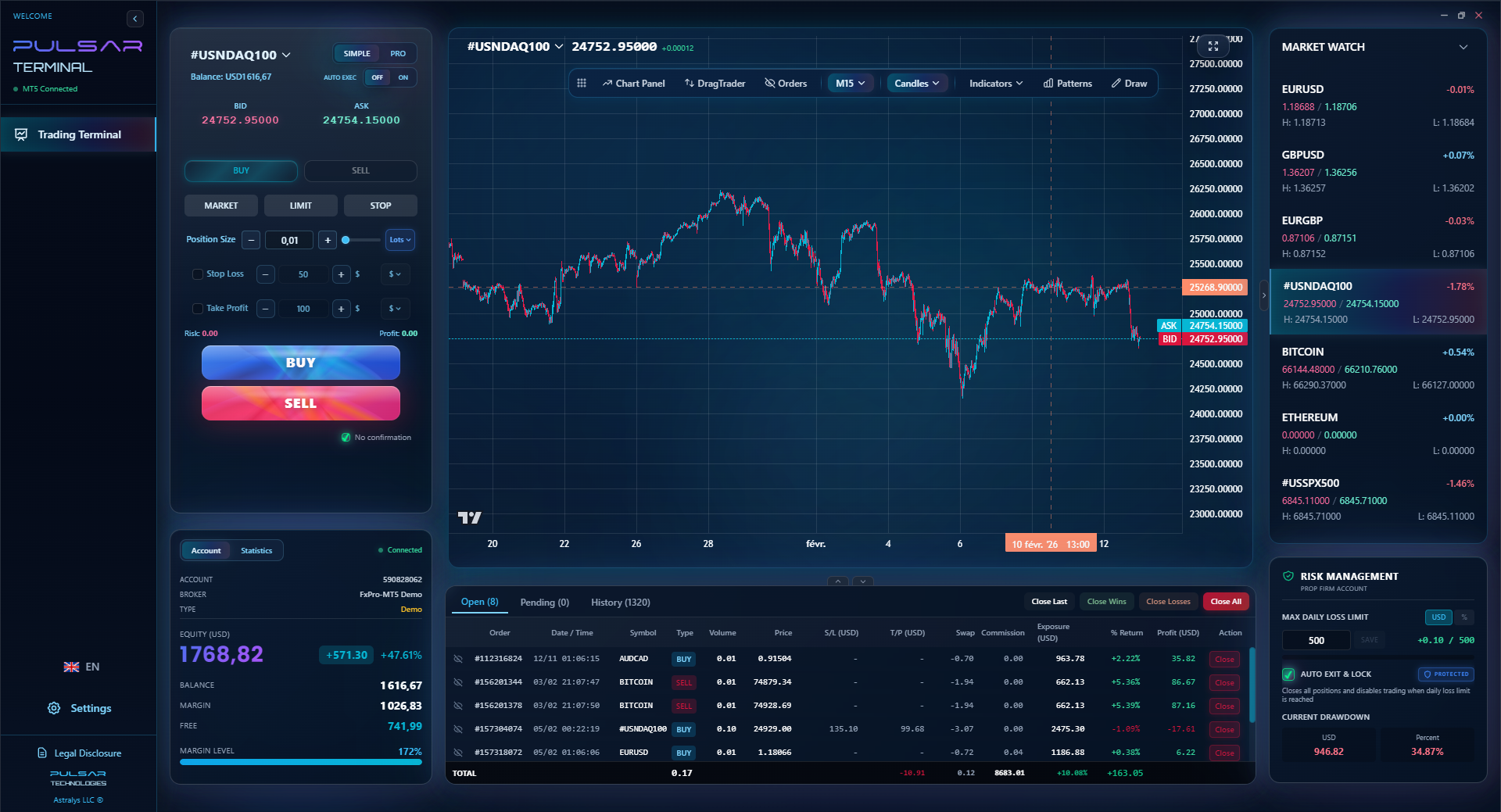
Managing multiple lots in a trending trade is where most traders fail, but Pulsar Terminal's multi-TP/SL with partial closure lets you automate your profit-taking and stop strategy directly on your MT5 chart.
Pulsar Terminal
The all-in-one MT5 companion: drag-and-drop orders, multi-TP/SL, trailing stop, grid trading, Volume Profile, and prop firm protection. Used by 1,000+ traders daily.
Trading from South Africa isn't just about charts. We have unique hurdles.
Exchange Control: This is the big one. The SARB limits how much money you can move offshore. You have a R1 million single discretionary allowance and a R10 million foreign investment allowance (with tax clearance). If you're successful and want to withdraw a large profit from an international broker, you need to follow the process. It's a paperwork headache, but it's the law. I know a trader who had a six-figure USD withdrawal held up for weeks because his bank's forex department needed endless documents. Plan for this.
Tax (SARS): Trading profits are considered income from a business or capital gains. You must declare this. Keep careful records of every trade, deposit, and withdrawal. The tax man is getting more sophisticated. This isn't a side hustle you can hide.
Load Shedding & Internet: Our national pastime. You must have a backup. A UPS for your router and laptop is a trading expense, not a luxury. I was in a great USD/ZAR short trade when the lights went out. By the time my LTE router kicked in, price had spiked 80 pips and hit my stop loss. The trend then resumed down without me. That was an expensive 2-minute blackout.
Using an FSCA-regulated broker provides a layer of protection for your funds. But remember, no regulator guarantees your trading profits. They just ensure the broker isn't a outright scam. The margin call is a function of your use and risk, not their kindness.
💡 Winston's Tip
Your broker's spread is the cover charge to enter the market club. If the charge is too high (like on exotic pairs), you'll never make enough on the dance floor to make the night worthwhile. Pick your venue wisely.
“Adding to a losing trend trade isn't a strategy, it's a funeral plan for your trading account.”
I've made these. My friends have made these. Let's save you the pain and money.
1. Adding to a Losing Position (Averaging Down): This is the account killer. "USD/ZAR is so high, it has to come down, I'll just add another lot here at R18.80." You're not trading, you're praying. A trend is not your friend until it proves it is. Add to winners, not losers.
2. Taking Profits Too Early: You get in a trend, make 30 pips, and get out because you're scared to give it back. Then you watch it run another 200 pips. The solution? Use a trailing stop or take partial profits. Let a portion of your trade ride.
3. Ignoring the Higher Timeframe Trend: The 5-minute chart says buy, but the daily chart is in a crushing downtrend. Guess who wins? The daily, every time. Always trade in the direction of the higher timeframe trend. It's the tide that lifts or sinks all boats.
4. Chasing After a Massive Move: You see EUR/USD has already moved 150 pips today. FOMO kicks in, and you buy at the very top. The trend is exhausted, it reverses, and you're left holding a bag. Wait for the pullback. There's always another bus.
5. Not Accounting for Spreads on Exotics: Getting into EUR/ZAR might seem like a great trending idea, but if the spread is 200 pips, you need the trend to move 200 pips just to break even. That's a terrible bet. Understand the cost of doing business on each pair. A pip definition is simple, but its cost in different pairs is critical.
This is the boring, systematic work that makes money.
Sunday Evening: Scan the weekly and daily charts of your 5-7 core pairs (include USD/ZAR, EUR/USD, GBP/USD). Identify which are in clear trends and note the key support/resistance levels. Read the weekly fundamental recap - what are the central bank speakers saying?
Monday Morning: Refine your list. Has the weekend gap changed anything? Place alerts on your trading platform at those key levels you identified. Now, you wait. Your job isn't to trade every day. Your job is to wait for your high-probability setup in a confirmed trending forex pair.
During the Week: Execute only when price reaches your alert zone with the right structure (pullback to MA, bullish/bearish candle pattern). Set your trade with stop loss and take profit. Use a trailing stop if your platform allows it. If you're interested in the fast-paced style, understand that scalping strategy requires a different mindset entirely than trend following.
Friday Afternoon: Review. Journal every trade. Why did you enter? Did you follow your plan? What was the outcome? This feedback loop is how you improve. It's more important than any indicator.
Trending markets are where the real money is made in forex. They require patience, discipline, and a respect for the fundamental drivers. For us in South Africa, we have the added advantage of deep, personal insight into the ZAR's movements. Use it. Trade the pairs you understand, manage your risk like your financial life depends on it (because it does), and remember that the trend is your friend... but only until the final bend.
FAQ
Q1What is the most traded trending forex pair in South Africa?
Globally, it's EUR/USD. But for South African traders specifically, USD/ZAR is the most significant and actively watched trending pair due to its direct impact on the local economy and its high liquidity relative to other ZAR crosses.
Q2What is the best time to trade trending pairs from South Africa?
The overlap of the London and New York sessions (approximately 3:00 PM to 7:00 PM SAST) is the most liquid period. This is when trends in majors like EUR/USD and GBP/USD often see their clearest, strongest movements with the tightest spreads.
Q3Can I trade forex with a South African broker using Rands?
Yes, many FSCA-regulated brokers like Khwezi Trade offer ZAR-denominated accounts. Many international brokers with FSCA licenses (e.g., IG, AvaTrade) also offer ZAR accounts. This saves you costly currency conversion fees on deposits and withdrawals.
Q4How much money do I need to start trading trending pairs in South Africa?
While some brokers allow deposits as low as R70-R150, a realistic minimum to practice proper risk management on trending trades (which require wider stops) is between R5,000 and R10,000. Starting with too little forces you to use excessive use to see meaningful returns, which is a fast track to losing your capital.
Q5What use can I use as a retail trader in South Africa?
The Financial Sector Conduct Authority (FSCA) limits use to a maximum of 30:1 for retail forex traders. Some international brokers may display higher use options, but for FSCA-regulated entities serving SA clients, 30:1 is the legal cap.
Q6Are my forex trading profits taxable in South Africa?
Yes. The South African Revenue Service (SARS) views consistent trading profits as income (if you're seen as running a business of trading) or as capital gains. You are legally required to declare this income and pay the applicable taxes. Keep detailed records of all transactions.
Q7Why is USD/ZAR so volatile and prone to trends?
USD/ZAR is highly sensitive to shifts in global risk sentiment, commodity prices (especially gold and platinum), US interest rates, and domestic South African politics and fiscal policy. When these factors align in a sustained direction, they create powerful fundamental drivers that lead to strong, trending price movements.
Prof. Winston's Lesson
Key Takeaways:
- ✓Trade with the higher timeframe trend, always.
- ✓Risk a maximum of 2% of capital per trade, no exceptions.
- ✓Wait for the pullback entry; never chase a moving trend.
- ✓A 50-pip stop is fine if your profit target is 150+ pips.
How useful was this article?
Click a star to rate
Weekly Trading Insights
Free weekly analysis & strategies. No spam.
About the Author
David van der Merwe
Emerging Markets Trader
Johannesburg-based trader with 11 years in emerging market currencies. Specializes in ZAR pairs, FSCA-regulated trading, and South African market analysis.
Comments
Risk Disclaimer
Trading financial instruments carries significant risk and may not be suitable for all investors. Past performance does not guarantee future results. This content is for educational purposes only and should not be considered investment advice. Always conduct your own research before trading.
You Might Also Like

Cara Trading Forex Sukses: 7 Prinsip dari Trader Profesional
Cara trading forex sukses dengan 7 prinsip trader pro: manajemen modal, disiplin, journal trading, backtest. Data nyata, bukan janji profit palsu.
Jam Trading Forex Terbaik untuk Trader Indonesia: Panduan Lengkap dengan Tabel Waktu
Panduan jam trading forex untuk trader Indonesia. Tabel 4 sesi dunia, jam emas 20:00-00:00, sesi mana yang harus dihindari. Data akurat + tips dari trader berpengalaman.
Top 5 Sàn Forex Uy Tín Nhất 2026: Review Jujur dari Trader Indonesia
Top 5 sàn forex uy tín 2026 untuk trader Indonesia. Review jujur: spread, deposit, withdraw, dukungan lokal. Exness, XM, IC Markets & lebih.
Get Pulsar Terminal
All these calculators are built into Pulsar Terminal with real-time data from your MT5 account. One-click position sizing, automatic risk management, and instant calculations.
Get Pulsar Terminal