


I lost R4,200 in a single morning back in 2018.

David van der Merwe
Emerging Markets Trader ·  South Africa
☕ 10 min read
What you'll learn:
- 11. The Spot Market: The Real Deal (And Why You're Probably Not In It)
- 22. Forex CFDs: This Is Your Actual Battlefield (FSCA Rules & Real Costs)
- 33. Forex Futures & Options: The Institutional Arena
- 44. Currency ETFs & Trackers: The 'Set-and-Forget' Approach
- 55. Copy & Social Trading: Letting Someone Else Drive (FSCA License Check!)
- 6How to Choose the Right Type for You in South Africa
I lost R4,200 in a single morning back in 2018. I was trying to trade USD/ZAR like it was EUR/USD, piling into a position without understanding the fundamental difference between the spot market and the CFD I was actually in. The spread was monstrous, the liquidity dried up, and my stop-loss got skipped. That loss, more than any win, taught me that knowing the types of forex you're dealing with isn't academic. It's survival. For South African traders, with our unique regulations from the FSCA and our obsession with the Rand, picking the right battlefield is half the fight.
When people talk about 'forex,' this is the pure, undiluted version. It's the immediate exchange of one currency for another at the current market rate, with settlement usually in two business days (T+2). Think of a tourist exchanging ZAR for USD at a bank. That's spot.
For large institutions, this is the primary arena. The daily volume is staggering - trillions of dollars. But here's the raw truth for you and me: as retail traders in South Africa, we almost never trade the actual spot market directly. The minimum transaction sizes are huge (think millions), and you need direct access to the interbank network.
So why do you need to know about it? Because it's the price source. Every other type of forex trading you do - CFDs, futures, options - derives its value from the spot price. Your broker's quote for EUR/USD is based on the spot rate, plus their markup (the spread). When news hits, it moves the spot market first, and everything else follows.

Warning: Many new traders confuse trading forex CFDs with trading the spot market. You're not buying the physical currency. You're entering a contract that speculates on the price movement of that currency pair. This distinction is critical for understanding your rights, the costs involved, and the regulatory protections (or lack thereof) that apply.
My early mistake was ignoring this. I'd see 'USD/ZAR' on my platform and think I was trading the Rand itself. I wasn't. I was in a leveraged derivative, which behaves very differently, especially around local market closes and during SARB announcements.
This is where 95% of South African retail traders live: Contracts for Difference on forex pairs. A CFD is an agreement to exchange the difference in the value of an asset (like EUR/USD) from when the contract is opened to when it is closed. You never own the underlying currency.
Why is it so popular here? Accessibility. You can start with a few hundred Rand, use use, go long or short easily, and trade micro-lots. But the FSCA has put up guardrails. Since 2021, use for retail clients is capped at 30:1 for major pairs. For a pair like USD/ZAR, it's often lower, like 20:1. This is a good thing. My R4,200 loss? That was on 50:1 use with an offshore broker. The 30:1 limit forces more sensible position size calculator use.
Let's talk real South African costs, because this is where profits go to die.
The Spread & Commission Double-Tap: On a major pair like EUR/USD, you might see two types of accounts:
- Commission-Free Account: The spread is wider, baking the broker's fee into the price. Think 0.8 to 1.3 pips. You pay as soon as you enter.
- Raw/ECN Account: The spread is razor-thin (even 0.0 pips), but you pay a commission per lot. For example, R3 ($~3) per standard lot, per side.
For USD/ZAR, forget tight spreads. It's an exotic pair. Spreads of 50-100 pips are common. I once entered a trade where the spread itself was R85 on a mini lot before the market even moved. You need a much wider stop-loss, which means risking more capital per trade.
The Overnight Financing Killer (Swap Rates): Hold a position past 10 PM GMT (midnight SAST in summer), and you'll pay or receive a swap fee. This is the cost of rolling the CFD contract. If you're long a currency with a high-interest rate (like the ZAR) against a low-yielding one, you might earn a small daily credit. But if you're short the ZAR, you'll pay. These fees compound and can wreck a long-term swing trading position. I learned this the hard way holding a short USD/ZAR trade for two weeks; the swap fees ate 40% of my paper profits.
Brokers like Exness, IC Markets, and XM are popular here, but always check their FSCA license status first. An FSCA license means client funds are segregated - a non-negotiable safety net.

💡 Winston's Tip
Stop obsessing over the instrument and start obsessing over the spread. A 100-pip spread on USD/ZAR means you need a 101-pip move just to break even. That's not trading; it's donating to your broker.
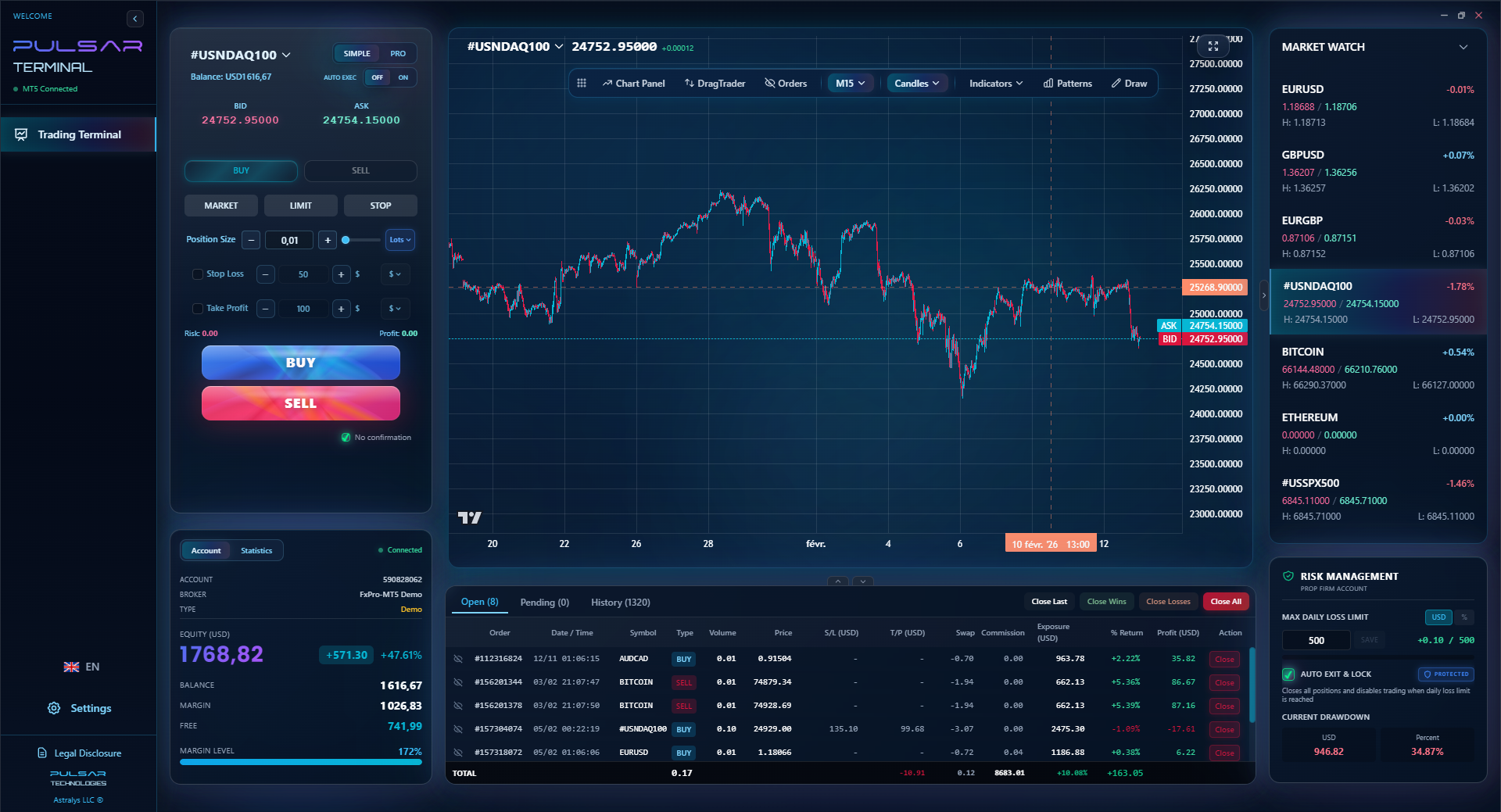
Managing multiple CFD trades and their specific stop-losses is complex, but tools like Pulsar Terminal automate advanced order types directly on your MT5 platform.
Pulsar Terminal
The all-in-one MT5 companion: drag-and-drop orders, multi-TP/SL, trailing stop, grid trading, Volume Profile, and prop firm protection. Used by 1,000+ traders daily.
“As a South African retail trader, you are almost certainly trading CFDs, not the actual spot market. This changes everything.”
These are exchange-traded derivatives, meaning they're standardized contracts traded on regulated exchanges like the JSE (they have currency derivatives) or the CME in the US. They're not as common for the average South African retail trader, but you should know what they are.
Forex Futures: A binding contract to buy/sell a currency at a set price on a future date. The contract sizes are fixed (e.g., 100,000 EUR). They have minimal counterparty risk (the exchange guarantees the trade) and are very transparent. However, the barrier to entry is high in terms of capital and knowledge. Liquidity for ZAR pairs on international exchanges can be low.
Forex Options: This gives you the right, but not the obligation, to buy (call option) or sell (put option) a currency at a set price before a certain date. You pay a premium for this right.
Why Most South Africans Skip These
The simplicity is the killer. With a CFD, I can click and be in a trade for R1,000 in seconds. With futures or options, I'm dealing with contract expiry, different margin call rules, and a much steeper learning curve. The liquidity for the pairs we care about (USD/ZAR, EUR/ZAR) is also far greater in the CFD or spot markets. I dabbled in ZAR options on the JSE years ago. The premiums were high, the time decay was brutal, and I quickly realized my edge wasn't in predicting both direction and timing to that degree of precision.
Want exposure to forex without staring at charts? This might be for you. A Currency Exchange-Traded Fund (ETF) or tracker is a basket of securities that mirrors the performance of a currency or a basket of currencies.
For a South African, the most relevant example is something that tracks the USD/ZAR exchange rate. Instead of opening a CFD, you could buy units in an ETF that rises when the Dollar strengthens against the Rand. It's traded on the JSE like a stock.
The Pros:
- Simple: Buy it through your normal stockbroking account.
- No use: This eliminates the single biggest risk for new traders.
- No Overnight Fees: You might pay a small management fee, but no daily swap calculations.
- Long-Term Focus: Perfect for a macro view, like believing the ZAR will steadily weaken over years.
The Cons:
- No Shorting (Easily): While some ETFs are structured for short exposure, it's not as straightforward as clicking 'sell' on a CFD platform.
- Slower Execution: You're at the mercy of JSE trading hours.
- Less Precision: You can't trade a 15-minute chart setup.
I use a small portion of my long-term portfolio for this. It's a hedge. When my active CFD trading is all about the next few hours or days, having a currency ETF position reminds me to think in quarters and years, not just pips.
💡 Winston's Tip
The FSCA's 30:1 use limit isn't a restriction; it's a gift. It's the regulator forcing you to use a size that won't obliterate your account in one bad trade. The best traders I know use 10:1 or less.
“The swap fee is the silent killer of long-term swing trades, especially on ZAR pairs.”
This has exploded in popularity. Platforms like eToro or proprietary systems from brokers allow you to automatically copy the trades of another selected trader. You allocate funds, and every trade they make is replicated in your account proportionally.
It sounds like a dream for beginners. The reality is a minefield, especially post-FSCA regulations.

Pro Tip: As of now, any platform offering copy-trading or signals to South African clients MUST be an FSCA-licensed Financial Services Provider (FSP). This is a recent and crucial change. If they're not licensed, they are operating illegally. Check the FSCA website before depositing a cent.
I tried copy-trading early on with an offshore platform. I picked a 'star' trader with a 12-month winning streak. I allocated $1,000. Their strategy was high-risk, high-reward scalping. For two weeks, it worked. Then, in one session, they took 15 consecutive loss-making trades chasing the market. My copied account was down 35% before I could manually disconnect. The 'star' trader was likely just on a lucky run, and their risk management was terrible.
The lesson? Due diligence is everything. Don't just look at the percentage return. Look at:
- Maximum Drawdown: How much did their account lose from its peak? If it's over 20%, be very wary.
- Average Trade Length: Are they a scalper or a swing trader? Their style must match your psychology.
- Asset Focus: Do they only trade Gold (XAU/USD) during London hours? That's a specific edge. If they jump from crypto to indices to forex, they're probably gambling.
Social trading can be a great learning tool if you use it to analyze what others are doing, not just to blindly follow. But remember, even the person you're copying is likely trading forex CFDs, with all the associated risks and costs we've already covered.
So, with all these options, where do you park your capital? It's not about the 'best' type, but the best fit.
Ask yourself these questions:
- What's your time horizon?
- Minutes/Hours (Scalping/Day Trading): Forex CFDs are your only real option. You need the instant execution, use, and ability to go short. Just respect the 30:1 FSCA limit and manage that risk fiercely.
- Days/Weeks (Swing Trading): Forex CFDs still work, but swap fees become a real factor in your calculations. Use a position size calculator that includes swap costs.
- Months/Years (Long-Term Investing): Consider a Currency ETF for core exposure. It's cleaner, with no use blow-up risk.
-
What's your risk tolerance? If the thought of losing more than 2% of your account on a trade makes you sick, avoid leveraged CFDs. Start with a demo, then a micro CFD account, or look at ETFs. My first profitable year only came after I reduced my use from the max down to 10:1, forcing me to be more selective.
-
What pairs do you want? If you want to trade USD/ZAR, EUR/ZAR, or GBP/ZAR, your practical choices are CFDs or ETFs. The futures market for these is too niche for most. Remember the wide spreads on exotics.
-
What's your learning appetite? CFDs are simple to enter but complex to master. Futures and options require serious study. If you just want passive forex exposure while you focus on your job, an ETF is a valid, low-effort choice.
My personal mix today: 80% of my active trading capital is in forex CFDs (using FSCA-regulated brokers like Pepperstone or IC Markets). I trade mostly majors like EUR/USD for their liquidity. The other 20% is in long-term currency and commodity ETFs on the JSE as a permanent portfolio hedge. I don't touch copy-trading with my own money anymore, and futures/options are tools I understand but don't currently use.
The landscape here is good. The FSCA regulation, while restrictive, protects you. The key is to match the instrument to your personality, your schedule, and your risk capital. Don't be the 2018 version of me, throwing money at a screen without knowing what type of forex beast I was actually fighting.
💡 Winston's Tip
If you're using copy-trading, you haven't outsourced the risk, only the decision-making. You are 100% responsible for the capital loss. Vet the trader's history like you're hiring a CEO for your R10,000 company.
FAQ
Q1What is the most common type of forex trading for South Africans?
Overwhelmingly, it's trading Forex CFDs (Contracts for Difference). This is what all major FSCA-regulated online brokers like Exness, XM, and IC Markets offer. It provides access with small capital, use (capped at 30:1), and the ability to go long or short easily on platforms like MT5.
Q2Is forex trading legal in South Africa?
Yes, it is completely legal. It is regulated by the Financial Sector Conduct Authority (FSCA). However, you must use an FSCA-licensed broker to ensure your funds are segregated and you have legal recourse. Trading with unlicensed offshore brokers is risky and not recommended.
Q3What is the difference between spot forex and forex CFDs?
The spot forex market is the actual exchange of currencies. Retail traders almost never access this directly. A Forex CFD is a derivative contract that speculates on the price movement of a spot currency pair. You don't own the currency; you profit from the price difference. CFDs involve use, spreads, and overnight swap fees.
Q4Why are spreads on USD/ZAR so high?
USD/ZAR is considered an exotic currency pair. It has lower liquidity and higher volatility compared to majors like EUR/USD. Fewer market participants means brokers face higher costs to help trades, which they pass on as wider spreads, often 50-100 pips or more.
Q5Can I trade forex without use in South Africa?
Absolutely. You can trade forex CFDs with 1:1 use (effectively no use) by simply not utilizing the margin offered. Alternatively, you can gain forex exposure through Currency ETFs traded on the JSE, which involve no use at all, just the movement of the underlying exchange rate.
Q6What is a swap rate, and when is it charged?
A swap rate (or overnight financing fee) is the cost of holding a leveraged CFD position open overnight. It's calculated based on the interest rate differential between the two currencies in the pair. It's applied daily, usually around 10 PM GMT (midnight SAST in summer). It can be a credit or a debit to your account.
Q7Are copy-trading platforms regulated by the FSCA?
Yes, they must be. Any entity providing financial services, including trade signals or copy-trading automation, to South African clients is required to hold an FSCA license. Always verify the provider's FSP number on the FSCA's official website before participating.
Prof. Winston's Lesson
Key Takeaways:
- ✓Forex CFDs are your main tool, not spot forex.
- ✓FSCA 30:1 use is a protective ceiling, not a target.
- ✓USD/ZAR's wide spread demands a wider stop-loss.
- ✓Always verify your broker's FSCA license number.
- ✓Swap fees can turn a winning trade into a loser over time.
How useful was this article?
Click a star to rate
Weekly Trading Insights
Free weekly analysis & strategies. No spam.
About the Author
David van der Merwe
Emerging Markets Trader
Johannesburg-based trader with 11 years in emerging market currencies. Specializes in ZAR pairs, FSCA-regulated trading, and South African market analysis.
Comments
Risk Disclaimer
Trading financial instruments carries significant risk and may not be suitable for all investors. Past performance does not guarantee future results. This content is for educational purposes only and should not be considered investment advice. Always conduct your own research before trading.
You Might Also Like

Cara Trading Forex Sukses: 7 Prinsip dari Trader Profesional
Cara trading forex sukses dengan 7 prinsip trader pro: manajemen modal, disiplin, journal trading, backtest. Data nyata, bukan janji profit palsu.
Jam Trading Forex Terbaik untuk Trader Indonesia: Panduan Lengkap dengan Tabel Waktu
Panduan jam trading forex untuk trader Indonesia. Tabel 4 sesi dunia, jam emas 20:00-00:00, sesi mana yang harus dihindari. Data akurat + tips dari trader berpengalaman.
Top 5 Sàn Forex Uy Tín Nhất 2026: Review Jujur dari Trader Indonesia
Top 5 sàn forex uy tín 2026 untuk trader Indonesia. Review jujur: spread, deposit, withdraw, dukungan lokal. Exness, XM, IC Markets & lebih.
Get Pulsar Terminal
All these calculators are built into Pulsar Terminal with real-time data from your MT5 account. One-click position sizing, automatic risk management, and instant calculations.
Get Pulsar Terminal