


Over 190,000 South Africans trade forex, yet the brutal truth is most lose.

David van der Merwe
Emerging Markets Trader ·  South Africa
☕ 9 min read
What you'll learn:
- 1Why the Strategy Type Matters More Than the Strategy Itself
- 21. Scalping: The 5-Minute Sprint
- 32. Day Trading: The 9-to-5 Shift
- 43. Swing Trading: The Patient Game
- 54. Position Trading: The Marathon (Months to Years)
- 65. Algorithmic (Automated) Trading: The Robot
- 7What NOT to Waste Your Time On (From Experience)
- 8Choosing Your Type: A South African Checklist
Over 190,000 South Africans trade forex, yet the brutal truth is most lose. The FSCA says 51-89% of retail accounts end in the red. I was part of that statistic for my first two years. The biggest reason? We chase shiny, complex systems without understanding the core types of strategies in forex and which one fits our lives. This isn't about finding a magic bullet. It's about matching a strategy's rhythm to your schedule, psychology, and the Rands in your account.
I used to download every free EA and strategy PDF I could find. My MT4 was a graveyard of indicators. The turning point came after a R4,200 loss on a USD/ZAR trade in 2019. I was trying to scalp a 5-minute chart while at my day job, missing my exit by minutes because a meeting ran over. The strategy was sound, but its type - scalping - was a catastrophic mismatch for my lifestyle.
Choosing a category of forex strategy is like choosing a vehicle. You wouldn't use a Formula 1 car to do the school run. Yet traders do the equivalent all the time. The main types of strategies in forex are defined by their time horizon and holding period. This dictates everything: how often you need to be at your screen, the size of your typical profit target, the psychological stamina required, and how costs like the spread eat into your edge.
For us in South Africa, with load-shedding and the ZAR's volatility, this choice is even more critical. A strategy requiring constant screen time is a liability when Eskom's schedule is your co-pilot.

Warning: The FSCA's 30:1 use cap is a gift. High-frequency strategies that rely on insane use to make micro-moves profitable often fail here. It forces you to build a real edge.

💡 Winston's Tip
Your first goal isn't to find a profitable strategy. It's to find a strategy you can follow consistently for 100 trades without changing the rules. Consistency breeds clarity.
Scalping is about taking 5-20 pips, multiple times a day. Trades last seconds to minutes. It's intense.
The Reality for South African Traders
You need a broker with razor-thin spreads and instant execution. That R2-R3 spread on EUR/USD? On a 5-pip target, it's already consumed 40-60% of your potential profit. I used brokers with "low costs" but slow execution; my intended 1.1120 entry on EUR/USD would fill at 1.1123. That 3-pip slippage was often my entire profit.
My Experience: I tried a simple scalping strategy on GBP/USD using 1-minute charts and the RSI indicator. Over a week, I took 47 trades. Won 32, lost 15. Net profit? A pathetic $87. After factoring in commissions and the spread, my "winning" strategy barely broke even. The transaction costs slaughtered me.
Who it's for: The disciplined, full-time trader with a dedicated, stable internet connection (consider a UPS). You need a broker like Tickmill or IC Markets with raw spreads and ECN execution.
Local Tip: Trade during the London/New York overlap (3 PM - 5 PM SAST). Liquidity is highest, spreads are tightest. Avoid trading major SA data releases (like CPI or SARB announcements) on your pairs - spreads widen violently.
“I was trying to scalp a 5-minute chart while at my day job, missing my exit by minutes because a meeting ran over. The strategy was sound, but its *type* was a catastrophic mismatch.”
This is my bread and butter. Day trading means opening and closing all positions within the same day. No overnight swaps. You're looking at 30-100 pip moves, using 1-hour or 4-hour charts. It’s the sweet spot for many working South Africans.
You can analyse in the morning, set alerts, and manage trades on your phone during breaks. I’ve closed trades from my phone in the Checkers queue. This strategy type aligns with the FSCA's ethos of more deliberate, less frantic trading.
A Real Trade (October 2023): On the 4-hour chart, EUR/USD was in a clear range. Price hit the bottom support at 1.0520 with a bullish MACD divergence. I went long at 1.0525. My stop was at 1.0495 (30 pips). I took half off at 1.0575 (+50 pips) and let the rest run to the range top, exiting at 1.0610 (+85 pips). Total gain: 67.5 pips. Used a 1% risk position. Took about 36 hours from entry to final exit, all within the same week.
The Key: Patience. You might only take 2-3 setups a week. It’s about quality, not quantity. Always use a position size calculator. With our 30:1 use, a 50-pip stop on a standard lot requires about R2,500 in margin. Risking 1% of a R25,000 account means your position size should be 0.2 lots. Get this math wrong, and you're one trade from a margin call.
💡 Winston's Tip
The spread isn't just a cost; it's a filter. If your strategy's average profit target is less than 3 times the average spread, you're not trading, you're donating to the broker.
Swing trading is holding for days to weeks, capturing the ‘swings’ within a larger trend. This is perhaps the most accessible type of strategy for beginners with day jobs. You analyse on weekends, place trades, and check in once a day.
It works well with the ZAR pairs. USD/ZAR, EUR/ZAR - they have strong, trending personalities driven by commodity prices and local politics.
My Hard Lesson: In early 2022, I was swing trading USD/ZAR long. Price was climbing beautifully. I ignored the upcoming SARB interest rate decision, thinking my trend would override it. They hiked less than expected. The Rand strengthened violently. I watched a R8,000 profit turn into a R5,000 loss in under an hour. I didn't have a stop in place because "swing trading is relaxed." Stupid.
The Rule: Always know the economic calendar. For swing trading ZAR pairs, SARB meetings, CPI data, and budget speeches are landmines. Place your stops outside the expected volatility range.

Pro Tip: Use the overnight swap to your advantage. If you're swing trading a carry trade pair (like going long on a high-yield currency vs. a low-yield one), you can earn a small credit each day you hold. It can offset costs over time.
“The FSCA's 30:1 use cap is a gift. It forces you to build a real edge.”
This is macro-economics trading. You're betting on long-term themes: interest rate cycles, geopolitical shifts, commodity super-cycles. Trades last for months. You need significant capital to withstand drawdowns of hundreds of pips.
Most South African retail traders aren't cut out for this. It requires deep pockets and ice in your veins. You might put on a trade based on a SARB policy outlook and not touch it for 6 months.
Why it's rare here: Our maximum 30:1 use makes it capital intensive. To hold a position through a 500-pip counter-swing, you need a huge margin buffer. Also,, the psychological toll of seeing a R15,000 drawdown on your screen for weeks is immense. It's a strategy better suited for funds and ultra-high-net-worth individuals.
If you try it: Use only a tiny fraction of your capital (1-2% risk per trade). Your analysis must be fundamental first, technical second. And you must be prepared to literally forget about the trade for long periods.
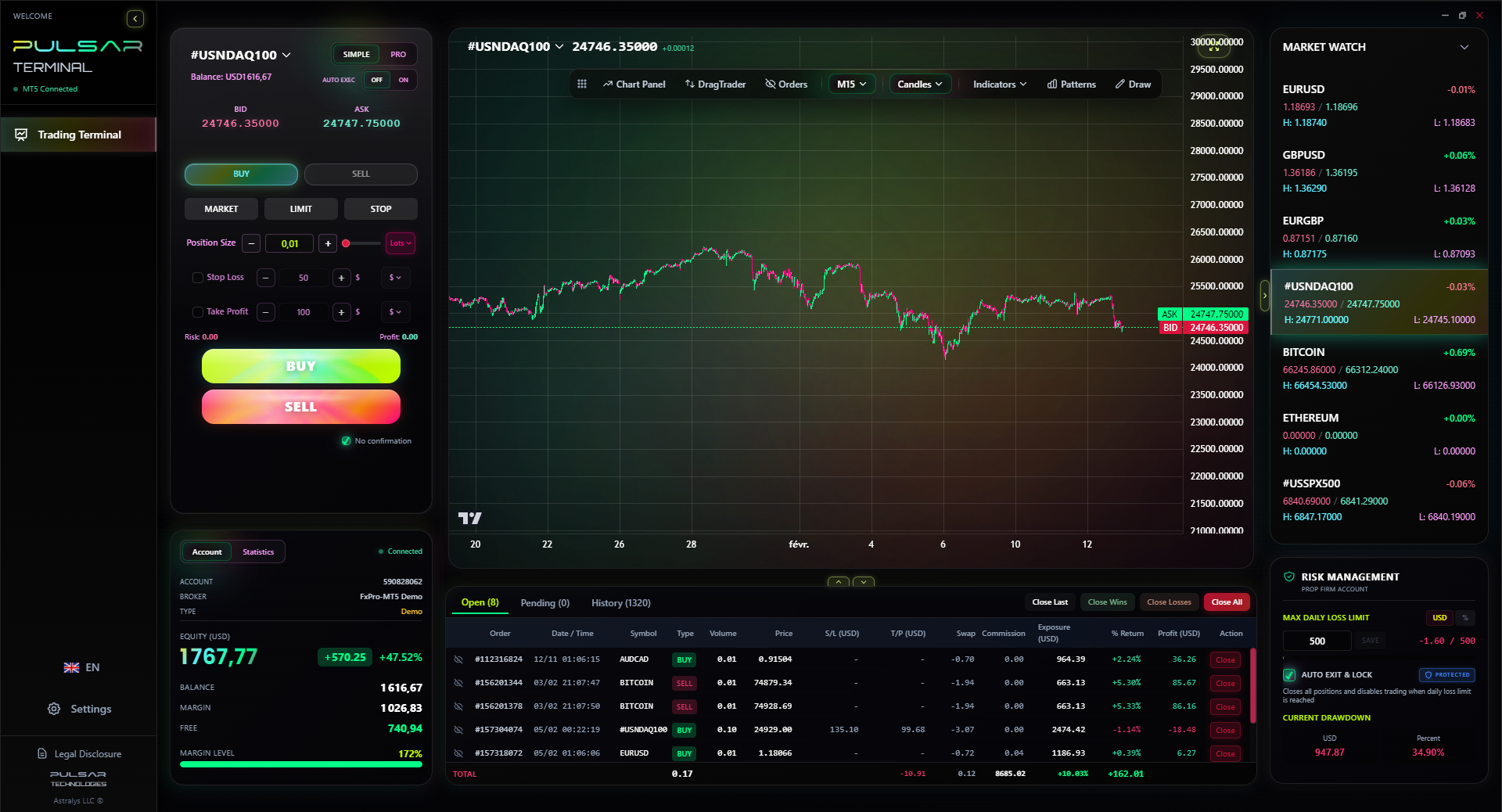
Managing multiple take-profit levels and trailing stops across several swing trades is complex, but tools like Pulsar Terminal automate this directly on your MT5 platform.
Pulsar Terminal
The all-in-one MT5 companion: drag-and-drop orders, multi-TP/SL, trailing stop, grid trading, Volume Profile, and prop firm protection. Used by 1,000+ traders daily.
You code a strategy (Expert Advisor on MT4/MT5) and let it run. It removes emotion. Sounds perfect, right? Here's the catch: it requires programming skill, endless back-testing, and constant monitoring. The market changes; a robot that worked in 2023 might bleed money in 2024.
South African Reality: Our internet instability is the kryptonite of algorithmic trading. A disconnection during a high-volatility event can mean your robot can't close a trade, leading to a disaster. I know a trader in Joburg whose EA opened 10 positions during a news event, then load-shedding hit. By the time power returned, he was facing a margin call.
If you go this route, you need a VPS (Virtual Private Server) hosted in Europe or the US with guaranteed uptime. This adds cost. Brokers like Pepperstone and XM offer integrated VPS services for a fee or if you meet a minimum monthly volume.

Example: Let's say your EA trades 10 times a day. At an average spread of 1 pip on EUR/USD and a $3 commission per round turn, your daily cost is: (10 trades * 1 pip * $10 per pip) + (10 trades * $6 commission) = $100 + $60 = $160. Your strategy must generate more than $160 daily just to cover costs. That's R2,900 a day, just in fees.
💡 Winston's Tip
Load-shedding is your strategy's stress test. If your plan falls apart without a constant internet connection, it's not a strong plan. Build in contingencies.
“Your analysis must be fundamental first, technical second. And you must be prepared to literally forget about the trade for long periods.”
1. The "Sure Thing" News Scaler
Trying to trade the immediate spike from CPI or employment data. You're competing against institutional algos with co-located servers. Your order is at the back of the queue. The spread on XAU/USD can blow out from 30 cents to $5 in a second. I've been filled so far from my price that I was in loss the second my trade opened.
2. The Social Media Signal Copier
Paying some "guru" on Telegram for signals. The signal might be good, but their risk management isn't yours. They might be risking 0.5% on a R500,000 account. You're risking 5% on a R10,000 account. Same trade, wildly different outcomes. I lost R3,000 in two days following signals before I realised this.
3. The Over-Optimized Back-Test Fantasy
Spending months tweaking an EA to have a 99% win rate on 2017 EUR/USD data. It's called curve-fitting. It will fail in live markets. I once built an EA that was "perfect" on past data. It lost 23% in its first live month. The past doesn't repeat; it just rhymes.
Answer these honestly:
- Screen Time: How many hours continuously can you be at your charts, undisturbed? (Be honest about work/kids/load-shedding).
- <1 hour/day → Swing or Position Trading.
- 1-3 hours/day → Day Trading.
- 4+ hours/day → Scalping (if you have the infrastructure).
- Capital: What's your true risk capital (money you can afford to lose)?
- < R10,000 → Stick to day trading or swing trading on micro lots. Scalping will kill you with costs.
- R10,000 - R50,000 → Day trading is ideal. You can start dabbling in small swing positions.
- R50,000+ → You have more options, including allocating a small portion to longer-term positions.
- Psychology: How do you handle loss?
- Can't stand being in a losing trade for more than an hour? → Avoid swing trading.
- Get bored if you don't trade often? → Avoid position trading.
My final advice: Start with day trading. It's the best training ground. It teaches you discipline, risk management, and market structure without the frantic pace of scalping or the agonising patience of swinging. Paper trade a day trading strategy for two months. Then, start with a live account of at least R5,000-R10,000. Use a reputable, FSCA-regulated broker. And for goodness sake, always know where your stop is before you know where your profit will be.
FAQ
Q1What is the best type of forex strategy for beginners in South Africa?
For most South African beginners, day trading or swing trading is the best starting point. They don't require constant screen time, which fits around work schedules and load-shedding. They also allow you to learn market fundamentals without the extreme transaction costs of scalping. Start by paper trading a simple strategy on the 1-hour or 4-hour chart.
Q2How much money do I need to start swing trading in South Africa?
You can technically start with as little as R500 on a micro account, but it's not advisable. A realistic minimum is R5,000-R10,000. This allows you to trade proper position sizes (using a calculator) with sensible stops. For example, to risk 1% (R100) on a USD/ZAR trade with a 50-pip stop, you'd need enough margin to cover the position, which the 30:1 use cap influences. Start small, preserve capital.
Q3Is algorithmic trading legal and profitable in South Africa?
Yes, it's legal if you use a strategy you've developed or properly licensed. Is it profitable? That's the hard part. Very few retail traders create consistently profitable algorithms. The costs (VPS, potential slippage), the need for coding skills, and the ever-changing market make it a high-barrier endeavor. It's more of an advanced project than a beginner's path to riches.
Q4Why do most scalping strategies fail for South African traders?
They fail primarily due to transaction costs and infrastructure. The spread and commission can consume 30-70% of a scalper's small profit target. Add in occasional slippage and the reality of unstable internet (load-shedding, connectivity issues), and the odds stack against you. The FSCA's 30:1 use limit also reduces the profitability of micro-movements that scalpers often rely on.
Q5Can I trade forex part-time in South Africa and make money?
Yes, absolutely. In fact, part-time trading often leads to better discipline than full-time trading for beginners. Swing trading and some forms of day trading are designed for part-time participants. The key is to choose a strategy type that doesn't require constant monitoring. Analyse the markets during your free time, set your trades with stop-loss and take-profit orders, and review them once a day. Consistency and risk management are far more important than screen time.
Q6How do I manage risk with the ZAR's volatility?
Trade ZAR pairs with extra-wide stops. A 50-pip stop might work on EUR/USD, but USD/ZAR can move 100 pips on a quiet day. Use the Average True Range (ATR) indicator to gauge recent volatility and set your stop at least 1.5x the ATR away from your entry. Most importantly, always use a stop-loss order - no exceptions. The SARB's decisions can cause gaps that wipe out accounts without one.
Q7What's the biggest mistake when choosing a forex strategy type?
The biggest mistake is choosing a strategy based on promised returns, not personal fit. A high-frequency scalping strategy promising 20% a month is useless if you have a 9-5 job and frequent load-shedding. You'll either miss trades or execute them poorly. Be brutally honest about your available time, risk tolerance, and starting capital. Match the strategy's demands to your reality, not your fantasy.
Prof. Winston's Lesson
Key Takeaways:
- ✓Match strategy type to your daily life, not desired profits.
- ✓Transaction costs define scalping's viability.
- ✓Always know the economic calendar for ZAR pairs.
- ✓Use a VPS for algorithmic trading, always.
How useful was this article?
Click a star to rate
Weekly Trading Insights
Free weekly analysis & strategies. No spam.
About the Author
David van der Merwe
Emerging Markets Trader
Johannesburg-based trader with 11 years in emerging market currencies. Specializes in ZAR pairs, FSCA-regulated trading, and South African market analysis.
Comments
Risk Disclaimer
Trading financial instruments carries significant risk and may not be suitable for all investors. Past performance does not guarantee future results. This content is for educational purposes only and should not be considered investment advice. Always conduct your own research before trading.
You Might Also Like

Cara Trading Forex Sukses: 7 Prinsip dari Trader Profesional
Cara trading forex sukses dengan 7 prinsip trader pro: manajemen modal, disiplin, journal trading, backtest. Data nyata, bukan janji profit palsu.
Jam Trading Forex Terbaik untuk Trader Indonesia: Panduan Lengkap dengan Tabel Waktu
Panduan jam trading forex untuk trader Indonesia. Tabel 4 sesi dunia, jam emas 20:00-00:00, sesi mana yang harus dihindari. Data akurat + tips dari trader berpengalaman.
Top 5 Sàn Forex Uy Tín Nhất 2026: Review Jujur dari Trader Indonesia
Top 5 sàn forex uy tín 2026 untuk trader Indonesia. Review jujur: spread, deposit, withdraw, dukungan lokal. Exness, XM, IC Markets & lebih.
Get Pulsar Terminal
All these calculators are built into Pulsar Terminal with real-time data from your MT5 account. One-click position sizing, automatic risk management, and instant calculations.
Get Pulsar Terminal