


I thought I was being clever.

James Mitchell
Senior Trading Analyst
☕ 10 min read
What you'll learn:

I thought I was being clever. Back in 2018, I set up a UK Limited company through an online agent for about £300, thinking it would give my trading a 'professional' structure and maybe some tax flexibility. I was a US resident trading my own capital. The reality? A £1,200 annual accounting bill, a mountain of IRS forms I didn't understand, and a nasty letter from HMRC asking about my 'UK permanent establishment.' I closed the company after 18 months, having made exactly zero trades through it. The hassle wasn't worth the perceived credibility. If you're a US resident looking at a UK LTD for forex, you need to read this first.
Let's be honest, the idea has surface-level appeal. You see slick websites from UK company formation agents promising a 'global business in 24 hours.' For a trader, the pitch hits some nerves.
First, there's the perceived credibility. Having "LTD" after your trading entity's name feels more substantial than just your personal account. Some prop firms or private capital groups might glance more favorably at a corporate structure (though they'll dig deeper).
Second, there's the myth of tax optimization. You hear whispers about the UK's 19-25% Corporation Tax rate, which can look attractive compared to a US marginal rate of 37%. The dream is to keep profits in the company, reinvest them, and somehow defer or reduce your US tax bill. I had this dream. It's a fantasy for nearly all US retail traders.
Third, there's limited liability. In theory, your trading losses are contained within the company. In practice, if you're a solo trader funding the company yourself, this is a very thin veil. No serious lender will give a trading company a loan without your personal guarantee anyway.
Finally, there's access. A UK company can, in theory, open accounts with brokers like Exness or Pepperstone that don't accept US residents personally. This is the one tangible, operational reason - but it comes with a nuclear-grade compliance burden.
This is where the fantasy dies. The US IRS doesn't care where you incorporate. If you're a US person (citizen, green card holder, or resident), you're taxed on your worldwide income. Full stop. Trying to hide behind a foreign company doesn't work; it just makes your life infinitely more complicated.
When you, a US resident, own a foreign company that engages in investing (like forex trading), the IRS has two special regimes designed to trap this exact setup: PFIC and CFC.
PFIC - Passive Foreign Investment Company: If your UK LTD's primary income is from investments (like forex trading gains), it's almost certainly a PFIC. The tax treatment for PFIC shareholders is punitive. You lose the benefit of lower capital gains rates. You're forced into one of three complex tax calculation methods (QEF, Mark-to-Market, or the default Excess Distribution method), all of which likely result in your profits being taxed at your highest marginal rate PLUS an interest charge. You must file Form 8621 for each PFIC you own. The form is notoriously complex, and accountant fees for filing one start around $500 per year.
CFC - Controlled Foreign Corporation: If you own more than 50% of the UK LTD (which, as a solo trader, you do), it's also a Controlled Foreign Corporation. This triggers Form 5471. The penalties for filing this form late or incorrectly are brutal: $10,000 per form, per year, with additional penalties for each month it's late. This applies even if you owe zero tax.

Warning: I consulted a US international tax attorney after setting up my LTD. His quote: "For a solo trader, this structure is administrative masochism. You will pay me more to file these forms than you'll likely save in any conceivable tax scenario." He was right.
You don't get to choose the UK's simpler corporate tax system. You're layered under the US system first. The UK LTD becomes a costly reporting entity, not a tax-saving vehicle.

💡 Winston's Tip
A complex structure is often a distraction from a flawed strategy. Master trading one currency pair, like the [EUR/USD](/en/guides/instruments/eurusd), inside a simple personal account before you even think about corporate entities.
“The UK LTD becomes a costly reporting entity, not a tax-saving vehicle.”
Let's talk real money. Here’s what my misadventure actually cost, and what you can expect today.
Setup Costs (One-Time):
- Company Formation Agent: £79 - £550. You need this as a non-resident.
- Registered Office Address: Mandatory in the UK. £40-£120/year.
- Legal/Advice (Strongly Recommended): $500 - $2,000 for a US tax pro to explain why this is a bad idea.
Annual Running Costs:
- UK Accountant: To file mandatory UK annual accounts (even showing $0 activity) and a Confirmation Statement. £750 - £1,200. My bill was £1,100.
- US Tax Preparer: To handle the PFIC/CFC forms (Forms 8621 & 5471). Add at least $1,000 - $2,500 to your normal tax prep fees.
- Companies House Fee: £50 for the annual confirmation statement.
- Bank Account Fees: If you can even get one (see below).
The Hidden Cost: Time & Complexity Every trade, every profit and loss, now needs to be accounted for in two corporate structures for tax purposes. You're running a multinational corporation for what is a personal trading activity. The mental overhead is enormous.

Example: Your UK LTD makes a £10,000 profit trading forex. The UK might tax it at 19% (£1,900). But as a US shareholder, you must report that income on your US return. You'll likely get a foreign tax credit for the UK tax paid, but then the PFIC rules may apply, potentially raising your effective US rate. After $2,000+ in professional fees, any marginal benefit is vaporized.
So you've swallowed the cost and complexity. Now you need to actually use the company. Good luck.
The Banking Problem: Opening a UK business bank account as a non-resident director is famously difficult. High-street banks like Barclays or Lloyds will often refuse you. Your best bets are digital banks:
- Wise (formerly TransferWise): Offers business accounts with UK account details. Not a full bank, but works for holding and moving funds.
- Revolut Business: Similar offering.
- EMIs (Electronic Money Institutions): Various other options exist, but they're not banks, so deposit protection is different.
You'll need to provide extensive documentation about the source of funds and the nature of your trading business. Expect delays.
The Brokerage Problem: This is the carrot. Your UK LTD can apply to brokers that don't accept US persons. But it's not a golden ticket.
- The broker will still perform KYC (Know Your Customer) on you, the director and ultimate owner. They will see you are a US resident.
- Many reputable international brokers have policies against this specifically - they don't want the US regulatory scrutiny that comes with a US beneficial owner.
- You'll be trading from the US. Your IP address, your location - all of this is visible. If you misrepresent your location to a broker, you're committing fraud and will have zero protection if they freeze your funds.
You might succeed in opening an account with a broker like IC Markets global entity. But you're doing so under a cloud of regulatory ambiguity, with a complex corporate structure that makes withdrawing profits to your personal US bank account a multi-step, fee-laden process.
💡 Winston's Tip
Your first job as a trader is risk manager, not corporate lawyer. A single missed IRS Form 5471 carries a penalty that could wipe out years of careful trading profits. Keep your legal risk zero.

“You are not optimizing taxes; you are creating a double-layer of compliance.”
Let's be fair. There are vanishingly small niches where this structure isn't insane.
The Only Viable Scenario: You are a professional, institutional-level trader with significant capital (think seven figures), a team, and legitimate non-US clients/investors. You are setting up a formal fund or trading firm, not just a vehicle for your personal capital. You have a dedicated US international tax lawyer and a UK accountant on retainer. The corporate structure is for genuine business reasons, not tax avoidance.
If that's not you (and it's 99.9% of readers), here are your actual alternatives:
1. Trade Personally with a US Broker: This is the default, correct path for most. You get the full protection of CFTC/NFA regulation, segregated accounts, and straightforward tax reporting on Schedule D or Form 6781. Your spreads might be higher due to US use caps, but the simplicity is priceless.
2. Form a US Entity: If you want limited liability and a professional structure, form an LLC in your home state. It's a "disregarded entity" for tax purposes (you file a Schedule C). It's simple, cheap, and your US broker will understand it. No foreign reporting forms.
3. Make the Section 475 Election: As a US trader, you can elect mark-to-market accounting under IRS Section 475. This turns your trading gains/losses into ordinary business income, allows you to deduct losses without limitation, and avoids wash sale rules. It's a powerful tool available to you without any foreign corporate drama. You need to file the election by the deadline, but it's a domestic solution to a domestic problem.
4. Use a Prop Firm Account: Many prop firms now offer paths where you trade their capital. Your tax situation is on the profit splits you receive as income. It's a way to access larger capital without structuring your own corporate vehicle.
I can't recommend it, but if you're determined, here’s the least-bad way to do it. Consider this a map of the minefield.
Step 1: US Tax Consultation (Non-Negotiable) Before you even Google "UK company formation," pay for an hour with a US tax attorney or CPA specializing in international tax and PFIC/CFC rules. Get a fee estimate for the annual compliance. Get it in writing.
Step 2: Choose a Reputable Formation Agent Use a well-reviewed UK agent like 1st Formations, Companies Made Simple, or Rapid Formations. They'll handle the Companies House filing and provide the registered office address. The cost is worth it for the guidance.
Step 3: Draft a Simple Corporate Structure Keep it simple. One director (you). One shareholder (you). A very basic set of articles of association. The more complex it is, the more it costs to maintain and explain.
Step 4: Secure Banking & Brokerage Start with Wise or Revolut Business for banking. For brokerage, be brutally honest in your application about your US residency and the nature of the company's ownership. Be prepared for rejection.
Step 5: Implement Rigorous Accounting from Day One Open a separate accounting software (like Xero or QuickBooks Online) for the LTD immediately. Record every transaction, no matter how small. This data is what your expensive accountants need to produce the UK accounts and the US IRS forms.
Step 6: Calendar All Deadlines
- UK Accounts Filing: 9 months after your company's year-end.
- UK Confirmation Statement: Annual, on your incorporation anniversary.
- US Tax Forms (5471, 8621): Filed with your personal 1040 by April 15 (with extension). Missing any of these is financially catastrophic.

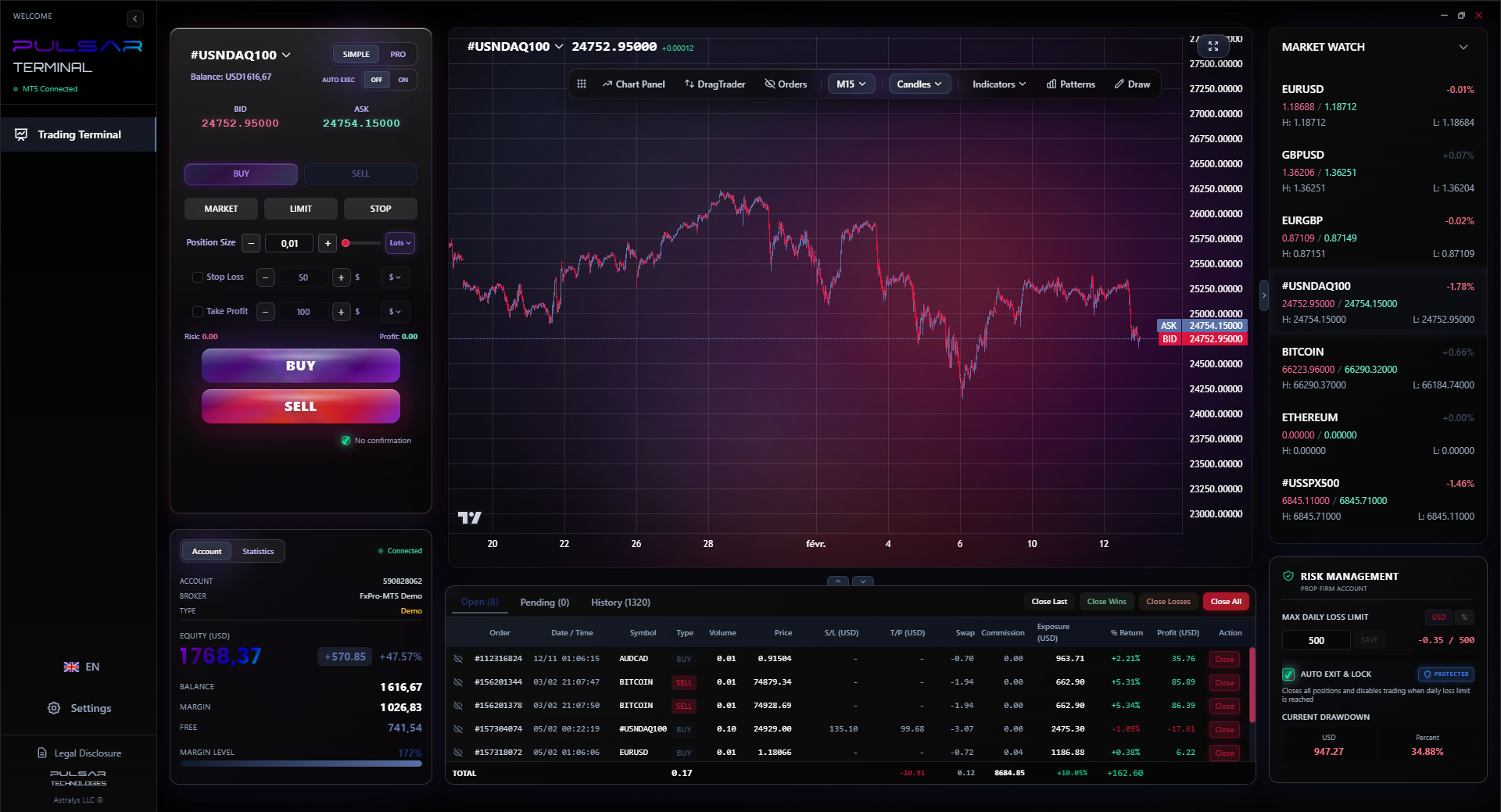
Pro Tip: If your goal is trading automation or better order management, solve that with technology, not corporate law. A tool like Pulsar Terminal for MT5 gives you advanced order types, trailing stops, and grid trading capabilities without needing a UK company.
Instead of complicating your legal structure, simplify your trading execution with tools that manage complex order types and risk directly on your charts.
Pulsar Terminal
The all-in-one MT5 companion: drag-and-drop orders, multi-TP/SL, trailing stop, grid trading, Volume Profile, and prop firm protection. Used by 1,000+ traders daily.
“Your energy is finite. Pour it into your trading strategy, not your corporate structure.”
After 12 years in this game and seeing countless traders blow up from complexity, my review is unequivocal: For a US resident engaged in personal forex trading, forming a UK Limited Company is one of the worst strategic decisions you can make.
You are not optimizing taxes; you are creating a double-layer of compliance. You are not protecting assets; you are creating a target for penalties. You are not gaining credibility; you are signaling to any savvy counterparty that you don't understand basic regulatory jurisdiction.
The allure is a mirage. The perceived benefits are eaten alive by professional fees, administrative time, and the constant, low-grade anxiety of filing something wrong and triggering a five-figure penalty.
Your energy is finite. Pour it into your trading strategy, your risk management, and your psychology. Use a position size calculator religiously. Master a core strategy like swing trading or scalping. Learn to read price action alongside tools like the RSI or MACD.
Keep your business structure boring, domestic, and invisible to your trading process. The goal is to make money trading, not to run a costly international holding company that happens to place a few forex trades. I learned this the expensive way so you don't have to.

FAQ
Q1Can a US resident legally own and operate a UK Limited Company for forex trading?
Yes, it's legal to own one. However, operating it for forex trading from the US introduces massive legal complexity. You must comply with both UK company law and US tax/reporting laws for foreign corporations (PFIC/CFC rules), which are extremely burdensome and expensive for an individual trader.
Q2Will a UK LTD save me money on taxes as a US forex trader?
Almost certainly not. The US taxes its residents on worldwide income. The UK LTD's profits will flow through to your US tax return. The punitive PFIC/CFC regimes likely mean your profits are taxed at your highest ordinary income rate, and you'll pay $2,000-$4,000+ annually in accountant fees to file the required forms. Any potential UK tax saving is erased.
Q3What is the biggest risk of using a UK LTD as a US trader?
The catastrophic IRS penalties for failing to file or incorrectly filing Form 5471 (for Controlled Foreign Corporations) or Form 8621 (for Passive Foreign Investment Companies). Penalties start at $10,000 per form, per year, and can be levied even if you owe zero tax. It's an administrative mistake that can bankrupt you.
Q4Can I use a UK LTD to trade with brokers like Exness or Pepperstone that don't accept US clients?
You can apply, but success is not guaranteed. Brokers perform thorough KYC and will identify you, the director, as a US resident. Many have policies against this exact scenario to avoid US regulatory complications. If you misrepresent your status, you risk account closure and forfeiture of funds.
Q5What's a simpler alternative for a US trader who wants a corporate structure?
Form a single-member LLC in your US state. It's a 'disregarded entity' for tax purposes, meaning you report the profits/losses on your personal Schedule C. It provides some liability separation, is understood by all US brokers, and costs a few hundred dollars per year to maintain with zero international reporting headaches.
Q6How much does it really cost to maintain a UK LTD as a non-resident?
Expect minimum annual costs of £800-£1,300 for UK accounting and compliance, plus an additional $1,000-$2,500 for US tax preparation to handle the PFIC/CFC forms. Total: $2,500-$4,500+ per year, before you've made a single profitable trade.
Prof. Winston's Lesson
Key Takeaways:
- ✓US worldwide taxation nullifies foreign corporate tax benefits.
- ✓PFIC/CFC reporting penalties start at $10,000 per form.
- ✓Annual compliance costs easily exceed $2,500 before trading.
- ✓Simplicity is the ultimate sophistication in trading structures.
How useful was this article?
Click a star to rate
Weekly Trading Insights
Free weekly analysis & strategies. No spam.
About the Author
James Mitchell
Senior Trading Analyst
Based in New York with over 9 years of trading experience. Focuses on major USD pairs, prop firm challenges, and the US regulatory landscape.
Comments
Risk Disclaimer
Trading financial instruments carries significant risk and may not be suitable for all investors. Past performance does not guarantee future results. This content is for educational purposes only and should not be considered investment advice. Always conduct your own research before trading.
You Might Also Like

Cara Trading Forex Sukses: 7 Prinsip dari Trader Profesional
Cara trading forex sukses dengan 7 prinsip trader pro: manajemen modal, disiplin, journal trading, backtest. Data nyata, bukan janji profit palsu.
Jam Trading Forex Terbaik untuk Trader Indonesia: Panduan Lengkap dengan Tabel Waktu
Panduan jam trading forex untuk trader Indonesia. Tabel 4 sesi dunia, jam emas 20:00-00:00, sesi mana yang harus dihindari. Data akurat + tips dari trader berpengalaman.
Top 5 Sàn Forex Uy Tín Nhất 2026: Review Jujur dari Trader Indonesia
Top 5 sàn forex uy tín 2026 untuk trader Indonesia. Review jujur: spread, deposit, withdraw, dukungan lokal. Exness, XM, IC Markets & lebih.
Get Pulsar Terminal
All these calculators are built into Pulsar Terminal with real-time data from your MT5 account. One-click position sizing, automatic risk management, and instant calculations.
Get Pulsar Terminal