


You're looking at Upcomers Prop Firm and wondering if it's the real deal, right? Another day, another prop firm promising you a six-figure account if you can just pass their 'simple' challenge.

James Mitchell
Senior Trading Analyst
☕ 11 min read
What you'll learn:
- 1What Exactly Is Upcomers Prop Firm?
- 2The Devil in the Details: Challenge Rules & Costs
- 3The Million Dollar Question: Do They Actually Pay Out?
- 4Stacking Up: Upcomers vs. Established Prop Firms
- 5Who Should Absolutely Avoid Upcomers (Right Now)?
- 6A Safer Path: What To Do Instead
- 7Final Verdict: High Risk, Unproven Reward

You're looking at Upcomers Prop Firm and wondering if it's the real deal, right? Another day, another prop firm promising you a six-figure account if you can just pass their 'simple' challenge. I get it. The allure is powerful, especially when you're stuck trading your own small account and watching spreads eat your profits. But before you pull out your credit card for that evaluation fee, let's talk about what you're really buying. I've traded with and analyzed over a dozen of these firms, and the devil is never in the marketing brochure. It's buried in the rulebook, the payout process, and the subtle ways they stack the odds just enough to keep most people paying fees, not collecting profits.
Upcomers Prop Firm is one of the newer players in the proprietary trading space, offering traders the chance to trade the firm's capital for a split of the profits. The basic pitch is standard: you pay a one-time fee for a challenge account. If you hit their profit target without breaking their rules (like daily loss limits or maximum drawdown), you 'graduate' to a funded account. From there, you keep a percentage of what you make.
On the surface, it looks like any other prop firm. But here's the first red flag I look for: transparency. When I first checked their site, key details like who exactly is running the firm, where it's legally based, and who their liquidity providers are were vague or missing. That's a problem. You're giving them money to take a test. You deserve to know who's administering it.
Their main selling points seem to be lower challenge fees compared to some giants and a straightforward profit split. They offer various account sizes, typically starting at a $10,000 simulated account and going up from there. Remember, you're not trading real market money in the challenge phase. You're trading in a simulated environment. The firm only risks its capital once you've proven yourself under their specific, often restrictive, conditions.

Warning: The term 'funded account' is misleading. In almost all retail prop firms like Upcomers, you are not given direct access to a pool of company money. You trade a simulated account, and the firm mirrors your trades with its own capital based on your performance. Your 'funded account' is still a demo. This matters for execution and slippage.
This is where most traders get wrecked. Not by the markets, but by the rulebook. Let's break down a typical Upcomers challenge structure, which is eerily similar to many others.
The Profit Target & Time Limit
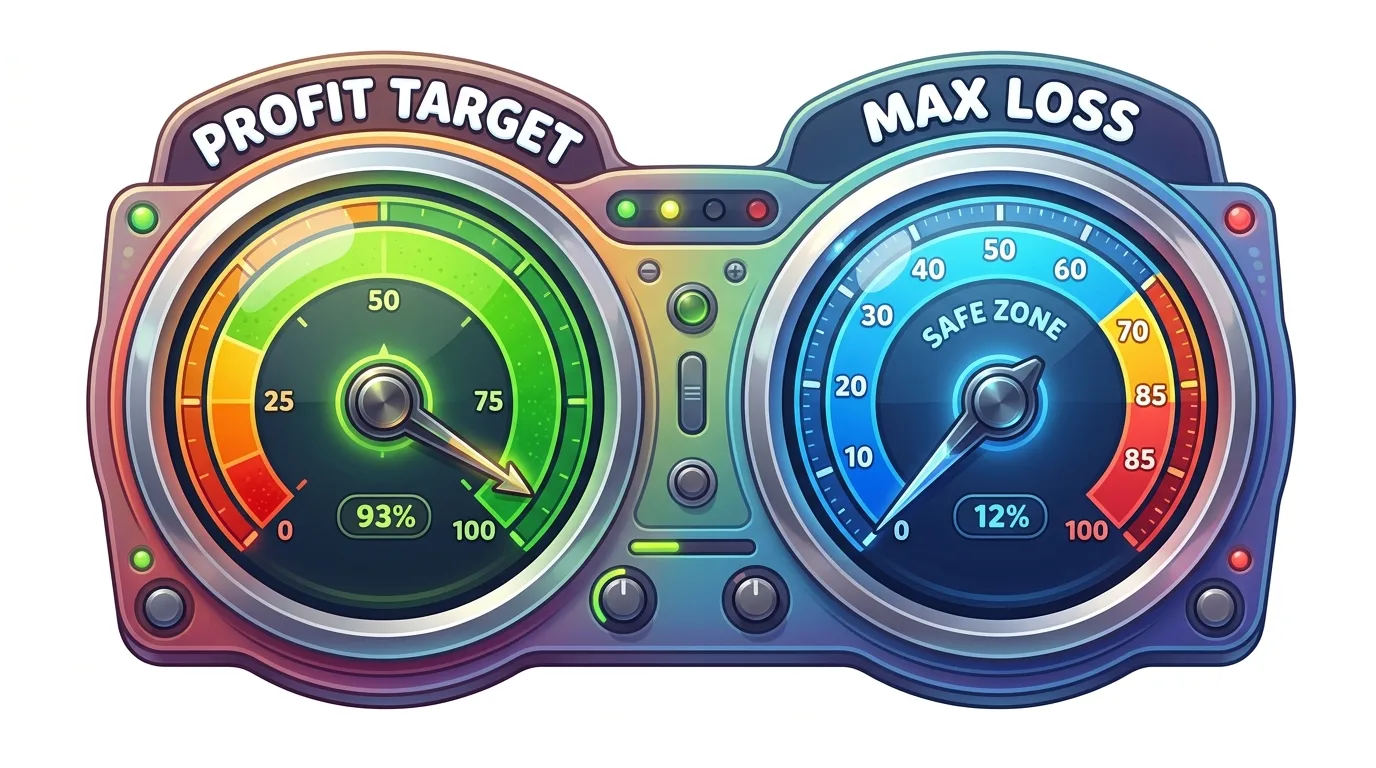
You might see an 8% profit target in 30 days. Sounds achievable, right? That's about 0.27% per day. But it's not linear. This target forces a specific behavior: you have to take enough risk to get there in time, which often conflicts with their other rules. The clock creates psychological pressure that leads to overtrading, the number one killer of challenge accounts.
The Drawdown Rules
This is the trap. You'll have a maximum drawdown (often 5-6%) and a daily loss limit (often 2-3%). The critical thing most miss is how it's calculated. Is the max drawdown based on your starting balance? Your highest balance? Or is it a trailing drawdown from your peak equity? Upcomers, like many, likely uses a trailing drawdown. This means your safety net shrinks as you profit.
Let me give you a real example from a different firm that had identical rules. I passed a $50k challenge by grinding out $2,400 (4.8%) in profit over 25 days. My max drawdown was 5% ($2,500). Because it was trailing from the peak, once my equity hit $52,400, my new loss limit was $52,400 - $2,500 = $49,900. I was only $900 above my starting line! One bad trade could wipe weeks of work. I didn't blow it, but the stress was immense. This rule is designed to make you stop trading after hitting the target, which is antithetical to developing a real trader's mindset.
The Costs
You'll pay a fee for the challenge. It might be $299 for a $25k account or $499 for a $100k account. This is non-refundable. Think of it as an exam fee. The firm's business model relies on a large percentage of people failing and re-buying challenges. Your success is not their primary revenue stream. Always use a position size calculator that incorporates these drawdown rules, not just your account balance.

💡 Winston's Tip
A prop firm's business model is built on challenge fees, not your success. Your first job is to understand how their rules are designed to make you fail, not just to manage risk.

“You are not just trading the market; you are betting on the firm's financial integrity and operational longevity.”
This is the only thing that matters. A prop firm that doesn't pay is a scam, full stop. As of my last deep dive, Upcomers Prop Firm doesn't have a long, verifiable track record of consistent payouts to a large number of traders. That's a major concern.
When evaluating, I look for:
- Public Payout Proof: Can I find video testimonials, bank statements, or PayPal screenshots from traders that aren't just affiliate marketers? With newer firms, this evidence is thin.
- Clear Payout Terms: What's the profit split? 80/20? 90/10? How frequently can you withdraw? Is there a minimum profit threshold? Are there any hidden fees on withdrawals?
- Processing Time & Methods: Do they pay via crypto, wire, or Skrill? How long does it take? Delays are a classic warning sign.
I made the mistake early in my career with a different new prop firm. I passed their challenge, made a $1,500 profit on the funded account, and requested a payout. Radio silence for two weeks, then an email claiming I violated a rule about news trading (a rule buried in a FAQ page). My account was closed, no payout. The $399 challenge fee was gone. That experience cost me real money and taught me to wait for community trust to build.

Pro Tip: Before buying any challenge, spend a week in online trading forums (not the firm's own Discord). Search the firm's name + 'payout' or 'scam'. Look for patterns of complaints. One or two disgruntled losers is normal. Dozens of people saying they weren't paid is a pattern.
Until Upcomers establishes a solid, 12+ month history of smooth, dispute-free payouts, you are an early adopter taking a significant risk. Your capital for the challenge is at risk, and your time and effort certainly are.
How does it compare to the names you know? Let's be blunt: the established firms are expensive for a reason. They have proven systems and, crucially, a reputation to protect.
| Feature | Upcomers Prop Firm (Typical) | Established Firm (e.g., FTMO, SurgeTrader) |
|---|---|---|
| Challenge Fee | Lower ($200-$500 range) | Higher ($500-$1,000+) |
| Rule Clarity | Often vague, subject to change | Very detailed, but complex |
| Payout History | Short/Unproven | Long, well-documented |
| Trader Support | Limited, slow | Dedicated, faster (usually) |
| Instrument Coverage | Standard Forex, maybe indices | Forex, indices, commodities, crypto |
| Primary Risk | Firm may not pay/fold | You failing the strict rules |
The trade-off is clear. With an established firm, you're paying a premium for reliability. You're betting against their rules, but you're confident the prize is real if you win. With a newer firm like Upcomers, you're betting against their rules and their solvency and honesty. That's two layers of risk.
For a US trader, this is even more critical. Many top global prop firms don't accept US clients due to regulatory hurdles. The ones that do are a smaller pool. A new firm popping up and accepting US traders immediately makes me skeptical about their regulatory compliance and long-term stability. Have they consulted with US securities lawyers? It's unlikely. This isn't to say Upcomers is a scam, but the lack of established history in a restrictive regulatory environment like the US is a giant yellow flag.
If you're considering a firm for swing trading strategies, you need to check their holding rules over weekends and on news events. Newer firms often have overly restrictive rules here to protect themselves.
💡 Winston's Tip
If you can't find 10 independent, non-affiliated traders showing proof of payment from a firm older than 18 months, you are the guinea pig. Your fee is funding their marketing, not your future.

“The potential savings on a challenge fee are not worth the overwhelming risk of the firm failing to pay you your earned profits.”
Based on my analysis, here are the traders who should steer clear of Upcomers Prop Firm at this stage:
- New Traders: If you have less than a year of consistent, profitable live trading experience, you are just donating your challenge fee. These rules are designed to exploit the undisciplined. You need a rock-solid, rule-based strategy first. Learn about the MACD indicator or RSI indicator in a real market context, not under challenge pressure.
- Traders Needing the Money: If the challenge fee is a significant portion of your trading capital, you cannot afford the risk. The psychological burden will ruin your trading.
- US Traders Seeking Certainty: The US prop firm space is murky. If you need reliable payouts as a business income stream, the risk of a new firm folding or not paying is too high. Look at more established options that explicitly serve the US market, even if their rules are tougher.
- Scalpers and High-Frequency Traders: New firms often have poor execution infrastructure and higher latency. They may also prohibit scalping strategies or have minimum trade times. You'll get filled at worse prices, turning winning strategies into losers.
I fell into the first category years ago. I was green, had a few good months on a demo, and thought a prop firm challenge was my ticket. I blew two challenges in a row, losing nearly $1,000 in fees. That money would have been better spent on a course, books, or just trading a micro account at a broker like Pepperstone or IC Markets to learn real spread dynamics.

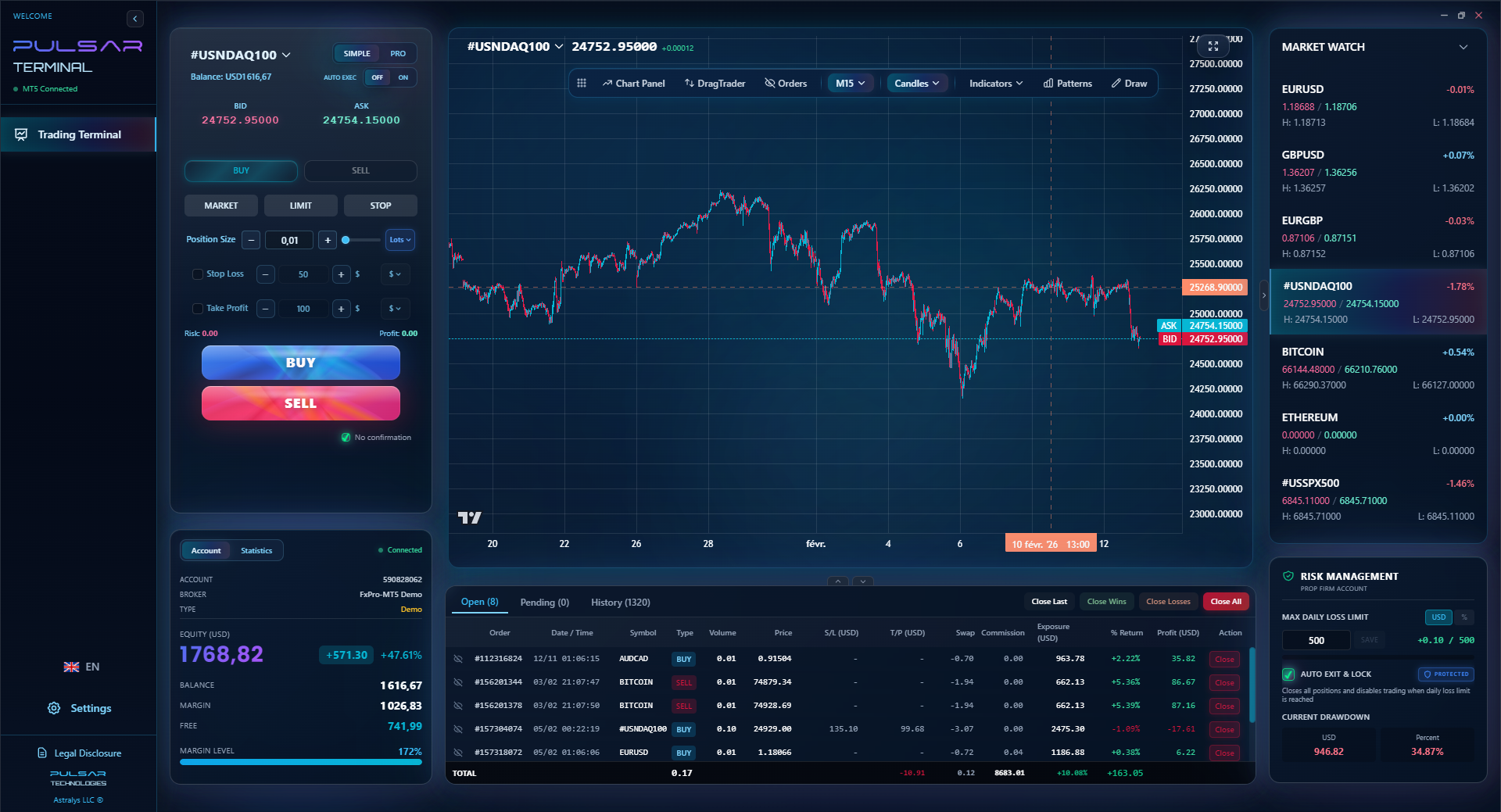
Managing the complex trailing drawdown and daily loss rules of a prop firm challenge is nearly impossible manually, which is why tools like Pulsar Terminal automate this protection directly on your MT5 platform.
Pulsar Terminal
The all-in-one MT5 companion: drag-and-drop orders, multi-TP/SL, trailing stop, grid trading, Volume Profile, and prop firm protection. Used by 1,000+ traders daily.
If you're drawn to Upcomers for the lower fee, I propose a different, more powerful approach. This is what I wish I had done.
Step 1: Prove Yourself to Yourself. Open a small live account with a reputable, well-regulated broker. Deposit an amount you can afford to lose - say $500. Your goal is not to get funded. Your goal is to grow that account by 8% in 30 days while adhering to a strict risk management rule: never risk more than 1% of your account on a single trade, and never let your account draw down more than 5% from its peak. This simulates the prop firm challenge, but the money is real, the psychology is real, and you keep all the profits. If you can't do this with your own $500, you will not do it with a firm's simulated $50,000.
Step 2: Build a Track Record. Do this for 3-6 months. Document every trade. Use a journal. Build a verifiable track record of consistency. This record is now your resume.
Step 3: Choose a Firm with Evidence. Once you have a proven strategy and iron discipline, then consider a prop firm. But now, you can choose based on reliability, not just price. You can look at firms with years of payout history. The higher fee is an investment in security, not a cost. You'll approach their challenge with the calm of a professional, not the desperation of a gambler.
This path takes longer, but it builds actual skill. The prop firm then becomes a logical step to scale your proven business, not a lottery ticket you hope will solve your problems. It turns you from a customer buying a dream into a service provider selecting a partner.

Example: Your $500 account. A 1% risk is $5. With a 50-pip stop loss on EUR/USD, your position size is $1 per pip (a micro lot). To make 8% ($40), you need to capture 40 pips of profit. This is a realistic, pressure-free goal that teaches real trading.

“Be the trader that firms want to fund, not the customer they hope will fail and re-buy.”
So, is Upcomers Prop Firm legit? The unsatisfying answer is: maybe, but the evidence isn't in yet.
It operates in a gray area with a business model that inherently profits from failure. Its lack of a substantial public track record of payouts, especially for US traders, makes it a high-risk venture. You are not just trading the market; you are betting on the firm's financial integrity and operational longevity.
My professional opinion: Avoid it for now.
The potential savings on a challenge fee are not worth the overwhelming risk of the firm failing to pay you your earned profits, or worse, folding and disappearing with your challenge fee. The emotional and financial cost of that outcome far exceeds the few hundred dollars you might save.
Focus on the slower, surer path. Build a real track record with your own capital. Develop unshakable discipline. The world of prop trading isn't going away. When you are truly ready, the reputable firms will still be there, and you'll pass their challenges on your first try because you've already done the hard work. Don't be in a hurry to give your money to an unproven entity. Be the trader that firms want to fund, not the customer they hope will fail and re-buy. That shift in mindset is the only thing that will make you money in the long run, regardless of whose capital you're using.
Remember, a margin call on your own small account is a cheap lesson. A blown prop firm challenge because of opaque rules is an expensive tuition fee paid to the wrong school.
FAQ
Q1What is the minimum challenge fee for Upcomers Prop Firm?
While fees change, they typically start around $200-$300 for their smallest account size (e.g., $10,000-$25,000 in simulated capital). Always check their official website for current pricing, but remember: a lower fee often correlates with higher risk regarding the firm's overall stability and payout reliability.
Q2Does Upcomers Prop Firm accept traders from the United States?
Based on their marketing, they appear to accept US clients. However, this is a major red flag for due diligence. The regulatory environment for prop firms serving US traders is complex. A new firm readily accepting US clients should prompt serious questions about their legal structure and long-term compliance, which directly impacts your ability to get paid.
Q3What is the profit split with Upcomers?
Most newer firms like Upcomers offer competitive splits, often 80% or more to the trader. However, the split percentage is meaningless if the firm doesn't honor payouts. Always prioritize proof of consistent payments over a slightly higher percentage in the contract.
Q4How long does it take to get a payout from Upcomers?
There is insufficient public data from a large pool of traders to establish a reliable payout timeline for Upcomers. Established firms often process payouts within 1-10 business days. The lack of widespread, verifiable user reports on Upcomers' payout speed is a significant concern and part of the 'unproven' risk.
Q5Can I use Expert Advisors (EAs) or trade during news with Upcomers?
You must read their specific Terms of Service. Most prop firms, especially newer ones, restrict or prohibit EAs and have strict rules around news events (like holding positions through major economic releases). These rules are designed to limit the firm's risk and are common points of failure for traders who don't read the fine print.
Q6Is Upcomers Prop Firm a scam?
Based on available information, I cannot definitively label it a scam. It operates a common prop firm model. However, it exhibits high-risk characteristics: short operational history, lack of extensive public payout proof, and vagueness around key details. The burden of proof is on the firm to establish trust. Until they do, traders should treat it as a high-risk, speculative venture, not a reliable business partner.
Q7What's the biggest risk with a firm like Upcomers?
The biggest risk is not failing the challenge. It's passing the challenge, making profits on the funded account, and then the firm failing to pay you. This could be due to insolvency, fabricated rule violations, or simply shutting down. You lose your challenge fee, your time, and all your earned profits. This risk is substantially higher with unproven firms.
Prof. Winston's Lesson
Key Takeaways:
- ✓Prop firm profits come from failed challenges, not your success.
- ✓A trailing 5% drawdown leaves almost no room for error after profit.
- ✓Never trust a firm without 12+ months of public payout proof.
- ✓A lower challenge fee usually means a higher risk of non-payment.
- ✓Prove your strategy on a $500 live account before attempting any challenge.
How useful was this article?
Click a star to rate
Weekly Trading Insights
Free weekly analysis & strategies. No spam.
About the Author
James Mitchell
Senior Trading Analyst
Based in New York with over 9 years of trading experience. Focuses on major USD pairs, prop firm challenges, and the US regulatory landscape.
Comments
Risk Disclaimer
Trading financial instruments carries significant risk and may not be suitable for all investors. Past performance does not guarantee future results. This content is for educational purposes only and should not be considered investment advice. Always conduct your own research before trading.
You Might Also Like

Cara Trading Forex Sukses: 7 Prinsip dari Trader Profesional
Cara trading forex sukses dengan 7 prinsip trader pro: manajemen modal, disiplin, journal trading, backtest. Data nyata, bukan janji profit palsu.
Jam Trading Forex Terbaik untuk Trader Indonesia: Panduan Lengkap dengan Tabel Waktu
Panduan jam trading forex untuk trader Indonesia. Tabel 4 sesi dunia, jam emas 20:00-00:00, sesi mana yang harus dihindari. Data akurat + tips dari trader berpengalaman.
Top 5 Sàn Forex Uy Tín Nhất 2026: Review Jujur dari Trader Indonesia
Top 5 sàn forex uy tín 2026 untuk trader Indonesia. Review jujur: spread, deposit, withdraw, dukungan lokal. Exness, XM, IC Markets & lebih.
Get Pulsar Terminal
All these calculators are built into Pulsar Terminal with real-time data from your MT5 account. One-click position sizing, automatic risk management, and instant calculations.
Get Pulsar Terminal