


I remember staring at my screen in late 2024, watching the Naira hit 1717 to the dollar.

Olumide Adeyemi
West African Trading Pioneer ·  Nigeria
☕ 11 min read
What you'll learn:
- 1use 101: It's Just a Magnifying Glass (For Better or Worse)
- 2The Naira & Numbers: Calculating Your Real Risk
- 3The Regulatory Tightrope: SEC Rules vs. Broker Offers
- 4How to Actually Use use Without Self-Destructing
- 5Getting Money In & Out: The Nigerian Lifeline
- 6Mistakes I've Made (So You Don't Have To)
- 7Essential Tools: From MT5 to Risk Managers
- 8The Final Word for the Nigerian Trader
I remember staring at my screen in late 2024, watching the Naira hit 1717 to the dollar. My small $200 account, juiced up with 1:500 use, felt like a rocket ready to launch. I went all-in on a USD/NGN bet, convinced the CBN would intervene. They did, but not before a 90-pip spike against me wiped out my entire margin in under an hour. That cold, sick feeling taught me more about what leverages in forex really are than any textbook ever could. It's not free money, it's borrowed risk, and in Nigeria's volatile market, understanding that difference is everything.
Let's strip away the fancy terms. What are leverages in forex, really? Think of it as a magnifying glass for your trading capital. You put down a small deposit (your margin), and your broker lends you the rest to control a much larger position. That's the loan. The use ratio tells you how much bigger that position is compared to your cash.
Here's the classic example: with 1:100 use, you control $100,000 with just $1,000 of your own money. If the market moves 1% in your favor, you make $1,000 - a 100% return on your cash. Sounds amazing, right? But here's the flip side. That same 1% move against you? You lose your entire $1,000. Poof. Gone.
For us in Nigeria, this is crucial. Our market moves can be sharp and news-driven. A CBN circular or a shift in oil prices can send pairs like GBP/NGN or USD/NGN swinging wildly. High use on those pairs is like holding that magnifying glass in a hurricane.

Warning: use doesn't change the value of a pip. On a standard lot (100,000 units), one pip is always roughly $10. use just determines how much of your own cash is backing each of those $10 moves. More use means each pip movement has a larger impact on your account balance, percentage-wise.
Okay, let's get practical with some numbers you'll actually see. Many brokers popular here, like XM or IC Markets, offer use up to 1:1000. That's insane power on a small account.
Let's say you deposit 50,000 NGN (about $37 at ~₦1350/$). With 1:500 use, your usable margin lets you open a position worth $18,500. You decide to buy 0.2 lots of EUR/USD (where 1 lot = €100,000).
Here's the math that keeps you alive:
- Position Value: 0.2 lots = €20,000. At EUR/USD = 1.0850, that's $21,700.
- Required Margin: At 1:500 use, margin = Position Value / 500. So, $21,700 / 500 = $43.40.
- Your Cash at Risk: Your 50,000 NGN deposit is about $37. You see the problem? The margin requirement ($43.40) is already more than your entire account balance ($37). The broker would reject this trade. You'd need more capital or to lower your lot size.
This is why a position size calculator isn't a nice-to-have, it's a survival tool. You must calculate your lot size based on your account balance, your stop-loss distance in pips, and the percentage of your account you're willing to risk (never more than 1-2%).
The Local Account Advantage
Some brokers, like HFM, offer Naira-denominated accounts. This is a game-saver. You deposit and withdraw in NGN, and your profit/loss is displayed in NGN. It removes the mental gymnastics of converting every pip value from dollars to Naira and lets you focus on the trade. If your broker offers it, use it.

💡 Winston's Tip
Professor Winston always said, 'use is a multiplier of your psychology, not just your capital.' If you're prone to fear or greed with a small position, high use will turn those emotions into account-ending decisions.
“Your use should be inversely proportional to your time frame and the pair's volatility.”
This is where it gets interesting for Nigerian traders. Our local rules are tightening, but broker offers remain incredibly generous.
On one hand, you have the Securities and Exchange Commission (SEC) and its new Investments and Securities Act, 2025 (ISA 2025). This law says any platform offering forex trading services to Nigerians must register with the SEC. The catch? The SEC doesn't yet have a specific license for international spot forex brokers. So, who are we trading with?
Almost exclusively, we're using international brokers regulated abroad. Think Pepperstone (ASIC in Australia), Exness (FSA in Seychelles), or IC Markets (ASIC). These regulators have their own use limits for their regions (like 1:30 in Europe for major pairs), but they often allow their globally licensed entities to offer higher use to clients in countries like Nigeria.
That's why you see these jaw-dropping offers:
- 1:500 at Pepperstone, FP Markets
- 1:1000 at XM, IC Markets, Tickmill
- 1:2000 at HFM
- "Unlimited" at Exness (with conditions)
The broker isn't breaking Nigerian law (they're not physically here), and they're following their offshore license rules. But you, the trader, are operating in a grey area. Your protection comes from the broker's international regulation - their requirement to segregate client funds and provide dispute resolution - not from Nigerian law. Always verify a broker's overseas license before depositing a single kobo.

Pro Tip: Don't chase the highest use like it's a badge of honor. A broker offering 1:1000 with tight spreads and reliable withdrawals is better than one offering 1:2000 with slippage and hidden fees. I learned this the hard way with a sketchy broker that offered 'unlimited' use but mysteriously widened spreads every time I was about to hit profit.
So you've got this powerful tool. How do you use it without becoming another statistic? You adopt a strategy based on your trading style and the pair you're trading.
For Scalping: You're in and out for 5-10 pips. High use like 1:500 can make sense because your stop-loss is very tight (maybe 5 pips). Your total risk per trade in dollars is small, but the use amplifies the gain on those few pips. I used a scalping strategy on EUR/USD with 1:200 use, risking 0.5% per trade. A 7-pip win on a 0.1 lot trade netted me $7 on a $100 margin - a decent return for a minute's work.
For Swing Trading: You're holding for days or weeks, aiming for 100+ pip moves. Here, high use is a death trap. A 50-pip adverse swing on a highly leveraged position can trigger a margin call before your trade ever has a chance. For swing trading, I never use more than 1:50. The goal is to stay in the game, not get rich on one trade.
On Exotic Pairs (like USD/NGN or GBP/NGN): These are less liquid and more volatile. The spreads are wider - sometimes 50 pips or more. Using high use here is like juggling dynamite. I once put on a USD/NGN trade with 1:100 use. The spread alone was 80 pips. I was in the red before the trade even started, and a small move against me wiped out my margin. Lesson learned: on exotics, use minimal use (1:10 or less) or avoid them until you're very experienced.
The golden rule? Your use should be inversely proportional to your time frame and the pair's volatility. Shorter time frame, tighter stops, slightly higher use can work. Longer time frame, always lower use.
“The brokers will dangle 1:1000 in front of you. Your goal isn't to use the most use; it's to use the right amount.”
All this use talk is useless if you can't fund your account or get your profits out. This is a very real headache for us.
The Problem: CBN restrictions on using Naira debit cards for large international transactions. You might try to deposit $500 and your bank blocks it, labeling it a 'forex transaction'.
The Solutions Nigerian Traders Actually Use:
- Domiciliary Account: This is the king. You fund it with USD/GBP/EUR (through Bureau de Change or official channels) and transfer directly to your broker. It's clean and reliable.
- E-Wallets: Neteller and Skrill are workhorses. You fund them via your bank card or transfer, then send to the broker. Withdrawals come back to the e-wallet. Fees apply, but it bypasses many bank blocks.
- Local Payment Processors: This is the growing trend. Brokers are integrating with systems like Interswitch, Paystack, and Flutterwave. You pay in Naira from your bank app, they convert it and send USD to your trading account. Super convenient. Always check your broker's 'Deposit' page for the latest local options.
- Cryptocurrency: Some brokers accept deposits in USDT or Bitcoin. You buy crypto on a local exchange like Binance, then send it to your broker's wallet address. Fast, but be aware of crypto price volatility during the transfer.

Example: I use a combination. For regular funding, I use a local processor via my broker's website - 50,000 NGN arrives as ~$37 in minutes. For larger withdrawals (over $1000), I opt for a Skrill withdrawal to keep things smooth with my bank. It costs a few dollars, but it's worth the peace of mind.
💡 Winston's Tip
Here's a Winston-ism: Calculate your position size first, then see what use it requires. Never pick the use first and then see how big a trade you can afford. That's putting the cart before the horse, and the horse usually bolts.
Let me be brutally honest about where I've blown up. This is the unglamorous side of what leverages in forex can do.
Mistake 1: Overleveraging on News. When the CBN announced the new FX code in late 2024, I was sure the Naira would instantly strengthen. I used 1:500 use on a USD/NGN sell position. The news was bullish for Naira, but the market sold off initially on the details. A 0.2% move (which is nothing in forex) against me wiped out 100% of my margin on that trade. I was right on the direction eventually, but I was already out of the game.
Mistake 2: Ignoring the Spread on Entry. On a volatile day, the spread on GBP/USD can widen from 1 pip to 5 pips. If you're using 1:200 use and buying 1 lot, that's a $50 loss the moment you click 'Buy'. You're down 5 pips before the market even moves. This eats into your margin fast. Now I only enter trades when spreads are at their normal, tight levels, usually during the London or New York overlaps.
Mistake 3: No Stop-Loss, Thinking 'use is My Cushion'. This is the worst logic. I once held a losing EUR/USD trade, thinking "I have high use, I can withstand the drawdown." All use does is make the drawdown happen faster. The trade kept going south, and by the time I manually closed it, I'd lost 40% of my account. A hard stop-loss set at 1-2% risk would have saved me.
The pattern? use amplifies every little mistake - bad timing, poor execution, emotional decisions - into a catastrophic loss. It doesn't create better trades; it punishes bad ones more severely.
“use amplifies every little mistake into a catastrophic loss. It doesn't create better trades; it punishes bad ones more severely.”
To handle use responsibly, you need the right tools. For most of us, that's MetaTrader 4 or 5. It's the standard for a reason. But the default platform only gets you halfway.
You need to master its built-in risk features:
- The Order Window: Always set your Stop Loss and Take Profit before you click 'Buy' or 'Sell'. No exceptions.
- Account History: Review it weekly. Calculate your average win vs. average loss. If your average loss is bigger, your use is too high for your strategy.
- Market Watch: Right-click and select 'Spread' to see the live spread. Don't trade when it's abnormally wide.
For more advanced control, this is where companion tools shine. Imagine being able to set a rule like "move my stop-loss to breakeven when the trade is 15 pips in profit" on every trade, automatically. Or setting a trailing stop that follows the price up. Doing this manually on 5 different charts is impossible, but automation makes it consistent.
This kind of automated risk management is critical when using use. It takes the emotion out of the equation and enforces your rules, especially when you're in a profit and greed tells you to remove your stop. A tool that manages partial closures and trailing stops lets you lock in profits systematically, which is the only way to make high-use trading sustainable in the long run.
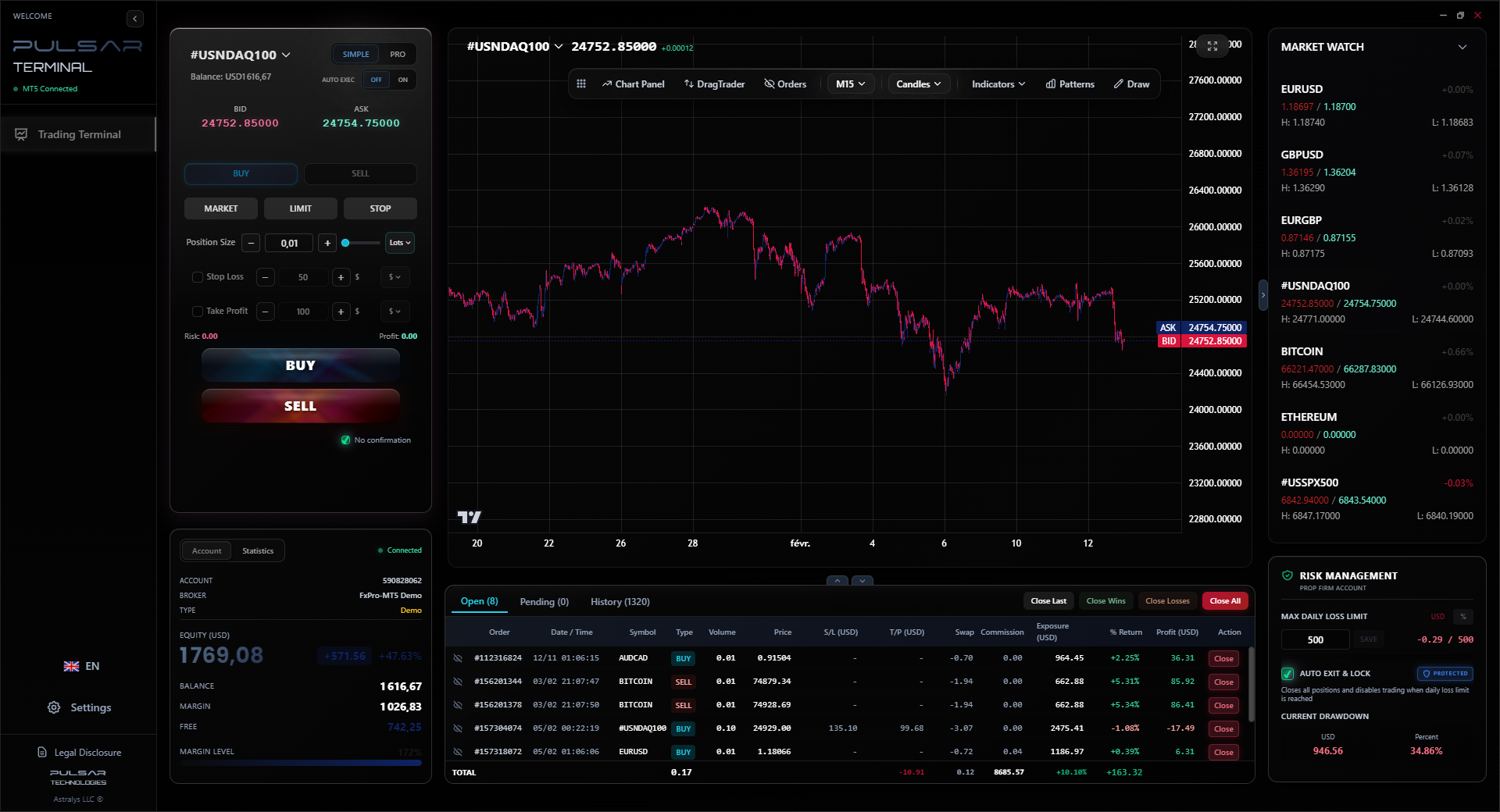
Managing the extreme risk of high leverage requires iron-clad discipline, which is exactly what automated tools like Pulsar Terminal provide by enforcing stop-loss, take-profit, and trailing stop rules directly on your MT5 platform.
Pulsar Terminal
The all-in-one MT5 companion: drag-and-drop orders, multi-TP/SL, trailing stop, grid trading, Volume Profile, and prop firm protection. Used by 1,000+ traders daily.
So, what are leverages in forex for you, right now in Nigeria? They're a test of discipline. In a market with unique challenges - Naira volatility, funding hurdles, and an evolving regulatory scene - use is the variable that determines how quickly you learn or how quickly you burn out.
The brokers will dangle 1:1000 in front of you. Your friend will brag about turning 20k NGN into 200k NGN in a week. Ignore the noise. Start with the lowest use your broker allows, maybe 1:50. Practice with a demo account, then a small live account funded via a local payment method. Use a position size calculator for every single trade.
Treat high use like a powerful prescription drug. In tiny, controlled doses for a specific purpose (like a scalping strategy), it can be effective. In large, reckless amounts, it's toxic. Your goal isn't to use the most use; it's to use the right amount to execute your strategy while keeping your account safe from the inevitable storms in our market. That's how you move from being a gambler magnifying his losses to a trader amplifying his gains.
FAQ
Q1Is forex use legal in Nigeria?
Yes, using use offered by international forex brokers is legal for individual Nigerian traders. However, the brokers themselves are not regulated by Nigerian authorities like the SEC for spot forex trading. The new ISA 2025 law requires platforms to register, but a specific framework isn't fully in place yet. Your protection comes from the broker's foreign regulation (e.g., ASIC, FCA, CySEC).
Q2What is a good use for a beginner in Nigeria?
Start with no more than 1:50, even if your broker offers 1:1000. This forces you to focus on proper position sizing and risk management. A beginner's goal should be to survive and learn, not to maximize returns. With 1:50, a 2% move against you will lose 100% of your margin. That's more than enough risk to start with.
Q3How does use affect my profit and loss in Naira?
use multiplies the dollar value of each pip movement, and that dollar P&L is then converted to Naira at the current exchange rate. If you use a Naira-denominated account, this conversion is done for you. For example, a $10 profit with use might become a $100 gain. At ₦1350/$, that's 135,000 Naira instead of 13,500 Naira. The same multiplication applies to losses.
Q4Can I lose more money than I deposit with use?
With most reputable international brokers offering retail accounts, you cannot lose more than your account balance due to mandatory negative balance protection. This is a key reason to use a well-regulated broker. If your losses reach your available margin, the broker will automatically close your positions (a margin call). You lose your deposit but owe nothing more.
Q5Why do brokers offer higher use to Nigerian traders?
Because the local regulatory caps that apply in regions like Europe (1:30) or the US (1:50) do not legally bind brokers' offshore entities serving clients in Nigeria. These entities operate under different licenses (often from Seychelles, Cyprus, or Mauritius) that permit higher use to attract clients from markets with less restrictive local forex laws.
Q6What's the difference between use and margin?
They are two sides of the same coin. use is the ratio (e.g., 1:100). Margin is the actual amount of your own money required to open and hold that leveraged position. If you want to control a $10,000 position with 1:100 use, the required margin is $10,000 / 100 = $100. That $100 is locked up while your trade is open.
Q7Should I use the maximum use my broker offers?
Almost never. The maximum use is a marketing tool, not a trading recommendation. Using it is like driving your car at its maximum speedometer reading constantly - it's only a matter of time before you crash. Choose your use based on your strategy's stop-loss size and your personal risk tolerance, not the broker's maximum.
Prof. Winston's Lesson
Key Takeaways:
- ✓Start with 1:50 max, no matter what the broker offers.
- ✓A 2% account risk per trade is a ceiling, not a target.
- ✓Always calculate position size before checking use.
- ✓If the spread eats more than 20% of your target profit, skip the trade.
- ✓Use a Naira account to eliminate currency risk on your P&L.
How useful was this article?
Click a star to rate
Weekly Trading Insights
Free weekly analysis & strategies. No spam.
About the Author
Olumide Adeyemi
West African Trading Pioneer
One of Nigeria's most active forex trading educators. 8 years of experience trading from Lagos. Specializes in low-capital strategies and prop firm challenges for African traders.
Comments
Risk Disclaimer
Trading financial instruments carries significant risk and may not be suitable for all investors. Past performance does not guarantee future results. This content is for educational purposes only and should not be considered investment advice. Always conduct your own research before trading.
You Might Also Like

Cara Trading Forex Sukses: 7 Prinsip dari Trader Profesional
Cara trading forex sukses dengan 7 prinsip trader pro: manajemen modal, disiplin, journal trading, backtest. Data nyata, bukan janji profit palsu.
Jam Trading Forex Terbaik untuk Trader Indonesia: Panduan Lengkap dengan Tabel Waktu
Panduan jam trading forex untuk trader Indonesia. Tabel 4 sesi dunia, jam emas 20:00-00:00, sesi mana yang harus dihindari. Data akurat + tips dari trader berpengalaman.
Top 5 Sàn Forex Uy Tín Nhất 2026: Review Jujur dari Trader Indonesia
Top 5 sàn forex uy tín 2026 untuk trader Indonesia. Review jujur: spread, deposit, withdraw, dukungan lokal. Exness, XM, IC Markets & lebih.
Get Pulsar Terminal
All these calculators are built into Pulsar Terminal with real-time data from your MT5 account. One-click position sizing, automatic risk management, and instant calculations.
Get Pulsar Terminal