


I lost ₦42,000 on a single USD/NGN trade in 2021, and the spread was the silent killer.

Olumide Adeyemi
West African Trading Pioneer ·  Nigeria
☕ 13 min read
What you'll learn:
- 1The Spread Explained: Your First and Most Important Cost
- 2How Spreads Actually Work on Your MT4/MT5 Screen
- 3The Real Cost: Calculating What the Spread Eats From Your Account
- 4Broker Spreads in Nigeria: Who's Tight, Who's Wide, and Who's Lying
- 5When Spreads Widen (And How to Avoid Getting Killed)
- 6Trading Strategies to Manage Spread Cost
- 7Advanced Concepts: The Stuff Your Broker Won't Tell You
- 8Your 5-Point Action Plan for Tighter Spreads
I lost ₦42,000 on a single USD/NGN trade in 2021, and the spread was the silent killer. I bought at ₦412.50, convinced the Naira was about to rally. The second my order filled, I was already in the red. The market needed to move over a full Naira in my favor just for me to break even. It never did. That painful lesson taught me that in Nigeria, where every Naira counts, understanding what a spread really is isn't just theory - it's survival. If you don't get this, you're funding your broker's new car before you've made a single profit.
Let's cut through the jargon. The spread is simply the gap between the price you can buy at (the Ask) and the price you can sell at (the Bid). It's not a tax or a separate fee you see on a statement. It's baked right into the price, which is why so many new traders miss it until it's too late.
Think of it like changing money at the airport. The board says 'Buy USD at ₦1,450, Sell USD at ₦1,420.' That ₦30 difference is the spread, and it's the bureau de change's profit. In forex, your broker is that bureau de change, and the spread is how they get paid for facilitating your trade. On a major pair like EUR/USD, this gap might be tiny, say 0.00010 (or 0.1 pips). On something like USD/NGN, especially during volatile CBN policy announcements, that gap can be a canyon.

Warning: A wide spread means the market is either illiquid (not many people trading) or highly volatile. Entering a trade during these times, like right before a major news release, is like agreeing to pay a huge entry fee. Your trade starts at a significant disadvantage.
The moment you click 'Buy,' you buy at the higher Ask price. To close that trade for a profit, the market must rise enough to cover the spread and then move further in your direction. If you buy EUR/USD at an Ask price of 1.0850 with a 1-pip spread, the Bid price (your immediate sell price) is 1.0849. You're losing 1 pip from the get-go. This is the fundamental answer to 'what does spread mean in forex trading' - it's the hidden hurdle you must jump over first.
Open your trading platform right now. Look at the market watch window for EUR/USD. You'll see two prices: Bid and Ask. The Bid is always lower. That difference, usually in pips, is your live spread.
Pips and Points: Measuring the Gap
For most pairs (EUR/USD, GBP/USD), a pip is a movement at the fourth decimal place: 0.0001. For JPY pairs (USD/JPY), it's the second decimal: 0.01. With Nigerian pairs like USD/NGN, a pip is typically ₦0.01 (the second decimal place, e.g., ₦1450.50).
Some brokers now quote to a fifth decimal place (0.00001). That last digit is a 'point' or 'pipette.' It allows for tighter spreads. A spread of 1.4 might be displayed as 1.4 pips, which is actually 14 pipettes.

Example: USD/NGN Quote: Bid = ₦1,448.30 / Ask = ₦1,448.85 Spread = ₦1,448.85 - ₦1,448.30 = ₦0.55 Since 1 pip on USD/NGN is usually ₦0.01, this is a 55-pip spread. That's massive compared to a 0.8 pip spread on EUR/USD. This shows the huge cost difference when trading less liquid pairs.
Variable vs. Fixed Spreads: Which is Better in Nigeria?
This is a big one. Most brokers offer variable spreads. This means the gap widens and tightens based on market liquidity. At 2 pm Lagos time on a Tuesday, EUR/USD might be at 0.9 pips. At 2:30 pm when US retail sales data drops, it could blow out to 5 pips in a heartbeat. I got caught in this during a Fed announcement; my planned 5-pip stop loss was triggered instantly by a spreading market, not a price move. The trade was a good idea, but the cost of entry killed it.
Fixed spreads are less common. The broker guarantees the spread won't widen, no matter the news. This sounds great for risk management, but there's a catch. To offer this guarantee, brokers often charge a higher average spread overall and may use a 'dealing desk' model, which can lead to requotes (your order is rejected and a new price is offered) during fast markets. For a scalping strategy where you're in and out quickly, a fixed spread can make cost calculation easier. For swing trading, a variable spread account from a good ECN broker is usually cheaper.

💡 Winston's Tip
A spread isn't a suggestion, it's a toll gate. If you can't afford the toll, you don't get on the expressway. Trade smaller or don't trade at all during wide spreads.
“In Nigeria, where every Naira counts, a wide spread isn't a fee, it's a financial ambush.”
Stop thinking in pips for a second. Think in Naira. That's the only number that matters to your pocket. The spread's cost in your account currency depends on three things: the spread size (in pips), the lot size you're trading, and the pip value.
Let's do the math that most Nigerian traders skip. Say you're trading a standard lot (100,000 units) of EUR/USD.
- Spread: 1.2 pips
- Pip Value for 1 standard lot: ~$10 (for EUR/USD)
- Cost of the trade: 1.2 pips * $10 = $12
At an exchange rate of ₦1,450/$, that's ₦17,400 gone before the market even moves. On a $1,000 account using 1:100 use, that's a 1.74% account drawdown just to open the trade. You need to make 1.74% back just to get to zero.
Now, let's look at a mini lot (10,000 units) on USD/NGN, which many Nigerians trade.
- Spread: 40 pips (₦0.40)
- Pip Value: For USD/NGN, the pip value calculation is different. A 1-pip move on 10,000 units is ₦100 (10,000 * ₦0.01).
- Cost of the trade: 40 pips * ₦100 = ₦4,000.
See the problem? Trading the Naira pair with a wide spread can be brutally expensive per trade. This is why you must use a position size calculator religiously. It forces you to see this cost upfront. I didn't, and that's how I turned a potentially small ₦8,000 loss on that USD/NGN trade into a ₦42,000 disaster - the wide spread magnified everything.

Pro Tip: Before you enter any trade, calculate the spread cost in Naira. Ask yourself: 'Is the potential profit from this move large enough to justify paying this upfront fee?' If you're aiming for a 50-pip profit but the spread is 20 pips, you've given away 40% of your potential gain before you start. That's a terrible deal.
Not all brokers are created equal, especially for Nigerian traders. Some international brokers see us as an afterthought and offer terrible conditions. Others actively compete for our business. You need to know how to compare.
First, brokers typically have different account types with different spread models:
| Account Type | Typical Spread (EUR/USD) | Commission | Best For |
|---|---|---|---|
| Standard/Zero Spread | 0.0 pips - 1.0 pip | Higher commission per lot | Scalpers, high-volume traders who want transparent pricing |
| Raw/ECN | 0.0 pips - 0.3 pips | $3 - $7 per lot round turn | Serious traders who want direct market access and the lowest total cost |
| Classic/Market | 1.5 pips - 2.0 pips | No commission | Beginners who prefer simple, all-in costs (though often more expensive long-term) |
The Commission vs. Spread Trade-off: A broker advertising 'Zero Spreads!' isn't being charitable. They make money on a commission instead. Your total cost = Spread + Commission. You must calculate the total. For example:
- Broker A: 1.8 pips spread, no commission. Cost on 1 lot EUR/USD: 1.8 * $10 = $18.
- Broker B: 0.2 pips spread + $7 commission. Cost: (0.2 * $10) + $7 = $9 total.
Broker B is literally half the cost. This is why brokers like IC Markets and Pepperstone are popular with informed Nigerian traders - their raw ECN pricing is brutally competitive.
Local Reality Check: Always check the spreads on the pairs you actually trade, not just EUR/USD. A broker might have great EUR/USD spreads but murderous USD/NGN spreads. Also, check deposit/withdrawal fees. A broker with slightly wider spreads but free, instant Naira deposits via Flutterwave might save you more money overall than a tight-spread broker that charges $30 for an international wire. Exness and XM have invested heavily in local payment rails for this reason.
Be wary of brokers offering insane use like 1:2000 alongside 'tight spreads.' The use is the bait. The wide spreads and hidden fees are the trap. They know high use leads to overtrading and bigger losses, from which they collect more spread revenue.
💡 Winston's Tip
Nigerian traders obsess over use. Smart traders obsess over spreads. use can blow up your account once. A bad spread bleeds it dry every single day.
“Stop thinking in pips. Start thinking in Naira. That's the only number that matters to your pocket.”
If you only learn one thing from this guide, learn this: Do not trade during high spread periods unless you absolutely know what you're doing.
Spreads are a volatility tax. Here are the most dangerous times:
- Major Economic News: US Non-Farm Payrolls, CBN Monetary Policy Committee announcements, CPI data. The spread on EUR/USD can jump from 0.8 to 10 pips in milliseconds. Your stop loss becomes useless.
- Market Open/Close: The London open (8 am GMT, 9 am WAT) and the New York close (4 pm EST, 10 pm WAT) often see liquidity gaps and wider spreads.
- Holidays: Trading on Christmas Day or Eid? Liquidity is dead. The few brokers still open will have massive spreads to protect themselves.
- Low-Liquidity Pairs: Exotic pairs and even minor pairs during off-hours. Trading GBP/AUD at 2 am Lagos time is asking for pain.
- Weekend Gaps: The market closes Friday and reopens Sunday. The spread at Sunday's open can be enormous to account for any weekend news.
My rule? I don't place new trades 15 minutes before and 30 minutes after a major news event I'm not specifically trading. I also avoid trading the first and last hour of the major sessions. This discipline alone has saved me more money than any fancy indicator. Tools that show real-time spread width are essential. You need to see the cost in real-time, not just guess.
Warning: A widening spread can trigger a margin call even if the price hasn't moved against you. This is because your floating loss (the negative value of your open position) increases as the bid/ask gap widens. If you're heavily leveraged, this can liquidate your account in seconds.
Your trading style dictates how much the spread hurts you. You have to adapt your strategy to the cost of doing business.
For Scalpers: You're the most vulnerable. Aiming for 5-10 pips profit? A 2-pip spread eats 20-40% of your target. You must use a broker with the tightest possible spreads and low commissions. Trade only the most liquid pairs (EUR/USD, USD/JPY) during the most liquid sessions (London-New York overlap). Your edge is so small that the spread is your biggest enemy. I failed at scalping for months because I ignored this, using a broker with 1.5 pip spreads. I was fighting a battle I couldn't win.
For Day Traders: You have more breathing room. You might target 30-80 pips. A 1-2 pip spread is a smaller percentage of your target. You can afford to trade a slightly broader range of pairs, but you still need to avoid high-spread periods. Using pending orders (limit orders) instead of market orders can help you get a slightly better entry price, but you risk missing the move.
For Swing Traders & Position Traders: The spread is almost negligible. If you're holding a trade for weeks aiming for 200+ pips, a 3-pip spread is a rounding error. Your focus should be on the broader trend, not the entry cost. However, this doesn't give you a license to be sloppy. Entering a swing trade right before the NFP report with a wide spread still adds unnecessary cost.
Universal Rule: Increase your profit target to at least 2-3 times the average spread of the pair you're trading. If USD/NGN has a 40-pip average spread, don't take a trade unless your analysis suggests a 120+ pip move is likely. Otherwise, you're just paying fees.
💡 Winston's Tip
Your first profit target should always be 'Break Even + Spread Cost.' If your analysis doesn't support that move, you have no edge. Save your money.
“High use is the bait. Wide spreads are the trap.”
Slippage and Spreads: Sometimes you get an even worse price than the quoted Ask. This is slippage. It happens during fast markets. You click buy at 1.0850, but by the time your order reaches the market, the best available price is 1.0853. You've just paid the spread + 3 pips of slippage. ECN brokers usually have less slippage than market maker brokers.
The Naira's Unique Problem: USD/NGN liquidity is directly tied to CBN interventions and the official I&E window. When the CBN is actively supplying dollars, spreads tighten. When reserves are low and the CBN steps back, spreads on the unofficial (and broker-traded) rate can go wild. You're not just trading economics; you're trading Nigerian monetary policy. This is a layer of risk European traders don't face with EUR/USD.
Prop Firm Challenges: If you're trying to pass a prop firm challenge (a popular side hustle here), spreads are your silent assassin. These challenges have strict daily loss limits. A few bad entries with wide spreads can blow through your daily loss limit even if your market analysis was correct. You need to factor the worst-case spread, not the average, into your risk calculations. I've seen more Nigerian traders fail challenges from spread-related losses than from outright bad direction calls.
Technology Matters: Your internet speed and broker's server location affect the spread you get. A 100ms delay from your Lagos internet to a broker's London server can mean the difference between the quoted spread and a worse one. This is another reason to choose a broker with strong technology. Using tools that help you manage risk automatically becomes critical here, because manual management can't keep up.
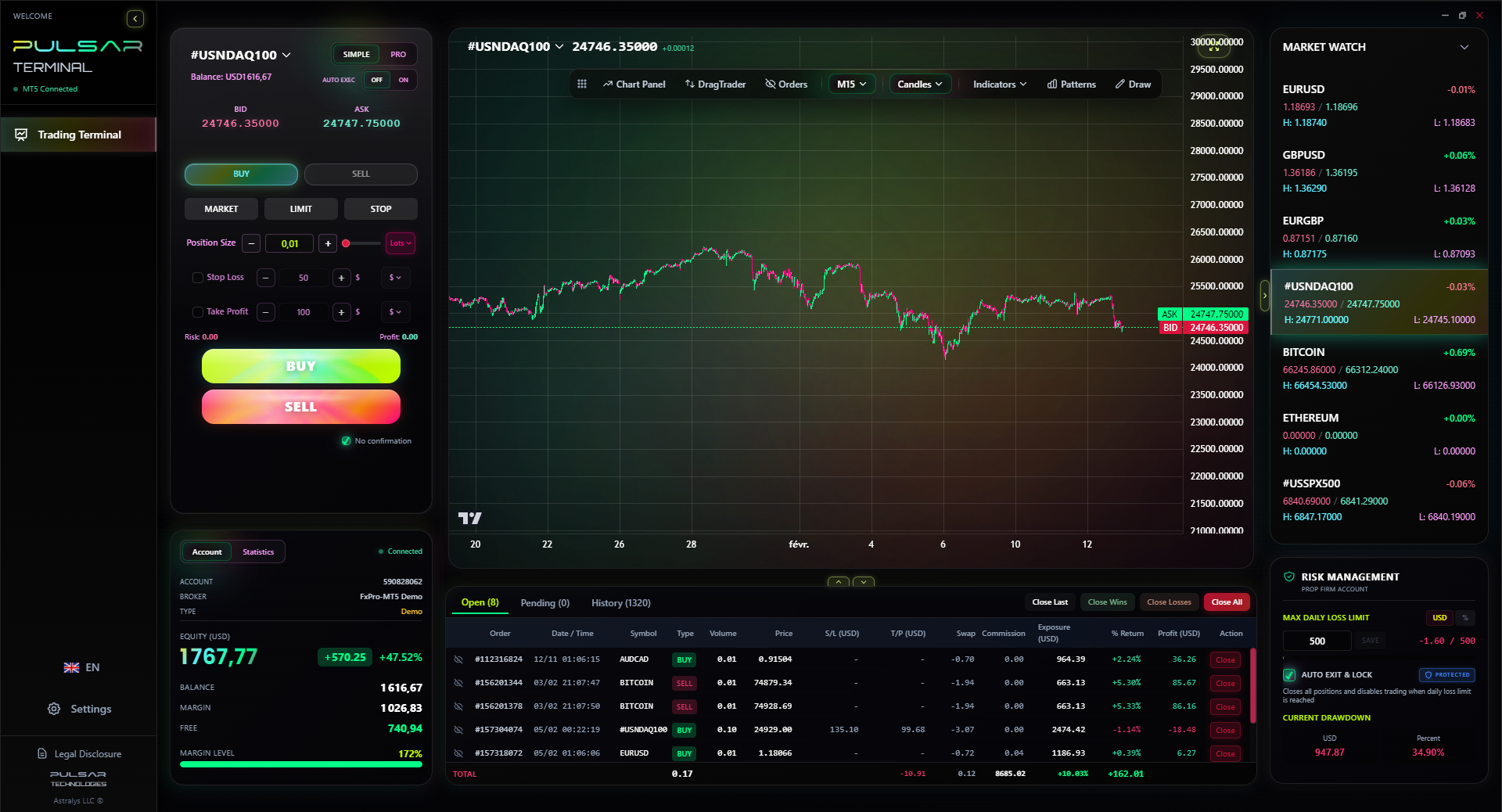
Managing the risk from volatile spreads during news events requires fast, automated tools, which is exactly what Pulsar Terminal's advanced order management provides on your MT5 platform.
Pulsar Terminal
The all-in-one MT5 companion: drag-and-drop orders, multi-TP/SL, trailing stop, grid trading, Volume Profile, and prop firm protection. Used by 1,000+ traders daily.
- Audit Your Broker: Right now, open your platform. Note the spread on EUR/USD at 10 am WAT and again at 4 pm WAT. Compare it to the spreads advertised on the broker's website. If it's consistently 0.5 pips or more above their claim, you're being had. Check USD/NGN spreads too.
- Calculate Your True Cost: For your last 10 trades, calculate the spread cost in Naira for each. Add it up. That's the real fee you paid. Is it 2% of your account? 5%? This number will shock you into action.
- Adjust Your Trading Hours: Plan your trading around the London (9 am WAT) and New York (2 pm WAT) sessions. Avoid trading between 10 pm WAT and 7 am WAT unless you're swing trading. Mark major news events on your calendar and stay out.
- Consider an Account Upgrade: If you're trading more than 5 lots a month, do the math on switching from a 'no commission' account to a raw spread/commission account. For active traders, it's almost always cheaper.
- Use Limit Orders: Instead of clicking 'Buy Market,' try placing a 'Buy Limit' order just above a key support level. This lets the market come to you at your price, potentially getting you a better entry inside the spread. You won't always get filled, but when you do, it improves your odds.
The spread isn't your enemy if you understand it. It's a known cost of business, like rent for a shop. But you wouldn't open a shop on the most expensive street in Lagos if you were selling pure water. Don't trade in expensive spread conditions if your strategy can't afford the rent. Master this, and you've removed one of the biggest leaks from your trading account.
FAQ
Q1What is a good spread for forex trading in Nigeria?
For major pairs like EUR/USD, a good spread during active trading hours is under 1.0 pip on a standard account, or 0.0-0.3 pips + commission on an ECN account. For USD/NGN, 'good' is relative due to lower liquidity. Aim for under 50 pips during stable market conditions, but always check live quotes before trading.
Q2How do I avoid paying high spreads?
Trade only major currency pairs (EUR/USD, GBP/USD, USD/JPY) during peak liquidity hours (London and New York session overlap). Avoid trading during major economic news releases, market opens/closes, and holidays. Use a broker known for tight, transparent pricing, and consider limit orders instead of market orders.
Q3Is a zero-spread broker better?
Not necessarily. 'Zero spread' usually means they charge a commission. You must calculate the total cost (Spread + Commission). Often, a raw spread account with a small commission is cheaper overall than a 'zero spread' account with a high commission or a standard account with a wide spread. Do the math for your typical trade size.
Q4Why is the spread on USD/NGN so much higher than on EUR/USD?
Liquidity. EUR/USD is the most traded financial instrument in the world, with billions traded daily. USD/NGN has a much smaller market, primarily driven by local banks, corporates, and the CBN. Lower liquidity means brokers face higher risk and cost to hold the position, which they pass to you as a wider spread.
Q5Can a wide spread cause me to lose money on a winning trade?
Yes, absolutely. If the spread is wider than your profit target, you can't win. For example, if you target a 3-pip profit but the spread is 5 pips, you need an 8-pip market move in your favor just to make 3 pips. It's a mathematical impossibility to hit a profit target smaller than the spread.
Q6Do all brokers have the same spread?
No, spreads vary massively between brokers. It depends on their liquidity providers, their business model (ECN vs Market Maker), and the account type you have. This is why broker comparison is crucial. Don't just look at use offers; the spread is your real ongoing cost.
Q7How does use affect my spread costs?
use itself doesn't change the spread in pips, but it magnifies its cost in monetary terms. A 2-pip spread on a ₦100,000 position is a small cost. The same 2-pip spread on a ₦10,000,000 position (achieved via high use) is a massive cost. High use makes you more sensitive to all costs, including the spread.
Prof. Winston's Lesson
Key Takeaways:
- ✓The spread is your broker's profit, taken before yours.
- ✓Calculate spread cost in Naira, not just pips.
- ✓Avoid trading during high volatility & news events.
- ✓Compare TOTAL cost (spread + commission).
- ✓Wider spreads demand larger profit targets.
How useful was this article?
Click a star to rate
Weekly Trading Insights
Free weekly analysis & strategies. No spam.
About the Author
Olumide Adeyemi
West African Trading Pioneer
One of Nigeria's most active forex trading educators. 8 years of experience trading from Lagos. Specializes in low-capital strategies and prop firm challenges for African traders.
Comments
Risk Disclaimer
Trading financial instruments carries significant risk and may not be suitable for all investors. Past performance does not guarantee future results. This content is for educational purposes only and should not be considered investment advice. Always conduct your own research before trading.
You Might Also Like

Cara Trading Forex Sukses: 7 Prinsip dari Trader Profesional
Cara trading forex sukses dengan 7 prinsip trader pro: manajemen modal, disiplin, journal trading, backtest. Data nyata, bukan janji profit palsu.
Jam Trading Forex Terbaik untuk Trader Indonesia: Panduan Lengkap dengan Tabel Waktu
Panduan jam trading forex untuk trader Indonesia. Tabel 4 sesi dunia, jam emas 20:00-00:00, sesi mana yang harus dihindari. Data akurat + tips dari trader berpengalaman.
Top 5 Sàn Forex Uy Tín Nhất 2026: Review Jujur dari Trader Indonesia
Top 5 sàn forex uy tín 2026 untuk trader Indonesia. Review jujur: spread, deposit, withdraw, dukungan lokal. Exness, XM, IC Markets & lebih.
Get Pulsar Terminal
All these calculators are built into Pulsar Terminal with real-time data from your MT5 account. One-click position sizing, automatic risk management, and instant calculations.
Get Pulsar Terminal