


I lost £1,200 in under an hour because I didn't understand pips.

Sarah Collins
Trading Strategist ·  United Kingdom
☕ 12 min read
What you'll learn:
- 1The Simple Definition: What Actually Is a Pip?
- 2How to Calculate Pip Value and Your Real Profit
- 3Why Pips Are Everything for UK Traders (It's Not Just Maths)
- 4Pip Calculations for Different Currency Pairs
- 5Pips, Spreads, and Real UK Broker Costs in 2026
- 6The 3 Most Common Pip Mistakes (And How to Avoid Them)
- 7A Complete Trade Example: From Pips to Pounds
- 8Beyond the Basics: Pipettes, Points, and Precision
I lost £1,200 in under an hour because I didn't understand pips. It was 2014, and I'd just opened a trade on GBP/JPY. The price moved 150 points, and I thought I'd made a killing. I hadn't. I'd confused pips with pipettes, misjudged my position size, and got absolutely rinsed on the spread. That loss taught me more than any winning streak ever could. If you're trading forex from the UK, you need to know what a pip is, how it's calculated, and why getting it wrong is the fastest way to an empty account. Let's break it down so you don't repeat my expensive mistake.
A pip is the smallest standard price move a currency pair can make. Think of it as the tick size for forex. For most pairs, like EUR/USD or GBP/USD, one pip is a movement of 0.0001. If EUR/USD moves from 1.0850 to 1.0851, that's a one-pip move.
It gets a bit different with the Japanese Yen. For pairs like GBP/JPY or USD/JPY, a pip is the second decimal place, a move of 0.01. So, if USD/JPY goes from 151.50 to 151.51, that's also a one-pip move. The reason is simple: the Yen is worth a lot less per unit than the Pound or Euro, so the quote convention adjusts.

Example:
- EUR/USD at 1.0850: The '50' in 1.0850 represents 50 pips from the 1.0800 level.
- USD/JPY at 151.50: The '50' in 151.50 represents 50 pips from the 151.00 level.
Brokers often quote an extra decimal place these days. That fifth digit (or third for JPY pairs) is called a pipette or a fractional pip. It's one-tenth of a pip. It allows for tighter spreads and more precise entries, but it doesn't change the fundamental pip value for your profit and loss calculations. You still need to think in whole pips when sizing your trades.
This is where most new traders mess up. They see a 50-pip move and think, "Great, I made 50 quid." It doesn't work like that. Your profit depends on three things: the pip value, your position size (lot size), and the number of pips the market moves.
The Standard Lot Breakdown
Forex is traded in lots. A standard lot is 100,000 units of the base currency. If you buy one standard lot of EUR/USD, you're buying €100,000. For a standard lot, one pip is usually worth $10 for pairs where the USD is the quote currency (the second one).
But most UK retail traders aren't trading full lots. Thanks to FCA use limits, you're probably on mini, micro, or nano lots.
| Lot Size | Units of Base Currency | Approx. Pip Value (USD Quote Pairs) |
|---|---|---|
| Standard | 100,000 | $10 |
| Mini | 10,000 | $1 |
| Micro | 1,000 | $0.10 |
| Nano | 100 | $0.01 |
The Formula That Matters
Here’s the universal formula for calculating pip value:
Pip Value = (One Pip in Decimal Form / Exchange Rate) x Trade Size (in Units)
Let's use a real trade I did last month. I went long on GBP/USD at 1.2600 with a micro lot (1,000 units).
- One pip for GBP/USD is 0.0001.
- Exchange rate at entry: 1.2600.
- Trade size: 1,000 units.
Pip Value = (0.0001 / 1.2600) x 1,000 = £0.0793.
So, each pip move was worth about 8 pence. The trade went to 1.2650, a 50-pip gain. My profit? 50 pips x £0.0793 = £3.97. Not exactly life-changing, but it was a well-sized, low-risk trade. If I'd naively traded a mini lot (10,000 units) thinking "it's only 50 pips," that same move would have been worth about £39.70. A 50-pip loss would have stung a lot more.
Always, always use a position size calculator before you enter a trade. It takes the guesswork out.

💡 Winston's Tip
A 'pip' is just a unit of measurement. The real skill is knowing what that unit *costs* you in your own currency on every single trade. If you don't, you're not trading, you're price guessing.
“Understanding pips is your first line of defence against reckless position sizing and ignored transaction costs.”
Understanding pips is your first line of defence against the two things that kill accounts: reckless position sizing and ignoring transaction costs.
1. Position Sizing & The FCA's Handcuffs The FCA limits use for us retail folks to 30:1 on major pairs. That means if you have £1,000 in your account, the maximum position you can open on EUR/USD is £30,000 (or 0.3 standard lots). If you don't understand that a 10-pip move on a 0.3 lot position is a different animal than on a 0.01 lot position, you're gambling. A margin call is just a bad trade away. I learned this the hard way early on by over-leveraging on XAU/USD (gold), which has a 20:1 limit. The volatility ate me alive.
2. The Silent Killer: The Spread The spread is the difference between the buy and sell price, measured in pips. It's the broker's fee. If the spread on GBP/USD is 1.5 pips, your trade starts 1.5 pips in the red. You need the market to move 1.5 pips in your favour just to break even. On a scalping strategy aiming for 5-10 pips, a 1.5-pip spread is a massive 15-30% tax on your potential profit. This is why comparing brokers like Pepperstone (often sub-1 pip spreads on majors) versus a broker with wider spreads is a real money decision.

Warning: That "commission-free" account? The spread is wider. That "raw spread" account? There's a commission per lot. You pay one way or another. Always calculate your total cost per trade in pips before you enter.
3. Setting Sensible Stop-Losses Saying "I'll risk £100" is meaningless. You need to translate that into pips. If your pip value is £0.80 per pip, a £100 risk means your stop-loss can be 125 pips away from your entry (£100 / £0.80). That dictates where you can logically place your stop based on market structure. Placing a random 20-pip stop on a volatile pair when your risk tolerance allows for 125 is a recipe for being stopped out by noise.
Let's get into the weeds with examples. This is where you move from theory to practice.
Example 1: EUR/USD (USD as Quote Currency)
This is the easiest. You're trading Euro against the Dollar, and your account is in GBP.
- Trade: Buy 0.1 lots (10,000 units) of EUR/USD at 1.0850.
- Pip Value (in USD): (0.0001 / 1.0850) x 10,000 = $0.92.
- To get GBP value: Divide by the GBP/USD rate. If GBP/USD is 1.2600, then £0.92 / 1.2600 = £0.73 per pip.
Example 2: USD/JPY (USD as Base Currency)
Here, the base currency is USD, not your account currency (GBP).
- Trade: Sell 0.05 lots (5,000 units) of USD/JPY at 151.00.
- Pip is 0.01: (0.01 / 151.00) x 5,000 = $0.331.
- Value in GBP: $0.331 / GBP/USD rate (1.2600) = £0.26 per pip.
Example 3: EUR/GBP (GBP as Quote & Account Currency)
This is common for UK traders. Your account is in GBP, and the quote currency is GBP.
- Trade: Buy 0.2 lots (20,000 units) of EUR/GBP at 0.8600.
- Pip Value: (0.0001 / 0.8600) x 20,000 = £2.33.
Notice that? The pip value is already in Pounds. No conversion needed. This simplifies things, but don't get complacent. A £2.33 pip value on a 0.2 lot trade means a 50-pip loss is over £116. That's a significant chunk of a small account.

Pro Tip: Most trading platforms have a built-in calculator or will show the approximate pip value on the order ticket. Never place a trade without checking this. If your platform doesn't show it, get a new broker. Seriously.
“The spread is your first and most consistent cost. That 'commission-free' account just hides it in wider pips.”
Let's talk about real money leaving your pocket. The spread is your first and most consistent cost. In 2026, the competition among FCA brokers is fierce, and spreads are tight, but you need to know what you're looking at.
I track my costs religiously. Here's a snapshot from my own trading journal comparing two common scenarios on a £10,000 account:
Scenario A: Trading EUR/USD with a 'Standard' Account
- Broker: A major UK high-street name.
- Average Spread: 1.8 pips.
- Commission: None.
- Trade: 0.5 lots (€50,000). Pip value ~$5.00 (£3.97).
- Cost to Open Trade: 1.8 pips x £3.97 = £7.15.
Scenario B: Trading EUR/USD with a 'Raw' Account
- Broker: IC Markets (FCA entity).
- Average Spread: 0.1 pips.
- Commission: $3.50 per side per 100k traded. For 0.5 lots, that's $1.75 per side.
- Cost to Open Trade: (0.1 pips x £3.97) + ($1.75 converted to GBP) = £0.40 + £1.39 = £1.79.
The difference is £5.36 on a single trade entry. If you're a frequent trader, that adds up to thousands per year. This is why brokers like Exness and XM also promote their low-cost models. But remember, the cheapest spread isn't everything. You need reliable execution, especially during news events, and the solidity of FCA protection including the £85,000 FSCS cover.
For a swing trading style where you hold for days, the spread is less critical. For scalping, it's paramount. Always check if the quoted spread is average or typical. The 'from' spread is often a marketing gimmick.
💡 Winston's Tip
The FCA's use limits are a gift, not a restriction. They force you to confront the reality of pip value and position size before you blow up. The traders who hate them are the ones who needed them most.
I've made these. My clients have made these. Let's save you the tuition fee.
1. Confusing Pips with Percentages A 100-pip move on GBP/USD from 1.2600 to 1.2700 is not a 1% move. It's a move of roughly 0.79% (0.01 / 1.26). Conversely, a 1% move requires about 126 pips. Traders see a big pip number and overestimate the significance. Use percentages for market analysis, and pips for trade execution and risk.
2. Ignoring Pip Value When Scaling In or Out Let's say you use a multi-take-profit strategy. You close half your position at +20 pips and let the rest run. If you don't know your pip value, you have no idea what you've actually banked or what your remaining risk is. That trailing stop on your runner? It needs to be managed based on the new, smaller position's pip value.
3. Forgetting About Cross Currency Pairs Trading AUD/JPY with a GBP account? Your brain will hurt. The pip value will be in JPY, which you then convert to GBP via your USD/JPY or GBP/JPY rate. This is where trading software or a good calculator is non-negotiable. I once miscalculated an NZD/CAD trade because I was lazy. The "small" loss was magnified by the currency conversion chain, and it wiped out a week's profits.
The antidote is a pre-trade checklist: 1) What's my position size in units? 2) What's my pip value in my account currency? 3) Where is my stop-loss in pips? 4) Does the potential reward in pips justify the risk? If you can't answer these instantly, don't hit the buy button.
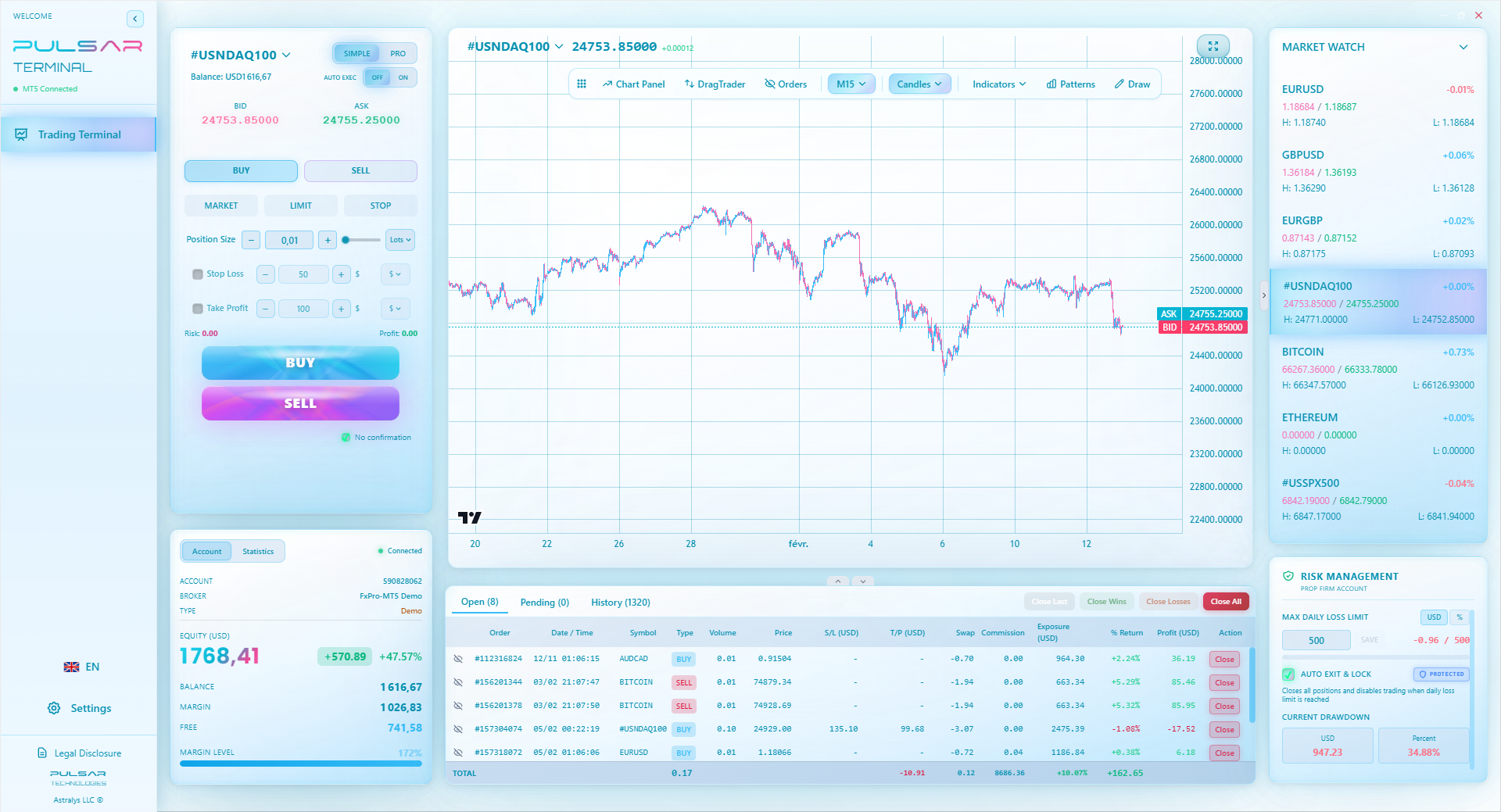
Managing multiple take-profit levels and calculating partial closure profits based on pip values is complex, but tools like Pulsar Terminal automate this directly on your MT5 platform.
Pulsar Terminal
The all-in-one MT5 companion: drag-and-drop orders, multi-TP/SL, trailing stop, grid trading, Volume Profile, and prop firm protection. Used by 1,000+ traders daily.
“Your analysis gets you the trade idea, but the pip math makes it an executable, low-risk plan.”
Let's walk through a full trade on the EUR/USD, the way I'd plan it today.
Account & Setup:
- Account Balance: £5,000 (GBP).
- Broker: FCA-regulated, raw spread account.
- Risk Per Trade: 1% of account = £50.
- Chart Setup: Price bouncing off a key support level, with RSI indicator showing oversold. MACD indicator is hinting at a bullish crossover.
Trade Execution:
- Entry: Buy (Long) EUR/USD at 1.0725.
- Stop-Loss: Place at 1.0695. That's 30 pips below my entry.
- Take-Profit: First target at 1.0775 (50 pips). Second target at 1.0825 (100 pips).
- Position Size Calculation:
- My risk is £50.
- My stop-loss is 30 pips away.
- Therefore, my maximum permissible pip value is £50 / 30 pips = £1.67 per pip.
- Current GBP/USD rate is ~1.2600.
- Working backwards: To get a pip value of £1.67 on EUR/USD, I need a position where (0.0001 / EURUSD Rate) x Units = £1.67.
- Let's simplify: For EUR/USD, a ~£1.67 pip value is roughly a 21,000 unit position (a 0.21 mini lot).
- I enter a trade size of 20,000 units (0.2 lots). My exact pip value is now £1.59.
Trade Outcome: Price hits my first take-profit at 1.0775. I close half my position (10,000 units).
- Profit on this half: 50 pips x (£1.59/2) = 50 x £0.795 = £39.75. I move my stop-loss on the remaining 10,000 units to breakeven (1.0725). Price later hits my second target at 1.0825.
- Profit on second half: 100 pips x £0.795 = £79.50.
Total Profit: £119.25. Risk: £50 (1% of account). Reward-to-Risk: ~2.4:1.
Notice how every single step was governed by an understanding of pips and their value. The analysis got me the idea, but the pip math made it a executable, low-risk plan.
Once you're comfortable with pips, you'll hear other terms. Don't let them confuse you.
Pipettes (Fractional Pips): As mentioned, this is a tenth of a pip. If EUR/USD moves from 1.08500 to 1.08501, that's a one-pipette move. Brokers use this for tighter pricing. When you see a spread quoted as 0.61, that means 0.6 pips plus 1 pipette. For your journal, you can still round to the nearest whole pip. The extra precision matters more for your entry and stop-loss placement than for your overall profit calculation.
Points: In other markets like indices (UK100) or commodities, they talk about points. A point on the FTSE 100 is a 1.0 move in the index value. The concept is identical to a pip - it's the standard unit of price movement - but the value per point is completely different and depends on your CFD provider's contract specifications. Never assume a point equals a pip in value.
The key takeaway? Master the standard pip first. All this other stuff is just finer granularity on the same ruler. Your risk management should be based on solid, whole pip calculations. The fractional stuff is for fine-tuning your entry to get an extra 0.2 pips of edge, not for deciding whether to risk 2% or 5% of your account.
💡 Winston's Tip
Your trading platform should show pip value automatically. If it doesn't, question everything else that broker is doing. Transparency starts with the basics.
FAQ
Q1Is a pip the same for every forex pair?
No. For most pairs (like EUR/USD, GBP/USD), a pip is 0.0001. For pairs involving the Japanese Yen (like USD/JPY, GBP/JPY), a pip is 0.01. This is due to the Yen's lower relative value per unit.
Q2How much is a pip worth in British Pounds?
There's no fixed answer. A pip's value in GBP depends on three things: the currency pair you're trading, the current exchange rate of that pair, and the size of your trade (lot size). You must calculate it for each trade using the formula: (One Pip in Decimal / Exchange Rate) x Trade Size in Units, then convert to GBP if needed.
Q3What's the difference between a pip and a pipette?
A pipette is one-tenth of a pip. It's the fifth decimal place for pairs like EUR/USD (e.g., 1.08501) or the third decimal place for JPY pairs (e.g., 151.501). Brokers use them to quote tighter spreads. For your core risk management, focus on whole pips.
Q4How do FCA use limits affect my pip value?
FCA use limits (e.g., 30:1 on majors) cap how large a position you can open with a given account balance. This directly limits your maximum possible pip value per trade. A smaller account with max use will have a higher pip value relative to its size, making each pip movement more significant to your equity.
Q5Why does the spread, measured in pips, matter so much?
The spread is your immediate cost. If you buy a pair with a 2-pip spread, the price must move 2 pips in your favour just for you to break even. On short-term trades, this can consume a huge portion of your potential profit. It's a direct deduction from your bottom line, so lower spreads generally mean lower trading costs.
Q6Can I trade forex without understanding pips?
You can try, but you will almost certainly lose money consistently. Not understanding pips means you cannot accurately calculate your risk, reward, position size, or true cost per trade. You're driving a car without knowing what the speedometer numbers mean - you might move, but you have no control over the outcome.
Prof. Winston's Lesson
Key Takeaways:
- ✓A pip is 0.0001 for most pairs, 0.01 for JPY pairs.
- ✓Pip value = (0.0001 / Price) x Position Size. Calculate it every time.
- ✓The spread in pips is a direct cost. A 2-pip spread requires a 2-pip move just to break even.
- ✓Use pips to set stops: Risk (£) / Pip Value (£) = Stop-Loss Distance (Pips).
- ✓FCA use limits (30:1 on majors) cap your max position size and pip value.
How useful was this article?
Click a star to rate
Weekly Trading Insights
Free weekly analysis & strategies. No spam.
About the Author
Sarah Collins
Trading Strategist
London-based trading strategist with 12 years in financial markets. Former analyst at a City of London brokerage. Covers GBP pairs, European markets, and FCA-regulated trading.
Comments
Risk Disclaimer
Trading financial instruments carries significant risk and may not be suitable for all investors. Past performance does not guarantee future results. This content is for educational purposes only and should not be considered investment advice. Always conduct your own research before trading.
You Might Also Like

Cara Trading Forex Sukses: 7 Prinsip dari Trader Profesional
Cara trading forex sukses dengan 7 prinsip trader pro: manajemen modal, disiplin, journal trading, backtest. Data nyata, bukan janji profit palsu.
Jam Trading Forex Terbaik untuk Trader Indonesia: Panduan Lengkap dengan Tabel Waktu
Panduan jam trading forex untuk trader Indonesia. Tabel 4 sesi dunia, jam emas 20:00-00:00, sesi mana yang harus dihindari. Data akurat + tips dari trader berpengalaman.
Top 5 Sàn Forex Uy Tín Nhất 2026: Review Jujur dari Trader Indonesia
Top 5 sàn forex uy tín 2026 untuk trader Indonesia. Review jujur: spread, deposit, withdraw, dukungan lokal. Exness, XM, IC Markets & lebih.
Get Pulsar Terminal
All these calculators are built into Pulsar Terminal with real-time data from your MT5 account. One-click position sizing, automatic risk management, and instant calculations.
Get Pulsar Terminal