


I remember staring at the screen, my AUD/USD trade deep in the red.

Sarah Collins
Trading Strategist ·  Australia
☕ 9 min read
What you'll learn:

I remember staring at the screen, my AUD/USD trade deep in the red. It was 2021, and I'd just blown through my third personal account that year. The frustration was real. That's when a mate at the pub mentioned 'prop firms'. I thought it was some Wall Street secret. Turns out, it's a game (a tough one) where you trade with someone else's capital. If you win, you get a cut. If you lose... well, they have rules for that. Let's break down exactly what a prop firm is, how it works for us Aussies, and whether it's a golden ticket or a clever trap.
At its core, a proprietary trading firm (prop firm) is a company that provides capital to traders. You're not trading your own money. You're trading theirs, and in return, you share the profits. It sounds like a dream, right? No more risking your savings. But here's the catch: you have to prove you can handle their money first. That's where the famous 'challenge' or 'evaluation' comes in.
Think of it like a tryout for a sports team. The firm gives you a simulated account with specific rules. You need to hit a profit target without breaking their risk limits. Pass the test, and you get a funded account. From there, you typically keep 70-90% of the profits you make. The firm takes the rest as their fee for providing the capital and platform.
It's crucial to understand they are not brokers. Brokers like IC Markets or Pepperstone make money from your spreads and commissions. A prop firm's primary business is to find talented traders, fund them, and share in their success. Their risk is limited to the capital they allocate to you, which is why their rules are so strict.

Warning: Not all prop firms are created equal. The industry has its share of shady operators. Always, always check reviews, payout proofs, and their regulatory standing (if any) before you hand over a cent for an evaluation fee.
This is where most people get tripped up. You don't just sign up and get a million bucks. You have to earn it through a structured test. While rules vary, the core structure is almost universal.
The Two-Phase Standard
Most reputable firms use a two-step process. Phase 1: Hit a profit target (e.g., 8%) within a set time (30 days). You also have a maximum daily loss (e.g., 5%) and a maximum overall loss (e.g., 10%). Blow either, and you're out. Phase 2: Similar rules, often with a slightly higher profit target. Pass both, and you're in.
The Rules That Will Make or Break You
This isn't free trading. The constraints are designed to filter for discipline.
- Profit Target: Seems small, but the pressure is immense.
- Daily Loss Limit: Your single most important number. Breach this, and the account is instantly closed. This is where emotional trading kills you.
- Maximum Drawdown: The total loss from the account's starting balance or its highest point (floating). This includes open trades. A series of small losing trades can quietly push you toward this cliff.
- Time Limit: Adds psychological pressure. You can't just sit in a trade for months.

Example: Let's say you buy a $100,000 AUD challenge. Your daily loss limit is $2,500 (2.5%). You have one bad scalping session and lose $2,400 by lunchtime. You MUST stop trading for that day. Full stop. Trading again could trigger a margin call on your entire future.
I learned this the hard way. On my first real attempt, I passed Phase 1. In Phase 2, I was up 4% and got greedy on a GBP/JPY move. I ignored my position size calculator, doubled down, and watched a news spike wipe out 6% in minutes. I breached the max drawdown. Game over. $500 evaluation fee gone. The lesson? The rules aren't suggestions; they are the entire game.

💡 Winston's Tip
Professor Winston always said: 'The market doesn't care about your profit target. Your only job is to not lose the daily limit.' Focus on survival first, profits second.

“The daily loss limit isn't a suggestion; it's the rule that defines the entire game.”
Is a prop firm right for you? Let's lay it out, specifically for traders in Australia.
The Pros (The Really Good Stuff)
- Access to Capital: This is the big one. You can trade sizes that would be insane with your own bankroll. Controlling a $200k account with only a few hundred dollars in risk? That's powerful.
- Removes Emotional Attachment: It's easier to follow a system when it's not your mortgage money on the line. The firm's strict rules force discipline you might lack on your own.
- Profit Split: The 80/20 or 70/30 split is fantastic. You're getting the lion's share for doing the work.
- Structured Path: It gives you a clear, measurable goal. For many, this structure is more motivating than trading alone.
The Cons (The Reality Check)
- Evaluation Fees: You have to pay to play. These can range from $50 to $500+. It's a cost, and if you fail repeatedly, it adds up fast.
- Extremely Restrictive Rules: The daily loss limit kills many swing trading strategies. A trade can move against you 2% overnight and you're out before Sydney opens.
- Payout Delays & Hurdles: Some firms make it difficult to withdraw your first profit. Read the fine print on minimum trading days and payout processing times.
- Tax Implications: Here's an Aussie-specific headache. Your profit share is likely considered ordinary income by the ATO, not capital gains. You need to declare it, and you'll pay tax at your marginal rate. Keep careful records.

Pro Tip: Start with the smallest, cheapest challenge a reputable firm offers. Treat the fee as tuition. Your goal isn't to pass on the first try (though that's nice). Your goal is to learn to trade within the system. The discipline you learn is worth the entry fee, even if you fail.

Forget finding a magic indicator. Passing a prop challenge is about risk management and psychology. Here’s what worked for me after my early failures.
1. Trade Small, Win Consistently. Your goal isn't to hit 8% in one trade. It's to grind out 0.5%-1% days with high consistency. This means your position size must be tiny. I'm talking 0.5% to 1% risk per trade, max. Use a position size calculator religiously. If your daily loss limit is $2,500, your per-trade risk should be no more than $125. This feels painfully small, but it keeps you in the game.
2. Favour High-Probability, Low-Reward Setups. This was a mental shift. I stopped chasing 5:1 reward-to-risk home runs. I started aiming for solid 1.5:1 or 2:1 setups on major forex pairs like EUR/USD. The win rate needs to be higher, but the equity curve is smoother, which is key for not breaching drawdown rules.
3. Use Simple, Rule-Based Entries. I combined support/resistance with a basic MACD indicator crossover and an RSI indicator filter. No more than three factors. The simpler, the faster you can act, and the less you second-guess.
4. The Daily Loss Limit is Sacred. If you lose 1.5% in a day, just stop. Close the platform. Go for a walk. The urge to 'get it back' is what triggers the fatal daily loss breach. The challenge gives you 30 days. You have time.
My successful pass came from a boring, mechanical week trading XAU/USD (gold). I risked $80 per trade on a $100k sim account, aiming for $120 profits. I took 2-3 trades a day, stopped after any loss, and finished the first phase in 12 trading days with a 9.2% gain. Boring? Yes. Effective? Absolutely.
💡 Winston's Tip
Treat the evaluation fee as the cost of the most valuable trading course you'll ever take. The lesson is in the discipline, not the diploma.

“Being funded is a fantastic opportunity, but it's not passive income. It's a job with a performance-based salary.”
With dozens of firms out there, choosing is a minefield. Here’s my checklist, honed from experience and more than a few forum arguments.
Green Lights (What to Look For):
- Transparent Payout Proof: Real, verifiable screenshots or videos from traders, not just testimonials.
- Clear, Reasonable Rules: The rules should be easy to find and understand. No hidden 'trailing drawdown' nonsense that activates after you pass.
- Good Customer Support: Test them before you buy. Send a question. See how fast and clearly they respond.
- Popular with Experienced Traders: Check independent forums. Firms like FTMO, The5%ers, and FundedNext have long track records.
Red Flags (Run Away):
- Overly Generous Offers: 'Pass our challenge in 1 day and get $1,000,000!' It's a scam.
- No Demo/Free Trial: A reputable firm will let you test their platform rules for free.
- Sloppy Website, Poor English: Indicates a lack of professionalism and potentially a fly-by-night operation.
- Pressure to Upgrade: If they're spamming you to buy a more expensive challenge before you've even started, their focus is on evaluation fees, not funding traders.
Aussie-Specific Consideration: Check how they handle AUD. Do they offer AUD accounts, or will you be trading USD-denominated accounts? What are their withdrawal methods? Wise (formerly TransferWise) and direct bank transfers are common, but fees can eat into profits.
| Consideration | Good Sign | Bad Sign |
|---|---|---|
| Profit Split | 80% or more to you | Less than 70% to you |
| Payout Frequency | Monthly or bi-weekly | Quarterly or 'on request' with hurdles |
| Rule Clarity | Daily & Max Loss clearly stated | 'Dynamic' or 'relative' drawdown rules |
| Platform | Common (MT4/5, cTrader) | Proprietary, clunky platform |
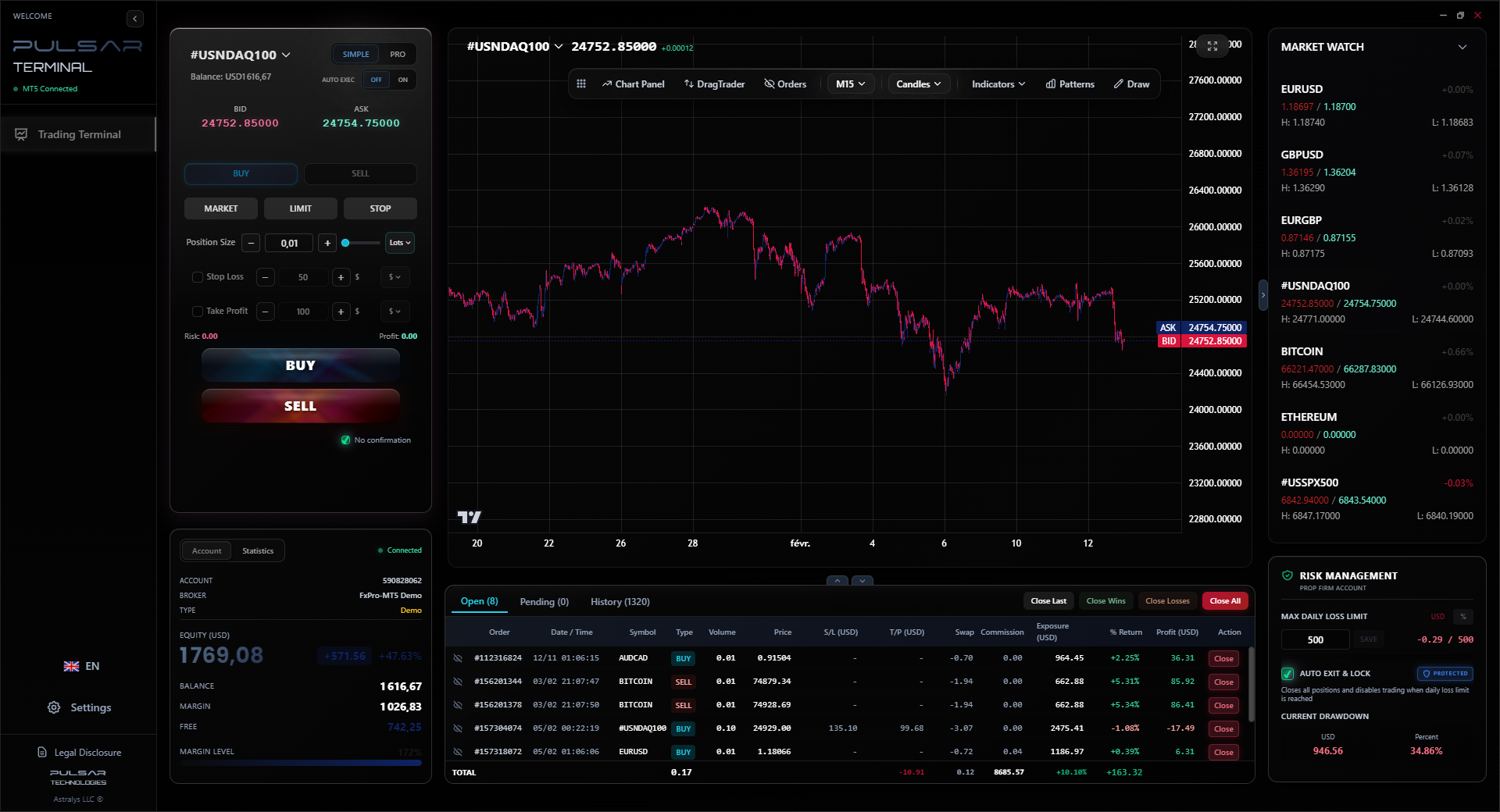
Managing the strict daily loss and drawdown rules of a prop firm is a constant manual headache, which is why tools like Pulsar Terminal automate it for you directly on MT5.
Pulsar Terminal
The all-in-one MT5 companion: drag-and-drop orders, multi-TP/SL, trailing stop, grid trading, Volume Profile, and prop firm protection. Used by 1,000+ traders daily.
You passed the challenge. Congrats! Now the real work begins, but the pressure changes. You're no longer fighting a rule set; you're building a business.
The First Payout Hurdle Most firms have a 'minimum trading days' rule before your first payout (e.g., 10 calendar days). You also usually need to reach a minimum profit threshold. This period is nerve-wracking. You have real capital, but one bad week could see you lose the account. The key is to stick to the exact same strategy that got you funded. Don't suddenly increase your risk because it's 'real money' now.
Scaling Up: The Real Goal The best prop firms have scaling plans. If you're consistently profitable for 3-4 months, they'll increase your capital. This is the holy grail. Going from a $50k account to a $200k account while keeping your risk percentage the same massively amplifies your earnings.
The Psychological Shift This was the biggest surprise for me. The pressure to perform didn't vanish; it evolved. Now I felt responsible to the firm that took a chance on me. I also had to manage my personal finances around irregular payouts. It's not a salary. Some months you make $5k, others you make $500. You need a rock-solid personal budget.
, being funded is a fantastic opportunity, but it's not passive income. It's a job with a performance-based income. You have to show up, follow your plan, and manage risk every single day. The moment you get complacent is the moment you give the capital back.


FAQ
Q1How much does it cost to join a prop firm?
You don't 'join' for free. You pay a one-time evaluation fee for a challenge, which typically ranges from $50 to $500+ depending on the account size you're trying for. This fee covers the firm's costs for running the simulated environment. If you pass, this fee is often refunded or credited. If you fail, you lose the fee.
Q2Can I use a robot or EA to pass a prop firm challenge?
Technically, many firms allow EAs. However, it's incredibly risky. Most EAs aren't designed for the strict daily loss and drawdown limits of a prop challenge. A few bad trades can blow your account. Also,, if the EA fails and you don't understand why, you've learned nothing. Firms are also getting better at detecting and restricting pure martingale or grid EAs that gamble rather than trade.
Q3Are prop firms legal in Australia?
There's no specific Australian law against participating in an overseas prop firm as a trader. The legal onus is on the firm itself. The key for you is to ensure the firm is legitimate. They are not ASIC-regulated in the way Exness or XM are, as they are not brokers. Your main protection is their reputation and track record of paying traders.
Q4What's the biggest mistake people make in prop challenges?
Oversizing. Hands down. They see a $100,000 account and think they should trade 10 lots. They risk 3% per trade to hit the target fast. One losing trade creates a huge drawdown, panic sets in, and they breach the daily limit trying to recover. The challenge is won by patience and microscopic risk, not aggression.
Q5Do I need a lot of trading experience to try a prop firm?
Yes and no. You absolutely need a tested, rule-based strategy and proven discipline. If you're still figuring out what a pip is or how spread works, you'll just burn evaluation fees. However, you don't need 10 years of experience. Many successful funded traders had only 1-2 years of consistent demo/live trading before attempting a challenge. The key is consistency, not longevity.
Q6Can I trade cryptocurrencies with a prop firm?
It's becoming more common, but forex and indices are still the main offerings. If you want to trade crypto, you must specifically find a firm that offers it. The rules are often even stricter due to crypto's volatility, with wider spreads and potentially smaller position sizes allowed.
Prof. Winston's Lesson
Key Takeaways:
- ✓Risk a maximum of 1% per trade during a challenge.
- ✓The daily loss limit is your primary indicator.
- ✓Aim for consistent 0.5-1% gain days, not home runs.
- ✓Choose firms with transparent payout histories.
- ✓Your first funded goal is to survive the minimum trading days.
How useful was this article?
Click a star to rate
Weekly Trading Insights
Free weekly analysis & strategies. No spam.
About the Author
Sarah Collins
Trading Strategist
London-based trading strategist with 12 years in financial markets. Former analyst at a City of London brokerage. Covers GBP pairs, European markets, and FCA-regulated trading.
Comments
Risk Disclaimer
Trading financial instruments carries significant risk and may not be suitable for all investors. Past performance does not guarantee future results. This content is for educational purposes only and should not be considered investment advice. Always conduct your own research before trading.
You Might Also Like

Cara Trading Forex Sukses: 7 Prinsip dari Trader Profesional
Cara trading forex sukses dengan 7 prinsip trader pro: manajemen modal, disiplin, journal trading, backtest. Data nyata, bukan janji profit palsu.
Jam Trading Forex Terbaik untuk Trader Indonesia: Panduan Lengkap dengan Tabel Waktu
Panduan jam trading forex untuk trader Indonesia. Tabel 4 sesi dunia, jam emas 20:00-00:00, sesi mana yang harus dihindari. Data akurat + tips dari trader berpengalaman.
Top 5 Sàn Forex Uy Tín Nhất 2026: Review Jujur dari Trader Indonesia
Top 5 sàn forex uy tín 2026 untuk trader Indonesia. Review jujur: spread, deposit, withdraw, dukungan lokal. Exness, XM, IC Markets & lebih.
Get Pulsar Terminal
All these calculators are built into Pulsar Terminal with real-time data from your MT5 account. One-click position sizing, automatic risk management, and instant calculations.
Get Pulsar Terminal