


I was staring at my screen in a Lagos apartment in late 2023, watching the USD/NGN rate on my broker's platform.

Olumide Adeyemi
West African Trading Pioneer ·  Nigeria
☕ 9 min read
What you'll learn:
- 1The Bare Bones Basics (Forget the Fluff)
- 2The Nigerian Market Reality: Regulations & The Naira
- 3The Real Costs: Where Your Money Actually Goes
- 4How People Actually Lose Money (The Ugly Truth)
- 5A Simple Framework to Start (If You Must)
- 6Tools, Platforms & Getting Your Money In/Out
- 7So, Is This For You? The Final Verdict
I was staring at my screen in a Lagos apartment in late 2023, watching the USD/NGN rate on my broker's platform. It wasn't moving on the chart, but the news was screaming about a 40% devaluation. My broker had simply widened the spread to over 500 pips, freezing any real trade. That moment, more than any win, taught me what forex trading is all about in Nigeria. It's not just buying Euros and selling Dollars. It's understanding a market where global liquidity meets local volatility, where your profit can be eaten by a spread wider than the Niger River, and where knowing the rules - written and unwritten - is the only thing between you and a blown account.
Forex trading is about speculating on the price movement of one currency against another. You buy the EUR/USD, you're betting the Euro will strengthen against the US Dollar. You sell it, you're betting the opposite. That's it. The fancy term is 'currency pair'.
The market is massive - trillions of dollars daily - but that liquidity isn't evenly distributed. For us in Nigeria, trading the USD/NGN directly with a foreign broker is often a fantasy. You'll see a quote, but try to execute a sizeable trade and you'll hit a wall. The real action for Nigerian retail traders is in major pairs like EUR/USD, GBP/USD, and commodities like gold (XAU/USD).

Warning: If a platform offers you USD/NGN with tight spreads and instant execution, be deeply suspicious. The real interbank market for Naira isn't accessible like that. You're likely trading a CFD (Contract for Difference) against your broker's quote, not the actual Central Bank of Nigeria (CBN) rate.
The market runs 24 hours from Sunday night to Friday night, our time (WAT). The sweet spot for volatility is when London and New York sessions overlap, roughly 1 PM to 6 PM WAT. That's when you get real movement to trade.
I learned this the hard way trying to scalping strategy the AUD/JPY at 3 AM. The spreads were horrific, and the price just drifted. No volume, no chance.

💡 Winston's Tip
If you can't explain your trade setup in one simple sentence - 'price bounced off the daily support level' - you don't have a setup. You have a hope.
Let's get the legalities straight. Yes, you can trade forex in Nigeria with your own money. No, the CBN won't knock on your door for using an international broker like Exness or IC Markets. The regulations target something else: people trying to source cheap dollars from official CBN windows to speculate. That's a no-go.
Your main concern shouldn't be local regulators, but the regulator of your chosen broker. That's your safety net. Look for brokers licensed by the FCA (UK), ASIC (Australia), or CySEC (Europe).
The Naira's Wild Ride
Your trading will be deeply affected by the Naira's value, even if you never touch the USD/NGN pair. Why? Because your capital is in Naira. A crashing Naira means your $100 deposit cost you ₦80,000 last month and ₦120,000 this month. Your psychology changes. You start taking trades just to 'catch up' with the devaluation, which is a guaranteed path to losses.
The CBN has been fighting this with reforms: unifying exchange rates, hiking interest rates to 26.25%, and introducing a new FX code in 2024/2025 to tidy up the institutional market. For you, this means more volatility in the economy, which can spill into global risk sentiment, affecting all your trades.

Pro Tip: Denominate your trading account in USD if your broker allows it. It mentally separates your trading capital from the volatile Naira. Convert a lump sum, trade in dollars, and only convert profits back when you withdraw. It creates cleaner mental accounting.
“Forex trading in Nigeria is about understanding a market where global liquidity meets local volatility.”
Forget the 'zero commission' ads. Trading has costs, and if you don't understand them, they'll bankrupt you before you even get started.
- The Spread: This is the difference between the buy (ask) and sell (bid) price. It's your broker's immediate fee. On EUR/USD, a good raw spread can be 0.0 to 0.3 pips on a professional account. A standard account might have 0.9 to 1.5 pips. Check our spread definition for a deeper look.
- Example: You buy EUR/USD at 1.0850 (ask). The bid is 1.0849. The spread is 1 pip. The price needs to move up 1 pip just for you to break even.
- Commission: On raw spread accounts, you pay a commission per lot. Typical is $3.50 per 100,000 units (1 standard lot) per side. So, a round trip (open and close) costs $7.
- Swap/Rollover Fees: If you hold a position overnight, you pay or receive interest. This can be a cost or a small income depending on the pair and your direction.
Here’s a real comparison from my own testing in 2024:
| Broker & Account Type | Avg. EUR/USD Spread | Commission per 1 Lot (RT) | Real Cost to Open 1 Lot |
|---|---|---|---|
| IC Markets Raw Spread | 0.1 pips | $7.00 | $7.10 (0.1 pip = ~$1 + $7 comm) |
| XM Standard Account | 1.7 pips | $0.00 | $17.00 (1.7 pips = ~$17) |
| Pepperstone Razor | 0.0 pips | $7.00 | $7.00 |
See the trap? The 'zero commission' account cost more than double to enter the trade. Always calculate the total cost in dollar terms using a position size calculator.
Tax? Officially, 10% capital gains tax on profits. In practice, few retail traders declare it, but the liability is there. Keep your own records straight.
This is the core of what forex trading is all about: risk management. I’ve blown accounts. I’ve seen friends lose millions of Naira. The pattern is always the same.
Mistake 1: No Stop Loss. You buy GBP/USD. It goes down. 'It’ll come back,' you say. It drops 100 pips. Now the loss is too big to accept, so you hold, hoping for a miracle. It drops another 100 pips. A margin call closes your position. You’ve lost 20% of your account on one stubborn trade.
Mistake 2: Over-use. Your broker offers 1:500 use. You deposit ₦100,000 (~$65). You use all your margin to buy 2 lots of gold. That’s controlling over $400,000 worth of gold with $65. A 0.15% move against you wipes you out. use is a tool, not a target.
Mistake 3: Chasing Losses. You lose ₦20,000. You’re angry. You double your position size on the next trade to 'make it back fast.' You’re now trading with emotion, not a plan. This is how a 5% loss turns into a 50% account blow-up in an afternoon.
My worst loss was in 2021. I was up 30% for the month on swing trading EUR/USD. Got greedy, ignored my rules, and put 50% of my account on a single USD/JPY trade based on a 'hunch.' A surprise Bank of Japan comment moved it 80 pips against me in seconds. I lost 40% of my entire account. I didn't trade for two months after that. The lesson was priceless.
💡 Winston's Tip
Your first profitable month is your most dangerous. It convinces you you're smarter than the market. That's when you take the stupid, oversized trade that wrecks you.
“Your main concern shouldn't be local regulators, but the regulator of your chosen broker. That's your safety net.”
After all that doom and gloom, here's a bare-bones plan if you're determined to proceed.
- Education First, Money Later: Spend 3 months on a demo account. Not 3 days. Three months. Go through a full market cycle. Learn how your platform works. Practice setting stops and limits.
- Pick One Pair & One Strategy: Don't jump from EUR/USD to Gold to the DAX index. Master one. Maybe start with the EUR/USD guide. Learn its personality. Combine price action with one or two indicators, like the RSI indicator for overbought/oversold levels or the MACD indicator for trend momentum.
- Risk Management is Your Bible: Never, ever risk more than 1-2% of your account on a single trade. On a ₦500,000 account, that's ₦5,000 - ₦10,000 max risk per trade. Use your stop loss to define this. If your stop is 50 pips away, your position size must be small enough that 50 pips lost equals ₦5,000. That’s maybe 0.05 lots. Use a calculator.
- Choose a Broker Wisely: Look for low, transparent costs and solid regulation. XM is popular here for a reason - low minimum deposit, good local support. But do your own comparison.
- Keep a Trading Journal: Write down every trade: entry, exit, reason, emotion. Review it weekly. Your biggest improvements will come from here, not from a new indicator.

Example: Your account: $1,000. Your rule: Risk 1% per trade = $10. You see a setup on GBP/USD. Your stop loss is 25 pips away. How much can you trade? $10 risk / 25 pips = $0.40 per pip. Since 1 standard lot on GBP/USD is ~$10 per pip, you can only trade 0.04 lots. That’s your position size. Not more.
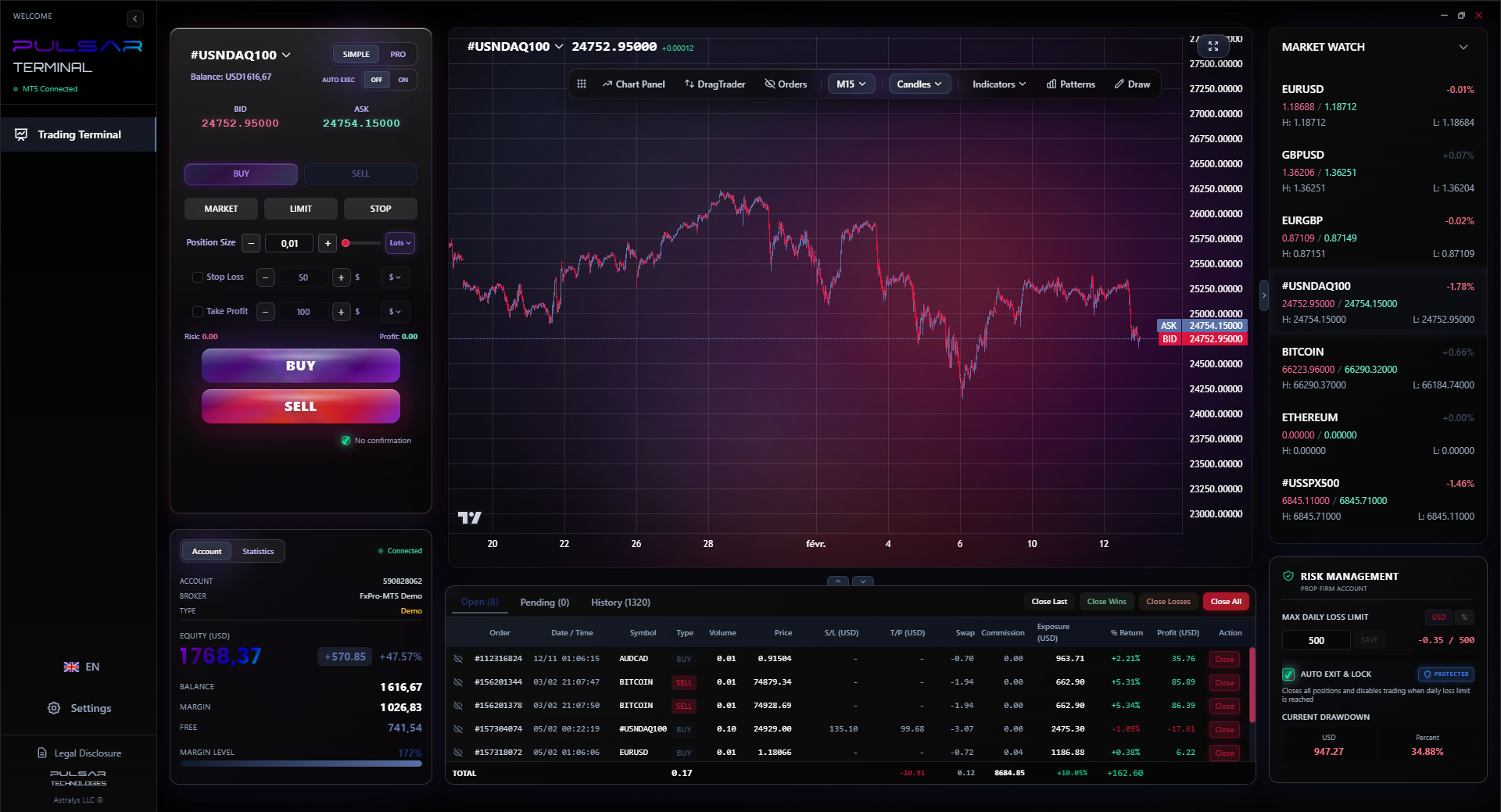
Managing multiple trades and setting precise stop losses is a core part of the framework, and Pulsar Terminal automates this directly on your MT5 platform.
Pulsar Terminal
The all-in-one MT5 companion: drag-and-drop orders, multi-TP/SL, trailing stop, grid trading, Volume Profile, and prop firm protection. Used by 1,000+ traders daily.
Platforms: MT4 is king in Nigeria. MT5 is gaining ground. They're reliable, familiar, and every broker supports them. Some brokers have slicker platforms like cTrader or xStation, but MT4/5's strength is its universality.
Payments: This is a crucial local specific. Funding your international broker account from Nigeria can be a hurdle.
- Bank Cards (Visa/Mastercard): Often work for deposits, but withdrawals back to the card can fail with Nigerian banks.
- Bank Transfer: Slow and expensive with forex conversion fees from your bank.
- E-Wallets (Skrill, Neteller): A popular bridge. Deposit Naira to a local e-wallet provider, convert to USD within the wallet, send to broker. Withdrawals come back the same way. Fees apply, but it's often the smoothest path.
- Cryptocurrency: Some brokers now accept deposits via USDT (Tether). Fast and avoids traditional banking channels, but adds crypto volatility risk.
Test a small withdrawal before you commit large capital. Knowing you can get your profits out is as important as making them.
“For every story of a trader buying a Range Rover, there are a thousand silent stories of depleted savings.”
What is forex trading all about for a Nigerian? It's a serious skill-based business, not a lottery ticket. It's about grinding on a demo, losing small amounts on a live account while you learn, and slowly building consistency over years. It's about managing your psychology more than your charts.
The market doesn't care about your rent, your dreams, or the Naira's value. It's brutally neutral.
If you approach it with patience, respect for risk, and a commitment to continuous learning, you have a fighting chance. If you're looking for a 'quick flip' to solve financial problems, you will lose. I've seen it a hundred times.
Start small. Think in percentages, not in Naira amounts. Protect your capital like it's the last money you'll ever have. That's the only way to find out if you're built for this. For every story of a trader buying a Range Rover, there are a thousand silent stories of depleted savings. Your job is to work to be the exception, not the rule.
💡 Winston's Tip
Spend 80% of your time analyzing your losing trades, not your winners. The losses hold all the secrets to your weaknesses.
FAQ
Q1Is forex trading legal and regulated in Nigeria?
Yes, it's legal for individuals to trade with their own money using international brokers. The Central Bank of Nigeria (CBN) doesn't directly regulate offshore forex brokers used by retail traders. Your protection comes from the foreign regulator overseeing your chosen broker (e.g., FCA, ASIC). The CBN's rules are focused on preventing speculation using dollars sourced from official channels.
Q2What is the minimum amount I need to start forex trading in Nigeria?
You can technically start with as little as $5-$10 with some brokers. But realistically, you need enough to survive small losses while learning. A more serious starting capital is $200-$500. More important than the amount is the risk management: never risk more than 1-2% of it on any single trade.
Q3Can I trade the Nigerian Naira (NGN) on forex platforms?
While some international brokers quote USD/NGN, it's often a derivative (CFD) with extremely wide spreads and low liquidity. It's not the same as trading the actual interbank Naira market. Most Nigerian retail traders focus on major global pairs like EUR/USD, GBP/USD, and commodities like Gold (XAU/USD).
Q4How do I withdraw my forex trading profits in Nigeria?
The most common method is via e-wallets like Skrill or Neteller. You withdraw USD from your broker to the e-wallet, then convert and send the Naira to your local bank account from the wallet's platform. Bank card withdrawals can be unreliable, and direct bank transfers are slow with high fees.
Q5What's the biggest mistake new Nigerian traders make?
Using excessive use. Brokers offer 1:500 or even 1:1000. New traders see this as a way to make huge profits from a small deposit. In reality, it's the fastest way to amplify losses and get a margin call. Start with low use (1:10 or 1:20) until you have a proven, profitable strategy.
Q6Do I pay tax on my forex trading profits in Nigeria?
Officially, yes. Profits are subject to Capital Gains Tax at 10%. You are responsible for declaring this to the Federal Inland Revenue Service (FIRS). In practice, many small retail traders do not, but you should maintain clear records of all trades and profits in case of future scrutiny.
Prof. Winston's Lesson
Key Takeaways:
- ✓Risk only 1-2% of your capital per trade.
- ✓Master one currency pair before adding others.
- ✓use kills accounts faster than bad analysis.
- ✓The spread and commissions are your first opponent.
How useful was this article?
Click a star to rate
Weekly Trading Insights
Free weekly analysis & strategies. No spam.
About the Author
Olumide Adeyemi
West African Trading Pioneer
One of Nigeria's most active forex trading educators. 8 years of experience trading from Lagos. Specializes in low-capital strategies and prop firm challenges for African traders.
Comments
Risk Disclaimer
Trading financial instruments carries significant risk and may not be suitable for all investors. Past performance does not guarantee future results. This content is for educational purposes only and should not be considered investment advice. Always conduct your own research before trading.
You Might Also Like

Cara Trading Forex Sukses: 7 Prinsip dari Trader Profesional
Cara trading forex sukses dengan 7 prinsip trader pro: manajemen modal, disiplin, journal trading, backtest. Data nyata, bukan janji profit palsu.
Jam Trading Forex Terbaik untuk Trader Indonesia: Panduan Lengkap dengan Tabel Waktu
Panduan jam trading forex untuk trader Indonesia. Tabel 4 sesi dunia, jam emas 20:00-00:00, sesi mana yang harus dihindari. Data akurat + tips dari trader berpengalaman.
Top 5 Sàn Forex Uy Tín Nhất 2026: Review Jujur dari Trader Indonesia
Top 5 sàn forex uy tín 2026 untuk trader Indonesia. Review jujur: spread, deposit, withdraw, dukungan lokal. Exness, XM, IC Markets & lebih.
Get Pulsar Terminal
All these calculators are built into Pulsar Terminal with real-time data from your MT5 account. One-click position sizing, automatic risk management, and instant calculations.
Get Pulsar Terminal