


My screen was a sea of red.

Olumide Adeyemi
West African Trading Pioneer ·  Nigeria
☕ 14 min read
What you'll learn:
- 1So, What Exactly Is Intraday Trading?
- 2The Nigerian Rules of the Game (It's Complicated)
- 3The Real Costs: What They Don't Tell You
- 4Getting Started: Your Trading Setup
- 5Intraday Strategies That Actually Work
- 6The Trader's Mindset & Daily Routine
- 7Mistakes to Avoid (I Made Them All)
- 8Your Action Plan to Start
My screen was a sea of red. It was March 2023, and the USD/NGN chart was doing things I'd never seen. The Central Bank had just announced a new exchange rate policy, and the pair shot up 25% in a single session. I was in a short position, convinced it couldn't go higher. I lost ₦120,000 in three hours. That brutal lesson taught me more about what is intraday trading in forex than any book ever could. It's not just buying and selling within a day. It's about surviving volatility, managing panic, and finding edges in chaos. Let's break down how it really works here in Nigeria.
Intraday trading, or day trading, means you open and close all your positions before the market closes for the day. You're not holding anything overnight. No sleeping with a trade open and waking up to a margin call because some news broke in London while you were asleep in Lagos.
The core idea is to catch small moves, sometimes just 10 to 50 pips, multiple times a day. You're a sprinter, not a marathon runner. The global forex market turns over about $9.6 trillion daily, and as a Nigerian intraday trader, you're trying to skim a tiny, tiny fraction of that.
Why do Nigerians gravitate towards it? A few reasons. First, you avoid swap fees, which are the interest charges for holding a position overnight. These can eat into profits on longer-term trades. Second, it fits the fast-paced, hustle mentality many of us have. Third, and most importantly, it lets you sidestep the risk of a massive gap in price when the market opens - something that can happen with the Naira pairs.
But here's the reality check I learned the hard way: it's incredibly demanding. You need to be glued to your charts. It's stressful. And if you're not disciplined, you can blow an account faster than you can say 'Lekki Phase 1.' It requires a specific mindset and a very clear set of rules, which we'll get into.

Warning: Many 'gurus' sell intraday trading as a get-rich-quick scheme. It's not. It's a skill that takes years to develop. The high use brokers offer (like 1:500 or even 1:1000) is a double-edged sword. It can amplify a 10-pip win into a nice profit, but it can also turn a small loss into a total account wipeout.

💡 Winston's Tip
The spread isn't just a cost, it's a filter. If your strategy needs a 5-pip move to be profitable and the average spread on your pair is 3 pips, you're fighting an uphill battle before you even start. Choose your pairs and broker accordingly.
This is where most new traders get confused. Let's clear the air.
Forex trading for individuals in Nigeria is legal. Full stop. You will not get arrested for trading EUR/USD on your phone. However, the regulatory environment has two big players with different agendas: the Central Bank of Nigeria (CBN) and the Securities and Exchange Commission (SEC).
The CBN's Role: Their main job is monetary stability. They control how dollars flow in and out of the country. You've felt this if you've tried to use your Naira debit card for a large international transaction - it often gets blocked. This is why we use domiciliary accounts, e-wallets like Opay or Paga, or even crypto (USDT is popular) to fund our international broker accounts. The CBN also intervenes in the USD/NGN market, which creates those huge, volatile moves I mentioned earlier.
The SEC's Role: This changed in April 2025 with the new Investments and Securities Act (ISA 2025). The law now says it's illegal for any company to operate a forex trading platform in Nigeria without registering with the SEC. This targets the shady 'fund managers' and Ponzi schemes, not you as an individual trader.
The Bottom Line for You: You are free to open an account with a reputable, internationally regulated broker. The SEC Nigeria doesn't yet license these brokers directly, so your safety net is the broker's own license from bodies like the UK's FCA, Cyprus's CySEC, or Australia's ASIC. Always choose a broker with strong international regulation. Your money is safer that way.

Pro Tip: When choosing a broker, don't just look at who offers the highest use. Check their regulatory status first. A broker like IC Markets or Pepperstone is regulated by ASIC, which is one of the strictest regulators globally. This matters more than a flashy bonus.
“Intraday trading is a marathon of sprints. It requires discipline, continuous learning, and brutal honesty with yourself.”
Let's talk numbers. This is where your profit gets chipped away if you're not careful.
1. The Spread: This is the difference between the buy (ask) and sell (bid) price. It's your primary cost of doing business. On a major pair like EUR/USD, a good spread for intraday is under 1 pip. Some brokers offer 'raw spread' accounts with a commission instead. You need to calculate which is cheaper for your trading style. For example:
| Broker | EUR/USD Spread (Standard) | Account Type |
|---|---|---|
| Capital.com | 0.64 pips | Spread-only |
| XTB | 0.92 pips | Spread-only |
| Exness | 1.0 pip | Spread-only |
| IC Markets | 0.1 pip + $7 commission | Raw Spread |
If you're placing 10 trades a day, a 2-pip spread versus a 0.5-pip spread makes a massive difference to your bottom line over a month.
2. Taxes: Yes, you have to pay. Profits from forex trading are subject to Capital Gains Tax (CGT), which is currently 10% of your gross profit. You're required to declare this to the Federal Inland Revenue Service (FIRS). If trading is your main business, it falls under Personal Income Tax. Keep a detailed trade journal. I use a simple spreadsheet logging every entry, exit, and profit. When tax season comes, it's straightforward.
3. The Hidden Cost of Losses: This is the biggest one. Say you start with ₦500,000. You lose 20% (₦100,000). To get back to your starting capital, you now need to make a 25% return on the remaining ₦400,000. Lose 50%, and you need a 100% return just to break even. This math is why risk management isn't optional. You must use a position size calculator for every single trade.
My own mistake? In 2022, I got overconfident. I had three winning days in a row on gold (XAU/USD). On the fourth day, I tripled my usual position size without adjusting my stop-loss. A sudden spike against me hit my stop, and I gave back all the profits from the previous three days plus some of my capital. I was furious with myself. Greed overrode my rules.
Choosing Your Broker
You need a broker that welcomes Nigerian clients and offers reliable deposits/withdrawals. Look for:
- Local payment options: Bank transfer, Paga, Opay, USSD.
- Low minimum deposit (some start at $1, but I recommend starting with at least $100 or ₦50,000 to have room to breathe).
- A platform you like, usually MT4 or MT5.
Brokers like Exness and XM are popular here because they've tailored their services for Nigeria. But always do your own due diligence.
Funding Your Account
Forget using your Naira card for large amounts. The CBN restrictions will block it. Here’s what works:
- Domiciliary Account: Fund it with USD/GBP/EUR, then transfer to your broker.
- E-wallets: Skrill, Neteller, or even the crypto route (buy USDT on a local exchange, send to broker).
- Local Broker Transfer: Some brokers have local Nigerian bank accounts you can pay into.
Your Toolkit: Charts and Indicators
MetaTrader 4 or 5 is the standard. For what is intraday trading in forex technically, you need clean charts and fast execution.
Indicators are your sensors, not your strategy. I use only a handful:
- Moving Averages (9 & 21 EMA): To gauge trend direction on the 15-minute and 1-hour charts.
- RSI Indicator: To spot potential overbought or oversold conditions within the trend. I look for divergence more than absolute levels.
- MACD Indicator: For momentum and trend confirmation on the 1-hour chart.
I keep my chart clean. Too many indicators give conflicting signals and cause paralysis. The price action (the candles themselves) tells the main story.

Example: Let's say EUR/USD is in an uptrend on the 1-hour chart, pulling back to the 21 EMA. On the 15-minute chart, the RSI dips near 40 (but not oversold), and the MACD histogram starts turning up. That's a potential long entry for a continuation of the main trend. Your stop-loss goes below the recent swing low on the 15-minute chart.
💡 Winston's Tip
Your first profit target should often be to cover your risk. Close half your position once you're in profit by the amount of your initial stop-loss. This moves your trade to 'risk-free' and lets you think clearly about the remainder.
“Your psychology will make or break you. The market doesn't care about your rent, your goals, or your feelings.”
You need a plan before the market opens. Here are two frameworks I've used successfully.
1. Trend-Following Scalping
This is my bread and butter. I don't try to pick tops and bottoms. I wait for the market to show its direction, then jump on for a ride.
- Timeframe: I use the 1-hour chart to define the trend (higher highs/higher lows for uptrend). Then I drop to the 5 or 15-minute chart to find an entry.
- Entry: Look for a pullback to a dynamic support level like the 9 or 21-period Exponential Moving Average (EMA). Wait for a bullish candlestick pattern (like a pin bar or engulfing) to form at that support.
- Exit: Aim for a risk-reward ratio of at least 1:1.5. If I risk 10 pips, I aim for 15 pips profit. I might close half my position at 1:1 and let the rest run with a trailing stop. For more on this fast-paced style, see our guide on scalping strategy.
2. Range Trading
When there's no clear trend, the price often bounces between a clear support and resistance level.
- Identify the Box: Mark the recent high and recent low on the 15-minute or 30-minute chart.
- Fade the Edges: Buy near the identified support, sell near the resistance.
- The Crucial Part: Your stop-loss must be placed just outside the range. If the price breaks out, your thesis is wrong. Get out. Don't hope it comes back.
A Personal Trade: On July 12th last year, GBP/USD was ranging between 1.2850 and 1.2920 for most of the London session. I went short at 1.2915, just below the resistance. Stop at 1.2930 (15 pips risk). Price rejected the level and fell back into the range. I took profit at 1.2870 for a 45-pip gain. Risk-reward was 1:3. That's a good trade. The key was patience to wait for the price to actually reach my zone.
Regardless of strategy, you must define your daily loss limit. Mine is 2% of my account. If I hit it, I shut down the platform and walk away. No revenge trading. This single rule has saved me more money than any indicator.
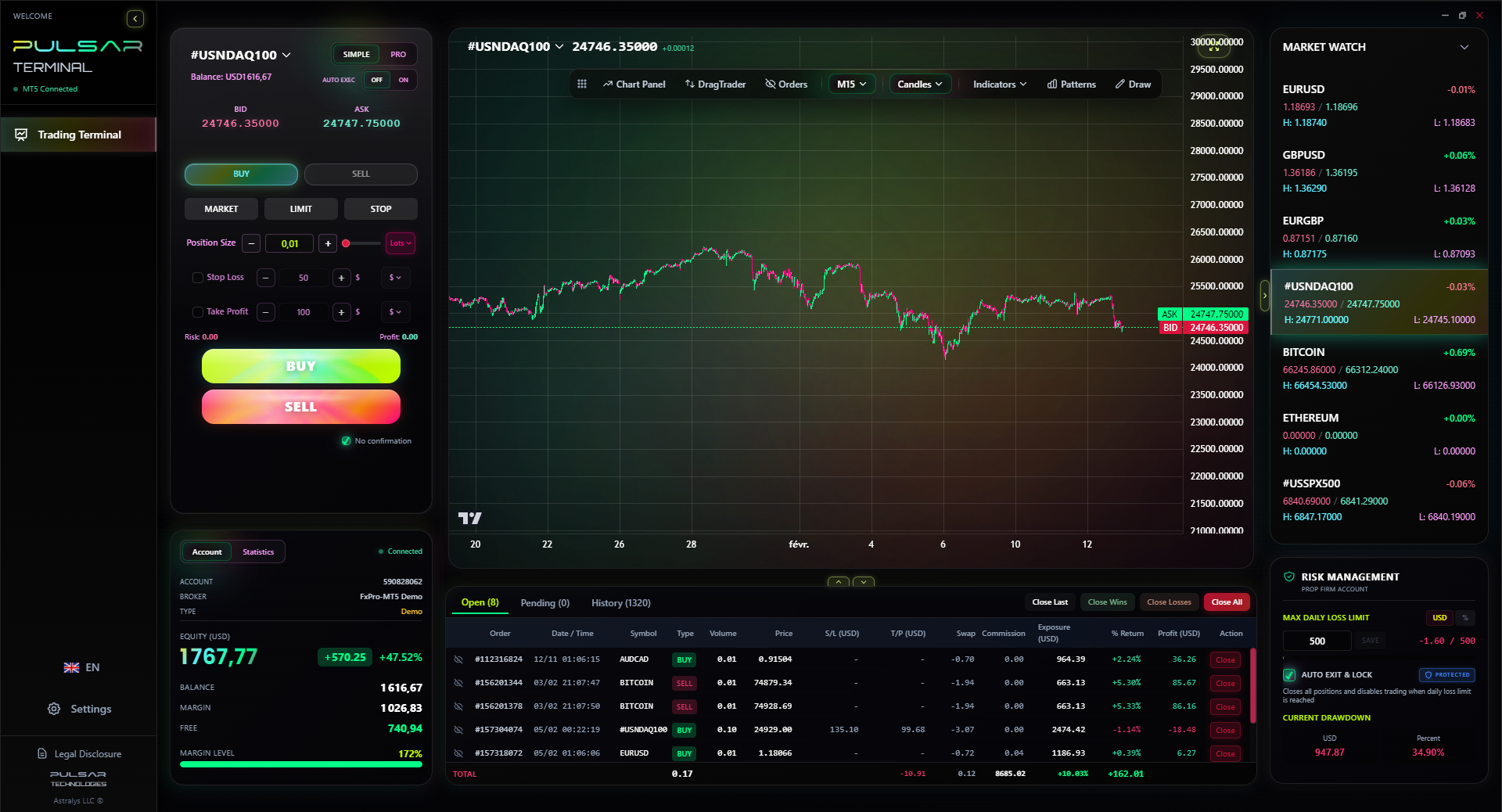
Managing multiple take-profit levels and trailing stops manually is stressful; Pulsar Terminal automates these advanced order types directly on your MT5 platform.
Pulsar Terminal
The all-in-one MT5 companion: drag-and-drop orders, multi-TP/SL, trailing stop, grid trading, Volume Profile, and prop firm protection. Used by 1,000+ traders daily.
Your psychology will make or break you. I've been there - the euphoria of a win, the desperation of a loss, the urge to 'get it back.'
A Non-Negotiable Daily Routine:
- Pre-Market (7:00 AM WAT): I don't trade right away. I review the economic calendar. Is there major news (like US NFP, CPI) due? If yes, I might sit out or trade with smaller size. I look at the daily charts of my 3-4 favorite pairs to see where they closed.
- London Session Open (8:00 AM WAT): Liquidity picks up. I assess the opening price action. Does it gap? Does it respect yesterday's levels? I don't place a trade for the first 30 minutes. Let the market settle.
- Trading Window (8:30 AM - 12:00 PM WAT): This is my most active period, overlapping London and the start of New York. I execute my plan. Every trade has a pre-defined entry, stop-loss, and take-profit. No deviations.
- Review & Shut Down (12:30 PM): I log every trade. Why did I take it? Did I follow my rules? Win or lose, the review is what helps you improve. Then I close the platform. Intraday doesn't mean all-day. Overtrading is a sure path to losses.
The Emotional Pitfalls:
- Revenge Trading: After a loss, you immediately jump into another trade to recover. This is when you take your worst setups. Stop. Walk away.
- Overconfidence: A few wins in a row and you think you've cracked the code. You increase your position size recklessly. The market humbles you quickly.
- Fear of Missing Out (FOMO): You see a pair shooting up, you chase it without a plan, and you buy at the top. Let the train go. There will be another.
The market doesn't care about your rent, your goals, or your feelings. It's your job to manage yourself. This is the hardest part of learning what is intraday trading in forex.
“A stop-loss is your life jacket. Trading without one, especially with use, is suicide.”
Let me save you some money and heartache by listing my most expensive lessons.
1. Trading Without a Stop-Loss. This is suicide, especially with use. I once sold USD/JPY and it moved against me slowly. 'It'll come back,' I thought. It didn't. I watched my loss grow from -10 pips to -50, to -100. By the time I manually closed, I had wiped out 30% of my account. A stop-loss is your life jacket. Use it.
2. Ignoring Major News. I was in a nice EUR/USD trade, up 20 pips. Then the US Federal Reserve made an unexpected announcement. Within 60 seconds, my profit turned into a 40-pip loss as the pair spiked 60 pips against me. Now, I always check the economic calendar. If high-impact news is due, I either don't trade or I widen my stop-loss significantly to account for the volatility.
3. Adding to a Losing Position (Averaging Down). This is a classic mistake masquerading as a strategy. If your trade is going wrong, your thesis is likely wrong. Adding more money to it is just throwing good money after bad. Close the bad trade, take the small loss, and look for a new opportunity.
4. Underestimating the Naira's Volatility. Trading USD/NGN can be tempting, but it's a different beast. The CBN can intervene, and liquidity can dry up. The spreads are often huge. I treat it with extreme caution and much smaller position sizes than I would for major pairs like EUR/USD.
5. Chasing 'Surefire' Signals from WhatsApp Groups. If someone had a guaranteed system, they wouldn't be selling it for ₦5,000 in a Telegram group. They'd be trading it. Do your own analysis. Trust your own plan.
Remember, a margin call happens when your losses exceed your available funds. The only way to prevent it is to risk a tiny percentage of your capital on each trade. Never risk more than 1-2% per trade. This isn't a suggestion; it's a rule for survival.
💡 Winston's Tip
The most important level on your chart is yesterday's closing price. Watch how price behaves around it at the open of the London session. It often sets the tone for the day's intraday bias.
Okay, you're still reading. That means you're serious. Here's your step-by-step plan.
Phase 1: Education (Weeks 1-4) Don't deposit real money yet. Download a demo account from a reputable broker. Practice for a minimum of one month. Your goal isn't to make fake money, but to:
- Learn how to place orders, set stops and limits.
- Test your emotions when a trade goes for or against you.
- Develop a simple checklist for your trades.
Phase 2: Develop a Simple Plan (Week 5) Answer these questions in writing:
- What pairs will I trade? (Stick to 2-3 major pairs like EUR/USD, GBP/USD, XAU/USD to start).
- What is my daily loss limit? (e.g., 2% of account).
- What is my maximum risk per trade? (e.g., 0.5% of account).
- What time of day will I trade? (e.g., London session).
- What is my entry criteria? (Be specific, e.g., "Price pulls back to 21 EMA on 15-min chart in line with 1-hour trend").
Phase 3: Go Live Small (Week 6+) Fund a live account with money you can afford to lose completely. This should not be rent money, school fees, or a loan. Start with the smallest possible position size. Your goal for the first 3 months is not profit. Your goal is to execute your plan perfectly and survive. If you can break even in your first three months, you're doing better than 80% of starters.
Phase 4: Review and Refine Every weekend, review your trades. Are you following your rules? Is your strategy working in the current market? Adjust slowly. Don't overhaul your entire plan every time you have a losing week.
Intraday trading is a marathon of sprints. It requires discipline, continuous learning, and brutal honesty with yourself. But if you treat it as a serious skill to be mastered, not a lottery ticket, it can be one of the most challenging and rewarding pursuits out there. Now, go set up that demo account and start practicing. I'll see you on the charts.
FAQ
Q1Is intraday trading in forex legal in Nigeria?
Yes, it is legal for individual Nigerian citizens to trade forex with their own funds using internationally regulated brokers. The regulations target unregistered platforms and investment schemes, not individual traders. However, you must pay a 10% Capital Gains Tax on your profits.
Q2How much money do I need to start intraday trading in Nigeria?
You can start with as little as $10-$20 with some brokers, but I strongly advise starting with at least ₦50,000 - ₦100,000. This allows for proper position sizing and risk management. More important than the amount is that it must be capital you can afford to lose completely without it affecting your life.
Q3What is the best time to trade forex intraday in Nigeria?
The most liquid and active periods are during the overlap of the London and New York sessions, roughly from 8:00 AM to 12:00 PM West Africa Time (WAT). This is when you'll see the most movement and the tightest spreads, which is ideal for intraday strategies.
Q4Can I make a living from intraday forex trading in Nigeria?
It's possible, but extremely difficult and should not be your expectation when starting. Most traders lose money. To even consider it, you need a large, well-capitalized account (multiple millions of Naira), a proven, disciplined strategy over several years, and the emotional resilience to handle inconsistent income. Treat it as a side skill first.
Q5What's the difference between intraday trading and swing trading?
Intraday trading means opening and closing all positions within the same day, aiming for small, frequent profits. Swing trading involves holding positions for several days or weeks to capture larger market swings. Intraday avoids overnight swap fees but requires constant screen time. Swing trading requires less monitoring but carries overnight and weekend gap risk.
Q6How do I avoid scams as a forex trader in Nigeria?
Avoid any person or company that: 1) Guarantees profits or specific returns. 2) Asks you to send money to a personal Nigerian bank account for 'management.' 3) Operates without clear international regulation (check the broker's website for FCA, ASIC, CySEC licenses). Only trade with your own money in an account you control directly with a reputable broker.
Q7Do I need a domiciliary account to trade forex?
It's highly recommended. Funding an international broker directly with a Naira card is often blocked by CBN restrictions. A domiciliary account (in USD, GBP, or EUR) or the use of e-wallets (Skrill, Neteller) or cryptocurrency (USDT) are the most reliable funding methods for Nigerian traders.
Prof. Winston's Lesson
Key Takeaways:
- ✓Risk max 1-2% of capital per trade.
- ✓Define daily loss limit (e.g., 2%) and stop.
- ✓Trade only during high-liquidity sessions (8am-12pm WAT).
- ✓Master 1-2 pairs before adding more.
- ✓A demo account is for practice, not profit simulation.
How useful was this article?
Click a star to rate
Weekly Trading Insights
Free weekly analysis & strategies. No spam.
About the Author
Olumide Adeyemi
West African Trading Pioneer
One of Nigeria's most active forex trading educators. 8 years of experience trading from Lagos. Specializes in low-capital strategies and prop firm challenges for African traders.
Comments
Risk Disclaimer
Trading financial instruments carries significant risk and may not be suitable for all investors. Past performance does not guarantee future results. This content is for educational purposes only and should not be considered investment advice. Always conduct your own research before trading.
You Might Also Like

Cara Trading Forex Sukses: 7 Prinsip dari Trader Profesional
Cara trading forex sukses dengan 7 prinsip trader pro: manajemen modal, disiplin, journal trading, backtest. Data nyata, bukan janji profit palsu.
Jam Trading Forex Terbaik untuk Trader Indonesia: Panduan Lengkap dengan Tabel Waktu
Panduan jam trading forex untuk trader Indonesia. Tabel 4 sesi dunia, jam emas 20:00-00:00, sesi mana yang harus dihindari. Data akurat + tips dari trader berpengalaman.
Top 5 Sàn Forex Uy Tín Nhất 2026: Review Jujur dari Trader Indonesia
Top 5 sàn forex uy tín 2026 untuk trader Indonesia. Review jujur: spread, deposit, withdraw, dukungan lokal. Exness, XM, IC Markets & lebih.
Get Pulsar Terminal
All these calculators are built into Pulsar Terminal with real-time data from your MT5 account. One-click position sizing, automatic risk management, and instant calculations.
Get Pulsar Terminal