


You've seen the MACD on your charts.

Olumide Adeyemi
West African Trading Pioneer ·  Nigeria
☕ 11 min read
What you'll learn:
- 1MACD Basics: It's Just Three Lines (But You're Reading Them Wrong)
- 2The Three Ways Nigerians Use MACD (And Which One Actually Works)
- 3Why the MACD Fails Nigerian Traders (It's Not the Indicator's Fault)
- 4MACD Settings for Nigerian Traders: USD/NGN, Oil, and Crypto
- 5The Winning Combo: MACD + Simple Price Action
- 6MACD Mistakes You're Probably Making Right Now
- 7Final Verdict: Is the MACD Worth It for a Nigerian Trader?
You've seen the MACD on your charts. You've probably even taken a trade because the lines crossed. But why did you still lose money? In Nigeria, where use is high and the temptation to 'hammer' the market is real, understanding what is MACD in forex is less about the textbook definition and more about survival. I've watched traders here chase MACD crossovers on USD/NGN pairs and get wiped out by a single CBN announcement. Let's strip this indicator down to its bones and talk about how to actually use it without sending your capital to 'God abeg' territory.
Everyone says the MACD is a 'momentum oscillator'. That's a fancy term for a tool that shows you if the buying or selling pressure is getting stronger or weaker. Forget the jargon for a second. Visually, it's the three lines below your price chart.
Here’s what they actually are:
- The MACD Line (The Fast One): This is just the difference between a 12-period and a 26-period Exponential Moving Average (EMA). If the price's short-term average (12) is rising faster than its longer-term average (26), this line goes up. It's the main character.
- The Signal Line (The Slow One): This is simply a 9-period EMA of the MACD line itself. It's a smoothed-out version of the main character, lagging behind to confirm its moves. Think of it as the cautious friend.
- The Histogram (The Storyteller): This is just the MACD Line minus the Signal Line, plotted as bars. When the bars are getting taller (above or below the zero line), momentum is accelerating. When they're shrinking, momentum is fading. This is often the first clue something is changing.
The classic buy signal is when the MACD line crosses above the Signal line. The sell signal is the opposite. But if you're just trading every crossover you see on the EUR/USD, you're in for a world of pain and whipsaws. The real question isn't "what is the MACD showing?" but "what is the context?"

Example: On a standard chart, the MACD settings are (12, 26, 9). This isn't magic. I've tested (5, 35, 5) for faster signals and (21, 55, 9) for slower ones on commodities like gold. The default works because everyone else sees it, creating self-fulfilling reactions around key levels.
I learned this the hard way in 2015, scalping GBP/JPY. I'd see a beautiful MACD crossover on the 5-minute chart, enter, and then get stopped out when the 1-hour chart's MACD was screaming the opposite direction. I was using the tool correctly but on the wrong battlefield. You must check the higher timeframe trend first. A scalping strategy on the 5-minute chart has a much higher chance if the 1-hour MACD is on your side.

💡 Winston's Tip
The MACD histogram is the first to move. If the lines haven't crossed but the histogram is starting to rise from deep negative territory, smart money is already accumulating. Watch it closely.
“The classic buy signal is when the MACD line crosses above the Signal line. But if you're just trading every crossover you see, you're in for a world of pain.”
1. The Crossover Chase (The Account Killer)
This is the most common, most tempting, and most dangerous method. You see the lines cross, you FOMO in. The problem? In a ranging market - which happens a lot with pairs like EUR/NGN - these crossovers happen constantly right at support and resistance. You get chopped up. The spread alone on exotic pairs can eat your potential profit from a small crossover move.
2. Zero Line Rejection (The Trend Follower's Friend)
This is more powerful. The zero line on the MACD represents the midpoint between the two moving averages. When the MACD line is above zero, the short-term average is above the long-term average - a basic uptrend. When it pulls back to the zero line in an uptrend and then bounces back up, that's often a high-probability continuation signal. It helps you avoid selling in a strong bull market just because of a tiny crossover.
I used this in 2021 trading XAU/USD (gold). The weekly MACD was firmly above zero. I waited for pullbacks on the daily chart where the MACD touched or neared the zero line and then started rising again. One trade entered at $1780 with the MACD histogram just turning green again rode to $1910. The zero line acted as a dynamic support. You can read more about this in our XAU/USD guide.
3. Divergence Hunting (The Reversal Whisperer)
This is the advanced class, and it's where MACD can be pure gold. Divergence is when the price makes a new high, but the MACD makes a lower high (bearish divergence), or the price makes a new low, but the MACD makes a higher low (bullish divergence). It signals the momentum behind the move is dying.

Warning: Divergence does NOT mean "reverse immediately." It means "be alert for a potential reversal." I've sat through three separate bearish divergences on a USD/JPY rally before it finally topped. If you short at the first sign, you get run over. You need confirmation from price action - like a break of a trendline or a key support level.
A broker with tight spreads is crucial here, as you're often entering against the prevailing momentum. This is where a broker like IC Markets or Pepperstone with their raw spreads can make a difference on your entry precision.
“Divergence does NOT mean 'reverse immediately.' It means 'be alert for a potential reversal.' I've sat through three before a top.”
Let's be frank. The MACD doesn't fail. Traders fail to understand its limitations, especially in our market.
First, we ignore volatility. The MACD is based on moving averages, which are lagging. During high-volatility events - like a surprise CBN circular on dollar allocations or a sudden shift in oil prices - the indicator will be slow to react. By the time it gives a crossover, the big move is already halfway done. You're late.
Second, we use insane use. I've seen guys use 1:1000 use from brokers like Exness on a MACD signal from a 1-minute chart. The indicator might be right 60% of the time, but that 40% loss with 1:1000 use is a 100% account wipeout. The MACD doesn't know you're over-leveraged. It just gives a signal. Your position size calculator is your real best friend, not the crossover.
Third, we trade in isolation. A MACD crossover on its own is weak. Does it align with a key support level? Is there a clear trend on the higher timeframe? Is the RSI indicator showing overbought or oversold conditions to confirm? If you're not asking these questions, you're gambling.
My most expensive lesson was in 2018. Naira futures were moving. I saw a perfect bearish divergence on the 4-hour chart and shorted. What I ignored was the massive bullish order block on the weekly chart that was still in play. The divergence played out for a 20-pip drop, then price reversed and took out my stop loss and kept going. I was technically right on the MACD but contextually wrong. The loss was 3% of my account because my position size was sane. Without that discipline, it would have been a disaster.
💡 Winston's Tip
A MACD crossover that also crosses the zero line is 3x more significant than a crossover that happens far from zero. It represents a shift in the underlying average price, not just short-term momentum.
“Divergence does NOT mean 'reverse immediately.' It means 'be alert for a potential reversal.' I've sat through three before a top.”
The default (12,26,9) works fine for major pairs like EUR/USD that have clean trends. But our local favorites? They need tweaks.
- USD/NGN (or Naira Pairs): This market is driven by liquidity events, CBN policies, and BDC flows. It can range for weeks then explode. Using a slower MACD like (21, 55, 9) on the daily chart can help you filter out the noise and only catch the bigger policy-driven moves. The regular crossovers on faster settings will drive you mad.
- Oil (USOIL): A key asset for Nigeria. It's trendy but volatile. I stick with the default on the 4-hour and daily charts for oil. The key is watching for divergences at major psychological levels ($80, $100). A divergence there, especially on the weekly chart, can signal a major turn.
- Crypto (BTC, ETH): Crypto moves fast. Some traders speed up the MACD to (6, 19, 9) to be more responsive. Personally, I keep it default but use it on longer timeframes (4-hour+) to define the overall market structure. Trading a MACD crossover on a 15-minute Bitcoin chart is a surefire way to donate your money.

Pro Tip: Don't change the settings to fit your bias. If you're bullish and the MACD is bearish, your brain will try to tweak the numbers until it says what you want to hear. Backtest. Use the strategy tester in MT5. See if your new (5,15,5) setting actually performed better over 100 trades on your chosen pair, or if it just generated more losing signals.
“The MACD doesn't fail. Traders fail to understand its limitations, especially in our market.”
This is the secret sauce. The MACD is a derivative of price. It should confirm what price is telling you, not the other way around.
Here’s my simple checklist before any MACD trade:
- Trend on Higher TF: Is the daily chart MACD above or below the zero line? That's my bias. I only take crossovers on the 4-hour or 1-hour chart that align with this bias.
- Key Level: Am I near a clear support or resistance level? A bullish MACD crossover at a strong support level is a much higher-probability trade than the same crossover in the middle of nowhere.
- Histogram Momentum: Is the histogram already accelerating in my direction, or is it flat? I want to see those bars growing, confirming the momentum shift.
For example, in a swing trading setup on EUR/USD: The daily MACD is above zero (uptrend). Price pulls back to a previous resistance-turned-support level on the 4-hour chart. As price touches this level, the 4-hour MACD shows a bullish crossover and the histogram ticks upward. That's a confluence. That's your signal.
This approach filters out probably 70% of the raw MACD crossovers you see. You'll trade less, but your win rate and peace of mind will improve dramatically. It forces patience, which is the one thing the Nigerian market will test relentlessly.
💡 Winston's Tip
If you see a divergence, don't trade it. Wait for the divergence to be 'confirmed' by the MACD line crossing the signal line in the direction of the divergence. This filters out many false alarms.
“The MACD doesn't fail. Traders fail to understand its limitations, especially in our market.”
Let's run through the hall of shame. I've committed every one of these.
- Trading the Histogram Like a Ping Pong Ball: "The histogram is below zero but rising, time to buy!" No. The histogram is just showing the gap between the two lines. In a strong downtrend, the histogram can rise for several bars (the gap is closing) while both the MACD and Signal lines are still falling and below zero. That's not a buy signal. It's a potential slowing of the sell-off.
- Ignoring the Zero Line in a Range: In a sideways market, the MACD line will dance around the zero line. Every crossover is meaningless noise. This is when you turn the indicator off and just trade the range boundaries.
- Using MACD Alone for Entries and Exits: The MACD is great for identifying a potential setup. But your actual entry should be on a price trigger - a candlestick close above a bar, a break of a small consolidation. Your exit should be based on a target (like a previous swing high) or a trailing stop, not waiting for the opposite MACD crossover, which will give back a huge chunk of profit.
- Not Understanding the Spread: If you're trading a pair with a 3-pip spread and you're aiming for a 10-pip profit from a MACD crossover, the spread is 30% of your target. You need the move to be significantly stronger just to break even. This kills scalp strategies based on fast MACD settings.
I once blew a 15% account profit in a day because I ignored mistake #3. I had a great long trade on AUD/USD. Instead of taking profit at a clear resistance level, I held because "the MACD was still strong." It reversed, the MACD eventually gave a sell crossover, and I exited for a 2% gain instead of the 7% I had. Greed, masked as indicator loyalty.
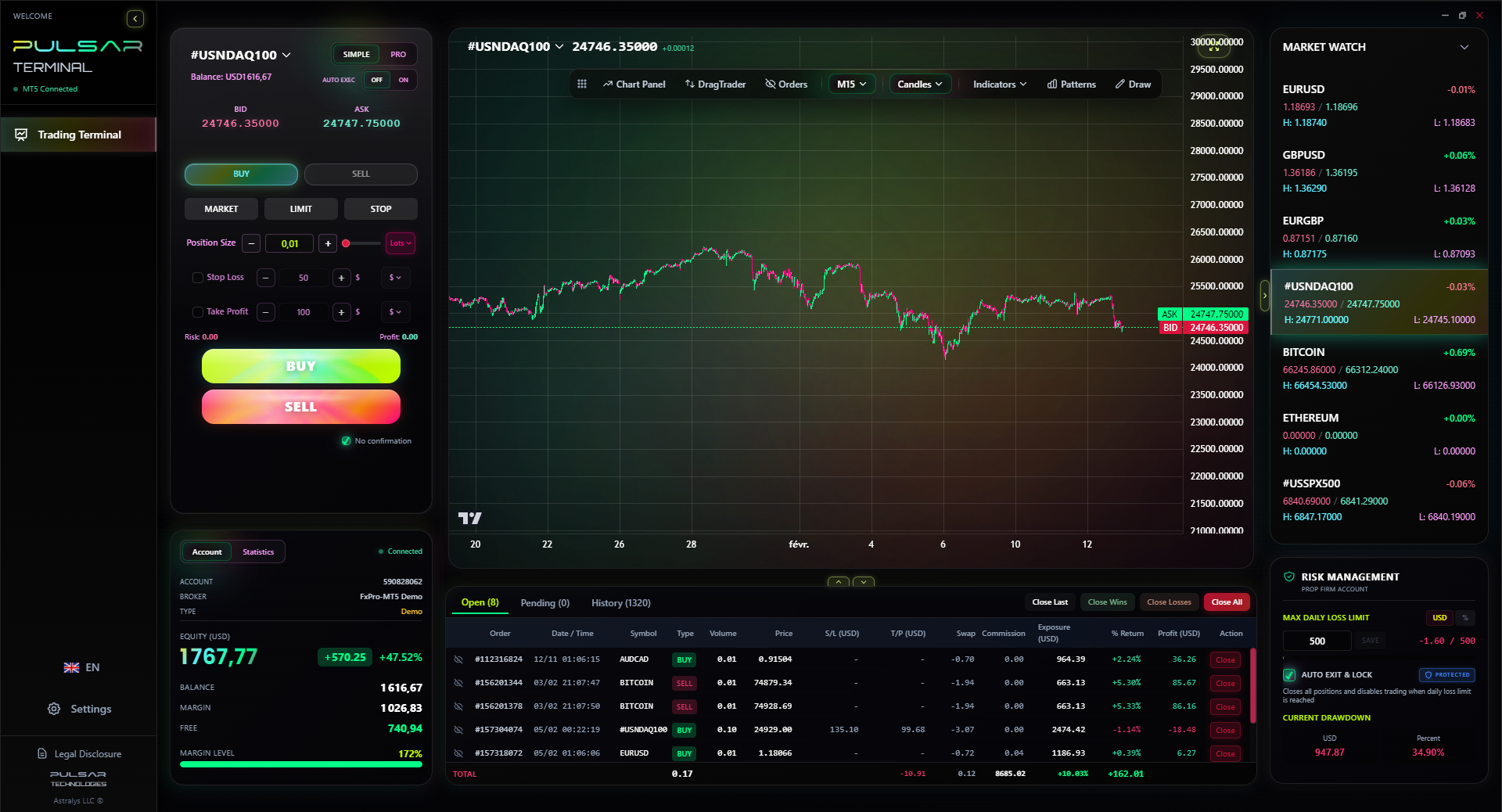
Managing multiple trades based on MACD signals across different pairs is complex, but tools like Pulsar Terminal let you set multi-TP/SL and trailing stops for all of them directly on your MT5 charts.
Pulsar Terminal
The all-in-one MT5 companion: drag-and-drop orders, multi-TP/SL, trailing stop, grid trading, Volume Profile, and prop firm protection. Used by 1,000+ traders daily.
“Think of the MACD as your momentum dashboard, not your steering wheel.”
Absolutely, yes. But not as a standalone signal generator. Think of it as your momentum dashboard, not your steering wheel.
Its real value is in helping you answer three critical questions: Is the trend up or down (Zero Line)? Is the momentum behind the trend strengthening or weakening (Histogram)? Is there a hidden disagreement between price and momentum that foreshadows a reversal (Divergence)?
For the Nigerian trader navigating power outages, internet fluctuations, and a volatile economic backdrop, simplicity is key. The MACD offers that. You don't need 10 indicators cluttering your screen. You need a deep understanding of one or two. Pair a clean understanding of what is MACD in forex with solid risk management - using a realistic position size calculator and knowing what a margin call level really means for your broker - and you've got a fighting chance.
Start by adding it to your chart. But don't trade it. Just watch it for a week. See how it behaves during trends, during ranges, during news events. Note when its signals were early, late, or right on time. That observational period will teach you more than any article. Remember, the goal isn't to master the MACD. The goal is to use it to master your own impulses.
FAQ
Q1What are the best MACD settings for forex trading in Nigeria?
Stick with the default (12, 26, 9) for most major pairs like EUR/USD. For local favorites like USD/NGN that are news-driven, try slower settings (21, 55, 9) on higher timeframes to filter out noise. Never change settings just to make the indicator agree with your trade idea - backtest any changes first.
Q2How reliable is the MACD crossover signal?
On its own, not very reliable - especially in a ranging market where it will whipsaw you constantly. Its reliability skyrockets when the crossover aligns with the higher timeframe trend (MACD above/below zero line) and occurs at a key support or resistance level. It's a confirming tool, not a standalone system.
Q3What is the difference between MACD and RSI?
Both are momentum oscillators, but they measure different things. The RSI measures the speed and magnitude of price moves to identify overbought/oversold conditions (like a speedometer). The MACD shows the relationship between two moving averages to identify trend direction and momentum shifts (like a trend and acceleration gauge). Many traders use them together for confirmation.
Q4Can I use MACD for scalping forex?
You can, but it's tricky. On very short timeframes (like 1-minute or 5-minute charts), market noise and spreads can render many MACD crossovers unprofitable. If you scalp, use it on slightly higher timeframes (like 15-minute) to establish bias, and use faster price action for your actual entry. A low-spread broker is non-negotiable for scalping.
Q5What does MACD divergence mean?
Divergence occurs when the price makes a new high or low, but the MACD does not. Bearish divergence (price makes a higher high, MACD makes a lower high) suggests weakening bullish momentum. Bullish divergence (price makes a lower low, MACD makes a higher low) suggests weakening bearish momentum. It's a warning of a potential reversal, not an immediate signal to trade.
Q6Is MACD a lagging indicator?
Yes, absolutely. It's based on moving averages, which are inherently lagging. It tells you what has already happened with momentum. This is why using it for prediction is dangerous. Use it to confirm what price is currently doing and to assess the strength of the move already in play.
Q7Should Nigerian traders use MACD for crypto trading?
It can be useful on higher timeframes (4-hour and above) to identify the core trend and spot major divergences. Crypto is extremely volatile, so using MACD on very short timeframes will generate many false signals. Always combine it with clear support/resistance levels and have a wider stop loss to account for crypto's wild swings.
Prof. Winston's Lesson
Key Takeaways:
- ✓Never trade a MACD crossover against the zero line trend.
- ✓A 3-pip spread eats 30% of a 10-pip target profit.
- ✓Divergence is a warning, not a trading signal.
- ✓The histogram shows momentum change before the lines cross.
How useful was this article?
Click a star to rate
Weekly Trading Insights
Free weekly analysis & strategies. No spam.
About the Author
Olumide Adeyemi
West African Trading Pioneer
One of Nigeria's most active forex trading educators. 8 years of experience trading from Lagos. Specializes in low-capital strategies and prop firm challenges for African traders.
Comments
Risk Disclaimer
Trading financial instruments carries significant risk and may not be suitable for all investors. Past performance does not guarantee future results. This content is for educational purposes only and should not be considered investment advice. Always conduct your own research before trading.
You Might Also Like

Cara Trading Forex Sukses: 7 Prinsip dari Trader Profesional
Cara trading forex sukses dengan 7 prinsip trader pro: manajemen modal, disiplin, journal trading, backtest. Data nyata, bukan janji profit palsu.
Jam Trading Forex Terbaik untuk Trader Indonesia: Panduan Lengkap dengan Tabel Waktu
Panduan jam trading forex untuk trader Indonesia. Tabel 4 sesi dunia, jam emas 20:00-00:00, sesi mana yang harus dihindari. Data akurat + tips dari trader berpengalaman.
Top 5 Sàn Forex Uy Tín Nhất 2026: Review Jujur dari Trader Indonesia
Top 5 sàn forex uy tín 2026 untuk trader Indonesia. Review jujur: spread, deposit, withdraw, dukungan lokal. Exness, XM, IC Markets & lebih.
Get Pulsar Terminal
All these calculators are built into Pulsar Terminal with real-time data from your MT5 account. One-click position sizing, automatic risk management, and instant calculations.
Get Pulsar Terminal