


Ever stare at a chart, wondering where the price might turn next? You're not alone.

David van der Merwe
Emerging Markets Trader ·  South Africa
☕ 9 min read
What you'll learn:
Ever stare at a chart, wondering where the price might turn next? You're not alone. For years, I chased breakouts that reversed and sold dips that kept dipping. Then I started paying attention to the quiet, calculated lines that floor traders have used for decades: pivot points. In forex, a pivot point isn't some mystical prediction. It's a simple, objective calculation that gives you a snapshot of yesterday's battle and a map for today's. For us trading from SA, with the Rand's unique volatility, these levels become even more critical. They're not a crystal ball, but they tell you where the fight is likely to happen.
Let's cut through the jargon. A pivot point is just the average price of the last trading period. That's it. We take the high, the low, and the closing price, add them up, and divide by three. The formula is P = (H + L + C) / 3.
This gives you the main pivot point (P). It's the centre of gravity. The market's memory of where value was. From this central point, we calculate support and resistance levels that fan out above and below. The most common set includes three support levels (S1, S2, S3) and three resistance levels (R1, R2, R3). Your trading platform does all this math instantly. You don't need a calculator; you just need to know what the numbers mean.
Here's the key: if price opens and trades above the main pivot (P) today, the short-term bias is considered bullish. The market is saying yesterday's closing struggle wasn't enough to keep it down. If it trades below P, the bias is bearish. It's not a guarantee, but it's the first clue about sentiment. I made the mistake for months of ignoring this simple high-low-close math, trying to use fancy indicators instead. The basics work.

Example: Let's say USD/ZAR had a high of 18.9500, a low of 18.7200, and closed at 18.8800 yesterday. Pivot Point (P) = (18.9500 + 18.7200 + 18.8800) / 3 = 18.8500. That 18.85 level becomes our line in the sand for the new session.

💡 Winston's Tip
The central Pivot Point is the king. Price holding above it suggests the bulls have the ball. Holding below it, the bears are in control. Trade in the direction of the king's court.
So you've got these lines on your chart. Now what? In the SA context, with brokers like Khwezi Trade or IFX Brokers offering tight spreads on ZAR pairs, pivots become fantastic tools for planning.
For Range-Bound Markets (Most Common)
When USD/ZAR or EUR/ZAR is chopping sideways, pivots are golden. I use S1 and R1 as the primary boundaries. My old strategy was to buy at S1 and sell at R1. Simple, right? It worked until it didn't - when a strong news event broke the range. The lesson? Use pivots for potential turning points, not certainties. I now place a limit order near S1, but only if other factors align (like a RSI indicator showing oversold conditions). The pivot gives me the where; my other analysis gives me the why.
For Breakout Confirmation
This saved me from many false moves. If price punches through R1 with conviction, I don't just jump in. I wait for a pullback to see if that old resistance (R1) now acts as support. If it holds, that's a much stronger signal to go long, targeting R2. The same logic in reverse for breaks below S1. It turns a risky chase into a calculated entry.
As a Sentiment Gauge
This is the simplest use. Is price consistently trading above the daily pivot (P)? Overall sentiment is bullish. Is it stuck below? It's bearish. I check this on the 1-hour and 4-hour charts to align my shorter-term scalping strategy with the broader intraday trend. Fighting the pivot bias is a quick way to lose money.

Warning: Pivots are derived from past data. They are static for the day. A major political announcement or SARB interest rate decision can render them instantly irrelevant. Always know the economic calendar.
“The biggest mistake is treating pivots like unbreakable walls. They're more like speed bumps - they slow price down, but a strong trend will blow right through.”
Trading EUR/USD with pivots is one thing. Trading USD/ZAR is another beast entirely. The Rand is a commodity currency, prone to sharper swings and wider spreads, especially during local market hours (8am-5pm SAST). This volatility makes pivot levels more reactive, but also more significant when they hold.
I remember a specific trade on USD/ZAR. Price had rallied hard and was approaching the daily R2 level around 19.05. At the same time, gold (XAU/USD) was starting to sell off. Given the Rand's correlation with gold, this was a confluence. I shorted at 19.03, just below R2. The pivot didn't cause the reversal, but it identified the precise zone where selling pressure overwhelmed buying. The trade netted 180 pips as price fell back to the pivot point. The key was using the pivot in context with an external driver.
For exotics like EUR/ZAR or GBP/ZAR, the pivot levels can be even more pronounced because liquidity is lower. A bounce off S1 can be swift and violent. This is where your position size calculator is non-negotiable. The potential reward is higher, but the risk of a spike through the level is too. I never risk more than 1% of my account on a single ZAR pivot play, precisely because of these gaps.
💡 Winston's Tip
On ZAR pairs, add 50% to your usual stop-loss distance from a pivot level. The volatility demands more breathing room, or you'll be stopped out by noise.
Let me be brutally honest about where I went wrong. It'll save you time and money.
Mistake 1: Treating Pivots as Holy Lines. I'd place a trade simply because price touched R1. No other analysis. I lost count of how many times price would kiss R1, dip a few pips, then blast straight through it. Pivots are magnets and barriers, but they aren't forcefields. They work best combined with price action - look for a pin bar or engulfing candle at the level for confirmation.
Mistake 2: Ignoring the Main Pivot (P). I was obsessed with S1 and R1. I completely overlooked the central pivot. Now, I see P as the most important level. A strong move from below P to above P often signals a genuine shift in intraday momentum. It's the midline in a tug-of-war.
Mistake 3: Using Only Daily Pivots for Short Timeframes. If you're scalping on the 5-minute chart, the daily S1 might be miles away and useless. I now use multiple timeframes: weekly pivots for the broad picture, daily for my main intraday bias, and hourly pivots (calculated from the previous hour's high, low, close) for fine-tuning scalp entries. It creates a hierarchy of levels.
Mistake 4: Forgetting About Fees. Early on, I'd set a profit target 5 pips above R1 on USD/ZAR. With a typical spread of 8-12 pips on some accounts, I was already in the hole before the trade started. You must factor in the cost of doing business. Aim for targets beyond the pivot level by a margin greater than the spread. This is where a broker like FP Markets or Tickmill, with their tighter ZAR spreads, gives you a real edge.
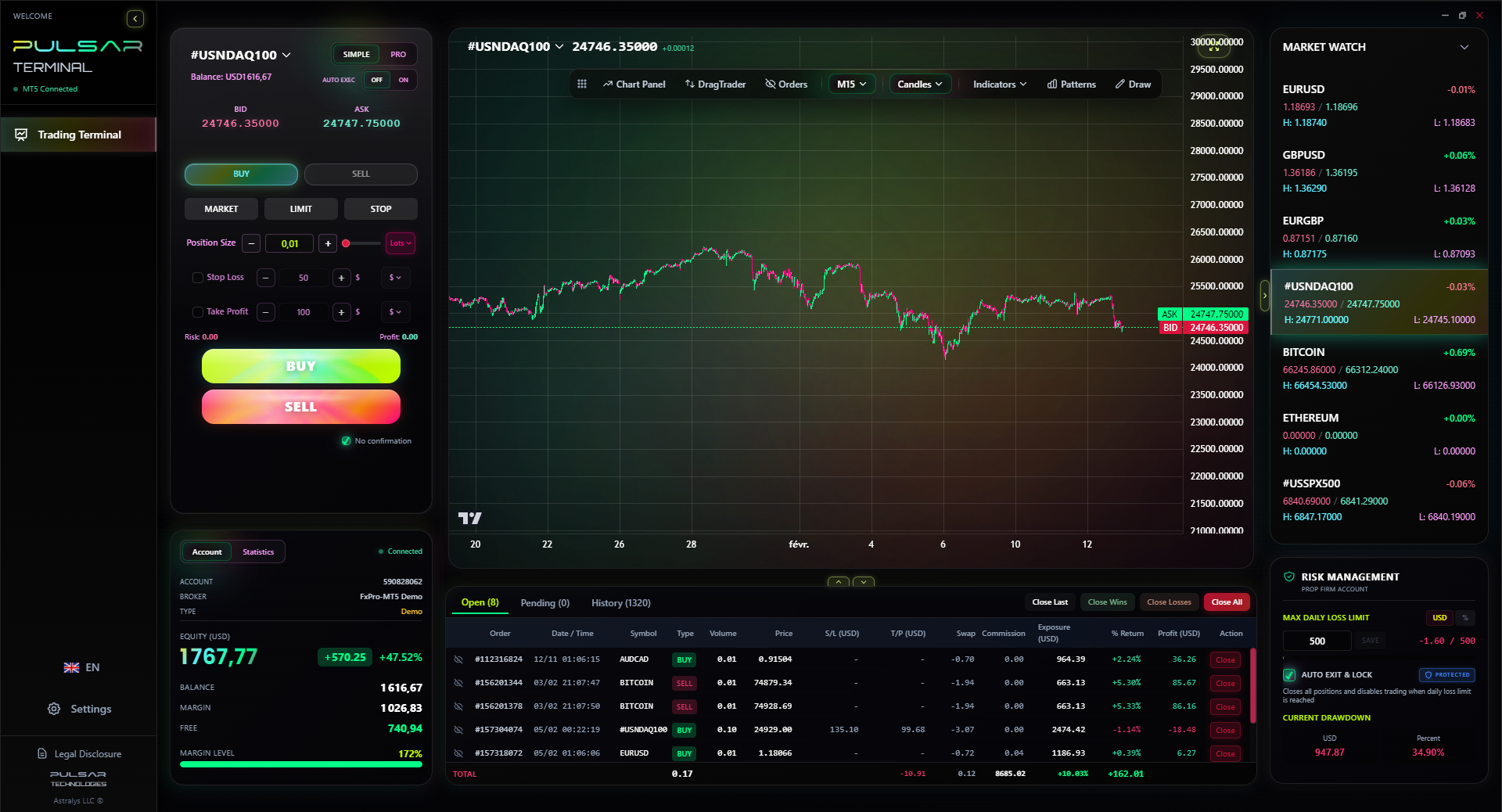
Manually moving stop losses to breakeven at key pivot levels is a chore; Pulsar Terminal automates breakeven and trailing stop functions directly on your MT5 chart, locking in profits as price respects your levels.
Pulsar Terminal
The all-in-one MT5 companion: drag-and-drop orders, multi-TP/SL, trailing stop, grid trading, Volume Profile, and prop firm protection. Used by 1,000+ traders daily.
“For ZAR pairs, pivots don't create the market move, but they perfectly highlight the zone where a fundamental driver will trigger the next big swing.”
Once you're comfortable with standard pivots, you can explore variations. Each has its own flavour.
Fibonacci Pivots: These use Fibonacci ratios to place the support and resistance levels. I find they often work well on EUR/USD and other majors, sometimes clustering with standard pivot levels to create a stronger "zone." They didn't work as well for me on pure ZAR pairs, but your mileage may vary.
Camarilla Pivots: These generate eight levels (four support, four resistance) clustered much closer to the opening price. They're designed for range-bound markets and can be fantastic for scalping. The H3 and L3 levels are often watched as potential breakout points. I used these successfully on GBP/JPY scalps but found them too noisy for my swing trading on USD/ZAR.
Woodie's Pivot Point: This method gives more weight to the closing price in its calculation. It tends to be more reactive to recent sentiment. During periods where the ZAR closes at a extreme high or low (often due to late-dollar flows), Woodie's pivots can sometimes predict a mean-reversion move better the next day.
The best approach? Test them. Add a Fibonacci pivot indicator to your MT4 chart alongside your standard pivots. See where the levels converge. Confluence is power. A standard R1 that lines up with a Fibonacci pivot and a previous daily high? That's a triple-threat resistance zone you ignore at your peril.
💡 Winston's Tip
Never enter a trade at the exact pivot level. Place your limit order 3-5 pips before it. Let the other impatient traders hit the level first and test it for you.
Theory is useless without application. Here’s a concrete example of how I structure a day using pivots, factoring in local costs.
Pre-Market (7:30 AM SAST):
- I calculate or note the daily pivot levels for my watchlist: USD/ZAR, EUR/USD, XAU/USD (Gold).
- I check where the current price is relative to the main Pivot (P). Bullish above, bearish below.
- I note the key S1/R1 levels. These are my initial profit targets or reversal zones.
- I open my position size calculator. For USD/ZAR, my broker's spread is 10 pips on a standard account. If S1 is 80 pips away, that's a valid target. If it's only 15 pips away, I skip the trade - the risk/reward is killed by the spread.
Trade Execution: Let's say USD/ZAR opens at 18.80, above the daily Pivot of 18.75. Bias is bullish. It pulls back to 18.78. I might look for a long entry here, with a stop loss below the pivot at 18.72 (60 pips risk). My first take-profit would be at R1, say 18.95 (170 pips potential). That's a risk-reward ratio of nearly 1:3. The pivot defined my stop and my first target.
Risk Management: This is the non-negotiable part. A pivot level is a hypothesis, not a fact. If price blows through my S1 support without pausing, my hypothesis is wrong. I don't "double down" and buy more. I either exit or, if I'm using a break-and-retest strategy, I wait to see if it comes back to test S1 as resistance. Stubbornness at pivot points has caused my biggest losses. Discipline is what lets you use them over the long term.

Pro Tip: Combine the daily pivot with the 200-period moving average on the 1-hour chart. When price is above the pivot and the 200 MA, look for long opportunities on pullbacks. When it's below both, look for shorts. This two-factor filter increases your odds significantly.
FAQ
Q1Are pivot points a leading or lagging indicator?
They're technically lagging because they're calculated from past price data. However, traders use them in a leading way, to anticipate where future support or resistance might form. Think of them as a forecast based on recent history.
Q2Which time frame is best for calculating pivot points in forex?
It depends on your trading style. Daily pivots (using the previous day's data) are most common for day traders and swing traders. Scalpers might use hourly or 4-hour pivots. For a broader view, weekly and monthly pivots are used by longer-term position traders. I use daily as my primary anchor.
Q3Do pivot points work better on certain currency pairs?
They tend to be most effective on major pairs with high liquidity and lower spreads, like EUR/USD, as the price respects technical levels more cleanly. For volatile pairs like USD/ZAR, they still work but require a wider berth and should be used in conjunction with fundamental drivers (like commodity prices).
Q4How do I add pivot points to my MT4 or MT5 chart?
It's built-in. In MT4/5, go to Insert > Indicators > Custom > Pivot Points. You can choose between Standard, Fibonacci, Camarilla, and others. You can also adjust the period (daily, weekly, monthly). Most South African brokers offering these platforms, like XM or Pepperstone, have them available.
Q5What's the difference between a pivot point and a support/resistance level?
Traditional support/resistance is subjective, drawn by identifying previous price highs and lows. Pivot points are objective, calculated mathematically. A pivot point is a type of support or resistance level, but it's pre-defined by a formula rather than trader observation.
Q6Can I use pivot points alone to trade?
I strongly advise against it. I tried, and it's inconsistent. Use pivots as a framework to identify potential turning points. Then, use other tools for confirmation - candlestick patterns, momentum indicators like the MACD indicator, or volume. Pivots give you the location; other analysis tells you if the trade is valid.
Q7Why do my pivot point levels sometimes differ from another trader's?
The main culprit is the "closing price" used. Some platforms use the 5 PM EST New York close, which is the traditional forex day. Others might use a midnight GMT close or your local broker's server time. For consistency, ensure your chart is set to the same session (e.g., "New York" session closing) that your pivot indicator uses.
Prof. Winston's Lesson
Key Takeaways:
- ✓The Main Pivot (P) defines intraday bias: above is bullish, below is bearish.
- ✓Always factor in the spread, especially on ZAR pairs (often 8-12 pips).
- ✓Use S1/R1 for targets in ranges, and for breakout confirmation on retests.
- ✓Combine pivots with 1 other indicator (like RSI or MACD) for entry signals.
- ✓Confluence of multiple pivot types (Standard & Fibonacci) creates powerful zones.
How useful was this article?
Click a star to rate
Weekly Trading Insights
Free weekly analysis & strategies. No spam.
About the Author
David van der Merwe
Emerging Markets Trader
Johannesburg-based trader with 11 years in emerging market currencies. Specializes in ZAR pairs, FSCA-regulated trading, and South African market analysis.
Comments
Risk Disclaimer
Trading financial instruments carries significant risk and may not be suitable for all investors. Past performance does not guarantee future results. This content is for educational purposes only and should not be considered investment advice. Always conduct your own research before trading.
You Might Also Like

Cara Trading Forex Sukses: 7 Prinsip dari Trader Profesional
Cara trading forex sukses dengan 7 prinsip trader pro: manajemen modal, disiplin, journal trading, backtest. Data nyata, bukan janji profit palsu.
Jam Trading Forex Terbaik untuk Trader Indonesia: Panduan Lengkap dengan Tabel Waktu
Panduan jam trading forex untuk trader Indonesia. Tabel 4 sesi dunia, jam emas 20:00-00:00, sesi mana yang harus dihindari. Data akurat + tips dari trader berpengalaman.
Top 5 Sàn Forex Uy Tín Nhất 2026: Review Jujur dari Trader Indonesia
Top 5 sàn forex uy tín 2026 untuk trader Indonesia. Review jujur: spread, deposit, withdraw, dukungan lokal. Exness, XM, IC Markets & lebih.
Get Pulsar Terminal
All these calculators are built into Pulsar Terminal with real-time data from your MT5 account. One-click position sizing, automatic risk management, and instant calculations.
Get Pulsar Terminal