


Ever feel like the market is just bouncing between invisible walls? You buy, it reverses.

Olumide Adeyemi
West African Trading Pioneer ·  Nigeria
☕ 11 min read
What you'll learn:
- 1The Core Idea: Yesterday's Action Defines Today's Battlefield
- 2How to Calculate Pivot Points (The Math Made Simple)
- 3How to Actually Trade Using Pivot Points
- 4Pitfalls to Avoid (Especially in Our Market)
- 5Making Pivots Powerful: Combine Them with This
- 6How to Set Up Pivot Points on MT4/MT5 in Nigeria
- 7Beyond the Classic: Other Pivot Point Types
Ever feel like the market is just bouncing between invisible walls? You buy, it reverses. You sell, it rallies. It's frustrating, right? What if I told you there's a free, dead-simple tool that shows you exactly where those walls are likely to be every single day? That's what a pivot point in forex is all about. It's not magic, it's just math, but for a trader in Lagos or Port Harcourt trying to make sense of USD/NGN or GBP/NGN moves, it can be the difference between getting chopped up and catching a clean breakout. I've been using them for over a decade, and I'll show you exactly how.
Forget complicated indicators for a second. A pivot point is the ultimate simplicity. It's a single price level, calculated from the previous day's high, low, and closing price. The core belief? Today's price action will often react around this level. Think of it as the market's center of gravity for the session.
From that main Pivot Point (PP), we calculate a series of support and resistance levels: typically three above (R1, R2, R3) and three below (S1, S2, S3). These aren't random lines. They are potential turning points where buyers or sellers might step in. It's a tool born on the trading floors, where quick, visual references were life. For us trading from Abuja or Ibadan, it gives structure to the chaos.

Example: Let's say USD/NGN yesterday had a High of 1605, a Low of 1580, and it Closed at 1595. The Main Pivot Point (PP) = (High + Low + Close) / 3 = (1605 + 1580 + 1595) / 3 = 1593.33. That 1593.33 becomes our key reference for today.
The beauty is in its objectivity. It removes emotion. The levels are there before the market opens in London. You're not guessing where resistance might be; you have a calculated level to watch. It works on any timeframe, but it's most powerful when you align your shorter-term moves (like on a 1-hour or 15-minute chart) with these daily levels. If you're into scalping strategy, knowing if you're scalping near a daily S1 or R1 is crucial info.
You don't need to be a mathematician. Most platforms draw them automatically. But knowing how they're built makes you a smarter trader. We use the Classic Pivot Point formula, which is the most common.
The Formulas:
- Pivot Point (PP) = (Previous High + Previous Low + Previous Close) / 3
- First Resistance (R1) = (2 x PP) - Previous Low
- First Support (S1) = (2 x PP) - Previous High
- Second Resistance (R2) = PP + (Previous High - Previous Low)
- Second Support (S2) = PP - (Previous High - Previous Low)
- Third Resistance (R3) = Previous High + 2*(PP - Previous Low)
- Third Support (S3) = Previous Low - 2*(Previous High - PP)
Why This Matters for Naira Pairs
When you're trading something like GBP/NGN, the spreads can be wider. You don't want to be buying at what you think is support only to find the real calculated support is 50 pips lower. Using the pivot S1 level gives you a precise zone to watch for a bounce, helping you enter with better risk/reward. I learned this the hard way early on. I'd see GBP/NGN drop and jump in, thinking it was "low enough." More often than not, it would drift right past my entry and hit the actual S1 before reversing, stopping me out. Let the levels guide your patience.

Warning: Always confirm which session's High, Low, and Close your platform uses! For forex, it should be the 24-hour period ending at the New York close (5 PM EST). If your broker uses the Tokyo close, your levels will be off. Check your settings.

💡 Winston's Tip
Price respects the Pivot Point most when the market is bored. On quiet days, it's the king of the range. On news days, treat it as a suggestion, not a command.
“Pivot points are a map, not the engine. They show you where the roads are, but you still need to check the traffic.”
Okay, the lines are on your chart. Now what? You use them as magnets and barriers. Here’s how I approach it.
1. The Pivot Point as a Trend Filter: This is my number one rule. If price is trading above the main PP for the day, my bias is cautiously bullish. I look for buy opportunities on pullbacks towards the PP or S1. If price is below the PP, my bias is bearish. I look to sell rallies towards the PP or R1. It instantly frames the day.
2. Trading the Bounces (Range-Bound Days): On days without major news, price will often oscillate between these levels. You see price approach R1, stall, and show rejection candles (like a pin bar or doji). That's a potential sell signal with a stop just above R1 and a target back down to PP or S1. The reverse is true at S1. I had a clean trade like this on EUR/USD last month. Price hit R1 at 1.0885, formed a clear bearish engulfing candle on the 1-hour chart. I sold, placed my stop at 1.0900 (above R1), and took profit at the PP near 1.0850. A nice, defined 35-pip move.
3. Trading the Breakouts (Trending Days): When a strong news event hits, price can blast through these levels. A decisive break and close above R1 suggests strength. Your strategy then shifts to buying the retest of R1 (now turned support) targeting R2. The same logic applies to breaks below S1. The key is confirmation. Don't jump in just because price spiked through. Wait for the price to come back and test the level from the other side. This patience has saved me from countless false breakouts.
Combining pivots with a momentum indicator like the RSI indicator can be powerful. Look for RSI divergence at a key pivot resistance for a stronger reversal signal. Remember, these levels work best when combined with other elements of price action. They are a map, not the engine.
I've made these mistakes so you don't have to. Here’s where it goes wrong.
Mistake 1: Treating Pivots as Holy Orders. The level is S1. Price touches it. You buy immediately. Sometimes it works. Often, it just slices right through. Pivot levels are zones, not exact prices. You need to see some evidence of buyers showing up - a bullish candlestick pattern, a surge in volume. Blindly trading at the line is a quick way to blow up an account.
Mistake 2: Ignoring the Underlying Trend. This was my biggest early error. In a strong, established downtrend, the pivot resistance levels (R1, R2) are far more significant than the support levels. The market is eager to sell rallies. Buying at S1 in a strong downtrend is like trying to catch a falling knife. Always contextualize the pivots with the bigger picture from the 4-hour or daily chart.
Mistake 3: Using Them in Isolation During High Volatility. On days with major CBN announcements or big US data, all technical levels can break. Pivot points are less reliable when the market is driven by pure emotion and news flow. On those days, it's better to step back or trade much smaller sizes. I learned this after losing two weeks' profits in 30 minutes around a US inflation print, thinking R2 would hold. It didn't.
Mistake 4: Not Adjusting for Your Instrument. Pivot points on a highly liquid pair like EUR/USD are cleaner than on an exotic like USD/NGN or USD/ZAR. With exotics, the levels can be messier due to wider spreads and less liquidity. Give the price more room to breathe around the level. Consider using the mid-point between S1 and S2 as a broader support zone, for example.
💡 Winston's Tip
If price opens the day far above or below the PP, that's a strong signal in itself. A gap open above the PP suggests bullish momentum that may target R1 or R2 first.
“I spent months switching between pivot formulas, confusing myself, before my mentor told me to just pick one and learn its personality.”
Pivot points are a fantastic foundation, but they're teammates, not superstars. Here’s what I pair them with.
1. Moving Averages for Confluence: A simple 50-period or 200-period Exponential Moving Average (EMA) on your chart. If price is at a daily pivot support (S1) AND that level coincides with the rising 50 EMA, you have a much stronger case for a bounce. Two tools are pointing to the same area. That's high-probability confluence.
2. Volume Profile for Precision: This is a more advanced, but incredibly powerful combo. While pivot points give you horizontal levels, Volume Profile shows you where the most trading activity happened. Sometimes the Pivot Point level will align perfectly with a high-volume node from the Volume Profile. That zone becomes a brick wall for price. It’s where big players have shown interest before.
3. The MACD for Momentum Shifts: Use the MACD indicator on a 1-hour or 4-hour chart. If price is approaching R1 and the MACD histogram is showing weakening bullish momentum (making lower peaks), it warns you the rally might be running out of steam right at the resistance. It helps you avoid buying the top.
My personal edge often comes from combining the daily pivot structure with intraday price action. I might use the daily S1 as my area of interest, then switch to a 15-minute chart and only enter if I see a specific bullish order flow pattern or a hidden bullish divergence on the RSI. This multi-timeframe, multi-tool approach filters out a lot of noise. For managing the trade, a tool that lets you set a trailing stop can help lock in profits as price moves from S1 to PP to R1. Managing multiple take-profit levels manually is stressful.
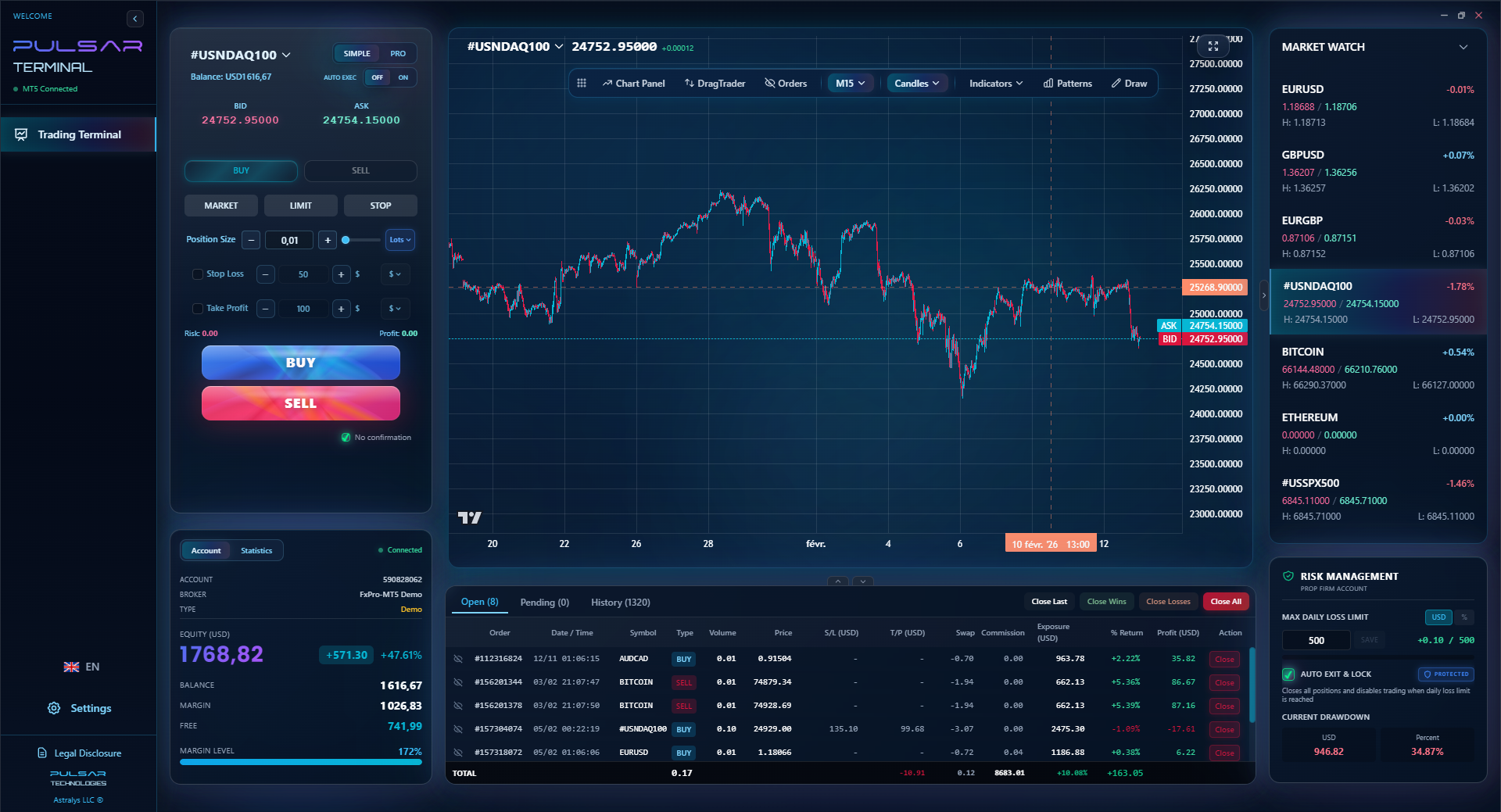
Manually moving stop-losses to breakeven as a trade moves from S1 to PP is a hassle; Pulsar Terminal can automate breakeven and trailing stops directly on your MT5 chart.
Pulsar Terminal
The all-in-one MT5 companion: drag-and-drop orders, multi-TP/SL, trailing stop, grid trading, Volume Profile, and prop firm protection. Used by 1,000+ traders daily.
Let's get practical. Here’s how to put this on your screen in 2 minutes.
On MetaTrader 4/5:
- Go to Insert -> Indicators -> Custom -> Pivot Points.
- A settings box will pop up. The key is the "Apply to" setting. Select "Previous day's data".
- You can adjust the style (colors, line thickness). I make the main PP a bold red line and the S1/R1 levels solid blue. S2/R2 and S3/R3 are dashed lines, as they are less frequently tested.
- Click OK. The indicator will draw all levels automatically based on the formula.
Choosing a Reliable Broker: Your broker's data feed matters. If their prices are slippy or the server is laggy, your calculated highs and lows might be slightly off. I've used platforms like Exness and IC Markets for years because they generally have stable feeds and tight spreads on majors, which makes pivot levels more accurate. Always test the indicator on a demo first to see if the drawn levels make sense with the previous day's visible range.
A Nigerian-Specific Tip: When trading late at night (after US close) or early before London open, be aware that liquidity is thin. Price can sometimes "poke" through a pivot level only to snap back when the real volume arrives. Don't panic-exit if your stop is placed just beyond a pivot level during these off-hours. Consider giving it a slightly wider buffer, or better yet, avoid trading those sessions until you're more experienced. Protecting your capital is rule number one, and a margin call from a thin-hours spike is a brutal teacher.
💡 Winston's Tip
The best trades often happen when price approaches a pivot level for the third time in a day. The first two tests probe it; the third often breaks it.
“Buying at S1 in a strong downtrend is like trying to catch a falling knife with your bare hands.”
Once you're comfortable with the Classic formula, you can explore others. They just change the calculation weight.
1. Fibonacci Pivot Points: These use Fibonacci retracement levels in the calculation. The support and resistance levels are derived by adding/subtracting Fibonacci multiples of the previous day's range to the main PP. Some traders believe these are more accurate for retracement levels. In my experience, they work well in strongly trending markets.
2. Woodie's Pivot Points: This formula gives more weight to the previous period's closing price. The main PP calculation is different: PP = (High + Low + 2*Close) / 4. The resulting levels tend to be closer to the current price. I find these can be more reactive, sometimes too jumpy for my taste.
3. Camarilla Pivot Points: These generate eight levels (four support, four resistance) very close to the current price. They are designed for range-bound markets and are popular with scalpers. The idea is that price will often reverse at the third or fourth level (H3, H4, L3, L4). They require very tight stops and are not for the faint of heart.
My Verdict: Stick with the Classic Pivot Points for at least your first year. They are the standard, most widely watched, and therefore often become self-fulfilling. The others are interesting, but mastering one method is better than being mediocre at five. I spent months switching between them, confusing myself, before my mentor told me to just pick one and learn its personality inside out. I chose Classic and never looked back.
FAQ
Q1Are pivot points good for forex trading?
Yes, but with a caveat. They are excellent for identifying potential support and resistance levels for the day, providing a clear framework. They work best when combined with other confirmation signals like candlestick patterns or momentum indicators. Used alone, they are not a trading system.
Q2Which time frame is best for pivot points?
Pivot points are calculated from daily data, so they are inherently a daily tool. However, you apply them to any intraday chart (1-hour, 15-minute, etc.) to see how shorter-term price action interacts with these key daily levels. The daily level is the anchor; the lower time frame gives you the entry signal.
Q3How accurate are pivot points?
They aren't about 100% accuracy. No tool is. Their value is in identifying high-probability reaction zones. Price will respect these levels a significant percentage of the time, especially the main PP, R1, and S1. Their accuracy increases when they align with other technical factors like previous swing highs/lows or moving averages.
Q4Can I use pivot points for scalping?
Absolutely. Many scalpers use them. For example, you might scalp a bounce off the S1 level on a 5-minute chart. The key is that the daily pivot gives your scalp a higher-timeframe reason to exist, improving the odds. Just be mindful of the spread, as scalping requires very low costs.
Q5Do professional traders use pivot points?
Yes, extensively. While they may use more sophisticated tools as well, the classic pivot point is a staple on many professional trading desks. Its simplicity and objectivity make it a common language for discussing intraday support and resistance. It's a foundational tool.
Q6What's the most important pivot level?
The Main Pivot Point (PP) is the most important. It's the primary gauge for intraday bias. After that, the first support (S1) and first resistance (R1) see the most action. The outer levels (S2/R2, S3/R3) become relevant on high-momentum trending days.
Q7Should I calculate pivot points myself?
You should know how, but you don't need to do it manually every day. Let your trading platform's indicator do the work. Understanding the calculation ensures you know what the levels represent and can troubleshoot if they look wrong (e.g., if your platform is using the wrong session close).
Prof. Winston's Lesson
Key Takeaways:
- ✓The Main Pivot Point (PP) defines your intraday bias: above is bullish, below is bearish.
- ✓Always wait for price action confirmation (a candle close, a pattern) at a pivot level before trading.
- ✓Pivot S1 and R1 are your primary work zones; S2/R2 and S3/R3 are for strong trend days.
- ✓Combine pivots with one other tool (like the 50 EMA or RSI) for higher-probability trades.
How useful was this article?
Click a star to rate
Weekly Trading Insights
Free weekly analysis & strategies. No spam.
About the Author
Olumide Adeyemi
West African Trading Pioneer
One of Nigeria's most active forex trading educators. 8 years of experience trading from Lagos. Specializes in low-capital strategies and prop firm challenges for African traders.
Comments
Risk Disclaimer
Trading financial instruments carries significant risk and may not be suitable for all investors. Past performance does not guarantee future results. This content is for educational purposes only and should not be considered investment advice. Always conduct your own research before trading.
You Might Also Like

Cara Trading Forex Sukses: 7 Prinsip dari Trader Profesional
Cara trading forex sukses dengan 7 prinsip trader pro: manajemen modal, disiplin, journal trading, backtest. Data nyata, bukan janji profit palsu.
Jam Trading Forex Terbaik untuk Trader Indonesia: Panduan Lengkap dengan Tabel Waktu
Panduan jam trading forex untuk trader Indonesia. Tabel 4 sesi dunia, jam emas 20:00-00:00, sesi mana yang harus dihindari. Data akurat + tips dari trader berpengalaman.
Top 5 Sàn Forex Uy Tín Nhất 2026: Review Jujur dari Trader Indonesia
Top 5 sàn forex uy tín 2026 untuk trader Indonesia. Review jujur: spread, deposit, withdraw, dukungan lokal. Exness, XM, IC Markets & lebih.
Get Pulsar Terminal
All these calculators are built into Pulsar Terminal with real-time data from your MT5 account. One-click position sizing, automatic risk management, and instant calculations.
Get Pulsar Terminal