


Let me be blunt: if you're trading forex in Nigeria without a solid risk management plan, you're not a trader, you're a gambler.

Olumide Adeyemi
West African Trading Pioneer ·  Nigeria
☕ 12 min read
What you'll learn:
- 1Risk Management Isn't Optional. It's Your Job.
- 2The Core Rules Every Nigerian Trader Needs
- 3Nigerian-Specific Factors & Costs You Can't Ignore
- 4Position Sizing: Where Most Nigerian Traders Go Wrong
- 5The Psychology: It's All About Emotional Control
- 6Advanced Tools for the Disciplined Nigerian Trader
- 7Putting It All Together: Your Risk Management Plan
Let me be blunt: if you're trading forex in Nigeria without a solid risk management plan, you're not a trader, you're a gambler. I've seen too many guys in Lagos and Abuja blow up their accounts chasing quick Naira gains, thinking a hot tip or a lucky streak is a strategy. What is risk management in forex? It's the boring, unsexy discipline that keeps you in the game long enough to actually make money. In this guide, I'll show you the exact rules, local costs, and painful lessons you need to know to protect your capital in Nigeria's wild market.
Here's the truth most 'gurus' won't tell you: making money in forex is less about picking the perfect entry and more about not losing your shirt on the bad trades. The market doesn't care about your analysis. A sudden CBN announcement, a shift in oil prices, or global risk sentiment can wipe out a month of profits in minutes. Your primary job as a trader is capital preservation.
Think of it like this. You're a business owner. Your trading account is your business capital. Would you risk 50% of your shop's inventory on a single, unproven supplier? Never. Yet I see traders regularly risk 20%, 30%, even 50% of their account on one 'sure thing' trade. It's madness.
For us in Nigeria, this is doubly important. Our Naira is volatile, funding can be a hassle, and rebuilding a lost account isn't easy. A proper risk management plan is your shield. It's what lets you sleep at night when the GBP/NGN is swinging wildly. It turns trading from a stressful gamble into a measurable business. If you don't have written rules for how much you'll risk per trade, where you'll cut losses, and how you'll protect profits, you're flying blind. Don't be that guy.

Warning: The SEC didn't historically regulate retail forex, meaning you had zero official protection if a broker went under. The new ISA 2025 law is changing that, but your first line of defense is still your own discipline. Don't rely on anyone else to protect your money.
The 1% Rule (And Why You Should Start at 0.5%)
The golden rule: never risk more than 1-2% of your total account balance on a single trade. For beginners, I'm militant about this: start at 0.5%. Let's do the math. If you have a $1,000 account (about 1.5 million Naira at current rates), risking 1% means your maximum loss on any trade is $10. That's it. It feels small, I know. You'll think, 'What's $10? I need to make real money!' But consistency is key. Ten losing trades in a row at 1% risk only puts you down 10%. You're still in the game. Ten losing trades at 5% risk? You're down 50%. Good luck climbing out of that hole with half your capital gone.
I learned this the hard way early on. Back in 2018, I was trading USD/NGN on margin. I got confident, risked about 7% on a trade expecting a CBN move. The move happened, but against me. That one trade wiped out nearly two weeks of careful profits. It was a gut punch. I had to step back, re-evaluate, and shrink my risk down to 1%. It felt slow, but it's the only reason I'm still trading today.
Stop-Losses: Your Best Friend
A stop-loss isn't a suggestion; it's a non-negotiable order. Before you enter any trade, you must know exactly where you'll get out if you're wrong. This is your predefined pain point. Setting it based on technical levels (like below support or above resistance) is smart. Setting it based on how much money you're 'willing to lose' is stupid. The market doesn't care about your willingness.
Let's say you're buying EUR/USD at 1.0850. You identify that if price falls below 1.0820, your trade idea is invalid. Your stop-loss goes at 1.0820. That's a 30-pip risk. Now, you use your position size calculator to figure out how many lots to trade so that 30 pips equals 1% of your account. This is the mechanical part that removes emotion.
The Risk/Reward Ratio: Your Roadmap to Profitability
You don't need to be right most of the time to be profitable. You need your winning trades to pay more than your losing ones cost. That's the risk/reward ratio (R:R). Aim for a minimum of 1:1.5. Better is 1:2 or 1:3.
Here's how it works. If your stop-loss is 30 pips away (your risk), your take-profit should be at least 45 pips away (1.5x your risk). So, even if you only win 40% of your trades, you can still be profitable. Winning 4 trades at 45 pips each (180 pips) and losing 6 trades at 30 pips each (180 pips) breaks you even. Bump your win rate or your reward, and you're in the green.

Example: Account: $1,000 | Risk per trade: 1% = $10 | Trade: Buy GBP/USD at 1.2650, SL at 1.2620 (30 pip risk). $10 / 30 pips = ~$0.33 per pip. A micro lot (0.01) is ~$0.10 per pip on GBP/USD. So, you can trade 0.03 lots. Your TP should be at least 1.2695 (45 pips away) for a 1:1.5 R:R.

💡 Winston's Tip
Your first loss is often your smallest loss. Taking that 1% hit quickly is a sign of professional discipline, not failure. The amateur holds on, hoping.
“Making money in forex is less about picking the perfect entry and more about not losing your shirt on the bad trades.”
Trading from Nigeria isn't the same as trading from London or New York. We have local realities that directly impact your risk management.
Taxes: The FIRS is Watching
This isn't a maybe. Profits from forex trading in Nigeria are subject to a 10% Capital Gains Tax by the Federal Inland Revenue Service (FIRS). You must factor this into your profit calculations. If you make 100,000 Naira in profit, 10,000 Naira belongs to the taxman. This effectively reduces your net returns, so your risk management needs to be even tighter to achieve your real profit goals. Ignoring this is a great way to get a nasty surprise later. Keep detailed records of all your trades.
Funding Costs & Spreads
How you fund your account eats into your capital. Bank transfers can have fees, and card payments might attract charges. Some brokers offer Naira accounts, which can help. But the biggest cost is usually the spread.
Spreads vary wildly. On major pairs like EUR/USD, a good broker like IC Markets or Pepperstone might offer spreads from 0.0 pips on an ECN account (but you pay a commission). Others, like some accounts at XM or Exness, might have spreads starting from 0.8 or 1.0 pip with no commission.
Why does this matter for risk? If the spread is 2 pips, your trade is already 2 pips in the red the moment you enter. Your stop-loss needs to be beyond that spread to be effective. A tight 5-pip stop on a pair with a 3-pip spread is practically suicide. Always check the typical spread for your pair and broker before calculating your risk. A high spread environment might mean you need to avoid scalping strategy altogether and focus on swing trading with wider stops.
Naira Volatility & Account Denomination
If your trading account is in USD but your income is in Naira, you have currency risk on your deposits and withdrawals. If the Naira weakens, funding your account gets more expensive. If it strengthens, your dollar profits are worth less in Naira terms. Some brokers offer NGN-denominated accounts to mitigate this. It's worth considering as part of your overall financial risk picture.
This is the most common, and most costly, mistake I see. People hear 'use' and think it means 'free money to trade bigger.' Wrong. use is a double-edged sword that amplifies both gains AND losses. The CBN and SEC are wary of it for a reason.
You get 500:1 use with some offshore brokers. That doesn't mean you should use it all. Using maximum use is like driving a Ferrari at 300 km/h on the Third Mainland Bridge during rush hour. A small mistake is catastrophic.
Your position size should be determined by your stop-loss distance and your account risk percentage, NOT by how much use is available. Here's a real example from my trading log last year:
- Trade: XAU/USD (Gold). Account: $5,000. Risk: 1.5% = $75.
- Entry: $1980. Stop-Loss: $1965 (a $15 risk per ounce).
- Calculation: $75 total risk / $15 per ounce risk = I can risk 5 ounces.
- Position Size: A standard gold lot is 100 ounces. So, my position was 0.05 lots. That's it. The platform might have let me trade 2 lots with my use, but that would have risked over $3,000 on one trade. Insanity.
Using a position size calculator automates this and saves you from emotional, greedy decisions. Input your account size, risk percentage, stop-loss in pips, and the pair. It spits out the correct lot size. Do this for every single trade, no exceptions.

Pro Tip: If you're trading a volatile pair like GBP/JPY or an exotic involving NGN, your stop-loss will naturally be wider. This means your position size must be SMALLER to keep your dollar risk the same. Don't force a tight stop on a wide-ranging pair just to trade a bigger size. Let the market tell you where the stop goes, then size accordingly.
“Using maximum use is like driving a Ferrari at 300 km/h on the Third Mainland Bridge during rush hour.”
All the rules in the world are useless if you can't follow them. And in the heat of the moment, your brain will try to sabotage you.
Moving Your Stop-Loss: This is the #1 account killer. Your trade goes against you, and instead of accepting the planned loss, you 'give it more room.' You move your stop further away. Now you're risking 3% instead of 1%. Often, the trade continues to go against you and hits the new, larger stop. You've just broken your rule and taken a loss you couldn't afford. I've done this. It never ends well. Your initial stop-loss is there for a reason. Respect it.
Revenge Trading: You take a loss. You're angry, frustrated. You immediately jump into another trade, often larger, to 'make the money back.' This is pure emotion, not analysis. You're now trading to be right, not to make money. The outcome is almost always another loss. After a bad trade, walk away. Close the platform. Come back tomorrow with a clear head.
Overconfidence After a Win: This is subtler. You have a few winning trades in a row. You start to feel invincible. You think your rules are too conservative. You increase your risk to 3%, then 5%. The market humbles you, fast. Stick to your plan whether you're up or down. Your system should be mechanical.
The best tool for psychological discipline is a trading journal. Write down every trade: entry, exit, reason, emotional state. Review it weekly. You'll see your patterns of failure clearly. It's painful but necessary medicine.
💡 Winston's Tip
If you feel the urge to move your stop-loss further away, that's your brain's survival instinct lying to you. The correct action is almost always to reduce your position size, not increase your risk.
Once you've mastered the basics, these tools can refine your risk management.
Trailing Stop-Loss: This locks in profits as a trade moves in your favor. If you buy EUR/USD at 1.0800 with a 30-pip stop and a 60-pip target, and it rises to 1.0860, a trailing stop of 20 pips would follow the price. If it then drops 20 pips from its highest point, you're out with a 40-pip profit instead of watching it reverse all the way to your original target or worse. It automates profit protection.
Correlation Awareness: Don't put all your eggs in one basket, even if they look like different baskets. If you're long USD/JPY (betting on a strong USD) and also long GBP/USD (betting on a weak USD), you're cancelling out your USD view. Worse, if you're long EUR/USD and long GBP/USD, you have two highly correlated positions. If the Dollar strengthens, you could get hit twice. Understand which pairs move together and adjust your total exposure.
Daily/Weekly Loss Limits: This is a circuit breaker. Set a hard limit, like 'if I lose 5% of my account in a day, I stop trading for the rest of the day.' It prevents a bad day from turning into a catastrophic week. This is especially crucial if you're trying to pass a prop firm challenge, where a daily loss limit is often a rule.
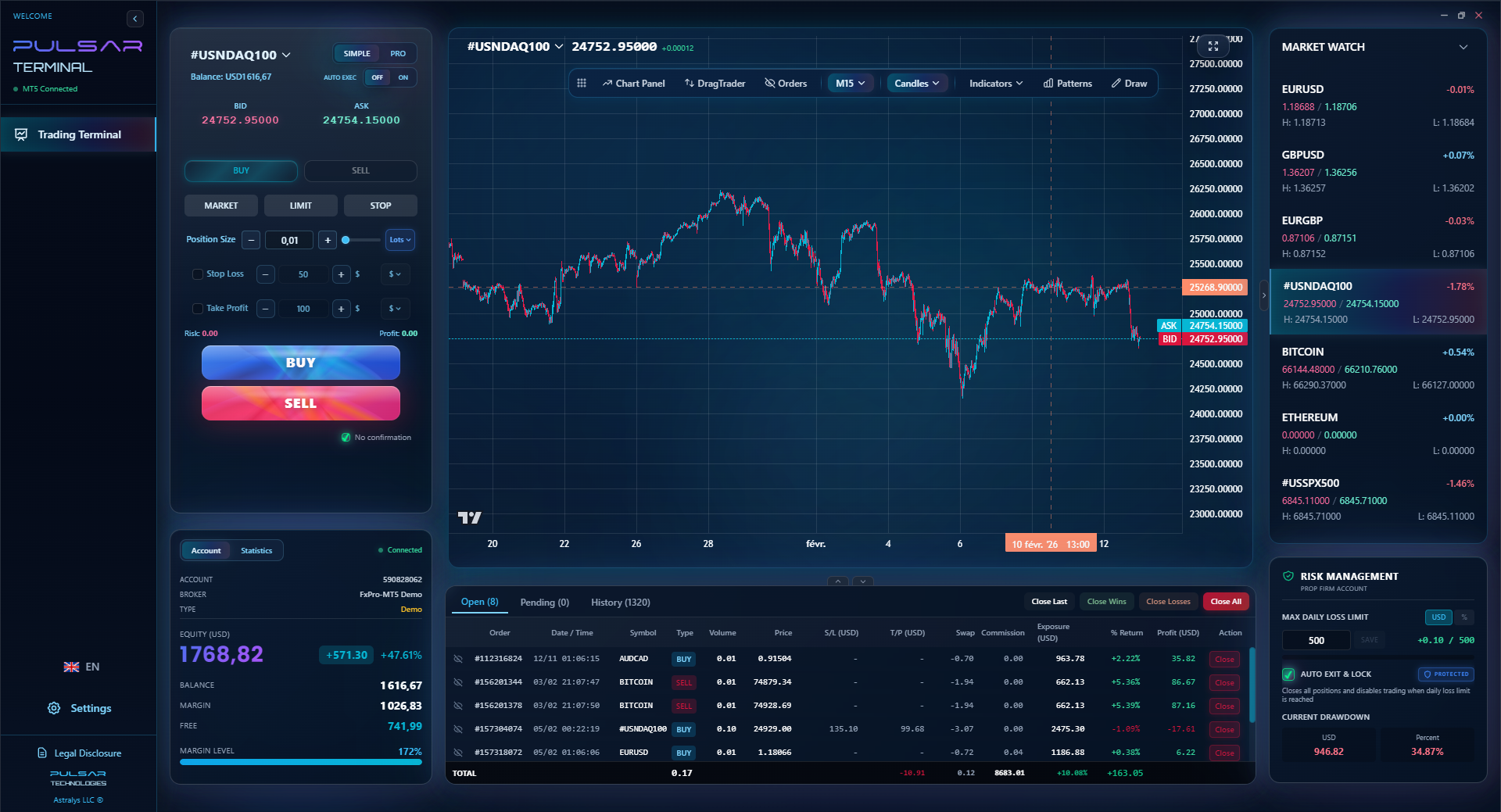
Pro Tip: Many of these advanced order types (trailing stops, multiple take-profits) are clunky to manage manually on MT4/MT5. This is where tools like Pulsar Terminal shine - they let you drag and drop these orders directly onto your chart, making sophisticated risk management execution simple.
Managing complex orders like trailing stops and partial closures manually is error-prone; Pulsar Terminal automates these directly on your MT5 chart, turning advanced risk management into a simple drag-and-drop.
Pulsar Terminal
The all-in-one MT5 companion: drag-and-drop orders, multi-TP/SL, trailing stop, grid trading, Volume Profile, and prop firm protection. Used by 1,000+ traders daily.
“Hope is not a strategy in the forex market.”
Your plan should be a written document. Here's a template you can adapt:
- Maximum Risk Per Trade: ______% (I recommend 1%).
- Maximum Risk Per Day/Week: ______% (e.g., 3% daily, 10% weekly).
- Minimum Risk/Reward Ratio: ______ (e.g., 1:1.5).
- Stop-Loss Rule: Always set before entry. Based on technical analysis, not dollar amount.
- Position Sizing Method: Use a calculator for every trade. Inputs: Account Balance, Risk %, Stop-Loss (pips), Currency Pair.
- use Usage: I will not use more than ______:1 use (e.g., I have 500:1 available but will never use more than 20:1 for my typical position sizes).
- Pre-Trade Checklist:
- Is this trade part of my strategy? (Yes/No)
- Have I calculated my position size? (Yes/No)
- Are my Stop-Loss and Take-Profit orders set? (Yes/No)
- Does this trade exceed my daily risk limit? (No)
- Tax Provision: I will set aside 10% of all net profits for FIRS Capital Gains Tax.
Print this. Stick it next to your monitor. Sign it. This is your contract with yourself. Without it, you're just hoping for the best. And hope is not a strategy in the forex market.
FAQ
Q1Is 2% risk per trade okay for a beginner in Nigeria?
Frankly, no. I strongly advise Nigerian beginners to start at 0.5% to 1%. Our market is volatile, and mistakes are common. A 2% risk means ten losses wipe out 20% of your capital. Starting small lets you learn without the intense psychological pressure of large losses. You can scale up to 1-2% only after you have a proven, profitable track record over several months.
Q2How do I calculate my position size in Naira?
Don't. Always calculate in the currency of your trading account (usually USD). The math is universal. Use a position size calculator. Input your USD account balance, your risk percentage, your stop-loss in pips for the pair you're trading (like EUR/USD), and it gives you the lot size. If your account is with a broker that offers NGN accounts, the principle is the same - use your NGN balance and a calculator that handles NGN-based pairs, but the core formula (risk % * account balance) / (pips risked * pip value) remains constant.
Q3What's the biggest risk management mistake Nigerian traders make?
Using excessive use and not using a stop-loss. They see the high use offered by international brokers as a way to make huge money with a small Naira deposit. They enter a trade with no stop, hoping it will come back. When it doesn't, a margin call wipes them out. use is a tool for efficient use of capital, not a magic profit multiplier. Always, always use a stop-loss.
Q4Does the new SEC regulation (ISA 2025) make trading safer?
It aims to, by forcing platforms to register. This should weed out some outright scams. However, it does NOT protect you from your own poor risk management. Even with a registered broker, you can still lose all your money if you trade poorly. The regulation is for platform integrity, not trader profitability. You are still 100% responsible for managing your own risk.
Q5How do I factor in spreads and commissions to my risk?
Your stop-loss distance must be greater than the spread. If you're scalping with a 5-pip target on a pair with a 3-pip spread, you're fighting an uphill battle. For risk calculation, the spread is the cost of doing business. Ensure your expected profit (take-profit distance) is significantly larger than the spread. For commissions, just treat them as a fixed cost that reduces your net profit. They don't change where you place your stop-loss, but they do affect your overall profitability, so you need a strategy that can overcome these costs.
Q6Can I use a Guaranteed Stop-Loss?
Some brokers offer them, but they come with a wider spread or a fee. In normal market conditions, a regular stop-loss is fine. A Guaranteed Stop-Loss (GSL) protects you from slippage during huge gaps - like what might happen after a major CBN announcement. For a large, volatile trade, paying a small premium for a GSL can be a wise part of your risk management, but it's not necessary for everyday trading.
Prof. Winston's Lesson
Key Takeaways:
- ✓Never risk more than 1% of your account on a single trade.
- ✓A stop-loss is a non-negotiable exit order, not a suggestion.
- ✓Always aim for a risk/reward ratio of at least 1:1.5.
- ✓Set aside 10% of all profits for FIRS Capital Gains Tax.
- ✓Position size is determined by your stop-loss, not your use.
How useful was this article?
Click a star to rate
Weekly Trading Insights
Free weekly analysis & strategies. No spam.
About the Author
Olumide Adeyemi
West African Trading Pioneer
One of Nigeria's most active forex trading educators. 8 years of experience trading from Lagos. Specializes in low-capital strategies and prop firm challenges for African traders.
Comments
Risk Disclaimer
Trading financial instruments carries significant risk and may not be suitable for all investors. Past performance does not guarantee future results. This content is for educational purposes only and should not be considered investment advice. Always conduct your own research before trading.
You Might Also Like

Cara Trading Forex Sukses: 7 Prinsip dari Trader Profesional
Cara trading forex sukses dengan 7 prinsip trader pro: manajemen modal, disiplin, journal trading, backtest. Data nyata, bukan janji profit palsu.
Jam Trading Forex Terbaik untuk Trader Indonesia: Panduan Lengkap dengan Tabel Waktu
Panduan jam trading forex untuk trader Indonesia. Tabel 4 sesi dunia, jam emas 20:00-00:00, sesi mana yang harus dihindari. Data akurat + tips dari trader berpengalaman.
Top 5 Sàn Forex Uy Tín Nhất 2026: Review Jujur dari Trader Indonesia
Top 5 sàn forex uy tín 2026 untuk trader Indonesia. Review jujur: spread, deposit, withdraw, dukungan lokal. Exness, XM, IC Markets & lebih.
Get Pulsar Terminal
All these calculators are built into Pulsar Terminal with real-time data from your MT5 account. One-click position sizing, automatic risk management, and instant calculations.
Get Pulsar Terminal