


Most people get into forex thinking they'll make a fortune in minutes.

Olumide Adeyemi
West African Trading Pioneer ·  Nigeria
☕ 9 min read
What you'll learn:
- 1Swing Trading Defined: It's Not What You Think
- 2Why It Works for Nigerian Traders (Especially)
- 3The Core Strategy: Finding and Riding the Swing
- 4Tools of the Trade: Keep It Stupid Simple
- 5Risk Management: The Non-Negotiable Pillar
- 6Mistakes I Made (So You Don't Have To)
- 7Getting Started: Your First Swing Trade

Most people get into forex thinking they'll make a fortune in minutes. They're wrong. The real money, the sustainable money, is made by those who have the patience to sit on their hands. That's what swing trading in forex is all about. It's the art of ignoring the noise to capture the meaty moves that last for days or weeks. I'll show you why this is the only style that makes sense for anyone with a day job and a shred of sanity.
Let's cut through the fluff. Swing trading in forex means you're holding a position for more than a day, but usually less than a few weeks. You're aiming to capture a 'swing' in the market - a significant price move from one point of equilibrium to another. Forget the 5-minute chart madness. You're playing on the 4-hour and daily timeframes, looking for trends that have room to run.
The core idea is simple: identify the direction of the intermediate-term trend, wait for a pullback against that trend, and then enter to ride the trend's resumption. You're not trying to catch the absolute top or bottom. You're aiming for the juicy middle 60% of a move. This requires patience, a solid stomach for overnight risk, and a trading plan you won't abandon at the first sign of a red candle.

Warning: If you check your trades every 30 minutes and panic when you're down 10 pips, swing trading will eat you alive. This is a marathon, not a sprint.
The biggest mental shift from scalping strategy is accepting that you will have drawdowns. Your trade will go against you temporarily. That's part of the plan. I once entered a long EUR/USD position based on a daily chart setup, only to watch it sink 85 pips into the red over the next day. I held because my stop-loss, based on the weekly structure, was still 40 pips away. It eventually reversed and hit my take-profit for a 220-pip gain. The loss was paper; the gain was real. That's the swing trader's mindset.
Listen, I've traded from Lagos with dodgy internet and during NEPA strikes. Swing trading is the most practical approach for our reality.
The Time Zone Advantage (or Disadvantage, Managed)
The major forex sessions (London, New York) often happen when we're at work or asleep. Trying to scalp the London open at 8 AM UK time (which is 8 AM here) is a nightmare if you have a 9-5. Swing trading lets you analyze the markets in the evening, place your trades with pending orders, set your stops and targets, and then walk away. You check in once a day, maybe twice. It fits a normal life.
Surviving the Infrastructure
Power cuts and data issues are a fact of life. A dropped connection for 10 minutes can kill a scalper. For a swing trader? It's irrelevant. Your trade is based on a 4-hour or daily candle closing. A brief disconnection won't change your analysis.
Managing the Naira Factor
Let's be blunt: our currency is volatile. The psychological pressure to 'make money fast' to offset inflation is immense. This leads to reckless trading. Swing trading forces discipline. It's about calculated, high-probability setups, not gambling. Using a proper position size calculator is non-negotiable here to protect your capital from a single bad swing. I learned this the hard way early on, over-leveraging on a GBP/USD swing that went wrong and wiping out two weeks of careful gains in one go.

💡 Winston's Tip
The market's job is to make you feel wrong. A good swing trade will test your conviction almost immediately. If you're not slightly uncomfortable when you enter, your edge is probably gone.

“Swing trading is the art of ignoring the noise to capture the meaty moves that last for days or weeks.”
This isn't magic. It's a process. Here’s the basic framework I've used for years.
1. Identify the Higher Timeframe Trend. Start on the daily chart. Is price making higher highs and higher lows (uptrend) or lower highs and lower lows (downtrend)? Use simple tools. A moving average like the 50 or 200-period can act as a dynamic trend filter. Price above it? Bias is long. Below it? Bias is short. Don't complicate it.
2. Wait for the Pullback on the Lower Timeframe. Zoom into the 4-hour chart. In an uptrend, wait for price to pull back to a key area. This could be a previous resistance-turned-support, a Fibonacci retracement level (38.2%, 50%, 61.8%), or that moving average from the daily chart. The pullback is your discount.
3. Spot an Entry Signal. You need a sign the pullback is over and the trend is resuming. This is where price action or basic indicators come in. Look for a bullish engulfing candle at support in an uptrend, or a bearish one at resistance in a downtrend. The MACD indicator crossing back in the trend's direction can add confluence. The RSI indicator coming out of oversold (in an uptrend) or overbought (downtrend) territory is another clue.
4. Define Your Risk Immediately. Your stop-loss goes below the recent swing low (for a long) or above the recent swing high (for a short). Your take-profit target is typically at the next major resistance (for a long) or support (for a short) area on the daily chart. Aim for a risk-to-reward ratio of at least 1:2. If you're risking 50 pips, you should be targeting 100+ pips.

Example: EUR/USD is in a daily uptrend. It pulls back on the 4H chart to the 61.8% Fibonacci level at 1.0850, which aligns with the 50-day moving average. A bullish pin bar forms. You go long at 1.0855. Stop-loss at 1.0820 (35 pips risk). Take-profit at the previous high of 1.0950 (95 pips potential). Risk/Reward = 1:2.7.
This is the essence of what swing trading in forex is. It's waiting for the right pitch.

You don't need 20 indicators blinking on your screen. You'll get analysis paralysis. Here’s all you really need:
| Tool | Purpose in Swing Trading |
|---|---|
| Moving Averages (50, 200) | Trend filter & dynamic support/resistance. |
| Fibonacci Retracement | To identify potential pullback levels within a trend. |
| Horizontal Support/Resistance | The most important levels on the chart. Price respects history. |
| Volume (if available on CFDs) | To confirm a breakout from a consolidation. |
| Basic Candlestick Patterns | Engulfing, pin bars, inside bars for entry signals. |
The MACD indicator and RSI indicator are useful secondary tools for confirming momentum, but they should not lead your analysis. Price and structure come first. I wasted my first year trying to trade divergences on the RSI alone. It's a supporting actor, not the star of the show.
Your most important tool is your trading platform's order management. You must be able to set stop-loss and take-profit orders reliably. This is non-negotiable. Brokers like IC Markets review and Pepperstone review offer tight spreads and reliable execution, which matters when your stop is 30 pips away.

“Your stop-loss is placed at a level that, if hit, proves your trade idea wrong. It is not a suggestion.”
This is where swing traders live or die. You are holding trades through market closes, news events, and gaps. Your risk controls must be airtight.
1. Position Sizing is Everything. Never risk more than 1-2% of your trading capital on a single swing trade. If you have a $1,000 account, that's $10-$20 max risk per trade. Use a position size calculator every single time. Don't guess.
2. The Stop-Loss is Sacred. Your stop-loss is placed at a level that, if hit, proves your trade idea wrong. It is not a suggestion. It's an automatic ejection seat. Setting it based on the chart structure, not on how much money you're willing to lose, is critical. A margin call is what happens when you ignore this rule.
3. Account for the Spread. Especially with exotic pairs or during off-hours, the spread definition can widen. If your typical stop is 30 pips, a 5-pip spread is eating 16% of your risk budget before the trade even moves. Factor this in. Stick to major pairs like EUR/USD or GBP/USD for cleaner swings and tighter spreads.
4. Overnight Financing (Swap Rates). You will pay or receive swap fees for holding positions overnight. On some brokers like Exness review, you can check the swap rates beforehand. For long-term swings, these can add up. Sometimes it's worth it for the trend, sometimes it's not. Know the cost of doing business.
💡 Winston's Tip
Your trading journal is more important than your indicator suite. Write down not just your entry and exit, but *why* you took the trade and how you felt. You're debugging a psychological system.

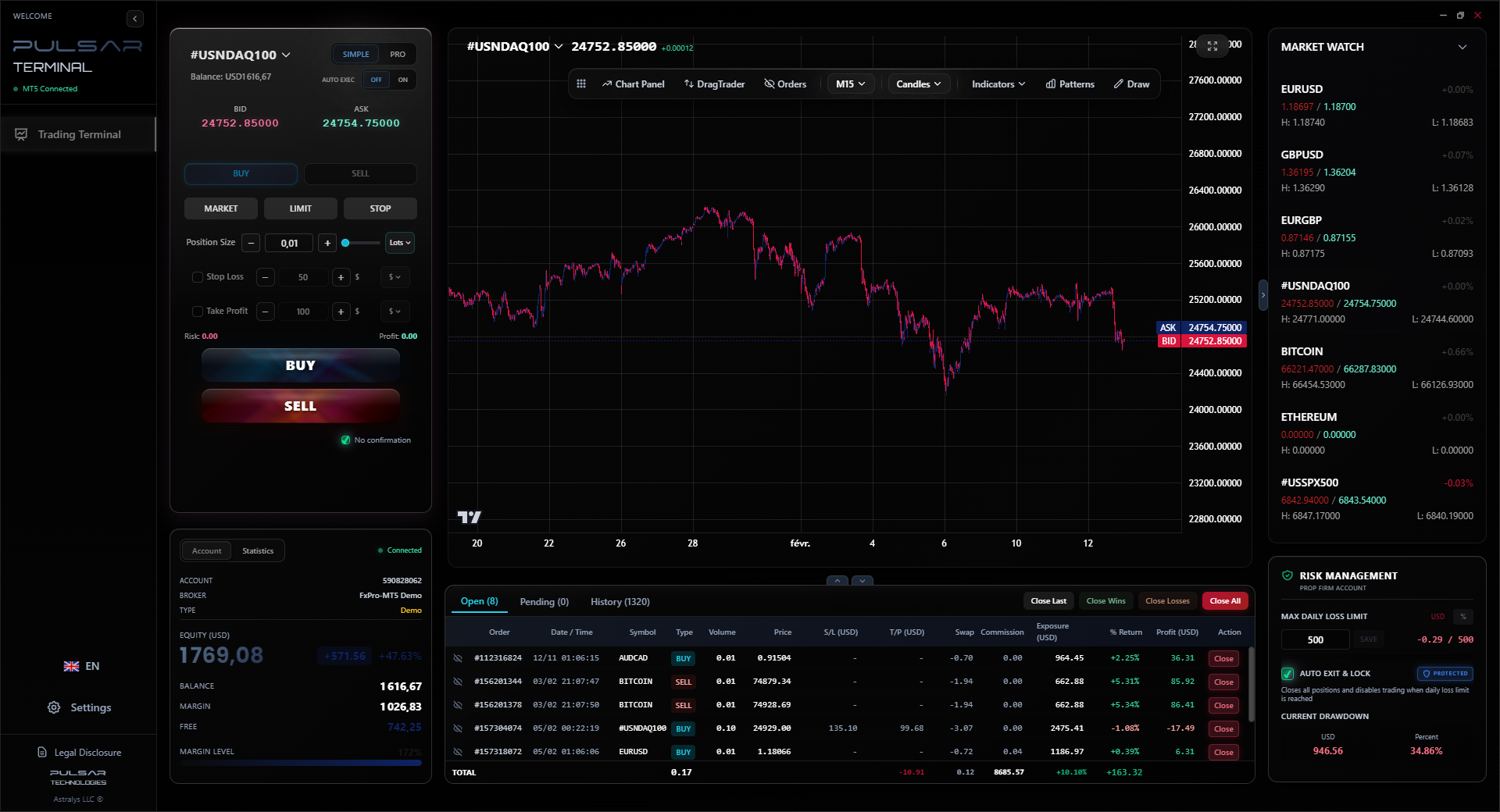
Managing multiple swing trades with precise stop-loss and take-profit levels is easier with tools like Pulsar Terminal, which lets you drag and drop orders directly onto your MT5 charts.
Pulsar Terminal
The all-in-one MT5 companion: drag-and-drop orders, multi-TP/SL, trailing stop, grid trading, Volume Profile, and prop firm protection. Used by 1,000+ traders daily.
I've blown up accounts. Here are the classic swing trading blunders.
Moving Your Stop-Loss Further Away. The trade goes against you, and instead of accepting the loss, you 'give it more room.' This turns a small, planned loss into a catastrophic one. Your stop is your plan. Stick to it.
Taking Profit Too Early. You're up 40 pips on a trade targeting 100, and you get scared it will reverse. You close it. Then you watch it sail another 60 pips without you. Greed makes you enter, fear makes you exit. Have a target and let it run. Use a trailing stop if you must, but let your winners breathe.
Overtrading During Quiet Periods. The market is ranging sideways on the daily chart. There is no swing to trade. Yet, you force a trade on the 1-hour chart because you're bored. This is how you slowly bleed your account. Patience isn't just waiting for a trade; it's also waiting for the right trade.
Ignoring Fundamental Catalysts. A swing can be killed by a major news event. You don't need to trade the news, but you must be aware of it. Holding a massive long GBP position into a Bank of England meeting where they might hike rates is Russian roulette. Check an economic calendar.

“Patience isn't just waiting for a trade; it's also waiting for the *right* trade.”
- Open a Demo Account. Use a reputable broker with a good MT4/MT5 platform. XM review offers solid demo accounts for practice. Trade with virtual money for at least 2-3 months. Track every trade in a journal.
- Pick One Pair. Start with EUR/USD. It's liquid, has tight spreads, and clear trends. Learn its personality. Read our EUR/USD guide for specifics.
- Analyze the Daily Chart. Every Sunday evening, mark key support and resistance levels on the daily chart. What's the trend?
- Switch to 4H for Entries. During the week, check the 4H chart for pullbacks to your marked levels. Look for your entry signal.
- Calculate and Place the Trade. Use your calculator. Place the entry, stop-loss, and take-profit orders all at once. Then close the platform. Seriously. Come back tomorrow.
- Review. When the trade closes (win or lose), analyze it. Did you follow your plan? What did the market teach you?
Swing trading in forex is a skill. It's not get-rich-quick. It's get-consistent-slowly. But consistency, in our game, is everything.
FAQ
Q1What's the best timeframe for swing trading forex?
Use the daily chart to determine the primary trend and the 4-hour chart to fine-tune your entries and manage the trade. The 1-hour can be used for very precise entries, but the 4H/Daily combo is the sweet spot for most.
Q2How much money do I need to start swing trading?
You can start with a few hundred dollars on a micro account, but realistically, you need enough so that proper position sizing (1% risk) allows you to place a trade. If a $500 account means your 1% risk ($5) only allows a 5-pip stop-loss, that's too tight. $1,000-$2,000 gives you more breathing room to set sensible stops on major pairs.
Q3Is swing trading safer than day trading?
It's different. It's safer in the sense that you're not exposed to intraday noise and emotional whipsaws. But it's riskier in terms of overnight exposure to gaps and news events. The 'safety' comes from having a solid, patient plan and stricter risk management over a longer period.
Q4How many pips can a swing trader make?
Forget counting pips. Focus on risk-to-reward. A good swing trade aims for 100-300 pips, but the key is that you're risking 50 to make 150 (a 1:3 ratio). A 50-pip win with a 10-pip risk is better than a 200-pip win with a 150-pip risk.
Q5Can I swing trade with a full-time job in Nigeria?
Absolutely. It's the best style for it. You do your analysis in the evening, set your orders, and check in once a day. It doesn't require you to be glued to the screen during London or New York opens.
Q6What's the biggest difference between swing trading and scalping?
Psychology and time. Scalping is a sprint; you're in and out in minutes, fighting for 5-10 pips. Swing trading is a marathon; you hold for days, endure drawdowns, and target moves of 100 pips or more. The stress is different, but for most, swing trading is less mentally exhausting.
Prof. Winston's Lesson
Key Takeaways:
- ✓Trade the 4H/Daily charts, not the 5-minute noise.
- ✓Never risk more than 1-2% of capital per trade.
- ✓Aim for a minimum 1:2 risk-to-reward ratio.
- ✓Your stop-loss is sacred; moving it is a sin.
How useful was this article?
Click a star to rate
Weekly Trading Insights
Free weekly analysis & strategies. No spam.
About the Author
Olumide Adeyemi
West African Trading Pioneer
One of Nigeria's most active forex trading educators. 8 years of experience trading from Lagos. Specializes in low-capital strategies and prop firm challenges for African traders.
Comments
Risk Disclaimer
Trading financial instruments carries significant risk and may not be suitable for all investors. Past performance does not guarantee future results. This content is for educational purposes only and should not be considered investment advice. Always conduct your own research before trading.
You Might Also Like

Cara Trading Forex Sukses: 7 Prinsip dari Trader Profesional
Cara trading forex sukses dengan 7 prinsip trader pro: manajemen modal, disiplin, journal trading, backtest. Data nyata, bukan janji profit palsu.
Jam Trading Forex Terbaik untuk Trader Indonesia: Panduan Lengkap dengan Tabel Waktu
Panduan jam trading forex untuk trader Indonesia. Tabel 4 sesi dunia, jam emas 20:00-00:00, sesi mana yang harus dihindari. Data akurat + tips dari trader berpengalaman.
Top 5 Sàn Forex Uy Tín Nhất 2026: Review Jujur dari Trader Indonesia
Top 5 sàn forex uy tín 2026 untuk trader Indonesia. Review jujur: spread, deposit, withdraw, dukungan lokal. Exness, XM, IC Markets & lebih.
Get Pulsar Terminal
All these calculators are built into Pulsar Terminal with real-time data from your MT5 account. One-click position sizing, automatic risk management, and instant calculations.
Get Pulsar Terminal