


Over 90% of retail forex traders lose money.

Olumide Adeyemi
West African Trading Pioneer ·  Nigeria
☕ 11 min read
What you'll learn:
- 1Forex is Not What You Think It Is
- 2The Nigerian Context: The Volatility Tax
- 3How Forex Trading Actually Works: Pips, Lots, and use
- 4Why Most Nigerian Traders Fail (And It's Not Bad Luck)
- 5First Steps to Not Blowing Up Your Account
- 6Forex vs. Other Markets: Where Does It Fit?
- 7The Real Meaning: Sustainable Risk Management
Over 90% of retail forex traders lose money. In Nigeria, that number might be higher, not because the market is rigged, but because most people get the fundamental meaning of forex completely wrong. They think it's a shortcut to buying a new car or escaping a 9-to-5. I thought that too, back in 2012. The real meaning of forex is simpler and far more brutal: it's a risk transfer market where the disciplined profit from the emotional. For us trading with the Naira, it's also a direct front-row seat to our own economic story, playing out in real-time on the USD/NGN chart.
Let's clear this up first. When someone in Lagos asks 'what is forex?', they often picture a guy on a phone shouting 'buy, buy, sell!' or a WhatsApp group promising 100% returns in a week. That's a fantasy.
The foreign exchange market is simply the global network where currencies are traded. It's where the value of your Naira against the Dollar is set, not just by the CBN, but by banks, corporations, governments, and yes, speculators like us. It's the largest financial market on earth, with over $7.5 trillion traded daily. Your trade is a drop in that ocean.
For you, the retail trader, the meaning of forex is speculation. You're not physically taking delivery of 50,000 Euros. You're placing a bet on whether the Euro will be worth more Naira tomorrow than it is today. The broker provides the use (borrowed money) to amplify your bet. This is the core mechanic, and it's where dreams go to die if misunderstood.

Warning: The biggest lie in Nigerian forex circles is that you need a 'strategy' to win. You don't. You need a risk management system to survive. A strategy tells you when to enter. Risk management tells you how much to bet and when to run. The second is infinitely more important.
I learned this the hard way. In 2015, I was convinced the Naira would crash further (it did). I loaded up on USD/NGN with way too much size. I was right on the direction, but a sudden, sharp retracement of 50 pips hit my stop-loss before the trend resumed. I was wiped out. Being right means nothing if your position size is suicidal. You can use a position size calculator to avoid this amateur mistake.
“The real meaning of forex is simpler and far more brutal: it's a risk transfer market where the disciplined profit from the emotional.”
Trading forex from Nigeria isn't the same as trading from the UK or US. You're trading in a uniquely volatile environment, and that changes everything.
Your Home Currency is a Wildcard
When you trade EUR/USD, you're thinking in Dollars. But your capital is in Naira, your profits convert to Naira, and your life is priced in Naira. The USD/NGN rate is your silent partner in every single trade. A 2% win on GBP/USD can be erased by a 3% move in USD/NGN by the time you withdraw. You're effectively trading two pairs at once.
The CBN is Your Unseen Counterparty
The Central Bank of Nigeria is the biggest player in the Naira market. Their interventions, policy shifts, and FX backlog clearances cause seismic shifts. Remember June 2024 when the Naira depreciated over 70% from the previous year? That wasn't just 'market forces'; it was policy-driven volatility. Trading around major CBN announcements is like gambling, not trading.
The Brokerage Landscape
Because local regulation is still evolving, many Nigerian traders use international brokers like Exness, XM, or IC Markets. This adds layers: payment method hurdles (bank transfers, crypto, fintech wallets), potential delays, and the constant check of 'is this broker still accepting Naira deposits?' It's an operational risk you must factor in.

Example: Let's say you deposit ₦500,000 when USD/NGN is 1,200. That's about $416. You trade a EUR/USD strategy and grow your account to $500. Great! But when you go to withdraw, USD/NGN has strengthened to 1,000. Your $500 is now only ₦500,000. You made a 20% profit in Dollar terms, but broke even in Naira. That's the volatility tax.

💡 Winston's Tip
The market doesn't owe you a profit. It only offers opportunities. Your job is to recognize them and bet an amount that won't destroy you if you're wrong.
“Being right on the market direction means nothing if your position size is suicidal.”
Forget the complex jargon for a minute. Let's break it down with real numbers.
You see a price quote: USD/NGN = 1,250.00 / 1,250.50. The first price (1,250.00) is the bid – what you can sell at. The second (1,250.50) is the ask – what you can buy at. The difference (0.50) is the spread. That's the broker's immediate fee. A tight spread, like those offered on raw accounts from brokers like Pepperstone, is crucial, especially for scalping.
What is a Pip?
A pip is the smallest price move. For USD/NGN, a move from 1,250.00 to 1,250.10 is 1 pip. For most pairs like EUR/USD, it's 0.0001. Understanding the pip definition is non-negotiable for calculating profit and loss.
Lots and use: The Double-Edged Sword
You don't trade one Dollar. You trade in lots.
- A standard lot is 100,000 units of currency.
- A mini lot is 10,000.
- A micro lot is 1,000. If you buy 1 micro lot of USD/NGN at 1,250.00, you're controlling $1,000 worth of Naira.
But you don't need $1,000 in your account. This is where use comes in. use of 1:100 means you only need 1% of the trade's value as margin, or $10. This amplifies both gains and losses. That 50-pip move against you? On a micro lot, that's a 5% loss of your $10 margin. On a standard lot with the same margin, it's a 500% loss – a margin call.
| Trade Size (Lot) | Units of Currency | Margin Required (1:100 use) | Profit/Loss per 10 Pip Move (USD/NGN) |
|---|---|---|---|
| Micro (0.01) | 1,000 USD | ~$10 | ₦100 (≈ $0.08) |
| Mini (0.10) | 10,000 USD | ~$100 | ₦1,000 (≈ $0.80) |
| Standard (1.00) | 100,000 USD | ~$1,000 | ₦10,000 (≈ $8.00) |
Table: Example using USD/NGN at rate 1,250. Margin and P&L are simplified approximations.
The real meaning of forex trading mechanics is this: use lets you control massive sums with little money, turning small market moves into large account swings. Most traders blow up because they use a standard lot mindset with a micro lot bankroll.
“Being right on the market direction means nothing if your position size is suicidal.”
After mentoring hundreds of traders, I see the same patterns. Failure here is a checklist, not a mystery.
- Trading for the Wrong Reasons: You're trading to make rent this month. This desperation guarantees emotional decisions. You'll hold losers hoping they turn (they get worse), and cut winners short to 'secure profit' (leaving 80% on the table). The market smells fear.
- Overleveraging the Naira Dream: You see USD/NGN at 1,300 and think, 'It's going to 1,500!'. So you put 50% of your account on one trade with high use. A 2% retracement against you (26 pips) can wipe out half your capital. The trend might still be right, but you're already out.
- Chasing 'Surefire' Signals: The WhatsApp guru, the YouTube prophet with the 'secret indicator'. If it was surefire, they'd be on a private island, not selling you a ₦10,000 course. I wasted over $2,000 on systems and indicators before I realized price action and volume were the only things that weren't lagging.
- No Written Plan: You wouldn't build a house without a blueprint. Yet traders enter a $7 trillion market with a vague feeling. A plan states: Which pair? What's my setup? What's my entry? Where's my stop-loss? Where's my take-profit? What's my position size? If you can't answer these before clicking 'buy', you're gambling.
- Ignoring the Macro: As a Nigerian, you have an edge if you use it. You feel inflation at the market. You hear about CBN policies. This is fundamental analysis. Ignoring it while trading XAU/USD (Gold) or USD/NGN is like driving blindfolded.
The antidote is boring: trade smaller, use a stop-loss every single time, keep a trade journal, and focus on consistency, not the one big win. A 2% gain per month compounds to over 26% a year. That beats any fixed deposit. But it's not sexy, so people ignore it.
💡 Winston's Tip
If you feel a strong urge to 'double down' on a losing trade to average your price, that's your ego talking. Close the screen. The first loss is always the cheapest.
“Failure in forex is a checklist, not a mystery.”
Here's where you start. Not with a trade, but with preparation.
1. Choose a Broker Like a Skeptic. Don't just go for the one with the highest use or flashy ads. Check: Are they regulated (by FCA, ASIC, CySEC etc.)? Do they offer reliable Naira deposit/withdrawal methods? What are their average spreads on the pairs you care about? Read our deep Exness review and XM review for examples of what to look for.
2. Start with a Demo Account. Seriously. Practice for at least 3 months. Your goal isn't to make fake money. Your goal is to execute your plan 100 times in a row without deviating. Can you place every stop-loss without hesitation? Can you watch a winning trade hit your take-profit without closing it early? This is psychological training.
3. Learn One Simple Strategy. Master the MACD indicator divergence or the RSI indicator overbought/oversold zones on a single timeframe. Understand its win rate (it won't be above 60%) and its average risk/reward. A strategy that wins 40% of the time is profitable if your winners are 3x bigger than your losers.
4. Implement the 1% Rule. Never, ever risk more than 1% of your trading capital on a single trade. If you have a ₦100,000 account, your maximum loss per trade is ₦1,000. This forces you to use sensible position sizes and ensures you can survive a string of losses. This is the single most important rule in this guide.
5. Keep a Trade Journal. Log every trade: entry, exit, reason, emotion, screenshot. Review it weekly. You'll see your own stupid patterns repeat. I did. I found I lost 80% of my trades entered after 11 PM Lagos time. I was tired and impulsive. I stopped, and my performance improved overnight.

Pro Tip: Before going live, 'trade' your strategy on a demo account for one full month, but track the results in a spreadsheet as if you were risking 1% of your real capital. At the end of the month, calculate your expected drawdown (max losing streak). If it's more than 20% of your real capital, your strategy or position sizing is still too risky.
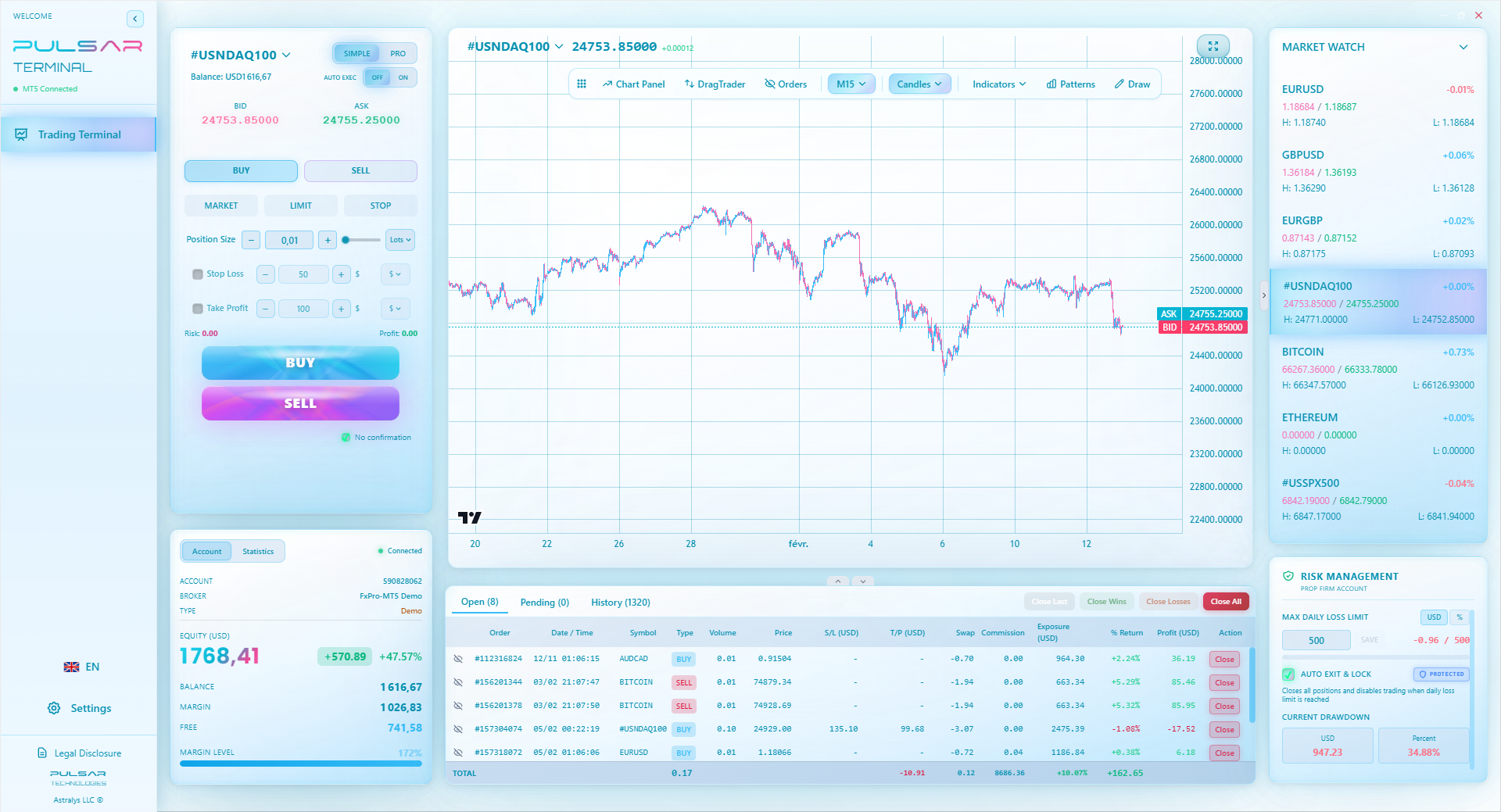
Executing a disciplined plan with precise stop-loss and take-profit levels is the core of survival, and tools like Pulsar Terminal automate this risk management directly on your MT5 platform.
Pulsar Terminal
The all-in-one MT5 companion: drag-and-drop orders, multi-TP/SL, trailing stop, grid trading, Volume Profile, and prop firm protection. Used by 1,000+ traders daily.
“Failure in forex is a checklist, not a mystery.”
Forex isn't the only game in town. Knowing its place helps you choose.
Forex (Currency Pairs):
- Pros: 24/5 market, extreme liquidity, high use available, direct exposure to global economics and local Naira news.
- Cons: High volatility (especially exotics), driven by unpredictable geopolitics and central banks, use makes losses swift.
- Best for: Disciplined traders comfortable with macroeconomics and strict risk management. Not for the passive investor.
Stocks (NGX, US Stocks):
- Pros: Ownership in a company, dividends, less intraday volatility than forex, analysis based on company health.
- Cons: Limited trading hours, lower use, susceptible to single-company risk.
- Best for: Longer-term investors comfortable with swing trading or holding for months/years.
Cryptocurrencies:
- Pros: 24/7 market, massive volatility for large swings, decentralized.
- Cons: Extreme volatility (can wipe you out in minutes), regulatory uncertainty in Nigeria, high potential for scams.
- Best for: Highly risk-tolerant speculators. Treat it like venture capital, not savings.
For most Nigerians, a blend makes sense. Use forex for shorter-term tactical plays based on liquid flows, and use stocks or crypto (cautiously) for longer-term thematic bets. Never put all your risk capital in one market.
💡 Winston's Tip
Your trading plan is a contract with your future self. Breaking it is a betrayal. Would you trust a business partner who breaks contracts? Don't trust that version of you.
“Your entire job is to ensure that when you are wrong, you lose as little as possible.”
So, what is the meaning of forex for you, the aspiring Nigerian trader? It's a skill-based profession where you get paid for being a good risk manager.
The profits aren't a reward for being clever; they're a premium for absorbing the risk that someone else doesn't want. When you buy USD/NGN, someone else is selling it to you. They have a different view, a different need, a different risk profile. One of you will be wrong.
Your entire job is to ensure that when you are wrong (and you will be, often), you lose as little as possible. And when you are right, you have a mechanism to let that profit run. That's it. Everything else - the indicators, the news analysis, the broker choice - supports that single mission.
It took me blowing up two accounts and seven years of breaking even before this clicked. The moment I stopped searching for the perfect entry and obsessed over the perfect exit (my stop-loss and take-profit), I became consistently profitable. The market didn't change. I did.
The meaning of forex, therefore, is a mirror. It shows you your own greed, fear, and indiscipline in raw financial terms. The successful traders aren't the smartest; they're the most emotionally controlled, the most patient, and the most respectful of the risk. In a volatile economy like Nigeria's, that discipline isn't just a trading tool. It's a life skill.
FAQ
Q1Is forex trading legal in Nigeria?
Yes, forex trading by individuals is legal in Nigeria. The Central Bank of Nigeria (CBN) and the Securities and Exchange Commission (SEC) oversee the financial markets. However, many Nigerian traders use international brokers regulated abroad (like FCA, ASIC) due to the evolving local regulatory framework for online retail forex. You must pay a 10% capital gains tax on your profits to the FIRS.
Q2How much money do I need to start forex trading in Nigeria?
You can start with very little. Some brokers like FBS offer accounts with a $1 minimum deposit, and XM allows deposits as low as $5. However, the amount you need depends on your risk management. With a ₦50,000 account, risking 1% per trade means you can only lose ₦500 per trade. This forces you to trade micro lots. A more practical starting capital for sensible position sizing is around ₦200,000 - ₦500,000.
Q3What is the best currency pair for Nigerian beginners?
Start with major pairs that have low spreads and high liquidity, like EUR/USD or GBP/USD. They are less prone to wild, unpredictable spikes than exotic pairs. Avoid starting with USD/NGN. The spread is often wide, and the CBN's direct influence can cause sudden, news-driven moves that are hard for beginners to navigate. Master the basics on a liquid major pair first.
Q4How do I fund my forex trading account from Nigeria?
Popular methods include local bank transfers (to the broker's local Nigerian account if they have one), Naira debit/credit cards (though some banks restrict international forex transactions), fintech wallets (like Opay, Moniepoint), and cryptocurrencies (like USDT). Brokers like Exness and XM have localized payment solutions. Always check your broker's specific deposit options and fees.
Q5What's the difference between a demo and a live account?
A demo account uses virtual money. It's for practicing your strategy and learning the platform without risk. A live account uses your real money. The key difference is psychology. On a demo, a ₦500,000 loss feels like nothing. On a live account, a ₦50,000 loss can trigger panic. You should only go live after you can execute your plan flawlessly on demo for months, treating the virtual money as if it were real.
Q6Can I make a living from forex trading in Nigeria?
It's possible, but statistically unlikely and incredibly stressful. It requires significant capital (so a 5% monthly return can cover living expenses), years of experience, robotic discipline, and a solid emergency fund. For 99% of people, it's better approached as a supplemental income source or a skill-building endeavor. Don't quit your job to trade forex.
Q7What is a pip and how is it calculated?
A pip is the smallest standard price move. For most pairs (e.g., EUR/USD), a pip is 0.0001. If EUR/USD moves from 1.0850 to 1.0851, it moved 1 pip. For pairs with the JPY (like USD/JPY), a pip is 0.01. For USD/NGN, a pip is typically 0.10. The value of a pip depends on your trade size (lot size). You can learn the full pip definition and calculation here.
Prof. Winston's Lesson
Key Takeaways:
- ✓Risk a maximum of 1% of capital per trade.
- ✓Master your exit (stop-loss) before your entry.
- ✓Trade micro lots until you are consistently profitable.
- ✓The Naira's volatility is a tax on your profits; account for it.
- ✓Your trading journal is your most important indicator.
How useful was this article?
Click a star to rate
Weekly Trading Insights
Free weekly analysis & strategies. No spam.
About the Author
Olumide Adeyemi
West African Trading Pioneer
One of Nigeria's most active forex trading educators. 8 years of experience trading from Lagos. Specializes in low-capital strategies and prop firm challenges for African traders.
Comments
Risk Disclaimer
Trading financial instruments carries significant risk and may not be suitable for all investors. Past performance does not guarantee future results. This content is for educational purposes only and should not be considered investment advice. Always conduct your own research before trading.
You Might Also Like

Cara Trading Forex Sukses: 7 Prinsip dari Trader Profesional
Cara trading forex sukses dengan 7 prinsip trader pro: manajemen modal, disiplin, journal trading, backtest. Data nyata, bukan janji profit palsu.
Jam Trading Forex Terbaik untuk Trader Indonesia: Panduan Lengkap dengan Tabel Waktu
Panduan jam trading forex untuk trader Indonesia. Tabel 4 sesi dunia, jam emas 20:00-00:00, sesi mana yang harus dihindari. Data akurat + tips dari trader berpengalaman.
Top 5 Sàn Forex Uy Tín Nhất 2026: Review Jujur dari Trader Indonesia
Top 5 sàn forex uy tín 2026 untuk trader Indonesia. Review jujur: spread, deposit, withdraw, dukungan lokal. Exness, XM, IC Markets & lebih.
Get Pulsar Terminal
All these calculators are built into Pulsar Terminal with real-time data from your MT5 account. One-click position sizing, automatic risk management, and instant calculations.
Get Pulsar Terminal