


Ever placed a trade, watched it go 20 pips in your favor, and then suddenly reverse to hit your stop loss before you could blink? That, my friend, is volatility in action.

Olumide Adeyemi
West African Trading Pioneer ·  Nigeria
☕ 9 min read
What you'll learn:
- 1Volatility Isn't Just 'Movement'
- 2How to Measure It: Your Toolkit
- 3What Causes the Storm? (Especially for Naira Pairs)
- 4Trading Strategies for High vs. Low Volatility
- 5The Non-Negotiable: Risk Management in a Volatile World
- 6Choosing a Broker When Volatility is Your Focus
- 7The Psychological Game: Staying Calm in the Chaos
Ever placed a trade, watched it go 20 pips in your favor, and then suddenly reverse to hit your stop loss before you could blink? That, my friend, is volatility in action. It's the wild, unpredictable heartbeat of the forex market. For us trading from Nigeria, understanding what is volatility in forex isn't just theory, it's survival. It's the difference between catching a life-changing move on USD/NGN and watching your capital get wiped out by a surprise CBN announcement. Let's break it down, Naija style.
Most new traders think volatility just means the market is moving. That's only half the story. True volatility is about the speed and size of those movements. Think of it like Lagos traffic. A slow, steady crawl from Oshodi to Victoria Island is low volatility. A danfo driver swerving through five lanes to beat the Lekki tollgate traffic? That's high volatility. The destination might be the same, but the ride is completely different.
In forex terms, a pair that moves 50 pips in a calm, predictable trend over 6 hours has lower volatility than a pair that spikes 50 pips in 5 minutes during a news release. The total distance is the same, but the risk is worlds apart. This is why measuring volatility is your first line of defense. You can't manage what you don't measure.

Warning: Don't confuse a volatile market with a trending market. A strong, smooth trend can have low volatility. A market chopping wildly sideways in a tight range has high volatility. One offers opportunity with control, the other is a minefield.

💡 Winston's Tip
Volatility is not your enemy. Ignorance of volatility is. Measure it with the ATR before every single trade, like checking the weather before you leave the house.
“Volatility is the market's heartbeat. Trade against its rhythm, and it will flatline your account.”
You need objective tools, not just a gut feeling. Your charts should tell you how 'wild' the market is right now.
The Average True Range (ATR)
This is my go-to. The ATR indicator doesn't tell you direction, it tells you the average trading range over a set period. If EUR/USD has an ATR of 10 pips on the 1-hour chart, that means it's been moving about 10 pips per hour on average. If the ATR suddenly jumps to 25, you know volatility has spiked. I use this to set my stop losses. Placing a 5-pip stop on a pair with a 25-pip ATR is suicide. I learned that the hard way losing $150 on a GBP/JPY trade in 2019. My stop was way too tight for the market's mood.
Bollinger Bands
These are fantastic for visualizing volatility. The bands widen when volatility increases and contract when it decreases. When the bands are squeezed tight, it's often a precursor to a big volatile move - a 'Bollinger Band squeeze'. Trading that breakout is a common scalping strategy.

Example: Let's say you're looking at XAU/USD (Gold). You check the 4-hour chart and the ATR reads $15. This means gold has been moving about $15 per 4-hour bar on average. If you're planning a trade, your stop loss should logically be placed beyond this average noise level, maybe $18-20 away, to avoid getting stopped out by normal market jitters. Our XAU/USD guide dives deeper into gold's unique volatility patterns.
“A 5-pip stop loss in a market with a 25-pip ATR isn't a trade, it's a donation.”
Volatility doesn't come from nowhere. It has triggers. Knowing them lets you anticipate the storm.
1. Economic Data (The Big Ones): This is the main event. When the US releases Non-Farm Payrolls (NFP), Inflation (CPI), or the Fed makes an interest rate decision, markets go wild. For us in Nigeria, US data moves everything because it affects the USD, which is half of most major pairs. But don't forget local triggers: CBN Monetary Policy Committee (MPC) meetings and Nigeria's inflation data. When the CBN surprises with a rate change, USD/NGN can move thousands of points in the parallel market. You can't trade the Naira pair directly with most international brokers, but the sentiment affects all your USD-based trades.
2. Geopolitical Events: Wars, elections, trade disputes. Remember when Russia invaded Ukraine? EUR/USD dropped over 300 pips in a day. Chaos in the oil markets sends CAD and NOK reeling. As a Nigerian, global oil prices are a permanent background hum to your trading.
3. Market Sessions Overlap: The market is sleepiest during the Asian session (late night our time). Volatility picks up when London opens (around 8 AM Nigerian time). Then it goes into overdrive when London and New York overlap (2 PM - 5 PM Nigerian time). Most of my profitable swing trading entries are planned for the London open.
4. Liquidity Dries Up: During holidays (like Christmas) or right before a major news event, liquidity vanishes. Fewer traders mean fewer orders in the market, so a single large order can cause a massive, erratic spike. It's best to just avoid trading then.
“A 5-pip stop loss in a market with a 25-pip ATR isn't a trade, it's a donation.”
You don't trade a calm market the same way you trade a hurricane.
High Volatility Environment (During News):
- Strategy: News trading, breakout trading.
- Mindset: Fast, precise, and accept higher risk. Your profit targets can be larger, but so must your stop losses.
- My Mistake: I once tried to scalp the ECB press conference with a 10-pip stop on EUR/USD. The news spike was 40 pips wide. My stop was hit instantly, and the price then raced 100 pips in my original direction. I was right on direction, but wiped out on volatility. Lesson: widen your stops or stay out.
- Tool: A trailing stop can be a lifesaver here to lock in profits as the market runs. Managing this manually is stressful.
Low Volatility Environment (Range-bound Markets):
- Strategy: Range trading, selling at resistance, buying at support. Indicator-based strategies like using the RSI indicator or MACD indicator for divergences can work well.
- Mindset: Patient, repetitive. Profits are smaller, so transaction costs (the spread) matter more. This is where a broker with tight spreads like IC Markets or Pepperstone really helps.
- Pro Tip: A low volatility period is NOT a time to get bored and force trades. It's a time to plan, research, and wait for the next high-volatility opportunity. Use a position size calculator to readjust your lot sizes for the quieter conditions.
💡 Winston's Tip
When the ATR expands by 100%, cut your position size by 50%. This simple arithmetic is the foundation of surviving volatile markets.
“Your use should be inversely proportional to the market's volatility. The wilder it gets, the smaller you should play.”
This is where most Nigerian traders fail. They see volatility as a chance to get rich quick, not as a force that can destroy them quicker. Your risk rules must be stricter when volatility is high.
- Smaller Position Sizes: If the ATR doubles, your position size should be halved. It's that simple. This keeps your potential loss in Naira terms the same, even though the market is moving more. Never, ever increase your lot size because 'the move is bigger.' That's how you get a margin call.
- Wider Stop Losses: Your stop must be placed outside the market's normal 'noise' level. Use the ATR. If the 1-hour ATR is 15 pips, a 5-pip stop is meaningless. Place it at 1.5x or 2x the ATR.
- Avoid Over-use: Nigerian brokers like Exness or XM offer crazy use like 1:2000. In a volatile market, that's a death wish. 1:100 is more than enough. High use turns a normal volatile swing into an account-ending event.
- Have a Volatility Filter: I have a simple rule. If the ATR on my chosen timeframe is more than 50% above its 20-period average, I don't enter new trades. I only manage existing ones. This keeps me out of the most unpredictable chaos.

Pro Tip: Your profit target should be a multiple of your stop loss. If you're risking 20 pips (based on ATR), aim for at least 40-60 pips. This means you can be wrong half the time and still break even. Volatility gives you the room to do this.
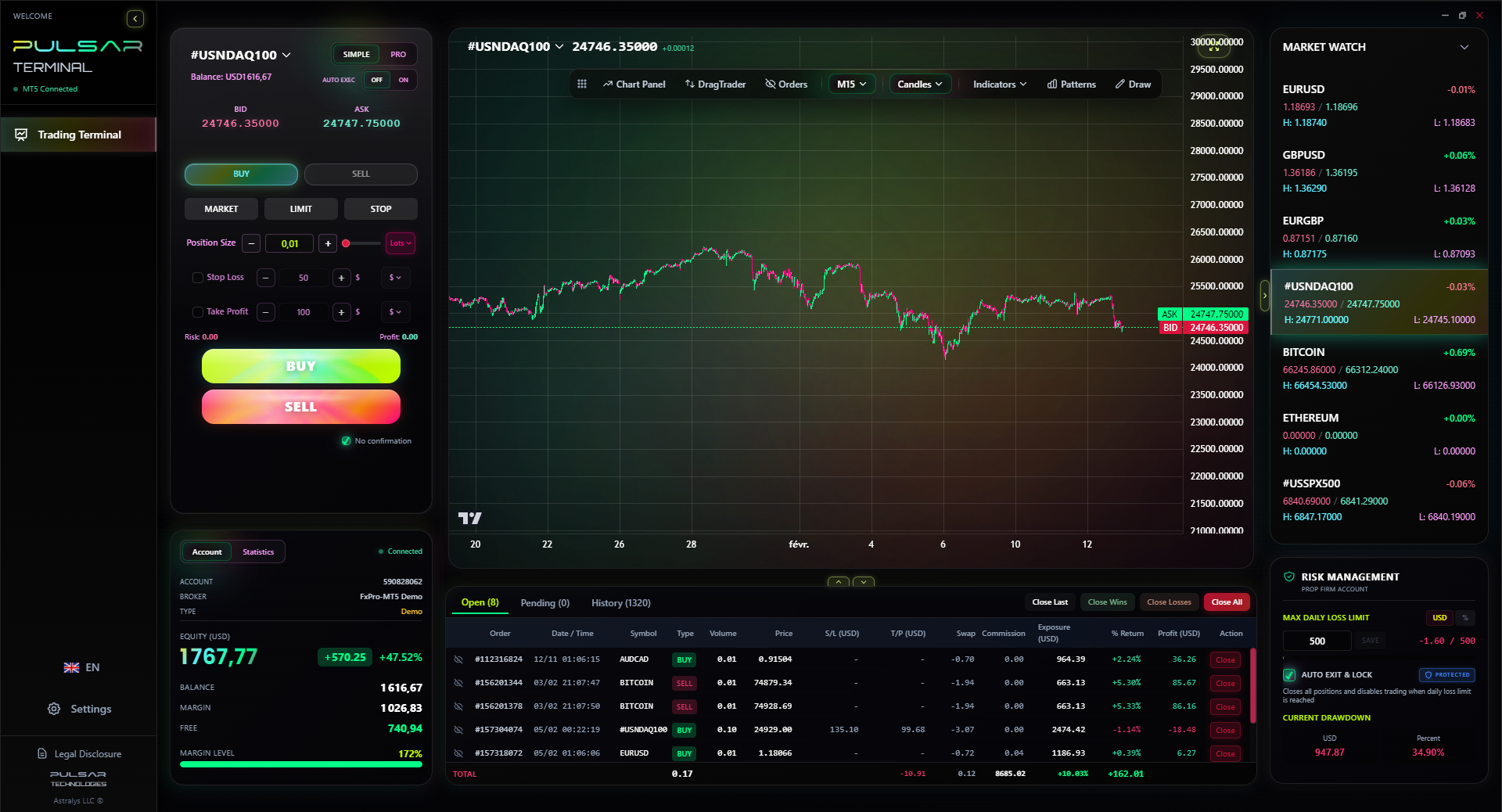
Managing multiple trades and adjusting stops in a volatile market is chaotic, which is why tools like Pulsar Terminal automate trailing stops and partial closures directly on your MT5 platform.
Pulsar Terminal
The all-in-one MT5 companion: drag-and-drop orders, multi-TP/SL, trailing stop, grid trading, Volume Profile, and prop firm protection. Used by 1,000+ traders daily.
“Your use should be inversely proportional to the market's volatility. The wilder it gets, the smaller you should play.”
Not all brokers handle volatile times well. You need one that won't work against you.
Key Factors for Nigerian Traders:
| Feature | Why It Matters for Volatility | Nigerian-Friendly Example |
|---|---|---|
| Execution Speed & Slippage | During news, prices gap. A slow broker gives you massive negative slippage, filling you at a much worse price. | IC Markets is renowned for fast execution. |
| Spreads | Spreads often widen massively during high volatility. A 'fixed spread' broker prevents this, but usually has higher costs overall. A 'raw spread' broker like FP Markets keeps costs low but spreads can widen. | Compare Exness (often stable) vs. IC Markets (raw). |
| Requotes & Order Rejection | The worst is placing an order and getting a 'requote' (new price) or flat-out rejection. Your trade is dead. | Look for brokers with 'No Dealing Desk' (NDD) execution models. |
| Deposit/Withdrawal Ease | With Nigerian bank card restrictions, you need a broker with reliable local payment channels (bank transfer, USSD, maybe crypto). Stressful volatility is worse when you can't fund your account. | XM and others offer local Naira deposit options. |
My personal take? I split my capital. I use a broker with super tight raw spreads (IC Markets) for my low-volatility, precision trades. And I use a broker known for stability (XM) for times when I might trade around major news, accepting a slightly higher cost for more reliability.
💡 Winston's Tip
The best trade during extreme volatility is often no trade at all. Preserving capital to fight another day is a strategic victory.
“In Nigeria, the most important volatility to understand isn't on your chart; it's in the parallel market rate for the Naira.”
Volatility plays with your emotions. It creates FOMO (Fear Of Missing Out) when prices rocket, and panic when they crash. Here's how I've learned to cope.
- Pre-Plan Every Trade: Before you click buy or sell, know your entry, stop loss, take profit, and why you're taking the trade. When volatility hits, you won't be thinking clearly. Your plan is your anchor.
- Accept That Stops Will Be Hit: In volatile markets, you will get stopped out more often. It's the cost of doing business. If your strategy is sound, one good volatile move will cover 5 small losses. I once got stopped out of 3 trades in a row on a choppy USD/CAD day, only to catch the 4th trade for a 4:1 reward that made my week.
- Turn Off the Screen: Seriously. If you have a trade running with a stop and target in place, especially during high volatility, walk away. Watching every pip jump will make you do something stupid like moving your stop loss further away (guaranteeing a bigger loss).
The goal isn't to predict every volatile swing. It's to have a strong system that survives them and capitalizes on a few. Understand what is volatility in forex, respect its power, and use it without letting it use you.
FAQ
Q1Is forex volatility good or bad for traders?
It's neutral, like fire. Controlled, it gives you opportunity (more pips to capture). Uncontrolled, it burns you. Skilled traders with solid risk management love volatility. Inexperienced traders without stops are destroyed by it. It's not good or bad, it just is. Your job is to adapt.
Q2What is the most volatile forex pair?
Exotic pairs and crosses involving volatile currencies are typically the most volatile. Pairs like USD/TRY (Turkish Lira) or GBP/AUD can have huge swings. Among the majors, GBP/JPY and AUD/JPY are known as the 'volatility kings' because they combine two risk-sensitive currencies. For a deep dive on a popular volatile pair, check our EUR/USD guide to see how its volatility compares.
Q3How does Nigeria's economy affect forex volatility?
It directly affects the parallel market rate for USD/NGN, which is a huge source of volatility for businesses and individuals here. For trading international pairs, Nigerian events (like CBN MPC decisions or oil price shifts) affect global sentiment towards risk. If Nigeria looks unstable, global investors might pull out of emerging markets, which can weaken currencies like the South African Rand (ZAR) or Mexican Peso (MXN), creating volatility in pairs like USD/ZAR.
Q4What time of day is forex most volatile?
The peak volatility window for a Nigerian trader is between 2 PM and 5 PM Nigerian Time. This is when the London afternoon session and New York morning session overlap. The most economic data is also released during this time. The least volatile period is during the Asian session (roughly 11 PM - 7 AM Nigerian Time).
Q5Can I trade volatility without predicting direction?
Yes, with strategies like straddles or using volatility-based indicators. However, these are advanced. A simpler method is to trade breakouts from periods of very low volatility (like a Bollinger Band squeeze), betting that a big directional volatile move is coming, without knowing if it's up or down until the break happens.
Q6Do I pay more tax on profits from volatile trades?
In Nigeria, you're subject to a 10% Capital Gains Tax on your gross trading profits, regardless of whether they came from calm or volatile trades. The key is keeping impeccable records of all your trades, as the tax authority (FIRS) will want to see your total profit calculation. Volatile trading often means more transactions, so your record-keeping needs to be even better.
Prof. Winston's Lesson
Key Takeaways:
- ✓Always check the ATR before setting your stop loss.
- ✓Halve your lot size when volatility doubles.
- ✓The London-New York overlap (2-5 PM Naija time) is volatility prime time.
- ✓10% Capital Gains Tax applies to all forex profits in Nigeria.
How useful was this article?
Click a star to rate
Weekly Trading Insights
Free weekly analysis & strategies. No spam.
About the Author
Olumide Adeyemi
West African Trading Pioneer
One of Nigeria's most active forex trading educators. 8 years of experience trading from Lagos. Specializes in low-capital strategies and prop firm challenges for African traders.
Comments
Risk Disclaimer
Trading financial instruments carries significant risk and may not be suitable for all investors. Past performance does not guarantee future results. This content is for educational purposes only and should not be considered investment advice. Always conduct your own research before trading.
You Might Also Like

Cara Trading Forex Sukses: 7 Prinsip dari Trader Profesional
Cara trading forex sukses dengan 7 prinsip trader pro: manajemen modal, disiplin, journal trading, backtest. Data nyata, bukan janji profit palsu.
Jam Trading Forex Terbaik untuk Trader Indonesia: Panduan Lengkap dengan Tabel Waktu
Panduan jam trading forex untuk trader Indonesia. Tabel 4 sesi dunia, jam emas 20:00-00:00, sesi mana yang harus dihindari. Data akurat + tips dari trader berpengalaman.
Top 5 Sàn Forex Uy Tín Nhất 2026: Review Jujur dari Trader Indonesia
Top 5 sàn forex uy tín 2026 untuk trader Indonesia. Review jujur: spread, deposit, withdraw, dukungan lokal. Exness, XM, IC Markets & lebih.
Get Pulsar Terminal
All these calculators are built into Pulsar Terminal with real-time data from your MT5 account. One-click position sizing, automatic risk management, and instant calculations.
Get Pulsar Terminal