


Here's the biggest lie I see new traders in Nigeria fall for: 'Margin is free money from your broker.' That thinking has wiped out more accounts than I can count.

Olumide Adeyemi
West African Trading Pioneer ·  Nigeria
☕ 10 min read
What you'll learn:
- 1Margin 101: It's Not Free Money, It's a Loan
- 2use & Margin: The Inseparable Dance
- 3The Nigerian Trader's Nightmare: Margin Call & Stop Out
- 4How to Calculate Your Margin in Naira & USD
- 5Choosing the Right use for the Nigerian Market
- 6Naira Accounts, Local Payments & Margin Management
- 7Beyond the Basics: Margin for Advanced Tactics
Here's the biggest lie I see new traders in Nigeria fall for: 'Margin is free money from your broker.' That thinking has wiped out more accounts than I can count. The truth is, margin is a double-edged sword - it can amplify your gains in Naira, but it can also liquidate your account faster than you can say 'CBN policy.' I learned this the hard way early on. Let's set the record straight on what margin really means in forex, how it works with our local brokers, and how you can use it without becoming another statistic.
Let's get this straight from the start. When you hear 'margin,' think 'collateral' or 'security deposit.' It's not a fee or a transaction cost you lose. It's a portion of your own trading capital that your broker temporarily locks up to cover potential losses on a position you've opened with borrowed funds.
Think of it like this: you want to trade a standard lot of EUR/USD, which is a $100,000 position. You don't have $100,000 in your account (who does?). So, your broker says, 'Show me you're good for it.' You put down a small deposit - the margin - and they front the rest. That's the core of what margin means in forex.
For us in Nigeria, this is crucial because we're often trading with smaller amounts in Naira, trying to get meaningful returns. That borrowed power is called use. If your broker offers 500:1 use, you only need to put down 0.2% of the total trade value as margin. On that $100,000 trade, that's just $200. Sounds amazing, right? It is, until the market moves against you. That's when the broker comes knocking for more collateral, leading to a margin call.

Warning: High use is a trap for new traders. Just because HFM or Exness offers 1:1000 or 'unlimited' use doesn't mean you should use it all. Starting with max use is a surefire way to get stopped out by normal market noise.

💡 Winston's Tip
Margin is rented capital, not owned. The broker can recall it (via stop out) at the worst possible moment. Never get emotionally attached to a trade just because you have a lot of margin tied up in it.
You can't talk about one without the other. use is the multiplier (like 100:1), and margin is the actual cash amount that multiplier determines.
Here’s a simple table to show how they connect for a $10,000 (₦~15M) position:
| use Ratio | Margin Required | Amount You Control |
|---|---|---|
| 10:1 | 10% ($1,000) | $10,000 |
| 50:1 | 2% ($200) | $10,000 |
| 100:1 | 1% ($100) | $10,000 |
| 500:1 | 0.2% ($20) | $10,000 |
See the pattern? Higher use means lower margin requirement. This is why brokers like XM, InstaForex, and Tickmill advertising 1:1000 use are so attractive to Nigerian traders starting with small capital. You only need $10 to control a $10,000 position.
But here's my personal rule, forged from a nasty loss in 2019: Never use more than 10% of your available margin. If your account has $1,000, don't let your total margin used exceed $100. This gives you a huge buffer. I once got cocky on a GBP/USD scalping strategy, used 90% of my margin on a single trade with 500:1 use. A 20-pip move against me wiped out 45% of my account. The trade eventually went my way, but I was already out. Lesson learned.

Pro Tip: Use a position size calculator. Before you enter any trade, plug in your account balance, risk percentage (I risk 1-2% max), stop-loss distance in pips, and it tells you the exact lot size. This automatically manages your margin usage. It's the single best habit you can build.
“High use is a marketing tool for brokers, not a trading tool for you.”
This is where the rubber meets the road. Understanding these terms is the difference between surviving a drawdown and getting a 'Dear Trader' email from your broker.
Margin Level is your key dashboard metric. It's calculated as (Equity / Used Margin) x 100%. If your account has $1,000 equity and you've used $200 as margin, your Margin Level is 500%. You're fine.
Margin Call is a warning. It's when your Margin Level falls to a broker-specific threshold, usually around 100%. At 100%, your equity equals your used margin. You have no buffer left. Your broker will alert you (the 'call') to add more funds or close some positions. In Nigeria, with sometimes spotty internet or power, you might miss this alert. Don't rely on it.
Stop Out Level is the liquidation point. If your losses continue and your Margin Level hits an even lower level (often 50% or 20%), the broker's system will automatically start closing your losing positions, starting with the biggest loser, to protect their loan. This is a forced closure, usually at the worst possible price.
A Real Example from My Trading
I had a $5,000 account with IC Markets. My broker's stop-out level was 50%. I entered a XAU/USD (gold) trade, using $1,000 as margin (20% of my account, already too high). Gold dropped sharply. My equity fell to $600, but my used margin was still $1,000. Margin Level = (600/1000)*100% = 60%. I got a margin call email. I was in a meeting and couldn't act. Gold kept falling. My equity hit $500. Margin Level = 50%. STOP OUT. Their system closed my trade at a massive loss. My account was left with about $520. I broke my own rules on position size and paid for it.
The brokers popular here have different levels. Some, like AvaTrade, might have a 100% margin call and 50% stop-out. Others might be 80% and 20%. You must know your broker's specific levels before you trade a single Naira.
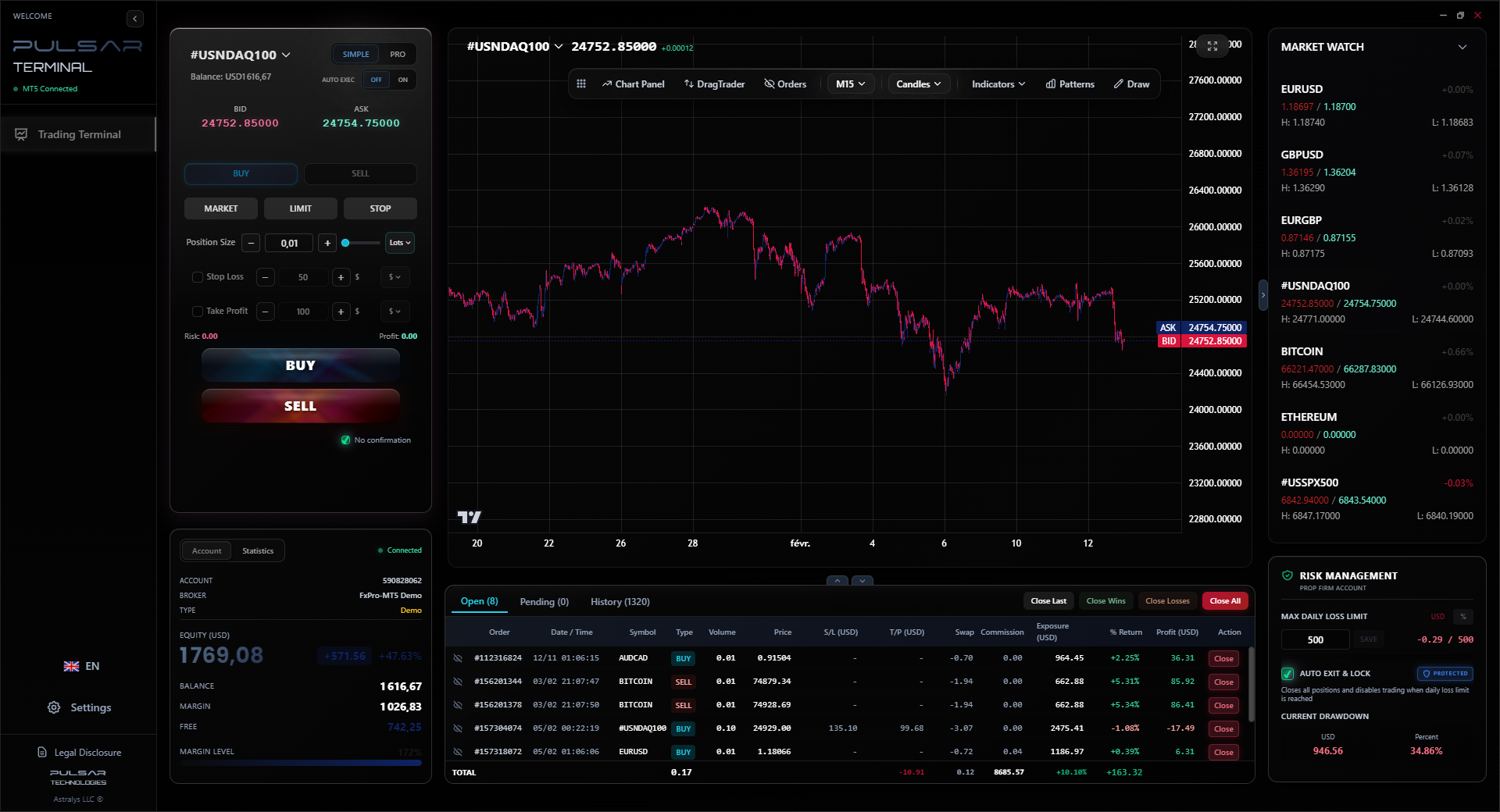
Managing multiple trades and their margin requirements manually is stressful; Pulsar Terminal's drag-and-drop order management and one-click partial closures let you adjust risk and free up margin in seconds directly on your MT5.
Pulsar Terminal
The all-in-one MT5 companion: drag-and-drop orders, multi-TP/SL, trailing stop, grid trading, Volume Profile, and prop firm protection. Used by 1,000+ traders daily.
Let's make this practical. You don't need to be a math genius, but you should know how the numbers work.
The basic formula is: Margin = (Trade Size / use) * Exchange Rate to Account Currency
Most Nigerian brokers denominate accounts in USD, but let's run an example in both.
Scenario 1: USD Account You want to buy 1 standard lot (100,000 units) of EUR/USD. Your broker (Pepperstone, for example) gives you 400:1 use on this pair.
- Trade Size: 100,000 EUR
- use: 400:1
- Margin = 100,000 / 400 = 250 EUR But your account is in USD, so you need to convert. If EUR/USD is trading at 1.0850:
- Margin in USD = 250 EUR * 1.0850 = $271.25 That $271.25 is what gets 'locked' in your account to open that trade.
Scenario 2: NGN Account (e.g., HFM) Same trade: 1 lot EUR/USD, 400:1 use.
- Margin in EUR is still 250 EUR.
- Convert to USD: 250 EUR * 1.0850 = $271.25
- Now convert USD to NGN. If the rate is ₦1,450/$:
- Margin in NGN = $271.25 * 1450 = ₦393,312.50
See how that works? Your trading platform does this automatically, but knowing the math keeps you grounded. It shows you that a 'small' 1-lot trade is actually tying up a significant chunk of capital.

Example: Let's say you're using a swing trading strategy on EUR/USD and only want to risk 1% of a ₦500,000 account (₦5,000). With a 50-pip stop loss, a position size calculator will tell you to trade a mini lot (10,000 units). The required margin at 200:1 use would only be about ₦39,000, leaving you plenty of breathing room.
💡 Winston's Tip
Your most important daily metric isn't your P&L; it's your Margin Level. If it's below 500%, you're likely over-trading. Aim to keep it above 1000%.
“If your used margin ever exceeds 10% of your total account equity, you're overexposed.”
Walking into a broker like Exness with 'unlimited' use is like a new driver getting behind the wheel of a Bugatti. It's asking for trouble. Your use should be a function of your strategy, experience, and the currency pair's volatility.
For Beginners: Start as low as possible. Many brokers have a default or 'retail' setting of 1:30 (like FP Markets' retail account). Use that. It forces you to build skill in analysis, not just rely on use to make money from tiny moves.
For Volatile Pairs (GBP/AUD, XAU/USD): Lower use. These pairs can swing 100+ pips in a session. High use on them is suicidal. I might use 1:50 or 1:100 max.
For Major Pairs (EUR/USD, USD/JPY): You can use slightly higher use, say 1:100 to 1:200, because they're generally less wild. But discipline is key.
The Reality of Nigerian Brokers: We have access to insane use. Here’s a quick rundown:
- HFM, InstaForex: Up to 1:1000
- XM, FBS: Up to 1:1000
- Exness: 'Unlimited' (effectively very, very high)
- AvaTrade, Pepperstone: Up to 1:400 for Nigerian clients
- IC Markets: Up to 1:500 (under global entity)
My advice? Open your account and manually lower your use in the client portal. Set it to 1:100. Get consistently profitable for 6 months. Then maybe consider 1:200. I've never needed more than 1:200 in 12 years of trading majors. The high numbers are a marketing tool, not a trading tool.
This is the uniquely Nigerian part of the equation. How you fund your account directly impacts your margin safety.
NGN vs. USD Accounts: Some brokers like HFM offer Naira-denominated accounts. This is convenient - you see your profit and loss in Naira, and you deposit/withdraw in Naira. However, remember the broker converts your margin and trades to USD internally. If there's a sharp devaluation of the Naira (which, let's be honest, happens), the Naira value of your required margin could technically increase, though this is usually managed in real-time by the broker's systems.
Funding Speed & Margin Calls: If you get a margin call, you need to fund your account FAST. This is where local payment methods are a lifesaver.
- Bank Transfer/Interswitch: Can take hours or a day. Too slow for a margin emergency.
- Local Processors (Paga, Opay): Often instant or within minutes. This is your best bet for quick top-ups.
- Cryptocurrency (USDT): Deposits are often processed within an hour on brokers that accept them. A good option if you're crypto-savvy.
- E-wallets (Skrill, Neteller): Usually instant.
The Bottom Line: Always keep a 'margin reserve.' Don't deploy 100% of your deposited funds into trades. Keep 30-50% of your account as free, usable margin. This buffer protects you from volatile CBN news, sudden spreads widening during London open, and gives you room to breathe. It also means you won't be forced to make a panic deposit from your savings when a trade temporarily goes south.
“Seeing a 1:1000 use option and using 1:1000 use are two very different things. Discipline is choosing the smaller number.”
Once you're comfortable, you can use margin concepts for more sophisticated moves.
Hedging: This involves opening two opposite positions on the same currency pair. Some brokers 'net' the margin for hedged positions (only requiring margin on one side), while others require margin for both. This is a capital-intensive strategy. Know your broker's policy.
Using Margin as a Risk Gauge: I look at my 'Used Margin' as a direct measure of my risk exposure. If my used margin ever exceeds 10% of my total account equity, I know I'm overexposed, regardless of how many trades I have open. It's a simple, effective red flag.
Correlation & Margin: Opening multiple trades on highly correlated pairs (like EUR/USD and GBP/USD) is taking the same trade twice. Your margin might be used for two positions, but your risk is concentrated. A move against you will hit both trades, draining your equity and crushing your margin level faster. I learned this trading both AUD/USD and NZD/USD during a China data release. The loss was nearly double what I'd modeled.
The most important advanced strategy is psychological: Stop seeing high available use as 'buying power.' See it as 'risk capacity.' Your goal isn't to use it all; your goal is to have so much unused that a margin call isn't even a remote possibility. That's when you trade with a clear head.
FAQ
Q1Is forex margin trading legal in Nigeria?
Yes, it's legal for individuals to trade forex with their own funds. However, the retail market is poorly regulated locally. Most Nigerian traders use international brokers regulated offshore by bodies like the FSCA (South Africa) or CySEC (Cyprus). Always check your broker's regulation.
Q2What's a good starter use for a Nigerian trader with ₦200,000?
Start very low. With ₦200,000 (approx. $135), I'd recommend using no more than 1:50 use. This forces you to focus on proper position sizing and risk management. On a 0.01 mini lot trade, your margin would be small, leaving most of your capital as a safety buffer. Jumping straight to 1:500 is a recipe for a quick account blow-up.
Q3How is margin calculated on Naira-denominated accounts?
The broker calculates the margin requirement in the base currency of the pair (e.g., EUR for EUR/USD), converts it to USD at the current rate, and then converts that USD amount to Naira using their internal rate. So, if you need 250 EUR margin for a trade, and EUR/USD is 1.08, that's $270. If their USD/NGN rate is 1450, your locked margin will be about ₦391,500. The platform shows you the final Naira figure.
Q4What happens if I don't meet a margin call?
If you don't add funds or close positions to raise your margin level above the broker's requirement, your losses will continue to eat into your equity. Once your equity falls to the 'Stop Out Level' (e.g., 50% of your used margin), the broker's system will automatically start closing your positions, often at the worst available price, to recover their loan. You can end up with significant losses.
Q5Can I lose more money than I deposited using margin?
With most reputable international brokers offering negative balance protection (like AvaTrade, HFM, Pepperstone), your loss is limited to your deposited funds. They will absorb any negative balance. However, not all brokers offer this, and under extreme market conditions (like a 'flash crash'), gaps can occur. Always confirm your broker has negative balance protection.
Q6Do I pay tax on profits made with margin trading in Nigeria?
Yes. According to Nigerian tax law, profits from forex trading are generally considered capital gains and are subject to a 10% Capital Gains Tax. You are responsible for declaring this income and paying the tax to the Federal Inland Revenue Service (FIRS).
Prof. Winston's Lesson
Key Takeaways:
- ✓Margin is collateral, not free money.
- ✓use above 1:200 is rarely needed for major pairs.
- ✓Always know your broker's exact margin call & stop-out levels.
- ✓Keep your Used Margin below 10% of your account equity.
How useful was this article?
Click a star to rate
Weekly Trading Insights
Free weekly analysis & strategies. No spam.
About the Author
Olumide Adeyemi
West African Trading Pioneer
One of Nigeria's most active forex trading educators. 8 years of experience trading from Lagos. Specializes in low-capital strategies and prop firm challenges for African traders.
Comments
Risk Disclaimer
Trading financial instruments carries significant risk and may not be suitable for all investors. Past performance does not guarantee future results. This content is for educational purposes only and should not be considered investment advice. Always conduct your own research before trading.
You Might Also Like

Cara Trading Forex Sukses: 7 Prinsip dari Trader Profesional
Cara trading forex sukses dengan 7 prinsip trader pro: manajemen modal, disiplin, journal trading, backtest. Data nyata, bukan janji profit palsu.
Jam Trading Forex Terbaik untuk Trader Indonesia: Panduan Lengkap dengan Tabel Waktu
Panduan jam trading forex untuk trader Indonesia. Tabel 4 sesi dunia, jam emas 20:00-00:00, sesi mana yang harus dihindari. Data akurat + tips dari trader berpengalaman.
Top 5 Sàn Forex Uy Tín Nhất 2026: Review Jujur dari Trader Indonesia
Top 5 sàn forex uy tín 2026 untuk trader Indonesia. Review jujur: spread, deposit, withdraw, dukungan lokal. Exness, XM, IC Markets & lebih.
Get Pulsar Terminal
All these calculators are built into Pulsar Terminal with real-time data from your MT5 account. One-click position sizing, automatic risk management, and instant calculations.
Get Pulsar Terminal