


Most new traders in Nigeria think a pip is just a tiny price movement.

Olumide Adeyemi
West African Trading Pioneer ·  Nigeria
☕ 9 min read
What you'll learn:
- 1The Absolute Basics: What Exactly Is a Pip?
- 2The Million-Naira Question: How Much Is a Pip Worth?
- 3pips-profit-loss-calculation
- 4Clearing the Confusion: Pips vs. Points vs. Pipettes
- 5The Real Use of Pips: Managing Your Risk, Not Chasing Profit
- 6Pips in the Nigerian Market: Local Pairs & Practical Realities
- 73 Costly Pip Mistakes Every Nigerian Trader Makes (And How to Stop)
Most new traders in Nigeria think a pip is just a tiny price movement. They're wrong. It's the unit that measures how fast you can lose money. I've seen traders blow accounts because they didn't understand that a 50-pip move on a large position could wipe out months of savings. This guide will show you exactly what a pip is, how to calculate its value in Naira, and why getting this wrong is the fastest path to the 'margin call' zone.
A pip, short for 'Percentage in Point,' is the smallest standard price move a currency pair can make. It's the basic unit of measurement in forex, like a centimeter for distance. For most pairs, like EUR/USD or GBP/USD, one pip is a movement of 0.0001. If EUR/USD moves from 1.1050 to 1.1051, that's a one-pip move.
For pairs involving the Japanese Yen (JPY), like USD/JPY, the rule changes. Because the Yen is valued differently, one pip is a movement of 0.01. So, if USD/JPY moves from 150.00 to 150.01, that's also a one-pip move.

Warning: Don't confuse pips with profit. A 100-pip win on a tiny trade might buy you a Coke. A 10-pip loss on a massive trade can buy you a world of hurt. The money comes from your position size, not just the pip count.
Now, brokers have gotten fancy. You'll often see a fifth decimal place, like 1.10501. That last digit is a 'pipette' or fractional pip. It's one-tenth of a pip. It allows for tighter spreads and more precise entries, but for your core calculations, you focus on the standard pip.
This is where theory meets your bank account. The value of a pip depends on three things: the currency pair, your trade size (lot size), and the current exchange rate. Most beginners skip this math, and that's why they're always surprised when they get a withdrawal notification from their broker.
The Standard Formula
For a standard lot (100,000 units of the base currency), the pip value is usually around $10 for pairs where the USD is the quote currency (the second one). For EUR/USD, 1 standard lot, 1 pip = roughly $10.
But you're trading from Nigeria. You need to know what that is in Naira. Let's say USD/NGN is at 1,500.
- 1 pip on EUR/USD (1 standard lot) = $10
- $10 x 1,500 (USD/NGN rate) = 15,000 NGN.
That single pip is now worth more than the daily minimum wage for many. Suddenly, a 20-pip stop-loss isn't 'small,' it's a 300,000 NGN risk. I learned this the hard way in 2018. I put on a 2-lot trade on GBP/USD, thinking a 25-pip stop was conservative. I didn't convert the pip value. That stop-loss hit, and I lost over $500 - about 375,000 NGN at the time - in under an hour. It was a brutal, but necessary, lesson in true position sizing.
Calculating for Other Pairs
What if you're trading USD/JPY or GBP/JPY? The formula gets a bit more involved because the quote currency isn't USD. You need to convert the pip value to USD first, then to Naira. This is why using a position size calculator isn't lazy, it's essential. It does this math instantly so you can focus on the trade, not the arithmetic.

Example: Let's calculate a mini lot (10,000 units) on USD/CAD, assuming USD/NGN is 1,500.
- For USD/CAD, a 1-pip move on a mini lot is roughly 0.99 USD (it changes with the USD/CAD rate).
- 0.99 USD x 1,500 = 1,485 NGN per pip. A 50-pip loss would cost you 74,250 NGN. See how fast it adds up?

💡 Winston's Tip
Never enter a trade without knowing, in Naira, what you stand to lose if your stop-loss is hit. That number should never scare you, because you decided it before you clicked 'buy.'
“A pip is the unit that measures how fast you can lose money.”
So you've entered a trade. How do you actually figure out your profit or loss in pips and then in cash? It's simple subtraction, but you have to get the decimal places right.
Scenario: You buy EUR/USD at 1.0850 and sell at 1.0875.
- Exit Price (1.0875) - Entry Price (1.0850) = 0.0025
- For EUR/USD, 0.0001 = 1 pip. So, 0.0025 / 0.0001 = 25 pips.
Now, to get the cash value. Let's say you traded a 0.5 (half) standard lot. A full lot pip is ~$10, so half is ~$5.
- Profit in USD: 25 pips x $5 per pip = $125.
- Profit in Naira (USD/NGN at 1,520): $125 x 1,520 = 190,000 NGN.
The reverse is true for a loss. If you sold at 1.0835 instead, the calculation is: 1.0850 - 1.0835 = 0.0015 = 15 pips. 15 pips x $5 = $75 loss, or 114,000 NGN.
This is why understanding the spread definition is critical. If the spread on EUR/USD is 1 pip, your trade starts 1 pip in the red. You need the market to move in your favor by more than 1 pip just to break even. On a scalping strategy where you target 5-10 pips, a 2-pip spread eats a huge chunk of your potential profit.
Broker platforms love to mix terms, and it trips everyone up. Let's set the record straight.
- Pip: The standard unit (0.0001 for most, 0.01 for JPY pairs).
- Pipette (or Point): One-tenth of a pip. The fifth decimal place for most pairs (0.00001), or the third for JPY pairs (0.001). If EUR/USD moves from 1.10500 to 1.10501, it moved 1 pipette.
Some platforms, like TradingView or certain broker terminals, might use the term 'points' to mean pips. Always check your broker's glossary. The key is consistency: know what unit your platform is using to display price and what unit it's using to calculate your P&L. I once set a stop-loss thinking in pips, but the platform required the input in points (pipettes). My intended 30-pip stop became a 3-pip stop, and I was taken out of a winning trade almost instantly. A costly interface misunderstanding.

Pro Tip: Before you fund a live account with any broker like Exness or IC Markets, open a demo. Place a few trades and verify the math. See if a 10-pip profit on your demo matches the P&L calculation you did by hand. This 15-minute test can save you a fortune.
“Your risk per trade should be a percentage of your account, usually 1-2%. Pips are the bridge between that percentage and your trade entry.”
Here's the professional secret: Pips are far more important for measuring risk than for measuring reward. Amateurs look at a chart and think, 'I can make 100 pips here!' Professionals look and think, 'Where is my 20-pip stop-loss?'
Your risk per trade should be a percentage of your account, usually 1-2%. Pips are the bridge between that percentage and your trade entry. Here’s how it works:
- You have a 500,000 NGN account. You decide to risk 1% per trade: 5,000 NGN.
- You analyze XAU/USD (Gold) and identify a key support level. You plan to buy if it holds, with a stop-loss 150 pips below your entry.
- You need to calculate your position size so that a 150-pip loss equals 5,000 NGN.
- First, find the pip value in Naira for a 1-lot trade on XAU/USD (this varies; let's say 1 pip = 8,000 NGN for a standard lot).
- For a 150-pip stop: 150 pips x 8,000 NGN = 1,200,000 NGN risk per lot. That's way over your 5,000 NGN limit.
- So, your position size must be: 5,000 NGN / (150 pips x 8,000 NGN) = approximately 0.0042 lots.
You'd trade a micro lot (0.01) or even a nano lot size to stay within your risk. This math forces discipline. It's boring, but it keeps you in the game. Without it, you're just gambling. This precise control is where tools like Pulsar Terminal shine, letting you set your stop in pips and automatically calculating the correct lot size to match your predefined risk percentage.
💡 Winston's Tip
If you can't instantly state your current risk per trade as a percentage of your account, you are not trading. You are speculating with an unknown downside. Close your positions and figure it out.
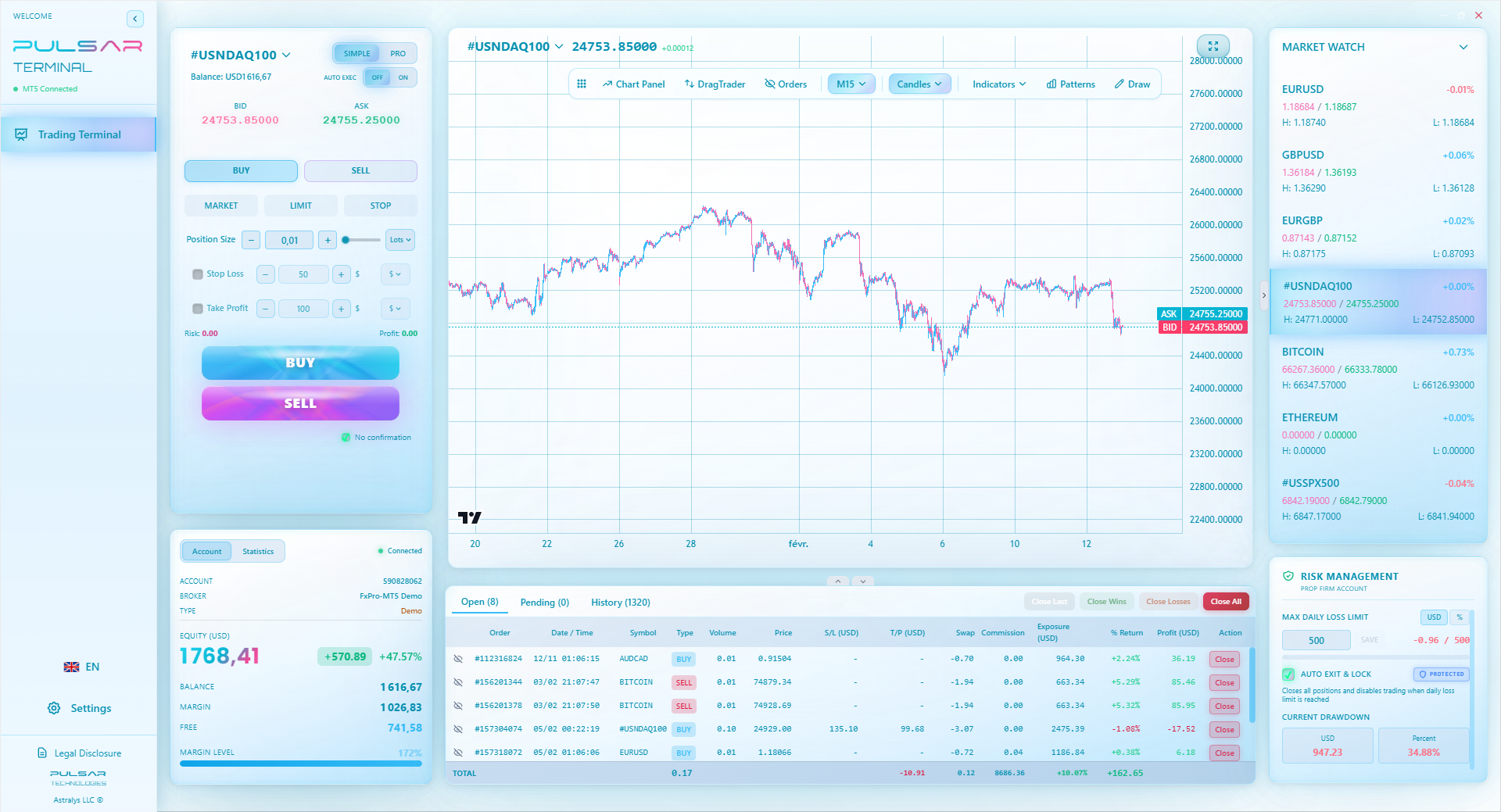
Manually calculating position size for every trade is tedious and error-prone. Pulsar Terminal automates this, letting you set your stop in pips and instantly calculating the perfect lot size to match your exact risk percentage, directly on your MT5 chart.
Pulsar Terminal
The all-in-one MT5 companion: drag-and-drop orders, multi-TP/SL, trailing stop, grid trading, Volume Profile, and prop firm protection. Used by 1,000+ traders daily.
Trading in Nigeria adds specific layers to the pip conversation.
Local Currency Pairs: You might see USD/NGN, EUR/NGN, or GBP/NGN offered by some brokers or in the local market. The pip definition here is different due to the Naira's value. For USD/NGN, a move from 1,500.00 to 1,500.50 is a 50-pip move (since the second decimal is the pip). The pip value is inherently in Naira, which simplifies things, but the volatility can be extreme and influenced heavily by CBN policies and local liquidity.
Costs Matter More: When your capital might be 200,000 NGN instead of $10,000, broker costs hit harder. A 1.5 pip spread on EUR/USD with a broker like XM or Pepperstone is a real cost you pay on every round-turn trade. If you're swing trading and holding for 100-pip moves, it's manageable. If you're a scalper, it's a tax that can kill your edge. Always factor the spread (in pips) into your potential profit target.
Withdrawals and Tax: Remember, your profit is in pips, but you live in Naira. When you withdraw, you're subject to the bank's or payment processor's exchange rate (for Neteller, Skrill, etc.), which is often worse than the interbank rate you see on your chart. Also, don't forget the 10% Capital Gains Tax on your gross profits payable to FIRS. A 500-pip winning trade doesn't mean much if half the profit is eroded by fees and taxes.
“Focus on managing your risk as a percentage of your capital, and use pips as the tool to execute that management.”
I've made these. My students have made these. Let's break the cycle.
1. Ignoring Pip Value for Different Lot Sizes. Trading 0.1 lots on EUR/JPY is not the same as 0.1 lots on EUR/USD. The pip value is different because the quote currency is different. Mistaking them can mean risking 2% of your account when you meant to risk 0.5%. Use a calculator. Every. Single. Time.
2. Setting Stops Based on Wishful Thinking, Not Chart Logic. You put a trade on and set a 10-pip stop because it 'feels safe.' But if the market's average daily range is 80 pips and your stop is 10 pips away from entry, you're almost guaranteed to get stopped out by normal noise. Your stop should be based on a logical market level (like beyond a recent swing high/low), measured in pips, and then your position size is adjusted to fit your risk. I got chopped up for months using arbitrary 20-pip stops until I learned to place stops where the market structure said my trade idea was wrong.
3. Confusing Large Pip Moves with Large Money Moves. A 200-pip move on a $1,000 account trading a 0.01 micro lot might net you $20 (30,000 NGN). That same 200-pip move on a crypto cross with high volatility could have a pip value 5 times larger, creating a much bigger P&L swing. Don't get hypnotized by the pip count. Always look at the final P&L in your account currency and relate it back to your account balance. That's the only number that matters for your growth.
FAQ
Q1How many pips should I aim for per trade?
There's no magic number. Your target should be based on your strategy and the market's setup, not a pip goal. A scalper might aim for 5-15 pips, a swing trader for 50-200. The key is that your target (in pips) should be significantly larger than your stop-loss (in pips) to maintain a positive risk-reward ratio, like 2:1 or 3:1.
Q2What is a good pip spread for a Nigerian trader?
For major pairs like EUR/USD, look for average spreads below 1.5 pips on a standard account. For ECN accounts, you can find raw spreads from 0.0 pips but you'll pay a commission. For a trader starting with a smaller Naira account, a low-commission ECN model with tight spreads from a broker like IC Markets can be more cost-effective than a standard account with a wider spread, especially if you trade frequently.
Q3How do I calculate pips for Bitcoin or other cryptocurrencies?
Crypto pairs (like BTC/USD) don't use the standard forex pip. The smallest move is usually 1.00 (a 'point'). A move from 65,400 to 65,500 is a 100-point move. The value of that point depends entirely on your trade size (how many BTC you're trading). The concept is similar, but the unit and calculation are different. Always check your broker's specifications.
Q4Does the pip value change?
Yes, it can. The pip value for a standard lot is fixed in the quote currency. But the value of that quote currency in your account currency (NGN) changes. For example, the USD value of a pip on EUR/USD is roughly constant, but its Naira value fluctuates with the USD/NGN rate. This is another reason to regularly check your risk calculations.
Q5What's more important, pips or percentage gain?
Percentage gain on your account, 100 times out of 100. A 100-pip gain on a massive position could be a 20% account gain. The same 100 pips on a tiny position might be 0.5%. Focus on managing your risk as a percentage of your capital, and use pips as the tool to execute that management on the chart.
Q6Can I trade with just an understanding of pips?
It's the necessary first step, like learning the alphabet before you write a novel. But you absolutely need more. You need a strategy for entries and exits, an understanding of support/resistance, and rock-solid risk management. Pips are the language of price movement, but they aren't the strategy itself.
Prof. Winston's Lesson
Key Takeaways:
- ✓A pip is 0.0001 for most pairs, 0.01 for JPY pairs.
- ✓Pip value converts price movement to cash; know it in Naira.
- ✓Risk should be 1-2% of account, not a random pip amount.
- ✓Use a position size calculator for every single trade.
- ✓Spreads (in pips) are a direct cost; factor them in.
How useful was this article?
Click a star to rate
Weekly Trading Insights
Free weekly analysis & strategies. No spam.
About the Author
Olumide Adeyemi
West African Trading Pioneer
One of Nigeria's most active forex trading educators. 8 years of experience trading from Lagos. Specializes in low-capital strategies and prop firm challenges for African traders.
Comments
Risk Disclaimer
Trading financial instruments carries significant risk and may not be suitable for all investors. Past performance does not guarantee future results. This content is for educational purposes only and should not be considered investment advice. Always conduct your own research before trading.
You Might Also Like

Cara Trading Forex Sukses: 7 Prinsip dari Trader Profesional
Cara trading forex sukses dengan 7 prinsip trader pro: manajemen modal, disiplin, journal trading, backtest. Data nyata, bukan janji profit palsu.
Jam Trading Forex Terbaik untuk Trader Indonesia: Panduan Lengkap dengan Tabel Waktu
Panduan jam trading forex untuk trader Indonesia. Tabel 4 sesi dunia, jam emas 20:00-00:00, sesi mana yang harus dihindari. Data akurat + tips dari trader berpengalaman.
Top 5 Sàn Forex Uy Tín Nhất 2026: Review Jujur dari Trader Indonesia
Top 5 sàn forex uy tín 2026 untuk trader Indonesia. Review jujur: spread, deposit, withdraw, dukungan lokal. Exness, XM, IC Markets & lebih.
Get Pulsar Terminal
All these calculators are built into Pulsar Terminal with real-time data from your MT5 account. One-click position sizing, automatic risk management, and instant calculations.
Get Pulsar Terminal