


Most new traders in South Africa obsess over the perfect entry.

David van der Merwe
Emerging Markets Trader ·  South Africa
☕ 10 min read
What you'll learn:
- 1The Exit Mindset: Why Selling is Harder Than Buying
- 2Technical Exit Signals: Reading the Chart's Story
- 3Fundamental Triggers: The South African Reality Check
- 4Selling for a Loss: The Art of the Stop-Loss
- 5Profit-Taking Strategies: Don't Be a Pig
- 6ZAR Pair Specifics: Trading Our Home Turf
- 7Common Exit Mistakes (I've Made Them All)
- 8Putting It All Together: Your Exit Checklist
Most new traders in South Africa obsess over the perfect entry. They'll spend hours hunting for that magic buy signal on USD/ZAR. But here's the uncomfortable truth I learned the hard way: your entry doesn't make you money. Your exit does. Knowing when to sell in forex is what separates the hopeful from the profitable. Let's talk about how to actually bank those pips, from the London open to our own volatile Rand pairs.
We're wired to seek opportunity, to get in on the action. Selling feels like closing the door on possibility, or worse, admitting a loss. I remember a trade on EUR/USD years ago. I bought at 1.1050, it ran to 1.1180. I was up 130 pips! Greed whispered, 'Just wait for 1.1200.' It reversed, I held, it crashed through my entry, and I finally sold at 1.0990 for a 60-pip loss. I turned a winning trade into a loser because I had no plan for when to sell in forex.
You need to decide your exit before you enter. It's not sexy, but it's non-negotiable. This means setting a take-profit (TP) and a stop-loss (SL) for every single trade. Your broker's platform, whether it's MT4 from someone like XM or cTrader from IC Markets, has these order types for a reason. Use them. Your future self will thank you when you're not staring at a screen, paralyzed by emotion.

Warning: The FSCA's use cap of 30:1 for retail traders is there for a reason. A bad exit with high use can wipe your account faster than you can say 'loadshedding.' Always use a position size calculator to ensure your potential loss on a trade is a small percentage of your capital.

💡 Winston's Tip
Your first profit target should be to get to breakeven. Move your stop-loss to your entry price as soon as the trade has moved in your favor by 1.5x your initial risk. This turns a risky bet into a free one.
Charts tell you when the party's over. You just have to listen.
Support and Resistance Flips
This is your bread and butter. You buy near support, you sell near resistance. But the real magic happens when these levels break. If you're long (bought) and price approaches a strong historical resistance level and starts to stall - forming pin bars or bearish engulfing patterns - that's the market telling you to take profits. Conversely, if you're short and price smashes through a support level, that's your cue to consider exiting or moving your stop-loss to breakeven.
Indicator-Based Exits
Indicators help remove emotion. I use the RSI indicator on the 4-hour and daily charts to spot overbought or oversold conditions. If I'm long and the RSI pushes above 70, I'm not immediately selling, but I'm tightening my stop or taking partial profits. The MACD indicator showing a bearish crossover on a higher timeframe is another strong 'sell' signal for a long position.
Trend Exhaustion
Trends don't move in straight lines. Look for momentum divergence: price makes a new high, but your RSI or MACD makes a lower high. That's often a leading signal that the trend is running out of steam. I caught the top of a big GBP/ZAR move in 2023 using this. Price hit R22.85, but the daily RSI was significantly lower than its prior peak. I sold my long position there and avoided a nasty 500-pip correction.

Example: You buy USD/ZAR at R18.50 with a target at a resistance level of R18.90. Price hits R18.88 and forms two consecutive doji candles (indecision). Your technical exit plan says 'sell at resistance with confirmation.' You close the trade, banking ~380 pips. You don't wait to see if it'll magically punch through.
“A stop-loss isn't a failure; it's a pre-paid insurance premium on your trading account.”
In South Africa, your charts can be rendered useless in seconds by a headline. Trading ZAR pairs means you're trading commodity prices, political risk, and SARB decisions.
SARB Interest Rate Decisions: This is huge. If you're long USD/ZAR (betting the Rand will weaken) and the SARB hikes rates more than expected, the Rand can strengthen violently. I've seen USD/ZAR drop 200 pips in minutes on a hawkish SARB surprise. Your technical exit might be miles away. In these cases, a fundamental trigger overrules everything. If you're in a trade around a major news event, you either exit before the announcement or have a very wide stop (which isn't ideal with our 30:1 use).
Commodity Prices: The Rand is a proxy trade for platinum, gold, and coal. Bad news for Chinese demand (a major commodity consumer) can hammer the Rand. If you're short AUD/ZAR (a common commodity-currency pair), and iron ore prices spike on positive China data, you need to reassess your sell thesis immediately.
Political and Local Events: Budget speeches, credit rating announcements, even major Eskom updates. These events inject volatility. Sometimes the smartest 'sell' decision is to exit all ZAR positions and sit in cash until the dust settles. There's no shame in preserving capital.
This is the most important sell order you'll ever place. A stop-loss isn't a failure; it's a pre-paid insurance premium on your trading account.
Where to Place It: Don't just pick a random number. Place your stop-loss beyond a recent swing point or a key support/resistance level. If you buy EUR/ZAR at R20.00 because it bounced off support at R19.80, your logical stop goes just below R19.80, say at R19.75. If that level breaks, your trade idea is invalid.
The Psychology: You must accept that a certain percentage of your trades will hit your stop. That's the cost of doing business. The goal is for your winning trades (when you sell for a profit) to be bigger than your losses. I use a 1:1.5 risk-reward ratio minimum. If I risk 100 pips, I aim for at least 150 pips profit.
The South African Cost Factor: Remember, wider spreads on exotic pairs like EUR/ZAR (often 12-18 pips) eat into your risk calculation. If your stop is only 20 pips away, the spread alone accounts for a massive chunk of your risk. This makes very short-term scalping strategy on ZAR pairs incredibly difficult. Your stop needs room to breathe.

Pro Tip: Never move your stop-loss further away to avoid a loss. That's called 'stop-hunting' your own account. If you're tempted to do this, close the trade manually. Taking a small, planned loss is always better than taking a huge, unplanned one that triggers a margin call.
💡 Winston's Tip
On ZAR pairs, always check the swap rate before holding over Wednesday night (when triple swap is charged). A negative carry can turn a winning trade into a loser if you hold too long.
“Bulls make money, bears make money, pigs get slaughtered.”
Bulls make money, bears make money, pigs get slaughtered. Here’s how to take profit without regret.
1. The Single Take-Profit: Simple. You set one TP level based on your analysis. This works well for clear, measured moves to a technical level. The downside? You might leave money on the table if the trend continues.
2. Partial Closures (Scaling Out): This is my preferred method. You sell a portion of your position at your first target (e.g., 50%), then move your stop-loss on the remainder to breakeven. This locks in some profit and lets you run the rest risk-free. For example, on a USD/ZAR trade, I might sell half at a 150-pip profit and let the other half ride with a trailing stop.
3. Trailing Stops: This automates the process of letting profits run while protecting them. You set a trailing stop of, say, 50 pips. If price moves 100 pips in your favor, your stop moves up 50 pips, locking in 50 pips of profit. It keeps you in the trend until it definitively reverses. This is crucial for capturing big moves during swing trading setups.
The key is to have a rule and stick to it. Did you hit your target? Sell. Is your trailing stop hit? Sell. No second-guessing.
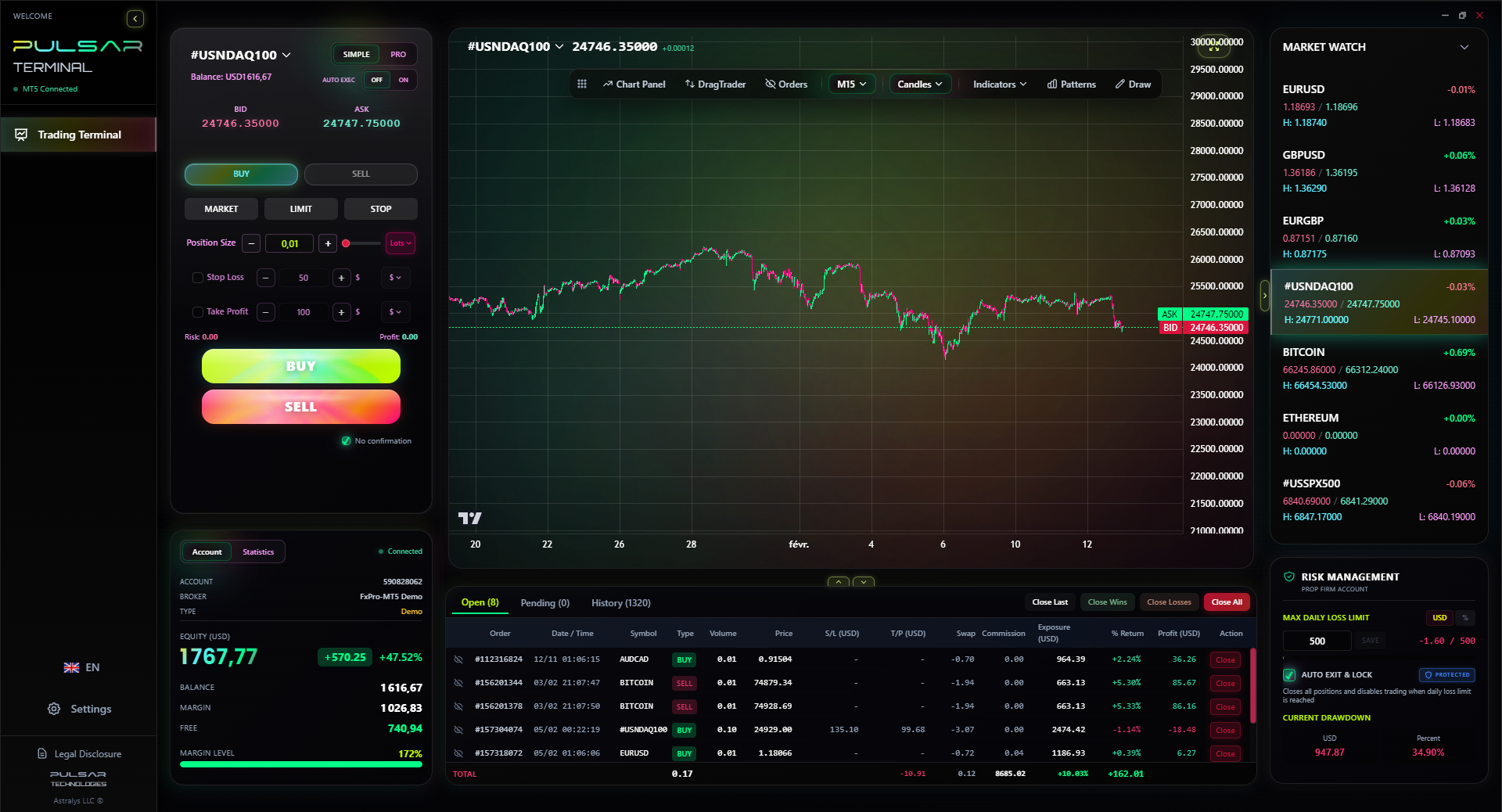
Manually trailing stops and managing partial closures is stressful, but tools like Pulsar Terminal automate this directly on your MT5 platform, letting you lock in profits systematically.
Pulsar Terminal
The all-in-one MT5 companion: drag-and-drop orders, multi-TP/SL, trailing stop, grid trading, Volume Profile, and prop firm protection. Used by 1,000+ traders daily.
Trading USD/ZAR, EUR/ZAR, or GBP/ZAR is a different beast to EUR/USD. The rules for when to sell need adjustment.
Liquidity & Slippage: While liquid for an exotic, these pairs can have thin moments, especially around SA public holidays or late New York session. Your sell order at a specific price might get filled at a worse price (slippage). Using limit orders to take profit can help, but during extreme volatility (like a SARB announcement), all bets are off.
Carry Trade Dynamics: ZAR is often a high-yield currency. If you're short a ZAR pair (e.g., long EUR/ZAR), you might be earning a positive swap (overnight interest). This can sometimes justify holding a trade longer through minor pullbacks, as you're being paid to wait. Check the swap rates in your broker's platform. Conversely, if you're long USD/ZAR, you might be paying a negative swap, which eats into profits on longer holds.
Broker Choice Matters: Not all brokers offer competitive pricing on ZAR pairs. You need a broker with tight, consistent spreads. Pepperstone and IC Markets are known for good pricing on exotics. A 5-pip spread vs. a 15-pip spread on USD/ZAR massively changes your effective entry and exit points. Always factor the spread definition into your profit targets.
“Knowing when to sell in forex is what separates the hopeful from the profitable.”
Let me save you some pain and lost Rands.
1. Exiting Too Early on Fear: You buy, it moves 20 pips in your favor, and you panic-sell because you're scared it will reverse. You've just turned a potential 100-pip winner into a 20-pip snack. Solution: Trust your analysis and don't watch the tick-by-tick movement.
2. Moving a Stop-Loss to Breakeven Too Soon: This is a subtle one. You get a 10-pip profit, move your stop to breakeven, and then get stopped out before the trade ever had a chance to reach its target. Give your trade some room. I wait for at least 1x my risk in profit before moving to breakeven.
3. Re-Entering a Sold Trade Out of FOMO: You sell at a great profit, price pulls back 20 pips, and you jump back in because 'the trend is still intact,' but without a fresh signal. This often leads to buying at a worse price and getting caught in a reversal. Once you sell, be done with that trade. Look for a new setup.
4. Ignoring Time-Based Exits: Some trades just die. If you're in a swing trading position and after 5-7 days it's gone nowhere but sideways, churning, that's a signal. The market is telling you it lacks conviction. Sometimes the best 'sell' decision is to exit at the market price and free up your capital for a better opportunity.
💡 Winston's Tip
If you find yourself constantly closing trades early out of fear, reduce your position size by 50%. You're trading too big for your psychology.
Before you click 'buy' or 'sell' to open a trade, answer these questions. Write them down.
- Why am I exiting? Is it a technical target (resistance, Fibonacci level), a fundamental event, or a time-based rule?
- What is my exact stop-loss price? Is it beyond a logical market structure level?
- What is my profit-taking plan? Single TP? Scaling out? At what precise levels?
- Have I calculated my position size? Use a position size calculator. My risk should never be more than 1-2% of my account on any single trade.
- What could invalidate my thesis? If X news happens or Y price level breaks, I will exit immediately, no questions asked.
Stick to this checklist for every trade. It turns the emotional chaos of 'when to sell in forex' into a boring, mechanical process. And boring, in trading, is beautiful. It means you're in control. Now, go review your last few trades. How would they have looked if you'd had this exit plan in place? That's where the real learning begins.
FAQ
Q1Is it better to use a take-profit order or to close the trade manually?
For 99% of traders, a take-profit order is better. It automates your exit, removing emotion. Manually closing often leads to greed ('just a few more pips') or fear ('get out now!'). Set your TP based on your pre-trade analysis and let it work. The only exception might be if you're actively trailing a stop on a very strong trend move.
Q2How do I handle selling during major South African news like the budget speech?
With extreme caution. If you have a position open, consider either closing it before the event or widening your stop-loss significantly to account for the inevitable volatility spike. Often, the smartest move is to have no position at all. The spreads will widen, liquidity can dry up, and prices can gap. It's usually not worth the risk for a retail trader.
Q3What's a realistic profit target for a ZAR pair like USD/ZAR?
It depends on your timeframe. For a day trade, 80-150 pips is a solid target given typical daily ranges. For a swing trade holding several days, 300-500+ pips is possible. Always base it on technical levels (distance to resistance) and use a risk-reward ratio of at least 1:1.5. Remember to factor in the wider spread (5+ pips) when calculating your net profit.
Q4Should I sell if my trade is at breakeven after a long time?
Yes, often you should. Capital tied up in a dead trade is opportunity cost. If the market had conviction, it would have moved by now. A time-based exit is a valid part of a strategy. Free up that margin and look for a fresh setup with better momentum.
Q5How does the FSCA's 30:1 use affect my exit strategy?
It forces more discipline. With lower use, your position sizes are smaller relative to your account, which gives your trades more room to breathe before a margin call. However, it also means you need to be more precise with exits, as you can't rely on huge use to generate large profits from tiny moves. It emphasizes quality exits over gambling on size.
Q6Can I use the same exit rules for major pairs like EUR/USD and ZAR pairs?
The core principles are the same (support/resistance, indicators), but the application differs. ZAR pairs are more volatile and have wider spreads. Your profit targets can be larger in pip terms, but your stop-losses also need to be wider to avoid being taken out by normal noise. Always adjust your position size down for ZAR pairs to account for the increased risk per pip.
Prof. Winston's Lesson
Key Takeaways:
- ✓Plan every exit before you enter the trade.
- ✓Use technical levels, not emotions, to define profit targets.
- ✓Always use a stop-loss; it's non-negotiable.
- ✓Factor wider ZAR pair spreads into your risk calculation.
- ✓Scale out of positions to lock in profit and reduce stress.
How useful was this article?
Click a star to rate
Weekly Trading Insights
Free weekly analysis & strategies. No spam.
About the Author
David van der Merwe
Emerging Markets Trader
Johannesburg-based trader with 11 years in emerging market currencies. Specializes in ZAR pairs, FSCA-regulated trading, and South African market analysis.
Comments
Risk Disclaimer
Trading financial instruments carries significant risk and may not be suitable for all investors. Past performance does not guarantee future results. This content is for educational purposes only and should not be considered investment advice. Always conduct your own research before trading.
You Might Also Like

Cara Trading Forex Sukses: 7 Prinsip dari Trader Profesional
Cara trading forex sukses dengan 7 prinsip trader pro: manajemen modal, disiplin, journal trading, backtest. Data nyata, bukan janji profit palsu.
Jam Trading Forex Terbaik untuk Trader Indonesia: Panduan Lengkap dengan Tabel Waktu
Panduan jam trading forex untuk trader Indonesia. Tabel 4 sesi dunia, jam emas 20:00-00:00, sesi mana yang harus dihindari. Data akurat + tips dari trader berpengalaman.
Top 5 Sàn Forex Uy Tín Nhất 2026: Review Jujur dari Trader Indonesia
Top 5 sàn forex uy tín 2026 untuk trader Indonesia. Review jujur: spread, deposit, withdraw, dukungan lokal. Exness, XM, IC Markets & lebih.
Get Pulsar Terminal
All these calculators are built into Pulsar Terminal with real-time data from your MT5 account. One-click position sizing, automatic risk management, and instant calculations.
Get Pulsar Terminal