


Most new traders in South Africa ask 'where can I trade forex?' and get the same useless advice: 'Just use a regulated broker.' That's like telling someone to 'just buy a car' without mentioning the difference between a Toyota and a stolen scooter.

David van der Merwe
Emerging Markets Trader ·  South Africa
☕ 9 min read
What you'll learn:
- 1The Legal Landscape: FSCA is Your Only Real Protector
- 2International Brokers: The Offshore Allure (And Pitfalls)
- 3Prop Firms: The Modern 'Where' (Trading with Their Money)
- 4The 'Where' is Also a Platform: MT5, cTrader & Web Terminals
- 5The Real Cost of Trading in South Africa (Forget the Ads)
- 6What to Avoid: Bucket Shops, Signal Sellers & 'Guaranteed' Returns
- 7Your Action Plan: How to Actually Start
Most new traders in South Africa ask 'where can I trade forex?' and get the same useless advice: 'Just use a regulated broker.' That's like telling someone to 'just buy a car' without mentioning the difference between a Toyota and a stolen scooter. The truth is, your choice of where to trade will determine if you keep your money, get paid your profits, or end up on the wrong side of the FSCA's enforcement list. I've seen too many 'students' lose capital not to market moves, but to shady brokers and their own ignorance. Let's cut through the marketing fluff and lay out your actual options, from the safest to the most reckless.
If you're trading with a rand-denominated account from a South African bank, you're playing in the FSCA's sandbox. The Financial Sector Conduct Authority is the main regulator for financial services providers (FSPs). Trading with an FSCA-licensed broker isn't just a suggestion, it's your primary shield against outright theft.
Here's what FSCA authorization actually means for you:
- Your funds are segregated. The broker can't use your deposit to pay their office rent. It must be held in a separate client money account.
- You have a formal complaints channel. If your withdrawal is 'delayed' for 3 months, you can escalate to the FSCA. Good luck doing that with an unregulated offshore entity.
- There are capital adequacy requirements. The broker must prove they have enough capital to operate. This weeds out the fly-by-night operations.

Warning: An 'FSCA regulated' broker might still be terrible - slow execution, wide spreads, poor support. Regulation doesn't guarantee a good trading experience, just a basic level of financial safety. It's the minimum requirement, not a stamp of excellence.
I learned this the hard way in 2018. I was with a small, FSCA-regulated broker that had great customer service. Then, during a massive GBP flash crash, their platform froze. My stop-loss wasn't honored, and I took a loss 3 times larger than my planned risk. My complaint to the FSCA resulted in a fine for the broker, but I never got my money back. The lesson? Even regulated brokers can fail technically. Your first question shouldn't just be 'where can I trade forex,' but 'where can I trade forex with a broker that has a strong, proven platform?'
Many top international brokers like IC Markets and Pepperstone also hold FSCA licenses to serve the South African market properly. This is often the sweet spot: global infrastructure with local compliance.
This is where most of the confusion and danger lies. You see ads for brokers with tiny spreads, massive use, and fancy platforms. They're often regulated in places like Cyprus (CySEC), Mauritius, or the Seychelles. Are they legal for South Africans to use? Technically, often yes. Is it smart? It depends.
The Pros: Why You Might Look Offshore
You're often chasing better trading conditions. The spreads can be genuinely tighter, especially on major pairs like the EUR/USD. use might be higher (which is a double-edged sword). The technology and platform variety (like raw MT4/MT5 access) are frequently superior. For a specific style like scalping, these conditions can feel necessary.
The Cons: What They Don't Tell You
Your primary risk shifts from broker insolvency to operational hassle. Your deposits and withdrawals are in USD or EUR, not ZAR. Your bank will charge you forex conversion fees both ways. Profit withdrawals can take days longer. If you have a dispute, you're dealing with a foreign financial ombudsman, which is a bureaucratic nightmare from 10,000km away.

Pro Tip: Before depositing with any international broker, do a withdrawal test. Open an account, deposit the minimum amount (e.g., $100), trade it once, then immediately request a full withdrawal back to your South African bank account. Note the fees and the time it takes. If it's smooth, the broker passes the first basic test of legitimacy.
I use a major ASIC-regulated broker (with an FSCA license as well) for my main account. The spreads on the NAS100 are routinely below 1.0 point. But when I first started with them, I did that withdrawal test. It took 2 business days and cost me about R45 in bank fees. I considered that a reasonable cost of entry for a reliable partner.

💡 Winston's Tip
Your broker is a utility, not a partner. If you're thinking about them more than the charts, you're with the wrong one.
“Regulation doesn't guarantee a good trading experience, just a basic level of financial safety.”
Prop (proprietary) trading firms have exploded as an answer to 'where can I trade forex' for people with skill but limited capital. You pass a challenge by hitting a profit target without breaching a drawdown limit, and they give you a funded account to trade. You keep a large split of the profits.
This isn't a broker in the traditional sense. You're not depositing your life savings to trade. You're paying a one-time fee (R1500 - R8000) for a chance to trade much larger capital (e.g., $100,000).
The catch? The rules are brutal. The daily loss limits are strict. The psychology is different. You're not just trading the market, you're trading against the firm's rulebook. A common trap is over-trading just to reach a profit target, which almost always leads to a margin call.
From my experience evaluating these for students: the best prop firms have clear, consistent rules and use reputable liquidity providers (like the tier-1 brokers mentioned). The worst are glorified casinos where your 'challenge fee' is just their revenue, and they bet against you. If you go this route, treat the challenge fee as a tuition cost, not an investment. Assume you'll fail the first one or two while you learn their specific game.
When you choose where to trade, you're also choosing what you trade on. This is critical. The platform is your cockpit.
- MetaTrader 5 (MT5): The industry standard. Most brokers offer it. Huge library of indicators (like the RSI and MACD) and Expert Advisors (EAs) for automation. If you're serious about developing a system, you'll likely end up here.
- cTrader: Gaining popularity for its cleaner interface and, crucially, superior order execution transparency. It often shows you the depth of market. Favored by manual traders who value execution speed.
- Web-based Platforms: Brokers like XM and Exness have their own. They're convenient for quick checks but are usually limited for serious analysis.
My rule: If a broker only offers their own proprietary web platform and doesn't give you access to MT5 or cTrader, walk away. You are locked into their environment. I made this mistake early on. The platform was slick, but I couldn't code a simple alert, couldn't use my custom indicators, and when I wanted to leave, transferring my trading history was impossible.
💡 Winston's Tip
The 'withdrawal test' costs less than a decent steak dinner and tells you more about a broker than 100 reviews.
“Your first goal is not to make profit, but to survive 100 trades without blowing up.”
Ads scream 'Zero Commission!'. That's a lie. You always pay. The question is how. Let's break down the real costs for a South African trading a standard lot (100,000 units) of EUR/USD.
| Cost Type | FSCA-Regulated Local Broker | Top Tier Int'l Broker (e.g., IC Markets) | Cheap Offshore Broker |
|---|---|---|---|
| Spread | 1.5 - 2.5 pips | 0.0 - 0.3 pips (raw) | 0.5 - 1.0 pips |
| Commission | Often none (built into spread) | $3.50 per round turn | None |
| Deposit/Withdrawal Fee | Low/None (Local EFT) | Bank Forex Fee + Possible Broker Fee | Varied, often high |
| Effective Cost per Lot | R150 - R250 (at 1.8 pips) | R70 - R100 ($3.5 + 0.1 pip spread) | R50 - R100 (at 0.8 pips) |
Note: Costs calculated with ZAR/USD ~ R18.50. 1 pip on EUR/USD = R185.
See the trade-off? The international broker seems cheaper on spread, but you pay a commission. The 'cheap' offshore broker has a moderate spread and no commission, but might hit you with hidden fees on withdrawals. You must use a position size calculator that includes commission to understand your true break-even point.
Your biggest hidden cost? The spread on your ZAR deposits and withdrawals with your bank. They'll give you a rate worse than the interbank rate. On a R10,000 deposit, that could be a R150-R300 loss before you place a single trade.
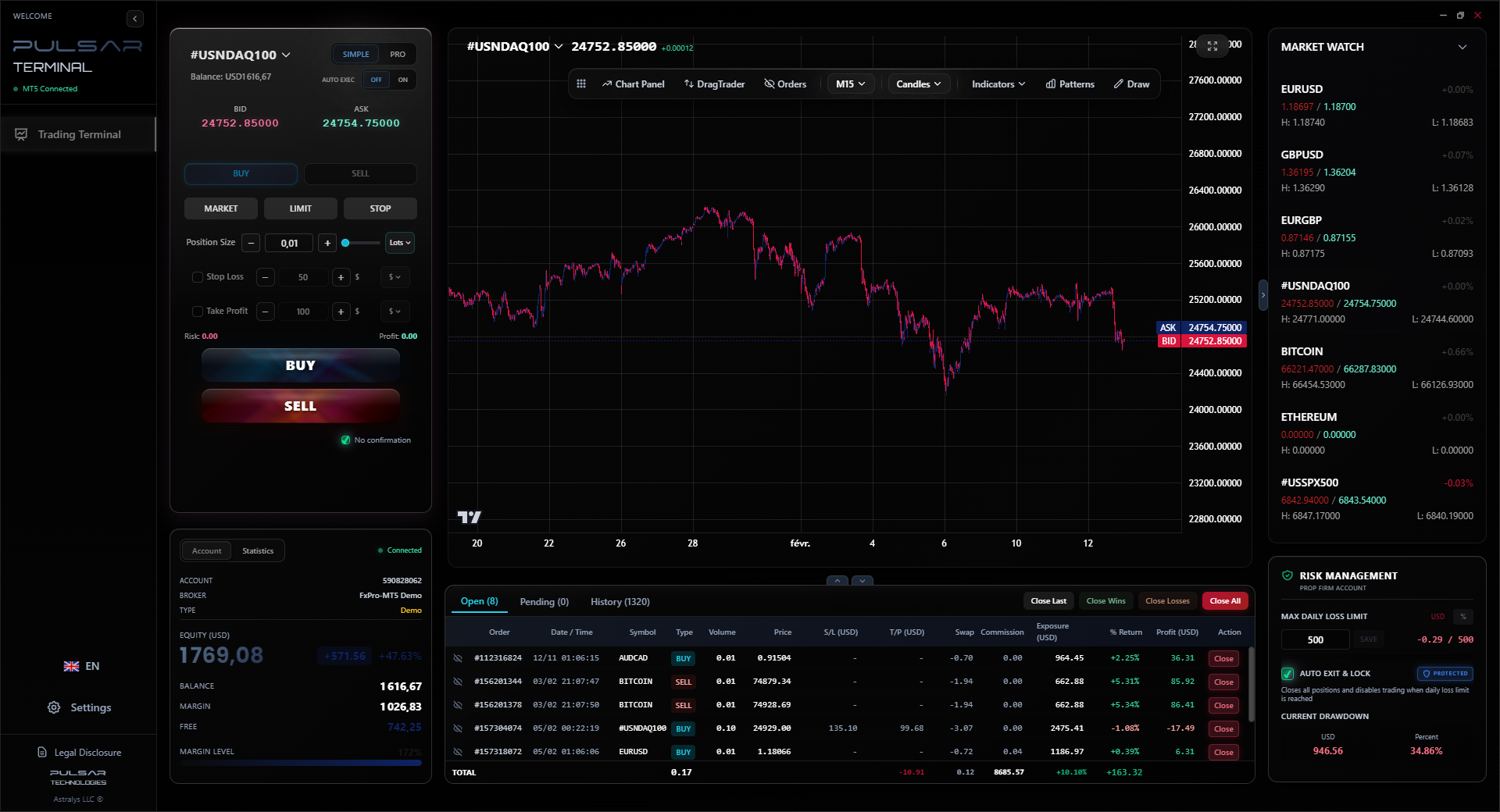
Managing complex trades and strict prop firm rules is exhausting manually, which is why tools like Pulsar Terminal automate partial closes, breakeven moves, and daily loss limits directly on your MT5 charts.
Pulsar Terminal
The all-in-one MT5 companion: drag-and-drop orders, multi-TP/SL, trailing stop, grid trading, Volume Profile, and prop firm protection. Used by 1,000+ traders daily.
Knowing where not to trade is more important. The landscape is littered with predators.
- The Bucket Shop: This is an unregulated 'broker' that doesn't send your trades to the real market. They take the other side of your trade. When you lose, they win. Your winning trades are a direct loss to them, which is why withdrawals suddenly become 'problematic'. If their platform looks like it was made in 2005 and their client support is a WhatsApp number, run.
- The Instagram Signal Seller / 'Mentor': The guy with pictures of cars and watches, selling 'premium signals' for R2000/month. He's not a trader. He's a marketer. Even if the signals are sometimes right (a broken clock is right twice a day), you'll never learn to trade. You're renting dependency.
- The 'Guaranteed' ROI Scheme: Anybody guaranteeing you monthly returns (e.g., '20% per month guaranteed') is running a Ponzi scheme. Full stop. They use new deposits to pay 'profits' to earlier clients. It collapses. Every. Single. Time.
Warning: If you are ever asked to deposit cryptocurrency directly to a private wallet for 'faster processing' by a broker you don't know intimately, you are about to be robbed. That money is gone the second you hit send. Only deposit to verified, official company bank accounts or through regulated payment processors.
💡 Winston's Tip
If you can't easily calculate your exact cost (spread + commission in Rands) before you click 'buy', you're not ready to trade live.
“Knowing where not to trade is more important than finding the perfect broker.”
Stop overthinking. Follow this sequence.
- Define Your Profile: Are you a swing trader holding for days? A scalper? Your style dictates the broker you need (low spreads for scalping, swap rates matter for swing).
- Shortlist 3 Brokers: Pick one top FSCA-regulated local broker, one major international with an FSCA license (like IC Markets or Pepperstone), and one prop firm if you're curious. Research them on our site.
- Open Demo Accounts: Not for a day. For a month. Trade your actual strategy on all three. Test execution during London open (3pm SAST). Test their mobile app. Pretend to withdraw.
- Do the Minimum Deposit Test: As outlined earlier. Deposit the minimum, withdraw it. This is your due diligence fee.
- Fund Your Choice & Start Small: Once you choose, fund your live account with an amount you can afford to lose 100% of. Your first goal is not to make profit, but to survive 100 trades without blowing up. Use a strict 1% risk rule and a position size calculator on every single trade.
The question 'where can I trade forex' has a simple answer: with a reputable, well-regulated entity that suits your trading style. The hard part is doing the boring work to verify that reputation before you send them your money.
FAQ
Q1Is Forex trading legal in South Africa?
Yes, absolutely. Trading forex through an FSCA-licensed Financial Services Provider (FSP) is completely legal. The illegality comes from unlicensed entities offering banking or investment services, or from individuals running Ponzi schemes disguised as forex trading.
Q2Can I use international brokers like IG or Forex.com?
Many large international brokers actively accept South African clients and some, like IG, have local offices. However, you must check which regulatory entity (FSCA, ASIC, FCA) is covering your specific account. Be prepared for currency conversion fees on deposits and withdrawals to/from your South African bank account.
Q3What is the minimum amount I need to start trading forex?
Technically, you can start with as little as $10 or R200 with some brokers offering micro accounts. Practically, I tell my students not to go live with less than R5000. Why? Because with proper risk management (e.g., risking 1% per trade), a R200 account means your position sizes are so tiny that spreads and commissions will eat you alive, and you can't psychologically engage with the process.
Q4Are prop firms a better option than using my own money?
Not 'better,' just different. They are excellent for skilled traders with limited capital who can operate within strict rules. They are terrible for beginners who will likely fail the challenges repeatedly, turning fee payments into expensive lessons. Use your own money first to learn the basics of the market, then consider prop firms to scale.
Q5How do I know if a broker is FSCA regulated?
Go directly to the FSCA's official website (www.fsca.co.za) and use their 'Search for an authorised Financial Services Provider (FSP)' tool. Don't trust a logo on the broker's site. Get the FSP number and verify it yourself. A legitimate broker will proudly display their FSP number.
Q6What is the safest way to deposit and withdraw funds?
For FSCA-regulated brokers, a direct EFT (Electronic Funds Transfer) from your South African bank account to the broker's nominated South African bank account is the safest and usually cheapest. For international brokers, regulated methods like bank wire transfers or reputable international payment processors (like Neteller, Skrill) are standard. Avoid direct crypto transfers to private wallets.
Q7I lost money with an unregulated broker. Can I get it back?
Honestly? Probably not. If the entity is based offshore with no local presence, the FSCA has no jurisdiction, and pursuing legal action in a foreign country is prohibitively expensive. This is the core risk of using unregulated brokers. Your money is effectively gone. Report it to the FSCA's scams unit to help warn others, but manage your expectations.
Prof. Winston's Lesson
Key Takeaways:
- ✓Always verify FSP numbers on the FSCA website yourself.
- ✓The minimum deposit withdrawal test is non-negotiable due diligence.
- ✓Your true cost is Spread + Commission + Bank FX Fees.
- ✓If they guarantee returns, it's a scam. Every time.
How useful was this article?
Click a star to rate
Weekly Trading Insights
Free weekly analysis & strategies. No spam.
About the Author
David van der Merwe
Emerging Markets Trader
Johannesburg-based trader with 11 years in emerging market currencies. Specializes in ZAR pairs, FSCA-regulated trading, and South African market analysis.
Comments
Risk Disclaimer
Trading financial instruments carries significant risk and may not be suitable for all investors. Past performance does not guarantee future results. This content is for educational purposes only and should not be considered investment advice. Always conduct your own research before trading.
You Might Also Like

Cara Trading Forex Sukses: 7 Prinsip dari Trader Profesional
Cara trading forex sukses dengan 7 prinsip trader pro: manajemen modal, disiplin, journal trading, backtest. Data nyata, bukan janji profit palsu.
Jam Trading Forex Terbaik untuk Trader Indonesia: Panduan Lengkap dengan Tabel Waktu
Panduan jam trading forex untuk trader Indonesia. Tabel 4 sesi dunia, jam emas 20:00-00:00, sesi mana yang harus dihindari. Data akurat + tips dari trader berpengalaman.
Top 5 Sàn Forex Uy Tín Nhất 2026: Review Jujur dari Trader Indonesia
Top 5 sàn forex uy tín 2026 untuk trader Indonesia. Review jujur: spread, deposit, withdraw, dukungan lokal. Exness, XM, IC Markets & lebih.
Get Pulsar Terminal
All these calculators are built into Pulsar Terminal with real-time data from your MT5 account. One-click position sizing, automatic risk management, and instant calculations.
Get Pulsar Terminal