


Everyone wants to know which forex trading is the best.

David van der Merwe
Emerging Markets Trader ·  South Africa
☕ 10 min read
What you'll learn:
Everyone wants to know which forex trading is the best. The truth is, they're asking the wrong question. I spent years chasing the 'perfect' style, blowing accounts on strategies that worked for others but not for me. The best forex trading isn't a specific method, it's the one that fits your life, your psychology, and the South African regulatory reality. Let me save you some pain and show you how to find yours.
Before we talk about strategies, we need to talk about rules. Trading here isn't the wild west. The Financial Sector Conduct Authority (FSCA) is the main watchdog, and they've put some serious guardrails in place since 2021. The big one? use is capped at 30:1 for retail traders. That might sound low if you've seen international ads promising 500:1, but trust me, it's a blessing in disguise. It forces you to use proper position size calculator and stops you from blowing up your account in one bad trade.
There's another quirk you need to know. As a South African resident, you're generally not allowed to speculate directly against the Rand. This means pairs like EUR/ZAR or USD/ZAR are often off-limits for pure speculation through most brokers. Your focus will be on the major and minor pairs like EUR/USD or GBP/JPY. Also, moving money involves Authorized Dealers (your bank) and those pesky exchange control regulations. I learned this the hard way when a R15,000 withdrawal got held up for days, costing me a planned trade entry.

Warning: Trading with an unregulated international broker might offer higher use, but the FSCA can't help you if something goes wrong. Your funds aren't as protected. I've seen too many stories of 'vanishing' brokers.
And then there's SARS. Yes, your net trading profits are considered income. Keep a detailed log of every trade. I use a simple spreadsheet: date, instrument, profit/loss. When tax season comes, it's a lifesaver.
“The best forex trading isn't a specific method, it's the one that fits your life, your psychology, and the South African regulatory reality.”
Let's cut through the marketing. Your broker is your business partner, and their costs eat directly into your profits. In South Africa, you have a solid mix of FSCA-regulated brokers and international ones that accept ZAR accounts.
The Spread Game
The spread is your most consistent cost. For a pair like EUR/USD, you'll see two main models. A 'commission-free' account with a wider spread (e.g., 0.6 pips on XM), or a 'raw spread' account with a tiny spread (often 0.0 pips) but a commission per lot. Which is better? It depends on your trade size.
Here’s a quick comparison from my own testing last quarter:
| Broker Type | EUR/USD Spread | Commission per Std Lot | Cost on a 1 Lot Trade |
|---|---|---|---|
| Commission-Free | 0.9 pips | $0 | $9.00 |
| Raw/ECN | 0.1 pips | $7 | $7.10 |
For larger volume, the raw account wins. For smaller, occasional trades, the commission-free might be simpler. Check out our deep dives on Exness review and IC Markets review for specifics on their South African offerings.
The Hidden Fees That Hurt
This is where I got burned early on.
- Inactivity Fees: Some brokers charge if you don't trade for 30 days. One broker hit me with a $10 fee during a month I was on a beach holiday, just watching the markets.
- Withdrawal Fees: Your broker might charge $25. Then your South African bank charges for the international payment. FNB can take R250-R500 for an outgoing payment. Always factor this in.
- Currency Conversion: If your account is in ZAR but you trade USD pairs, a conversion fee applies (often ~1.2%). It's small per trade, but it adds up over a year.

Pro Tip: When comparing brokers, don't just look at the minimum deposit ($5 at XM, $0 at Fusion Markets). Look at the total cost of trading for your typical trade size. A cheap entry fee means nothing if the spreads are choking you.

💡 Winston's Tip
Your first R10,000 in the market is tuition, not investment. Focus on learning, not earning.
“I had charts so cluttered with indicators they looked like a rainbow spaghetti explosion. All it did was confuse me.”
This is the heart of the question: which forex trading is the best? Is it the fast-paced world of scalping or the patient game of swing trading? I've done both, and my account statements tell the story.
Scalping: I tried this in my second year. The idea was sexy: grab 5-10 pips, multiple times a day. I used a tight scalping strategy on EUR/USD during the London open. The reality? I was a nervous wreck. I needed a broker with ultra-low spreads (every pip counted), lightning execution, and I had to sit glued to the screen for hours. In one month, I made 47 trades. My net profit was $212. After spreads and commissions, it was about $4.50 an hour for incredibly high-stress work. One missed news event wiped out three days of profits. It didn't fit my life.
Swing Trading: This is where I found my groove. Swing trading meant analysing the daily charts, placing a trade, and managing it over days or weeks. I wasn't fighting for single-digit pips. I was aiming for 100-200 pip moves on instruments like XAU/USD guide. The psychology was different. I could have a day job. I remember a great GBP/JPY short I held for 8 days. Entry at 156.20, exit at 154.85. That was 135 pips, or about $1,080 on my position size. The key was letting the trade breathe, using wider stops, and not micromanaging every wiggle.
The best style is the one you can execute consistently without burning out. For me, that was swing trading. For you, it might be different.
“I had charts so cluttered with indicators they looked like a rainbow spaghetti explosion. All it did was confuse me.”
I used to have charts so cluttered with indicators they looked like a rainbow spaghetti explosion. I had moving averages, Bollinger Bands, Stochastics, you name it. I was looking for a magic confirmation signal. All it did was confuse me and cause paralysis.
Professor Winston, my old mentor, drilled this into me: "Price is king. Everything else is a derivative." I stripped it back to two, maybe three tools.
- Support & Resistance: Plain old horizontal lines. Where has price reversed before? That's your map. Nothing fancy.
- RSI indicator: My go-to for spotting potential overbought or oversold conditions on the higher timeframes (4H or Daily). I use it as a context tool, not a direct signal. An RSI above 70 on the daily chart tells me a long trend might be tired, not that I should immediately short.
- MACD indicator: I use the histogram for momentum shifts. Is the momentum behind a move increasing or decreasing? The crossover is a lagging signal, but the histogram change can give an early hint.
Here's the lesson: Master one or two indicators inside out. Know their flaws. The RSI indicator can stay overbought in a strong trend for ages. If you try to short every time it hits 70, you'll get run over. I did. More than once.
💡 Winston's Tip
If you can't explain your trade setup in one simple sentence, you don't understand it well enough to risk money on it.
“Your first goal isn't profit, it's to execute your plan under real emotional pressure.”
You can have the best strategy in the world, but if your head isn't right, you'll lose. This is the unsexy truth about which forex trading is the best. The best trading is the one you can stick to emotionally.
My biggest demon was revenge trading. In 2020, I took a nasty 80-pip loss on a USD/CAD trade. I was furious at the market. Instead of shutting down, I jumped right back in with double the size, trying to win it all back immediately. I was emotional, not analytical. That second trade lost another 120 pips. In under an hour, I'd blown through my daily loss limit and then some. It was a classic margin call in the making. I had to walk away for two full days.
Now, I have two non-negotiable rules:
- The Daily Loss Limit: I risk 1.5% of my account per trade. If I lose three trades in a day (a 4.5% drawdown), I'm done. Computer off. No arguing.
- The Weekend Review: Every Sunday evening, I review my trades from the past week. Not for profit, but for process. Did I follow my plan? Where did my emotion creep in? This 30-minute habit has improved my consistency more than any indicator.
The market doesn't care about your ego, your bills, or your desire to be right. The moment you start fighting it, you've already lost.
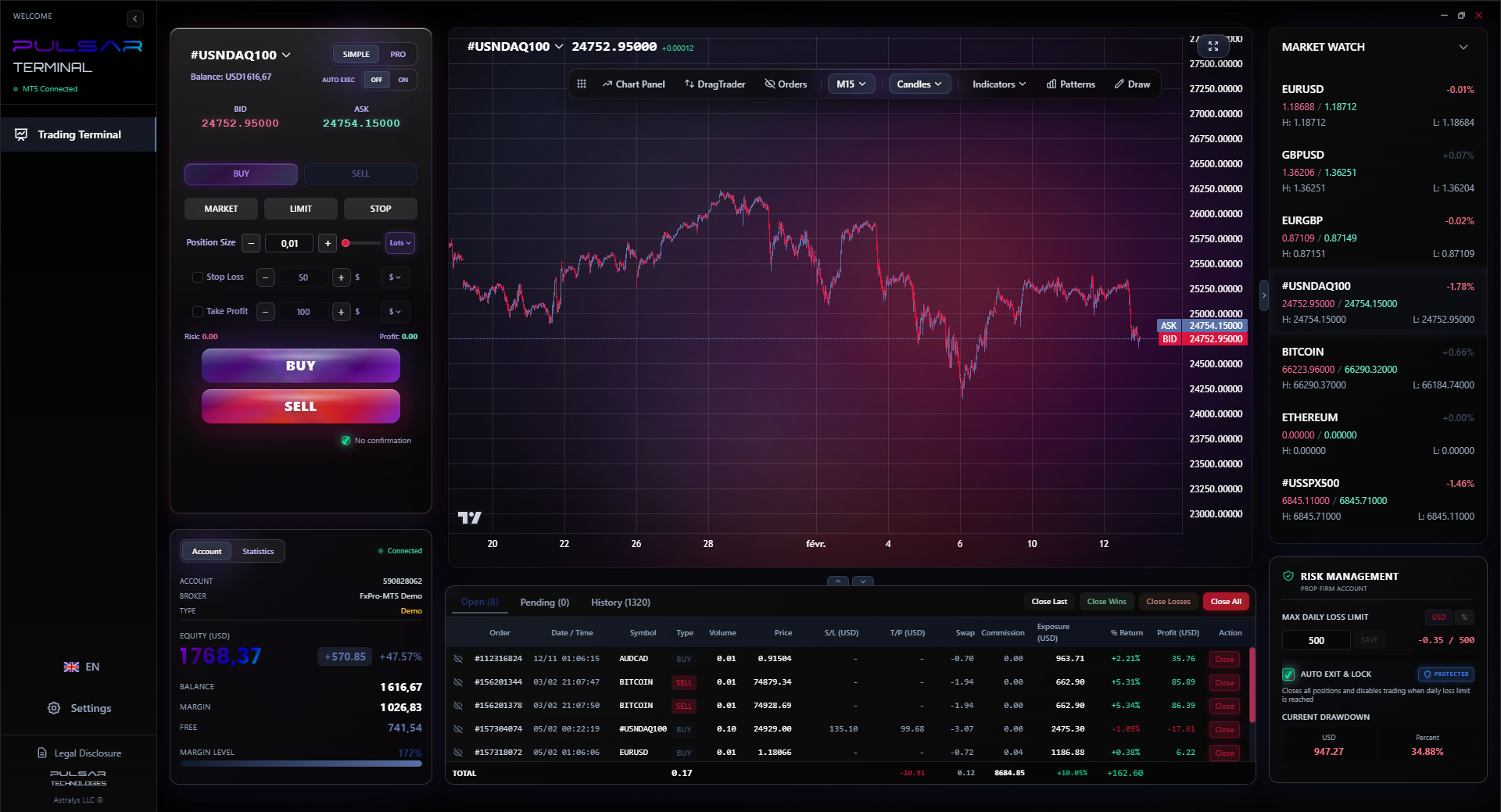
Managing the psychology of multiple trades is easier when your trade management tools are automated, letting you focus on analysis instead of mouse clicks.
Pulsar Terminal
The all-in-one MT5 companion: drag-and-drop orders, multi-TP/SL, trailing stop, grid trading, Volume Profile, and prop firm protection. Used by 1,000+ traders daily.
“Your first goal isn't profit, it's to execute your plan under real emotional pressure.”
So, let's build a practical framework to answer which forex trading is the best for you.
Step 1: Audit Your Life. How much time do you really have? If you have a 9-5 job, scalping is probably a terrible fit. Swing or position trading on higher timeframes is your friend.
Step 2: Pick Your Battleground. Don't trade 28 pairs. Pick 2-3 major pairs and learn their personality. I focus on EUR/USD and GBP/USD. I know how they react to news, their average daily range. Check our EUR/USD guide to see what that deep dive looks like.
Step 3: Choose a Broker Wisely. For a South African swing trader:
- FSCA regulation is a big plus for peace of mind.
- Look for a broker with reliable execution and reasonable spreads on your chosen pairs. A raw spread account might be worth it if your positions are sizable.
- Check their deposit/withdrawal process for ZAR. How long does it take? What are the total fees? Reviews for Pepperstone review and XM review often cover this from a local perspective.
Step 4: Start Small & Journal Everything. Use a demo account to test your strategy for at least 2-3 months. Then, go live with the smallest possible amount. Your first goal isn't profit, it's to execute your plan under real emotional pressure. Log every trade: entry, exit, why you took it, how you felt.

Example: My first profitable month live wasn't about the money. It was because I followed my rules on 19 out of 20 trades. The one I broke, I lost. The lesson was cemented.
💡 Winston's Tip
The market's job is to find the price where you will be most wrong. Your job is to have a plan for when that happens.
“The 30:1 FSCA use limit isn't a restriction, it's a seatbelt.”
Let me save you some classic South African trader mistakes.
- Chasing High use Offshore: Yes, an offshore broker might offer 500:1. That's a quick way to turn a R5,000 account into R0 or R25,000 very fast. The 30:1 FSCA limit is there for a reason. Use it.
- Ignoring Tax Implications: SARS will find you. Set aside a percentage of your profits for tax from day one. Don't get a nasty surprise.
- Trading Around SARB Announcements: The South African Reserve Bank's interest rate decisions can cause wild, unpredictable swings in ZAR pairs. Unless you're an expert, it's often wise to be flat or have very wide stops during these events.
- Overcomplicating Withdrawal: Remember, you need to use an Authorized Dealer (your bank) to get money back home. Factor in the time (a few business days) and the fees. Don't plan on withdrawing money to cover an urgent bill the same day.
- Believing the 'Get Rich Quick' Hype: The stats are brutal. With many brokers, 73-89% of retail accounts lose money. You're not trading against a machine, you're trading against other people, many of whom are professionals with better tools, information, and psychology. Your edge is your discipline, not a secret indicator.
FAQ
Q1Is forex trading legal and safe in South Africa?
Yes, it's legal. It's safest with an FSCA-regulated broker, as they must segregate client funds and adhere to strict conduct rules. Trading with unregulated international brokers is possible but riskier, as you have little local recourse if things go wrong.
Q2What is the maximum use I can use in South Africa?
For retail traders, the FSCA caps use at 30:1. This applies to brokers regulated by them. Some offshore brokers may offer higher use to South African clients, but using it significantly increases your risk of a rapid margin call.
Q3How are my forex trading profits taxed?
The South African Revenue Service (SARS) views net profits from forex trading as income. You must declare it in your annual tax return. Keep detailed records of all trades, including losses, which can offset profits.
Q4Can I trade USD/ZAR as a South African resident?
Generally, no. Exchange control regulations typically prohibit residents from speculating directly against the South African Rand (ZAR) through forex brokers. Your trading will focus on international pairs like EUR/USD, GBP/USD, or gold (XAU/USD).
Q5What's a realistic starting amount for forex trading in SA?
You can start with as little as $5 or $10 with some brokers. However, a more realistic amount that allows for proper risk management is R5,000 - R10,000. This lets you trade sensible position size calculator positions and absorb a few losses without blowing your account.
Q6Which is better for beginners: scalping or swing trading?
For most beginners, swing trading is far more suitable. It operates on longer timeframes (like 4-hour or daily charts), is less stressful, doesn't require you to stare at screens all day, and gives you more time to make decisions. Scalping strategy is fast, expensive due to spread definition costs, and emotionally intense.
Prof. Winston's Lesson
Key Takeaways:
- ✓use is a tool, not a weapon. 30:1 is enough.
- ✓Master one pair before you touch ten.
- ✓Journal your emotions, not just your P&L.
- ✓The spread is a silent tax. Know your costs.
- ✓A stopped-out trade is a good trade. It means your plan worked.
How useful was this article?
Click a star to rate
Weekly Trading Insights
Free weekly analysis & strategies. No spam.
About the Author
David van der Merwe
Emerging Markets Trader
Johannesburg-based trader with 11 years in emerging market currencies. Specializes in ZAR pairs, FSCA-regulated trading, and South African market analysis.
Comments
Risk Disclaimer
Trading financial instruments carries significant risk and may not be suitable for all investors. Past performance does not guarantee future results. This content is for educational purposes only and should not be considered investment advice. Always conduct your own research before trading.
You Might Also Like

Cara Trading Forex Sukses: 7 Prinsip dari Trader Profesional
Cara trading forex sukses dengan 7 prinsip trader pro: manajemen modal, disiplin, journal trading, backtest. Data nyata, bukan janji profit palsu.
Jam Trading Forex Terbaik untuk Trader Indonesia: Panduan Lengkap dengan Tabel Waktu
Panduan jam trading forex untuk trader Indonesia. Tabel 4 sesi dunia, jam emas 20:00-00:00, sesi mana yang harus dihindari. Data akurat + tips dari trader berpengalaman.
Top 5 Sàn Forex Uy Tín Nhất 2026: Review Jujur dari Trader Indonesia
Top 5 sàn forex uy tín 2026 untuk trader Indonesia. Review jujur: spread, deposit, withdraw, dukungan lokal. Exness, XM, IC Markets & lebih.
Get Pulsar Terminal
All these calculators are built into Pulsar Terminal with real-time data from your MT5 account. One-click position sizing, automatic risk management, and instant calculations.
Get Pulsar Terminal