


I was staring at my screen in late 2024, watching the Naira absolutely tank against the dollar.

Olumide Adeyemi
West African Trading Pioneer ·  Nigeria
☕ 12 min read
What you'll learn:
- 1The Basic Role: Your Gateway to the Interbank Market
- 2How Brokers Make Money (From You)
- 3The Nigerian Regulatory Landscape: Mind the Gap
- 4Choosing a Broker in Nigeria: The Key Factors
- 5Deposits, Withdrawals, and the Naira Reality
- 6Red Flags and Common Scams (Protect Your Money)
- 7My Personal Broker Journey: Lessons Learned the Hard Way
I was staring at my screen in late 2024, watching the Naira absolutely tank against the dollar. It had gone from around N400 to pushing N1700. My broker's platform was flickering with volatility, spreads were widening, and I was trying to get a short position on USD/NGN. That's when you really find out who your broker is. Not the smiling face on their website, but the entity that either gets your order filled at a decent price or leaves you hanging with a 'requote' message while the market runs away. So, who is a broker in forex? For you in Nigeria, it's your gateway, your risk manager, and sometimes your biggest obstacle. Let's break it down, Naija style.
Think of the forex market as a massive, global party where the big banks (like Citi, JP Morgan) are the VIPs trading billions directly with each other. You and I aren't on that guest list. A forex broker is the guy who knows the bouncer. They act as an intermediary, pooling the trades of thousands of retail traders like us to get access to those interbank prices.
Their main job is to provide a transaction platform - usually MT4, MT5, or their own software - where you can buy and sell currencies. They don't set the prices; they stream them from multiple liquidity providers (those big banks). Their profit comes from the difference between the buy and sell price (the spread) or by charging you a commission on each trade.
But here's the critical part for us in Nigeria: because our local regulatory scene for retail forex is, let's say, 'developing,' this intermediary role is even more crucial. A good international broker is your lifeline to a stable, regulated trading environment that you might not get locally. They also provide the use that lets you control large positions with a small deposit, which is a double-edged sword I've cut myself on more than once.

Warning: The broker is not your friend or your financial advisor. They are a service provider. Their business model often relies on you trading actively. Never take 'signals' or 'sure bets' from your broker's 'account manager' at face value. That's a conflict of interest waiting to happen.
“A forex broker is the guy who knows the bouncer to the interbank party.”
Understanding this is non-negotiable. If you don't know how they profit, you can't spot when a deal is too good to be true. There are three main models, and your costs change with each.
The Spread Markup
This is the most common. The broker adds a few extra pips on top of the raw interbank spread. If the real EUR/USD spread is 0.1 pips, they might quote you 0.9 pips. That 0.8 pip difference is their fee. It's built into every trade. Brokers like XM or Exness often use this model on their standard accounts. It's simple but can get expensive if you're a high-volume scalping strategy trader.
Commission + Raw Spread
Here, you get the raw, tight interbank spread (sometimes even 0.0 pips), but you pay a fixed commission per lot traded. This is popular with ECN/Pro accounts. For example, a broker might charge $3.50 per side per 100k lot. If you trade one standard lot (100k units), you pay $7 round turn. This is often cheaper for active traders. I switched to this model years ago on IC Markets and saved a bundle on my frequent EUR/USD trades.
The Dealing Desk (Market Maker) Model
This is the controversial one. The broker acts as the counterparty to your trade. If you buy, they sell to you. They may hedge your trade in the real market, or they might take the other side, betting you'll lose. This creates a potential conflict. They might profit from your loss. While not all market makers are bad, it's a structure that requires extreme scrutiny. Many of the 'unlimited use' offers come from this model.

Example: Let's say you trade 1 standard lot (100,000 units) of EUR/USD.
- Spread-Only Account: Spread is 1.2 pips. Cost = 1.2 pips * $10 per pip = $12.
- Commission Account: Spread is 0.1 pips. Commission is $7 round turn. Cost = (0.1 pips * $10) + $7 = $8. For active trading, the commission account wins. Always use a position size calculator to factor in these costs before you enter.

💡 Winston's Tip
Your broker's reliability is tested during news events and withdrawals. If they fail either, find a new one.
“High use isn't a benefit; it's a risk amplifier dressed as an opportunity.”
This is where it gets real for us. Forex trading is legal in Nigeria. Full stop. But the protection you get as a retail trader is patchy.
The Central Bank of Nigeria (CBN) runs the show for the big picture. They manage the Naira, hold reserves (which hit over $48.5 billion in early 2026, a good sign), and set rules for banks and Bureau de Change (BDCs). Remember, BDCs can only buy $150k weekly and must sell it within 24 hours - that's to stop speculation that hurts the Naira.
The Securities and Exchange Commission (SEC) is who you'd hope regulates your broker. But right now, they don't license or oversee local retail spot forex brokers. That's a massive gap. It means if you sign up with a 'Lagos-based forex firm' and they vanish with your money, you have very few official recourses.
This regulatory vacuum is precisely why savvy Nigerian traders look offshore. We use brokers regulated by top-tier international bodies like the UK's FCA, Australia's ASIC, or Cyprus's CySEC. These regulators have strict rules on client fund segregation (your money is kept separate from the broker's operating funds) and dispute resolution. I learned this the hard way early on with a shady local platform that 'had technical issues' every time I tried to withdraw profits.
The recent CBN FX Code (effective Dec 2024) is a step forward for the wholesale market, aiming for transparency. But for the retail trader on MT5, your primary protection is still your broker's international license. Always verify it on the regulator's official website, not just the broker's.
“High use isn't a benefit; it's a risk amplifier dressed as an opportunity.”
Forget the flashy ads with cars and beaches. Here’s your practical checklist, born from 12 years of wins and painful losses.
1. Regulation (The Non-Negotiable): This is your safety net. Prioritize brokers holding licenses from FCA, ASIC, CySEC, or FSCA (South Africa). Many top brokers like Pepperstone or AvaTrade hold these. Even if you open an account under their global entity (not the EU one), the parent company's reputation is on the line. I trust my capital with IC Markets because their ASIC oversight is solid.
2. Deposits & Withdrawals in Naira: Can you fund your account directly in Naira without getting killed by bank FX charges? Many brokers now offer Naira accounts or partner with local payment processors. Look for options like bank transfer, Verve/Mastercard, and e-wallets like Paga or Opay. The best brokers process withdrawals within 24 hours. Test this with a small amount first.
3. Trading Costs: Compare spreads on the pairs you'll actually trade. Don't just look at EUR/USD. Check USD/NGN, GBP/NGN, and Gold (XAU/USD). See our XAU/USD guide for why gold is popular here. Also, check swap rates (overnight financing costs) if you hold trades for days, which is common in swing trading.
4. use Offered: International regulators cap use for retail clients (e.g., 1:30 in EU). Brokers targeting Nigeria often offer much higher use (1:500, 1:1000, even 1:2000). This is not a benefit; it's a risk amplifier. I blew a $2,000 account in 2015 using 1:500 use on a single USD/JPY trade that went 40 pips against me. Start low. Use a position size calculator religiously.
5. Platform & Tools: MT4/MT5 is standard. But does the broker offer good mobile apps? Reliable VPS for automated trading? These matter. Also, check if they allow tools like Pulsar Terminal or TradingView integration for better analysis.
6. Customer Support: Can you get them on live chat or phone? Do they understand Nigerian payment issues? Try them before you deposit.
Here’s a quick comparison based on common Nigerian needs:
| Feature | Priority for New Trader | Priority for Active Trader | My Note |
|---|---|---|---|
| Min. Deposit | High (Look for $0-$50) | Low | Start small. FBS offers $1, XM $5. |
| Naira Payments | Very High | Very High | Saves on bank FX fees. HFM offers NGN accounts. |
| Spreads on Majors | Medium | Very High | Active traders need tight spreads. Check Pepperstone raw accounts. |
| use | Low (Use <1:100) | Medium | High use is a trap for the inexperienced. |
| Regulation | Very High | Very High | The bedrock of safety. Never compromise. |
💡 Winston's Tip
The 'spread' is the first tax you pay on every trade. Know it, calculate it, and hunt for the lowest on your most-traded pairs.
“The cost of a broker isn't just the spread. It's the security of your capital and your sanity.”
Funding your account is where theory meets the messy reality of Nigeria's financial system. You've made 500 pips on a Gold trade, now you want your profit. This is the moment of truth.
The Traditional Headache: Using your local bank card for an international broker often means your Naira gets converted to USD at your bank's terrible rate, plus you pay an international transaction fee (3-5%). For a $1000 deposit, you could lose N50,000 or more just in hidden fees. Withdrawals? Same story in reverse, and they can take 5-7 business days.
The Smarter Ways:
- Broker Naira Accounts: Some brokers now hold Naira directly. You transfer NGN to a local Nigerian account they specify, they credit your trading account with the USD equivalent at a fair rate. This is a game-saver. Withdrawals work the same way.
- E-Wallets: Using Skrill, Neteller, or even cryptocurrency (like USDT) as a middleman can be faster and sometimes cheaper. You fund the e-wallet, then transfer to the broker. It adds a step but can bypass bank restrictions.
- Local Processors: Some brokers integrate Paystack or Interswitch. This is seamless.
The Tax Man Cometh: Remember, the Nigerian government wants its share. You are liable for a 10% Capital Gains Tax on your trading profits. It's your responsibility to declare this. I keep a detailed trade journal partly for this reason. A big win feels great until you haven't set aside the tax.

Pro Tip: Before you deposit a large amount, do a test withdrawal. Deposit $50, trade it (or just leave it), then request a withdrawal back to your method. This tests the broker's withdrawal process, speed, and the actual final amount that lands in your pocket. It's the best $50 you'll ever spend on due diligence.
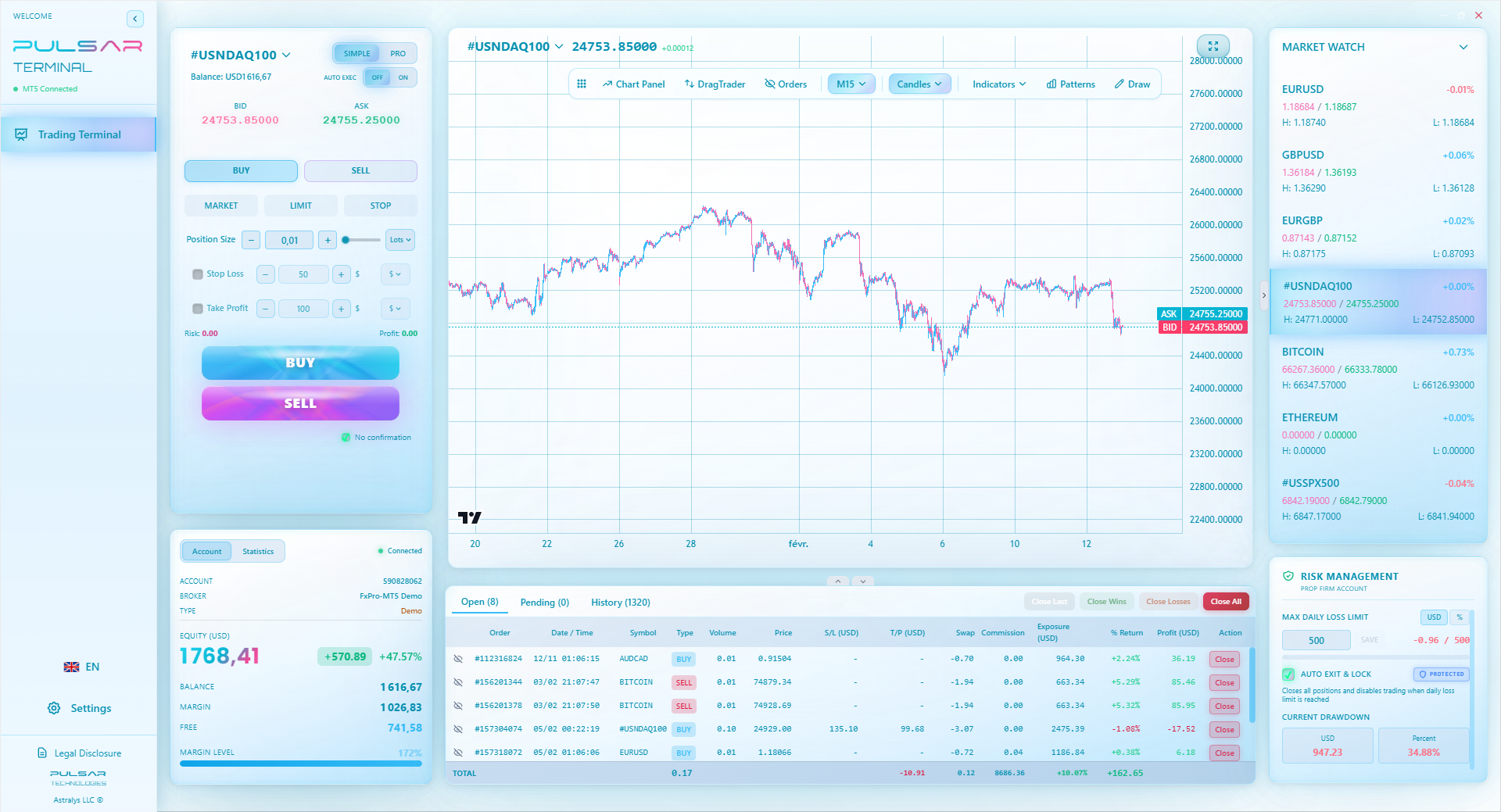
Managing complex trades and risk is half the battle with your broker, which is why tools like Pulsar Terminal that offer drag-and-drop orders, multi-TP/SL, and auto-breakeven directly on MT5 are so valuable.
Pulsar Terminal
The all-in-one MT5 companion: drag-and-drop orders, multi-TP/SL, trailing stop, grid trading, Volume Profile, and prop firm protection. Used by 1,000+ traders daily.
“The cost of a broker isn't just the spread. It's the security of your capital and your sanity.”
The lack of strong local regulation makes Nigeria a hunting ground for shady operators. Here’s what to run from:
- "Guaranteed" Profits or Daily ROI: Anyone promising you 20% monthly returns is running a Ponzi scheme. Full stop. I've seen friends lose millions of Naira to these. A broker facilitates trading; they don't guarantee outcomes.
- Unregulated "Local" Investment Hubs: That fancy office in VI offering forex 'investment packages' where you just send money and they 'trade for you.' Ask for their SEC license. They won't have one. Your money is gone.
- Sky-High use as a Main Selling Point: If a broker's main ad is "1:2000 use!" they are targeting greedy, inexperienced traders who will blow up accounts quickly. It's predatory.
- Difficulty Withdrawing: The first sign of a scam broker is excuses on withdrawals. 'Processing delay,' 'need to verify again,' 'pay a tax fee first.' Legit brokers like Exness or Vantage have clear, fast withdrawal processes.
- Copy Trading "Gurus" with Fake Track Records: Many broker platforms have copy trading. Be wary of leaders showing 1000% returns with tiny drawdowns. These are often manipulated or achieved with insane risk. They blow up eventually, and you blow up with them.
- Pressure to Deposit More: A 'personal account manager' calling you to deposit more to 'recover losses' or 'catch a sure opportunity' is a massive red flag. A real broker doesn't care if you trade $10 or $10,000. They execute your orders, that's it.
Your best defense is skepticism. Verify everything. Use our broker reviews (like our Exness review or IC Markets review) as a starting point, but always do your own final checks on the regulator's site.
💡 Winston's Tip
A flashy office in Lagos means less than a boring license number from the FCA. Trust the paperwork, not the paint.
“Do a test withdrawal before a large deposit. It's the best $50 you'll ever spend on due diligence.”
Let me get vulnerable. I didn't start with a top-tier broker. My first was an unregulated bucket shop I found online in 2012. The platform was clunky, but they offered 1:500 use and a $50 minimum. I turned $200 into $1,800 in two weeks scalping the EUR/USD. I felt like a genius. Then I tried to withdraw $500.
Radio silence for a week. Then an email asking for a 'verification fee' of $100. I paid it (stupid, I know). More silence. The platform then started freezing during volatile news events. My next big trade, a short on GBP/USD, spiked 30 pips against me in a second. Instead of my stop-loss at 20 pips triggering, I got a 'requote' and was filled 50 pips worse. Wiped out. That's when I learned what a margin call and a dishonest broker feel like together.
I switched to a properly regulated broker (with 1:100 use max). The difference was night and day. Orders were instant. Withdrawals hit my Skrill in 12 hours. The spreads were tighter. I wasn't fighting the platform anymore. My first big win on this legitimate setup was a long swing trade on USOIL. I bought at $42.50 in early 2016 based on a MACD indicator divergence and held for 6 weeks, exiting at $51.80. The profit was real, and the money landed in my account. That's the peace of mind a real broker provides.
The lesson? The cost of a broker isn't just the spread. It's the security of your capital, the fairness of execution, and your sanity. Don't cheap out on the most important relationship in your trading career.
FAQ
Q1Is forex trading legal in Nigeria?
Yes, forex trading is completely legal for individuals in Nigeria. However, the local regulation of the retail brokers you use is very limited. The CBN oversees the broader FX market, but the SEC does not currently license or regulate online spot forex brokers targeting Nigerian traders. This is why using internationally regulated brokers is the standard practice.
Q2What is the minimum amount to start forex trading in Nigeria?
You can start with very little. Many international brokers accept Nigerian clients with minimum deposits as low as $0 (e.g., XTB, Pepperstone), $1 (FBS), or $5 (InstaForex). However, you should start with an amount you are prepared to lose completely while you learn. A realistic starter amount for practice is between $50 and $200.
Q3How do I avoid forex scams in Nigeria?
Avoid any scheme promising guaranteed profits, offering outrageously high use as its main feature, or operating from a local office without verifiable international regulation. Never use an unregulated broker. Always verify the broker's license on the regulator's official website (e.g., FCA, ASIC). Stick to well-known, reviewed brokers with transparent Naira deposit/withdrawal methods.
Q4Do I pay tax on forex trading profits in Nigeria?
Yes. Nigerian forex traders are subject to a 10% Capital Gains Tax on gross profits. It is your responsibility to declare this income and pay the tax to the Federal Inland Revenue Service (FIRS). Keep detailed records of all your trades, deposits, and withdrawals for tax purposes.
Q5Can I use my Nigerian bank card to fund a forex account?
Yes, but it's often the most expensive way. Your bank will convert your Naira to USD at their own rate and likely charge an international transaction fee (3-5%). It's better to use brokers that offer direct Naira deposits into a local Nigerian bank account, or use e-wallets like Skrill or Neteller as an intermediary to get better rates and faster processing.
Q6What is the difference between a market maker and an ECN broker?
A market maker (dealing desk) may act as the counterparty to your trade, creating a potential conflict of interest. An ECN (Electronic Communication Network) broker directly matches your order with other participants in the market (banks, other traders). ECN brokers typically offer tighter spreads but charge a commission. For transparency, most experienced traders prefer the ECN model.
Q7Which forex broker is best for beginners in Nigeria?
There's no single 'best,' but a good beginner broker for Nigerians should have: 1) Strong international regulation, 2) A low minimum deposit ($0-$50), 3) The ability to deposit/withdraw in Naira easily, 4) A user-friendly platform like MT4 or MT5, and 5) Responsive customer support. Brokers like XM, Exness, and HFM are popular starting points due to their Naira support and educational resources, but always do your own due diligence first.
Prof. Winston's Lesson
Key Takeaways:
- ✓Regulation is your safety net, not a suggestion.
- ✓Test withdrawals prove a broker's integrity.
- ✓10% Capital Gains Tax applies to your profits.
- ✓Naira payment options save on hidden bank fees.
How useful was this article?
Click a star to rate
Weekly Trading Insights
Free weekly analysis & strategies. No spam.
About the Author
Olumide Adeyemi
West African Trading Pioneer
One of Nigeria's most active forex trading educators. 8 years of experience trading from Lagos. Specializes in low-capital strategies and prop firm challenges for African traders.
Comments
Risk Disclaimer
Trading financial instruments carries significant risk and may not be suitable for all investors. Past performance does not guarantee future results. This content is for educational purposes only and should not be considered investment advice. Always conduct your own research before trading.
You Might Also Like

Cara Trading Forex Sukses: 7 Prinsip dari Trader Profesional
Cara trading forex sukses dengan 7 prinsip trader pro: manajemen modal, disiplin, journal trading, backtest. Data nyata, bukan janji profit palsu.
Jam Trading Forex Terbaik untuk Trader Indonesia: Panduan Lengkap dengan Tabel Waktu
Panduan jam trading forex untuk trader Indonesia. Tabel 4 sesi dunia, jam emas 20:00-00:00, sesi mana yang harus dihindari. Data akurat + tips dari trader berpengalaman.
Top 5 Sàn Forex Uy Tín Nhất 2026: Review Jujur dari Trader Indonesia
Top 5 sàn forex uy tín 2026 untuk trader Indonesia. Review jujur: spread, deposit, withdraw, dukungan lokal. Exness, XM, IC Markets & lebih.
Get Pulsar Terminal
All these calculators are built into Pulsar Terminal with real-time data from your MT5 account. One-click position sizing, automatic risk management, and instant calculations.
Get Pulsar Terminal