


You've probably seen the ads: 'Trade from your couch and make millions!' So why is forex trading so difficult for most of us? The short answer is that it's designed to be.

David van der Merwe
Emerging Markets Trader ·  South Africa
☕ 11 min read
What you'll learn:
You've probably seen the ads: 'Trade from your couch and make millions!' So why is forex trading so difficult for most of us? The short answer is that it's designed to be. Between global banks, local regulations, and our own brains working against us, the odds are stacked high. I've been at this for over a decade, and I've lost more than I care to admit before figuring it out. Let's talk about what really makes it tough here in South Africa, beyond the usual 'manage your risk' platitudes.
Let's start with the cold, hard numbers. Globally, the failure rate for retail forex traders is often quoted at around 95%. In South Africa, a 2020 study found that 69% of forex-only traders admitted to losing money. That's not a coincidence; it's a feature of the market structure.
You're not just trading against other 'little guys'. Your counterparty is often a massive bank or liquidity provider with faster connections, better information, and algorithms you can't compete with. The spread - the difference between the buy and sell price - is your first immediate loss on every trade. On a major pair like EUR/USD, it might be small (0.0 to 1.3 pips), but on ZAR pairs, it's a killer. I've seen USD/ZAR spreads at 5 pips and EUR/ZAR at 14 pips. That means the price has to move significantly in your favor just for you to break even. It's like starting a 100m race 5 meters behind everyone else.

Warning: That 'professional' status some international brokers offer to bypass the FSCA's 30:1 use limit? It's a trap. You might get access to 1:500 use, but it also often means losing crucial regulatory protections, like segregated funds. I learned this the hard way with a broker that isn't around anymore.
Combine this with the psychological pressure, and you begin to see why is forex trading so difficult. It's a negative-sum game after costs. For every rand you make, someone else loses one, plus the brokers and banks take their cut. You need an edge that's statistically significant just to cover your costs, let alone generate profit. Most retail strategies, especially the ones sold on Instagram, don't have that edge.
“The spread is your first immediate loss on every trade. It's like starting a 100m race 5 meters behind everyone else.”
Trading legally in South Africa adds a unique layer of complexity. Our main watchdog is the Financial Sector Conduct Authority (FSCA). They're there to protect you, but their rules also limit how you can play the game.
The biggest rule? Retail use is capped at 30:1. After 2021, you can't legally get more from an FSCA-licensed broker. This is actually a good thing for beginners - it stops you from blowing up your account in seconds - but it feels restrictive if you're used to the wild west of offshore brokers offering 1:1000. It forces you to commit more capital per trade, which changes your entire risk calculus.
Another quirky SA rule: South African residents generally can't speculate directly against the Rand. You can't just short ZAR/USD for fun. You need a valid underlying transaction, like an import/export contract. This pushes most local traders towards major pairs (EUR/USD, GBP/USD) or CFDs on indices and commodities, which have their own dynamics to learn.
Then there's SARS. Yep, they want their share. Profits from trading are taxable as ordinary income. Even if you use an international broker like IC Markets or Pepperstone, you're obligated to declare that income. The flip side is you can deduct legitimate expenses - data subscriptions, trading course fees (be careful here), even a portion of your internet bill. Keeping careful records is a non-negotiable part of the job that many overlook until tax season hits.


💡 Winston's Tip
Your first R10,000 in the market is tuition, not investment. Expect to lose it while learning. If you can't afford to lose it, you can't afford to trade.
“Separating your self-worth from your P&L is the most important psychological skill you'll ever develop.”
This is where I've lost the most money. The charts are one thing, but the six inches between your ears is the real battlefield. Why is forex trading so difficult? Because it pits you against your own hardwired instincts.
The Fear & Greed Cycle
You see a trade moving in your favor. Greed whispers, 'Let it run, it'll go further!' You ignore your take-profit level. Then it reverses. Fear screams, 'It'll come back, just hold on!' You ignore your stop-loss. Before you know it, a small loss has become a margin call. I once turned a R500 profit on a GBP/USD scalping strategy into a R2,000 loss this exact way. I was up 10 pips, got greedy, watched it drop 30 pips against me, and froze.
Overconfidence After a Win
This is deadly. You have three good trades in a row. You start feeling invincible. You increase your position size without adjusting your risk. You take a fourth trade based on a 'gut feeling' that breaks all your rules. The market humbles you, fast. Profits from the first three trades vanish, plus some of your capital. Discipline isn't just for losing streaks; it's hardest to maintain when you're winning.
The Need to Be 'Right'
We tie our ego to our trades. Admitting a trade is wrong feels like personal failure. So we move stop-losses further away ('just giving it more room'), adding to a losing position (averaging down) to try and force the market to prove us right. This is the quickest path to a catastrophic loss. Separating your self-worth from your P&L is the most important psychological skill you'll ever develop.
Tools can help manage this. Using a position size calculator religiously removes emotion from deciding how much to risk. Setting a hard daily loss limit (and using software that enforces it) stops a bad day from becoming a ruinous one.
“Separating your self-worth from your P&L is the most important psychological skill you'll ever develop.”
Google 'forex strategy' and you'll find a million systems promising 90% win rates. They're mostly garbage. The difficulty comes in finding something that works for you, consistently, and then having the discipline to stick to it through losing periods.
Most beginner strategies are too simplistic. 'Buy when the RSI is under 30.' Okay, but in a strong downtrend, the RSI can stay under 30 for days while price keeps falling. I got chopped up for months trying to trade a simple MACD indicator crossover system in sideways markets. It would give false signal after false signal.
A strong strategy needs to account for:
- Market Context: Is the market trending or ranging? Your swing trading approach that works beautifully in a trend will lose money in a tight range.
- Time of Day: The London/New York overlap is volatile. The Asian session is often slow. Trading a news-based scalp during the Asian session is a recipe for boredom and small, pointless trades.
- Economic Events: Trading without an economic calendar is like driving blindfolded. I learned this by getting stopped out instantly when the SARB made an unexpected interest rate announcement. The news itself wasn't the problem; my being in the trade during the announcement was.
The real work isn't in finding a magical indicator. It's in backtesting and forward-testing a set of rules in different market conditions, understanding its win rate and risk-to-reward profile, and knowing it will have drawdowns. If a strategy claims to have no losing months, run away.
💡 Winston's Tip
The market doesn't care about your rent, your ego, or your analysis. It only cares about one thing: finding the next price where there are more buyers than sellers, or vice versa. Trade that, not your story.
“A well-executed trade that hits your stop-loss is a good trade. A poorly executed trade that luckily makes money is a bad trade.”
Let's talk about money. Not the money you hope to make, but the money you need to start and the money that quietly bleeds from your account.
Starting Capital: Yes, some brokers let you start with $5. But should you? Realistically, in South Africa, you need at least R1,000 to R4,000 to begin learning seriously. Why? Proper risk management. If you're only risking 1% per trade (a standard rule), a R500 account means risking R5 per trade. After spreads and potential slippage, that's not viable. You'll be tempted to risk 10% or 20% just to see a meaningful gain, which is a surefire way to blow up.
The True Cost of Trading:
| Cost Type | Typical Example | Impact on a R10,000 Account |
|---|---|---|
| Spread | 1.0 pip on EUR/USD | R10 cost to open/close a 0.1 lot trade |
| Commission | $7 per standard lot | ~R130 per full lot (round turn) |
| Swap/Overnight | Variable by pair & direction | Can eat profits on held positions |
| Currency Conversion | 0.5%-2% on ZAR deposits | R50-R200 on a R10,000 deposit |
These costs seem small individually, but for an active trader, they add up fast. If you're taking 20 trades a week and your strategy only aims for 5 pips of profit per trade, a 2-pip effective cost (spread + slippage) eats 40% of your potential profit before you even start.
This is why scalping with a high-frequency strategy is so tough for retail traders. The costs consume your edge. You often need a higher time frame swing trading approach where your profit target is 50-100 pips, making the 2-pip cost a much smaller percentage of the trade.

Example: You trade 0.1 lots of EUR/USD. Spread is 1.2 pips. That's a $1.20 (about R22) loss the moment you enter. Your take-profit is 10 pips away ($100 potential). The price needs to move 1.2 pips just for you to be at breakeven. You're already down 12% of your potential profit before the market moves a tick in your favor.
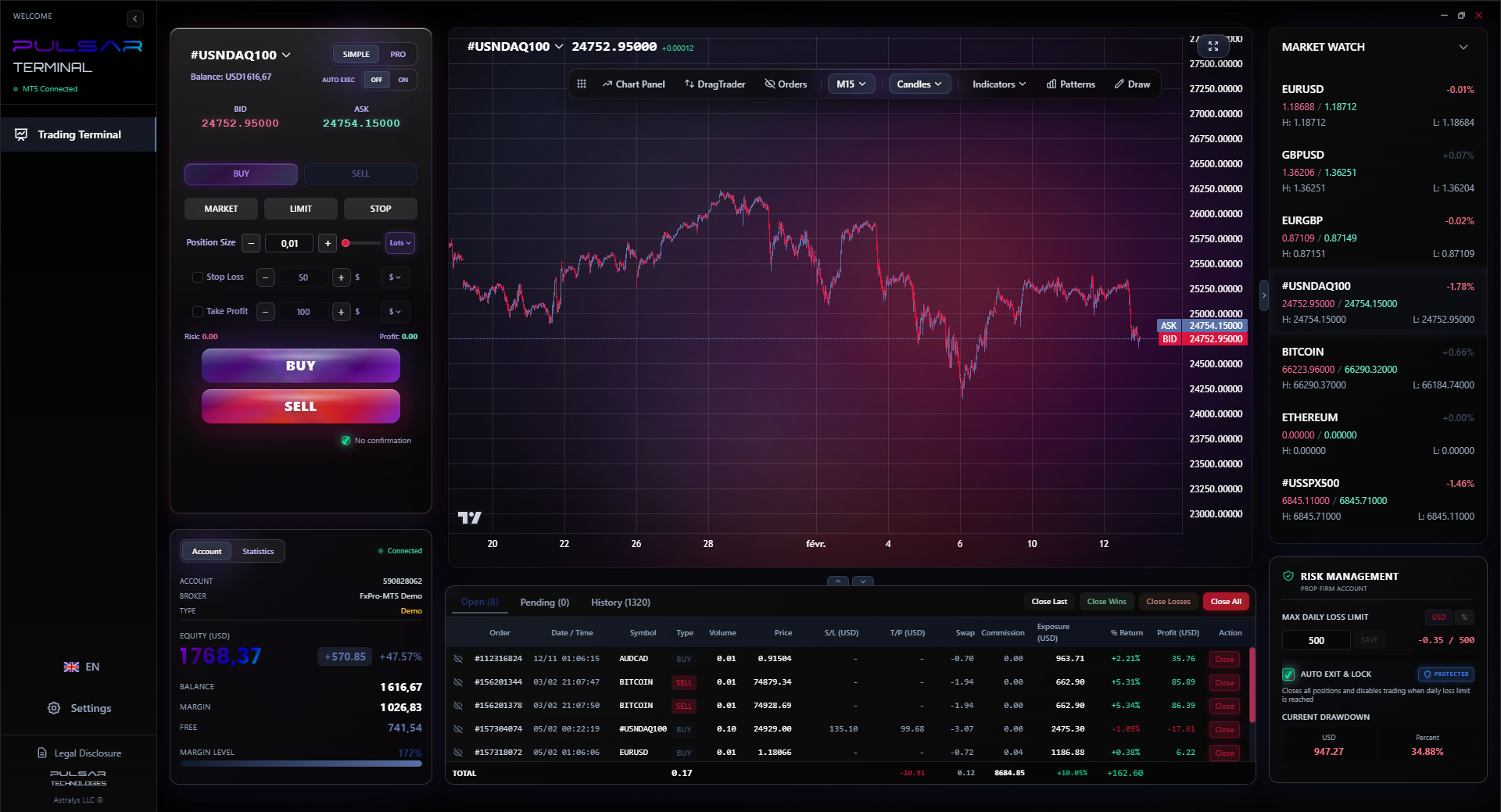
Managing the silent killers of cost and psychology is easier when your tools automate discipline, like setting hard daily loss limits directly on your MT5 platform.
Pulsar Terminal
The all-in-one MT5 companion: drag-and-drop orders, multi-TP/SL, trailing stop, grid trading, Volume Profile, and prop firm protection. Used by 1,000+ traders daily.
“A well-executed trade that hits your stop-loss is a good trade. A poorly executed trade that luckily makes money is a bad trade.”
The second biggest reason (after psychology) that traders fail is bad education. The space is polluted with 'gurus' selling dreams. You know the ones: pictures with Lamborghinis, claims of secret 'institutional' strategies.
I paid R8,000 for a 'mentorship' early in my career. The 'strategy' was just basic support and resistance with no risk management rules. The guy made his money from selling courses, not trading. It was a painful but valuable lesson.
Real learning is boring. It's reading the XM review to understand broker mechanics. It's studying what a pip definition really means for your P&L. It's practicing on a demo account until your execution is automatic, then switching to a live account with tiny size. It's analyzing your losing trades more than your winners.
The sheer volume of free information is also paralyzing. YouTube, forums, Telegram signals - everyone has an opinion. You jump from one method to another, never sticking with anything long enough to see if it works. You need to filter aggressively. Find one or two credible sources, ignore the noise, and focus on building your own process. The answer to why is forex trading so difficult isn't found in a paid Discord channel; it's found in your own trade journal.
💡 Winston's Tip
Your trading plan is your constitution. If you find yourself wanting to break its rules, shut down the platform and walk away. The urge to break rules is the market telling you you're about to make a donation.
“The difficulty transforms from an insurmountable wall into a series of manageable challenges.”
After all that gloom, is it possible? Yes, but it requires a complete mindset shift. You're not a gambler; you're a risk manager running a small business.
- Education First, Money Last: Don't fund a live account until you can articulate your edge. What market condition does your strategy exploit? What's its historical win rate and average risk/reward? Demo trade it for at least 3 months.
- Master Your Mechanics: Know your broker's platform inside out. Understand order types, how spread definition changes during news, what triggers a margin call. Choose a reputable broker like IC Markets or Pepperstone known for good execution.
- Build a Business Plan: This is your trading plan. It must include:
- Your allowed instruments (maybe just EUR/USD and XAU/USD to start).
- Your exact entry/exit/risk rules.
- Your position sizing formula (use that position size calculator every time).
- Your daily/weekly loss limits.
- Your journaling process.
- Start Absurdly Small: When you go live, trade the smallest possible size. Your goal for the first 6 months is not profit. It's to execute your plan flawlessly. Did you follow your rules? That's the only win that matters.
- Focus on Process, Not P&L: A well-executed trade that hits your stop-loss is a good trade. A poorly executed trade that luckily makes money is a bad trade. Judge yourself on the process.
The difficulty never fully goes away. But it transforms from an insurmountable wall into a series of manageable challenges. You stop fighting the market and start managing your interaction with it. That's when you have a chance.
FAQ
Q1Is it true that 95% of forex traders lose money?
Yes, that statistic is widely cited across global studies and is considered accurate. In South Africa, a more specific 2020 survey found 69% of forex-only traders reported losses. The reasons are structural: costs (spreads, commissions), poor risk management, psychological errors, and competing against professional institutions.
Q2What's the single biggest mistake South African forex traders make?
Using excessive use, especially through unregulated brokers offering 1:500 or more. The FSCA's 30:1 limit for retail clients exists for a reason. High use amplifies both gains and losses, and it's losses that wipe out accounts. It encourages overtrading and turns a small market move into a catastrophic loss.
Q3How much money do I realistically need to start forex trading in South Africa?
While you can technically start with R500, I'd strongly advise R4,000-R10,000 as a more realistic minimum. This allows you to trade micro lots (0.01) and practice proper risk management (risking 1% or less per trade) without fees and spreads consuming your entire capital. It's about having enough runway to learn.
Q4Do I have to pay tax on forex trading profits in South Africa?
Absolutely. SARS views profits from trading as income, not capital gains (unless you're classified as an investor, which has strict criteria). You must declare all profits, even from offshore brokers. Keep detailed records of all trades, deposits, withdrawals, and related expenses (like software fees) for your tax return.
Q5Can I trade the South African Rand (ZAR) as a retail trader?
Generally, no. South African residents are prohibited from speculating directly against the Rand (e.g., ZAR/USD) without an underlying commercial reason (like an import/export contract). Most local traders focus on major currency pairs (EUR/USD, GBP/USD) or CFDs on other assets through FSCA-licensed brokers.
Q6How long does it take to become consistently profitable?
Assume 2-3 years of dedicated study and practice. The first year is often pure learning and demo trading. The second year involves live trading with very small capital, making every mistake in the book. Consistency might begin in the third year if you've developed a strong plan and mastered your psychology. There are no shortcuts.
Q7Are forex trading signals or robots worth it?
Almost never. If someone had a truly profitable, automated system, they would use it to make money, not sell it for R500 a month. Signals create dependency and prevent you from learning your own edge. Robots (Expert Advisors) often work for a short period in specific market conditions, then fail catastrophically when conditions change.
Prof. Winston's Lesson
Key Takeaways:
- ✓Assume a 95% failure rate is real and work to be in the 5%.
- ✓The FSCA's 30:1 use limit is a protective gift, not a restriction.
- ✓Your trading psychology is 80% of the game; charts are the other 20%.
- ✓Realistic starting capital is R4k-R10k, not R500.
- ✓Judge your success on process, not daily profit & loss.
How useful was this article?
Click a star to rate
Weekly Trading Insights
Free weekly analysis & strategies. No spam.
About the Author
David van der Merwe
Emerging Markets Trader
Johannesburg-based trader with 11 years in emerging market currencies. Specializes in ZAR pairs, FSCA-regulated trading, and South African market analysis.
Comments
Risk Disclaimer
Trading financial instruments carries significant risk and may not be suitable for all investors. Past performance does not guarantee future results. This content is for educational purposes only and should not be considered investment advice. Always conduct your own research before trading.
You Might Also Like

Cara Trading Forex Sukses: 7 Prinsip dari Trader Profesional
Cara trading forex sukses dengan 7 prinsip trader pro: manajemen modal, disiplin, journal trading, backtest. Data nyata, bukan janji profit palsu.
Jam Trading Forex Terbaik untuk Trader Indonesia: Panduan Lengkap dengan Tabel Waktu
Panduan jam trading forex untuk trader Indonesia. Tabel 4 sesi dunia, jam emas 20:00-00:00, sesi mana yang harus dihindari. Data akurat + tips dari trader berpengalaman.
Top 5 Sàn Forex Uy Tín Nhất 2026: Review Jujur dari Trader Indonesia
Top 5 sàn forex uy tín 2026 untuk trader Indonesia. Review jujur: spread, deposit, withdraw, dukungan lokal. Exness, XM, IC Markets & lebih.
Get Pulsar Terminal
All these calculators are built into Pulsar Terminal with real-time data from your MT5 account. One-click position sizing, automatic risk management, and instant calculations.
Get Pulsar Terminal