


It was March 2020, and the USD/ZAR had just spiked to over R19.

David van der Merwe
Emerging Markets Trader ·  South Africa
☕ 12 min read
What you'll learn:
- 1Myth vs. Reality: What Successful Traders Actually Do
- 2Key Habits You Can Copy (Starting Today)
- 3The South African Context: Our Rules & The Volatile Rand
- 4The Real Struggle: It's All in Your Head
- 5Building Your Edge: Keep It Stupidly Simple
- 6Learning from Losses: A Story from My Trading Journal
- 7Your Path Forward as a South African Trader
It was March 2020, and the USD/ZAR had just spiked to over R19. My screen was a sea of red, my margin call alert was screaming, and a trade I was sure about was blowing up. In that moment of panic, I wasn't thinking about George Soros or Stanley Druckenmiller. I was thinking about how to survive the next five minutes without wiping out my account. We all dream of joining the ranks of the world's most successful forex traders, but the path there looks nothing like the movies. For us trading from SA, with our unique rules and the volatile Rand, the lessons are even more specific. Let's cut through the hype and talk about what actually works.
The internet is flooded with stories of traders turning R10,000 into R10 million in a year. It's mostly nonsense. The real world's most successful forex traders operate on a completely different set of principles, and understanding this is your first step.
They aren't gambling on hunches. They're running a business. Their edge isn't a secret indicator; it's a rigorous process of risk management and psychological discipline. I learned this the hard way early on. I'd have a few winning trades, get overconfident, and then blow up my profits on one oversized, emotional trade. The pros don't do that.

Warning: The biggest myth is that success comes from predicting the market perfectly. It doesn't. It comes from managing your losses so well that your winners can outpace them over hundreds of trades.
Think about it. The FSCA limits use to 30:1 for a reason. They know that excessive use is the fastest way for retail traders to lose everything. The real pros use far less. Their focus is on position sizing. They might only risk 0.5% to 1% of their capital on any single trade. This means they can be wrong repeatedly and still live to trade another day. You can plan your own risk with a position size calculator.
Another reality check: they spend more time on preparation and review than on actual trading. They have a written trading plan and they stick to it, especially when it feels terrible to do so. The glamorous image of shouting orders on a dealing floor? That's for TV. The real work is quiet, analytical, and often boring.

💡 Winston's Tip
A trading plan you don't follow is just a piece of paper. The real skill is in the execution, especially when you're scared.
“The world's most successful forex traders weren't born that way. They were once where you are now.”
You can't copy a billionaire's bankroll, but you can copy their daily habits. These are the non-negotiable routines that separate the consistent performers from the perpetual gamblers.
The Trading Journal is Your Best Teacher
I started keeping a detailed journal in 2015, and it changed everything. Before that, my memory was selective. I'd remember my big win on GBP/JPY but forget the three small losses that preceded it. Your journal must be brutal and honest. For every trade, record:
- The currency pair (e.g., EUR/USD, USD/ZAR)
- Entry and exit prices
- The reason for the trade (e.g., "Daily chart support bounce, confirmed by RSI divergence")
- The risk in Rands and as a percentage of your account
- The emotional state you were in
Review this weekly. You'll start to see patterns. Maybe you lose more on Friday afternoon trades when you're tired. Maybe your scalping strategy has a terrible win rate, but your swing trading setups are solid. The data doesn't lie.
Ruthless Risk Management
This is the cornerstone. Decide your risk before you enter the trade. Here's a concrete example from my own trading. My rule is to never risk more than 1% of my account balance on a single trade. If my account has R50,000, my max risk per trade is R500.
Let's say I'm looking at USD/ZAR, which is at R18.50. I want to buy, and I'll place my stop loss 50 pips (or 0.50 cents) lower at R18.00. Each pip on USD/ZAR is worth R1 for a standard lot, but I'm trading mini lots. If my stop is 50 pips away, and I can only lose R500, I quickly work out my position size. This is where discipline kicks in. The math might tell you to take a smaller position than your greed wants. You must listen to the math, every single time. A blown account from a margin call is a very real and painful teacher.

Pro Tip: Treat your trading capital like it's the only money you'll ever have to trade with. Because if you blow it, it very well might be. Protecting capital is job number one. Making profits is job number two.
“Protecting capital is job number one. Making profits is job number two.”
Trading from South Africa isn't the same as trading from London or New York. We have specific regulations, and we have the ZAR – one of the most emotionally traded currencies in the world.
First, the rules. The FSCA's 30:1 use cap is a blessing in disguise. It forces discipline. When I started, some offshore brokers offered 500:1. It was a trap. I once put on a trade on EUR/USD with massive use, made a few hundred dollars in minutes, and felt like a genius. The next trade wiped out a week's profits and then some. The 30:1 limit protects you from your own worst impulses.
You also need to think about your broker choice. Trading with an FSCA-regulated broker means your funds are in segregated accounts and you have a local recourse if something goes wrong. You can also fund your account in Rands, avoiding nasty conversion fees. I use a ZAR-denominated account with a local-regulated broker for my core capital. It just makes life simpler.
Now, the Rand. Trading USD/ZAR or EUR/ZAR is a different beast. Liquidity can dry up around local market closes or during local political announcements. The spread can widen dramatically. I remember during a major cabinet reshuffle a few years back, the spread on USD/ZAR blew out to over 50 pips for a few minutes. If you had a tight stop loss, you were taken out immediately.

Example: A 50-pip spread on USD/ZAR means you're already down R50 per standard lot the moment you enter the trade. Your trade needs to move 50 pips in your favor just to break even. This is why trading major pairs like EUR/USD or XAU/USD is often recommended for beginners – the spreads are tighter and more predictable.
The takeaway? You can trade ZAR pairs, but you must adjust. Use wider stop losses. Be acutely aware of the local economic calendar (SARB announcements, budget speeches). And never, ever assume the market will be liquid when you need to get out.
“Protecting capital is job number one. Making profits is job number two.”
This is the part nobody wants to talk about, but it's where the world's most successful forex traders have truly mastered their craft. You can have the best strategy in the world, but if you can't handle the psychological pressure, you will fail.
I'll give you a personal example. In early 2022, I had a beautiful swing trading setup on Gold. I entered at $1830, with a target of $1880 and a stop at $1800. The trade went my way, hitting $1865. Then it started to pull back. Greed kicked in. My plan said to take partial profits at $1860, but I thought, "It's going to $1880, I'll wait." It pulled back to $1840. Fear kicked in. "It's going to reverse!" I panicked and closed the entire trade for a measly $10 profit. The very next week, Gold rallied to $1885. I had been right on the direction, but my psychology had stolen the profit.
The two biggest enemies are fear and greed. Greed makes you hold winners too long or add to a losing position (averaging down). Fear makes you close winners early or hesitate on a valid entry. The solution is the boring, mechanical trading plan I mentioned earlier. It takes the decision-making out of the emotional moment.
You also need to detach your self-worth from your trading results. A losing trade doesn't make you a loser. It's just feedback. The pros have losing trades all the time. Their success is defined by their overall profitability over a quarter or a year, not by any single day. When you tie your identity to your P&L, every loss feels like a personal failure, and that's a fast track to revenge trading and blowing up.
💡 Winston's Tip
If you can't explain your edge in one simple sentence, you don't have one. Complexity masks uncertainty.
“Your edge doesn't need to be complicated; it needs to be consistent.”
Forget about buying the latest AI trading robot or the indicator with 15 lines on the chart. Complexity is the enemy of execution. The world's most successful forex traders often use surprisingly simple frameworks.
Your edge doesn't need to be complicated; it needs to be consistent. Here’s a basic, timeless framework you can build on:
- Find the Trend: Use something simple like a 50-period and 200-period Exponential Moving Average (EMA) on the daily chart. Is price above both? That's a potential uptrend. Below both? Potential downtrend. This keeps you trading in the direction of the larger flow.
- Wait for a Pullback: In an uptrend, wait for price to pull back to a key area. This could be the 50 EMA, a previous support level, or a 50% Fibonacci retracement.
- Look for Confirmation: Use one or two momentum indicators to see if the pullback is losing steam. The RSI indicator coming out of oversold territory in an uptrend, or a MACD indicator histogram turning up, can serve as a trigger.
- Execute with Precision: Place your entry, your stop loss (beyond the recent swing low), and your take-profit target (at a previous resistance level). Your risk-reward ratio should be at least 1:1.5.
I spent years layering on more and more indicators, convinced the secret was in the complexity. All it did was create confusion and paralysis. My most profitable year came when I stripped it all back to price action, two moving averages, and the RSI. I focused on mastering that one setup on just two or three major pairs.
The table below shows why simple is sustainable:
| Complex Strategy | Simple Strategy |
|---|---|
| Hard to execute under pressure | Easy to execute mechanically |
| Many conflicting signals | Clear, unambiguous rules |
| Difficult to backtest | Easy to review and refine |
| Promotes hesitation | Promotes discipline |
Find one thing that works, and do it a thousand times. That's how you build an edge.
“Your edge doesn't need to be complicated; it needs to be consistent.”
Let's get real with some numbers. This is a trade I took in July 2023. It's a perfect example of a good plan executed poorly due to psychology.
Pair: EUR/USD Setup: I identified a range on the 4-hour chart between 1.0950 and 1.1100. Price had bounced off the bottom three times. My plan was to buy near the support at 1.0970. The Trade: Price dipped to 1.0975. I entered a long position. My stop loss was at 1.0945 (30 pips below support). My first take-profit target was at 1.1050 (75 pips away), giving me a risk-reward of 1:2.5. Good so far. What Happened: Price moved up to 1.1030, then stalled. Instead of being patient, I got anxious. A news headline crossed about ECB uncertainty. Fear took over. I moved my stop loss to breakeven at 1.0975, locking in zero risk but also removing my original stop. Price then dipped to 1.0980, triggered my breakeven stop, and I was out. Two hours later, it rallied straight to 1.1080.
The Lesson: I had a great plan with a positive expectancy. My mistake was micromanaging the trade based on short-term noise and fear. I broke my own rule of leaving the stop alone. That trade would have hit my first target for a +75 pip gain if I'd just left it alone. By interfering, I turned a potential winner into a scratch. This is the daily grind. The difference between me that day and the truly successful traders is that they have the discipline to sit on their hands. Tools that help automate this discipline, like a trailing stop or a breakeven manager, are useful because they remove the emotional trigger finger.
💡 Winston's Tip
Your first R10,000 profit is less important than your first 100 trades executed with flawless discipline. Measure process, not just outcome.
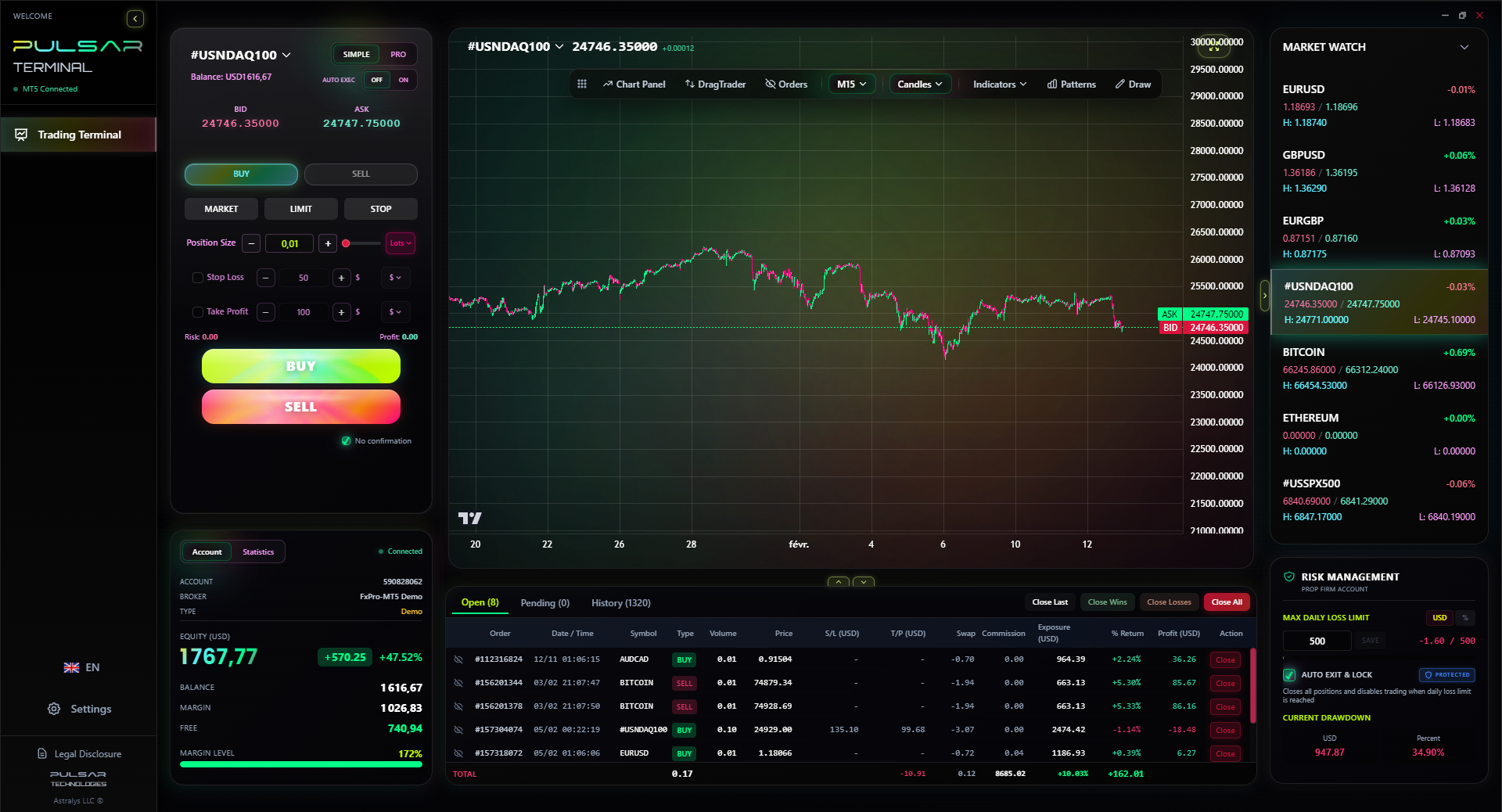
Managing the psychology of trades, like my failed EUR/USD example, is easier when you can set automated rules for breakeven and partial closures, which is exactly what Pulsar Terminal does on your MT5 platform.
Pulsar Terminal
The all-in-one MT5 companion: drag-and-drop orders, multi-TP/SL, trailing stop, grid trading, Volume Profile, and prop firm protection. Used by 1,000+ traders daily.
“A losing trade doesn't make you a loser. It's just feedback.”
So, how do you start moving toward becoming a consistently profitable trader, right here from SA? It's a marathon, not a sprint. Here's a practical roadmap.
Phase 1: Education & Simulation (Months 1-3) Don't deposit real money yet. Open a demo account with a broker like IC Markets or Pepperstone. They offer great demo environments. Practice the simple strategy from the previous section. Your goal isn't to make fake money. Your goal is to execute 100 trades exactly according to your plan. Start a trading journal from day one. Learn the mechanics of placing orders, setting stops, and what a pip really means for your potential profit and loss.
Phase 2: Small Live Account (Months 4-6) Fund a live account with money you can afford to lose completely. I'm talking R5,000 or R10,000 – an amount that, if it vanished, would sting but not ruin your life. The psychology changes with real money. Your goal in this phase is not to get rich. Your goal is to not blow up your account. Trade micro or nano lots. Focus on making 10, 20, 50 disciplined trades in a row. The profit is a secondary bonus.
Phase 3: Scaling & Refinement (Month 6+) Once you have a track record of 3-6 months of consistent, disciplined trading (even if the profits are small), you can think about scaling. This might mean adding slightly more capital, or adding one more currency pair to your watchlist. This is also where you can start exploring more advanced tools to help you manage trades more efficiently, especially when you're not glued to the screen.
Remember, the world's most successful forex traders weren't born that way. They were once where you are now. They just had the patience to follow the process, the humility to learn from losses, and the discipline to stick with it long after the initial excitement faded. You can do that too. Start simple, start small, and focus on the process. The results will follow.
FAQ
Q1Who is the richest forex trader in the world?
It's almost impossible to say for sure, as the wealthiest individuals trade privately. Names like George Soros, Stanley Druckenmiller, and Bill Lipschutz are often cited based on their legendary fund performances. However, for a South African retail trader, focusing on their specific strategies or bankroll is less useful than adopting their core principles of risk management and rigorous process.
Q2Can I become a millionaire trading forex from South Africa?
Theoretically, yes. Realistically, it's an extreme long shot and should not be your goal when starting. The vast majority of retail traders lose money. A far healthier and more achievable goal is to develop a consistent, disciplined process that generates steady returns over time. Aim to be a profitable trader first. Building significant wealth comes from compounding those profits over many, many years, not from a single lucky trade.
Q3What is the best forex trading strategy for beginners in SA?
The best strategy is a simple one you can understand and execute consistently. Start with major currency pairs like EUR/USD that have tight spreads. Learn a basic trend-following or range-trading strategy using a few key indicators like moving averages and RSI. Practice it relentlessly on a demo account for at least 3 months before risking any real money. Complexity is your enemy at this stage.
Q4Is forex trading taxable in South Africa?
Yes. The South African Revenue Service (SARS) views net profits from forex trading as income. You are required to declare these earnings in your annual tax return. It's crucial to keep careful records of all your trades, deposits, and withdrawals. Consult with a tax professional who understands trading to ensure you comply correctly.
Q5Why is the ZAR so volatile, and how do I trade it?
The Rand is considered an emerging market currency and is highly sensitive to local political events, commodity prices (like gold and platinum), global risk sentiment, and US Dollar strength. To trade USD/ZAR or other ZAR pairs safely, you must use wider stop losses to account for sudden spikes, be acutely aware of the South African economic calendar (SARB meetings, budget speeches), and consider it a more advanced pair. Many pros suggest beginners focus on major pairs first.
Q6Should I use a South African broker or an international one?
There are good arguments for both. An FSCA-regulated South African broker (like some offerings from Exness or XM) offers local customer support, ZAR accounts to avoid conversion fees, and the security of local regulation. Some international brokers offer tighter spreads or specific platforms. The critical thing is to ensure any broker you use is reputable and properly regulated by a recognized authority. Never trade with an unregulated entity.
Prof. Winston's Lesson
Key Takeaways:
- ✓Risk a maximum of 1% of your capital per trade.
- ✓Spend 80% of your time on your trading journal review.
- ✓Master one simple strategy on one pair before adding more.
- ✓Choose an FSCA-regulated broker for your core ZAR account.
How useful was this article?
Click a star to rate
Weekly Trading Insights
Free weekly analysis & strategies. No spam.
About the Author
David van der Merwe
Emerging Markets Trader
Johannesburg-based trader with 11 years in emerging market currencies. Specializes in ZAR pairs, FSCA-regulated trading, and South African market analysis.
Comments
Risk Disclaimer
Trading financial instruments carries significant risk and may not be suitable for all investors. Past performance does not guarantee future results. This content is for educational purposes only and should not be considered investment advice. Always conduct your own research before trading.
You Might Also Like

Cara Trading Forex Sukses: 7 Prinsip dari Trader Profesional
Cara trading forex sukses dengan 7 prinsip trader pro: manajemen modal, disiplin, journal trading, backtest. Data nyata, bukan janji profit palsu.
Jam Trading Forex Terbaik untuk Trader Indonesia: Panduan Lengkap dengan Tabel Waktu
Panduan jam trading forex untuk trader Indonesia. Tabel 4 sesi dunia, jam emas 20:00-00:00, sesi mana yang harus dihindari. Data akurat + tips dari trader berpengalaman.
Top 5 Sàn Forex Uy Tín Nhất 2026: Review Jujur dari Trader Indonesia
Top 5 sàn forex uy tín 2026 untuk trader Indonesia. Review jujur: spread, deposit, withdraw, dukungan lokal. Exness, XM, IC Markets & lebih.
Get Pulsar Terminal
All these calculators are built into Pulsar Terminal with real-time data from your MT5 account. One-click position sizing, automatic risk management, and instant calculations.
Get Pulsar Terminal