


Let's start with a number that should sober you up: 70-90% of retail traders lose money.
James Mitchell
Senior Trading Analyst
☕ 9 min read
What you'll learn:
Let's start with a number that should sober you up: 70-90% of retail traders lose money. Now, let's talk about a tool that promises to flip that statistic - the Xmaster Formula Forex Indicator. It's a popular custom MT4/MT5 tool that bundles signals into one neat package, and it claims its signals don't repaint. I bought it. I tested it. And I have some strong opinions, especially for traders in the heavily regulated US market where the rules of the game are different.
The Xmaster Formula is a custom technical indicator built for MetaTrader 4 and MetaTrader 5. Its main selling point is simplicity. Instead of cluttering your chart with a dozen different oscillators and moving averages, it tries to combine multiple signals into one visual system.
You'll typically see arrows (green for buy, red for sell) appearing on your chart. The logic behind these arrows often involves common components like moving averages for trend, the RSI indicator for momentum, and sometimes elements of the MACD indicator. The big marketing claim is "no repaint." This means once an arrow appears, it shouldn't disappear or move to a different bar later. That's a critical feature, as repainting indicators are basically fraud - they show you a perfect past but give false signals in real-time.

Warning: Just because an indicator says "no repaint" doesn't mean it's profitable. It just means it's not actively lying to you about where it placed a signal. The signal can still be wrong, late, or happen right before a massive reversal.
I downloaded it a few years back when it was being sold for $47 (down from a hilariously inflated $350). My first thought was how clean the chart looked. My second thought, after a week of testing, was that clean doesn't equal cash.
Here’s the raw truth: no indicator works all the time. The Xmaster Formula is no exception. Its effectiveness depends entirely on market conditions, just like any other tool.
When It Can Seem to Work
In strong, clear trending markets, trend-following indicators have a chance. If EUR/USD is in a sustained bull run, a buy arrow might catch a continuation move. I remember a trade on GBP/USD in 2023 where a buy signal lined up with a key daily support level. I took it, set a tight stop, and rode it for about 80 pips. It felt great. But that’s the trap - you remember the wins.
When It Falls Apart
The indicator, like most consolidated systems, struggles in ranging or choppy markets. It will whipsaw, giving consecutive buy and sell signals as price moves sideways, which can quickly drain an account through a death by a thousand cuts. This is where most traders using it will blow up. They don't have a filter for market regime.
The US Regulatory Context
This matters more than you think. In the US, you're limited to 50:1 use on majors and 20:1 on minors. A broker like FOREX.com or OANDA, regulated by the CFTC and NFA, will enforce this. This lower use is actually a blessing in disguise when testing an indicator like Xmaster. It forces you to use sane position sizes. If you were on an offshore broker with 500:1 use, a few bad Xmaster signals could trigger a margin call in minutes. The US framework, while restrictive, provides a safer sandbox for testing.

Example: A $1,000 account with 50:1 use gives you $50,000 in buying power. A bad 50-pip move against you on a standard lot (100k) would be a 50% loss. With a tool like Xmaster, you must use a position size calculator religiously. A 50-pip stop on a 0.10 lot is a $50 risk, or 5% of your account - still high, but manageable.

💡 Winston's Tip
An indicator is a flashlight, not a map. It can illuminate what's right in front of you, but it can't tell you where the cliff edge is. Always know the broader terrain.
“Clean charts don't equal cash. A simple tool in a complex market often just gives you simple losses.”
Traders don't fail because of bad indicators; they fail because of bad habits. Using the Xmaster Formula amplifies these habits if you're not careful.
1. Signal Blindness: You become a robot, clicking every arrow without context. The indicator isn't a strategy; it's one piece of input. Ignoring major support/resistance, economic news (like US NFP), or the overall trend on a higher timeframe is a recipe for disaster.
2. Over-optimization: You'll be tempted to tweak the settings for that one perfect backtest. I did this. I optimized it for EUR/USD in a specific month until it showed a 90% win rate. Then I used it live the next month and got slaughtered. The market had changed. Curve-fitting is a silent account killer.
3. Ignoring the Spread: The indicator gives a signal at a specific price. If you're trading a pair with a 2-pip spread, you're already 2 pips in the hole the moment you enter. On a scalping strategy, this can turn a theoretically profitable system into a losing one. You need a broker with consistently tight spreads to even give this a chance.
4. No Exit Plan: The indicator might suggest an entry, but it says nothing about when to get out. Do you take profit at 20 pips? 50? Use a trailing stop? I learned this the hard way on a gold trade. Xmaster gave a perfect buy signal on XAU/USD at $1815. It ran to $1835. I got greedy, didn't take profit, and watched it reverse to my entry, then my stop. I turned a winning trade into a breakeven. Profit management is everything.

Pro Tip: Never risk more than 1-2% of your account on any single Xmaster signal. The promise of "high probability" arrows will make you want to bet big. That's exactly how you lose your shirt.
If you've bought the Xmaster Formula indicator and want to give it a fair shot, here's a disciplined framework. Think of it as damage control for your curiosity.
Step 1: Use it as a CONFIRMATION tool, not a trigger. Don't just trade the arrow. Wait for the arrow to appear, then check: Is price at a key level on the higher timeframe? Did it just bounce off the 200-period moving average? Is there a confluence? The arrow should be the last reason to enter, not the first.
Step 2: Apply it to the right timeframe and pair. It might work better on the 1-hour or 4-hour charts for swing trading than on the 1-minute chart. Test it on major pairs like EUR/USD that have cleaner trends and better liquidity. Avoid exotic pairs where spreads are wide and price action is erratic.
Step 3: Have a fixed, mechanical exit strategy. Before you enter, decide your stop-loss and take-profit. A simple 1:1.5 risk-to-reward ratio is a good start. For example, if your stop is 30 pips, your target is 45 pips. Stick to it. This removes emotion, which is the entire point of using an indicator.
Step 4: Choose your broker wisely. You need fast, reliable execution and tight spreads. In the US, your choices are limited but solid. Brokers like FOREX.com (via StoneX) or OANDA offer MT4/MT5. Compare their typical spreads on the pairs you want to trade. Every pip saved on the spread is a pip added to your potential profit.
Here’s a quick comparison of execution environments:
| Feature | Why It Matters for Xmaster | US Broker Example |
|---|---|---|
| Spread Consistency | A volatile spread can trigger your stop prematurely. | OANDA, FOREX.com offer stable spreads. |
| Platform Stability | MT4/MT5 must run smoothly; a freeze during a signal is fatal. | All major US brokers provide strong MT4/MT5. |
| Order Execution Speed | Lag on a signal can mean a worse entry price. | Look for brokers with No Dealing Desk (NDD) models. |
| use Limits | US-mandated 50:1 max protects you from over-leveraging on bad signals. | Enforced by all NFA/CFTC brokers. |
💡 Winston's Tip
The most expensive indicator is the one that works just well enough to make you believe in it, right before it fails catastrophically. Never trust it more than you trust your stop-loss.
“The US-mandated 50:1 use limit isn't a restriction; it's a safety rail for when your indicator inevitably fails.”
After 12 years, I've learned that chasing the "perfect indicator" is a fool's errand. Sustainable trading is about process, not magic arrows. Here’s what I’d focus on instead of hunting for the next Xmaster.
Price Action & Key Levels: Learn to read raw price action and identify clear support and resistance levels. This skill is timeless and works on any chart, in any market. It’s free. A pin bar at a key level is often more reliable than a random indicator arrow.
Risk Management as Your Primary Strategy: This is your real edge. Make your position sizing and risk-per-trade rules non-negotiable. A mediocre entry with excellent risk management will outperform a brilliant entry with poor risk management every single time.
Use Indicators Sparingly for Specific Tasks: Instead of one all-in-one indicator, use single-purpose tools well. Use a moving average to define the trend. Use the RSI to spot potential overbought/oversold conditions within that trend. This gives you understanding and control, rather than a black box signal.
Focus on One Market: Become a specialist in one or two currency pairs. Learn their personality, their average daily range, how they react to news. You’ll develop a feel no indicator can give you. I trade EUR/USD and that’s it. I know it better than I know some of my relatives.
The bottom line? The Xmaster Formula Forex Indicator might give you some decent ideas, but it will not do the hard work for you. The hard work is managing your psychology, your risk, and your patience. No $47 download can install discipline into your brain.
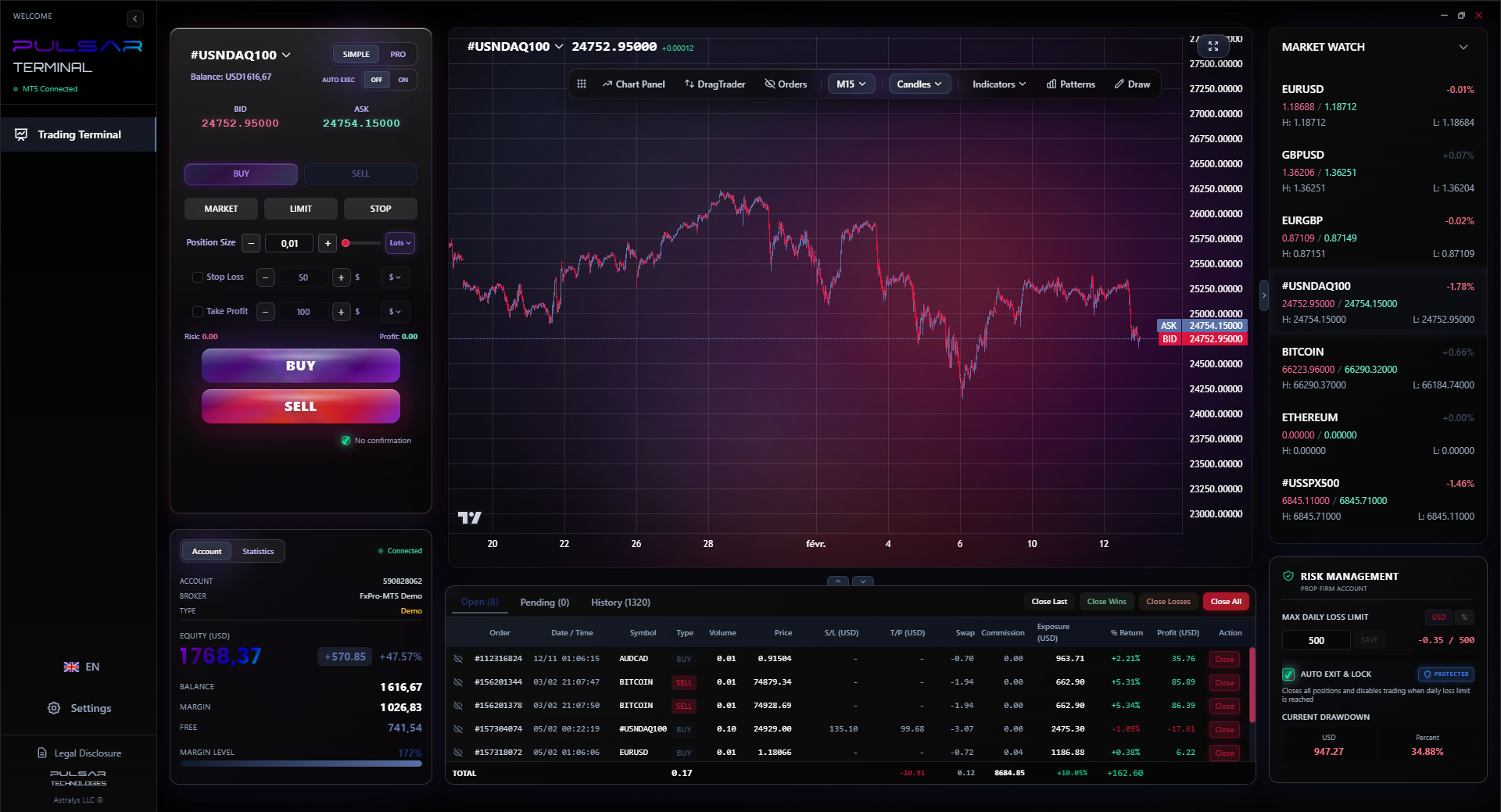
If you're using tools like the Xmaster Formula for signals, you need precise trade management to protect profits, which Pulsar Terminal automates directly on your MT5 platform.
Pulsar Terminal
The all-in-one MT5 companion: drag-and-drop orders, multi-TP/SL, trailing stop, grid trading, Volume Profile, and prop firm protection. Used by 1,000+ traders daily.
So, should you use the Xmaster Formula Forex Indicator?
Maybe, but with extreme caution and low expectations.
Treat it as a basic scanner that might highlight potential setups you missed. Never, ever, go on autopilot with it. The US regulatory environment, with its use caps and strict broker oversight, is actually your ally here. It prevents you from going completely nuts with size.
If you're a complete beginner, I'd advise against buying it. You'll spend $47 and likely lose ten times that trying to make it work. That money is better spent on a few good books on trading psychology and risk management.
If you're an experienced trader with a solid framework looking for an additional confluence tool, and you understand it's not a holy grail, then you might find some utility in it. But you probably don't need it. The greatest traders I know use incredibly simple charts.
The search for a perfect system is a trap. The real xmaster formula isn't an indicator; it's discipline plus risk management multiplied by patience. You can't download that. You have to build it yourself, one trade at a time.
FAQ
Q1Is the Xmaster Formula Indicator legal to use in the United States?
Yes, using custom indicators like the Xmaster Formula on your MT4 or MT5 platform is perfectly legal. The regulation applies to the brokers you trade with, not the analysis tools you use. You must ensure your broker is registered with the CFTC and is a member of the NFA, like FOREX.com or OANDA.
Q2Do the Xmaster signals really not repaint?
Based on my testing, the version I used did not repaint in the traditional sense - signals did not disappear from closed candles. However, a new signal can appear on the current, still-forming candle and then disappear if price moves the other way before the candle closes. This isn't technically repainting, but it can feel just as frustrating in real-time trading.
Q3What is the best timeframe to use with the Xmaster indicator?
It depends on your trading style, but I found it less noisy on higher timeframes. The 1-hour and 4-hour charts tend to provide more reliable signals than the 1-minute or 5-minute charts. Higher timeframes filter out market noise, which helps trend-following indicators perform better.
Q4Can I use the Xmaster Formula for scalping?
I wouldn't recommend it. Scalping requires extremely fast execution, tight spreads, and precision. The Xmaster signals can be late for a scalping context, and the inherent spread cost on most US broker accounts can wipe out the small profits you're targeting. It's better suited for swing trades where the profit target is wider.
Q5Which US brokers support MetaTrader for using this indicator?
Several CFTC/NFA regulated brokers offer MetaTrader. FOREX.com provides both MT4 and MT5. OANDA offers MT4. tastyfx (formerly IG US) offers both MT4 and MT5. Always check the broker's website for the most current platform offerings.
Q6How much profit can I expect with the Xmaster Formula?
Anyone who gives you a profit figure is lying. Your results depend on your risk management, market conditions, and discipline. A professional trader might target 5-10% monthly, but that comes from a full strategy, not just an indicator. Using Xmaster alone, with poor habits, you are far more likely to join the 70-90% of traders who lose money.
Q7Are there any free alternatives to the Xmaster Formula?
Absolutely. You can build a similar concept for free using MT4/MT5's built-in indicators. Try combining a moving average crossover system with the RSI. It won't have the same polished arrows, but it will teach you how the signals are generated, which is infinitely more valuable than blindly following a green arrow.
Prof. Winston's Lesson
Key Takeaways:
- ✓No indicator works 100% of the time; context is king.
- ✓US use limits (50:1) protect you from yourself.
- ✓Risk management is your only true edge.
- ✓A 1:1.5 risk-reward ratio is a sustainable starting point.
- ✓Focus on one currency pair to build real expertise.
How useful was this article?
Click a star to rate
Weekly Trading Insights
Free weekly analysis & strategies. No spam.
About the Author
James Mitchell
Senior Trading Analyst
Based in New York with over 9 years of trading experience. Focuses on major USD pairs, prop firm challenges, and the US regulatory landscape.
Comments
Risk Disclaimer
Trading financial instruments carries significant risk and may not be suitable for all investors. Past performance does not guarantee future results. This content is for educational purposes only and should not be considered investment advice. Always conduct your own research before trading.
You Might Also Like

Cara Trading Forex Sukses: 7 Prinsip dari Trader Profesional
Cara trading forex sukses dengan 7 prinsip trader pro: manajemen modal, disiplin, journal trading, backtest. Data nyata, bukan janji profit palsu.
Jam Trading Forex Terbaik untuk Trader Indonesia: Panduan Lengkap dengan Tabel Waktu
Panduan jam trading forex untuk trader Indonesia. Tabel 4 sesi dunia, jam emas 20:00-00:00, sesi mana yang harus dihindari. Data akurat + tips dari trader berpengalaman.
Top 5 Sàn Forex Uy Tín Nhất 2026: Review Jujur dari Trader Indonesia
Top 5 sàn forex uy tín 2026 untuk trader Indonesia. Review jujur: spread, deposit, withdraw, dukungan lokal. Exness, XM, IC Markets & lebih.
Get Pulsar Terminal
All these calculators are built into Pulsar Terminal with real-time data from your MT5 account. One-click position sizing, automatic risk management, and instant calculations.
Get Pulsar Terminal