


So you're a young South African looking at forex trading, maybe scrolling through TikTok or YouTube seeing those 'get rich quick' clips.

David van der Merwe
Emerging Markets Trader ·  South Africa
☕ 12 min read
What you'll learn:
- 1The Legal Stuff: You Can't Start Until You're 18
- 2The Real Costs: It's More Than Just Your Deposit
- 3Choosing a Broker: Safety Over Flashy Bonuses
- 4Your First Strategy: Keep It Stupidly Simple
- 5The Mind Game: This is Where You'll Battle Yourself
- 6Risk Management: Your Financial Seatbelt
- 7Your Action Plan: What to Do This Week
So you're a young South African looking at forex trading, maybe scrolling through TikTok or YouTube seeing those 'get rich quick' clips. You're probably asking: can I actually make money at this, or am I just going to lose my airtime money? I get it. The stats are brutal - youth unemployment is over 60% for some age groups. Trading looks like a way out. But let me tell you straight: it's not a side hustle, it's a skill. And if you approach it like a skill, you have a shot. I've been trading for over 12 years, and I've seen both the wins and the spectacular wipeouts. This guide isn't about hype; it's about what you actually need to know to start on solid ground, legally and financially.
First thing's first: you have to be 18. No ifs, ands, or buts. Under South African law, you need to be 18 to enter into a binding contract, and opening a trading account is exactly that. The Financial Sector Conduct Authority (FSCA) requires all regulated brokers to verify your age and identity through KYC (Know Your Customer) checks. Trying to use your older brother's ID or faking your details isn't just against the rules; it's fraud. You'll get caught, your account will be frozen, and you could face legal trouble. It's not worth it.
Beyond age, there's the broader regulatory landscape. The FSCA is our main watchdog. They're the ones who make sure brokers keep your money in separate, segregated accounts (so the broker can't use your deposit to pay their office rent). Always, and I mean always, check that your broker is FSCA-regulated. You can look up their license number on the FSCA's website. It's your first line of defence against scams.
Then there's the South African Reserve Bank (SARB). They control how money moves in and out of the country. For you, this matters when you deposit to or withdraw from an international broker. There are limits and paperwork. Some brokers offer ZAR-denominated accounts, which simplifies things massively and saves you on bank conversion fees. As of late 2025, SARB also tightened rules on sending South African-source income offshore, requiring tax clearance. It's a headache you can avoid by choosing a good local broker from the start.

Warning: If a 'broker' or 'mentor' asks you to pay them in Bitcoin or via a friend's FNB account to 'skip the paperwork', run. That's a scam. Legitimate businesses have transparent, traceable banking.
I learned this the hard way early on. I deposited R2,000 with an unregulated outfit promising 'guaranteed signals'. The signals were garbage, and when I tried to withdraw my remaining R800, they ghosted me. Poof. Money gone. That R800 lesson was cheaper than what many learn.

💡 Winston's Tip
The market's greatest trick is making you feel smart when you're lucky. Your strategy must work when you're feeling stupid.
Let's talk numbers, because this is where most new traders get a nasty shock. Your starting capital isn't just the money you trade with; it's the money that gets eaten by costs before you even make a profit.
The Obvious Cost: Your Deposit
Yes, you can technically start with R150 on a micro account. But should you? Honestly, no. With R150, a single bad trade can wipe out 20% of your account. The psychological pressure is insane, and you'll likely overtrade just to try and make it 'worthwhile'. A more realistic, safer starting point is R1,500 to R5,000. This gives you room to breathe, make mistakes, and use proper position size calculator without risking a huge percentage on each trade. For serious, long-term focused trading, I'd suggest aiming for R5,000 to R20,000 as starting capital.
The Hidden Costs: Spreads, Commissions, Swaps
This is the real market tax.
- Spreads: This is the difference between the buy and sell price. On major pairs like EUR/USD, a good spread might be 0.6 pips. A bad one can be 2 pips or more. If your strategy involves scalping, a wide spread will kill your profits.
- Commissions: Some brokers charge a fee per lot traded instead of widening the spread. It might be $4 per standard lot. This can be cheaper overall if you trade large volumes.
- Swap Fees: Hold a trade overnight? You'll pay or earn a small interest fee based on the difference between the two currencies' central bank rates. It's usually small, but it adds up.

Example: Let's say you buy 1 mini lot (10,000 units) of EUR/USD. Your broker's spread is 1.2 pips. That's a R9.60 cost (1.2 pips * R0.80 per pip on a mini lot) the moment you enter the trade. The price needs to move 1.2 pips in your favour just for you to break even. Now you see why a low spread definition matters.
My biggest early mistake was ignoring swaps. I held a GBP/JPY sell position for three weeks during a quiet period, trying to ride out a small drawdown. I ended up breaking even on the price move, but the negative swap fees had quietly chipped away over R120 from my account. I was 'right' on the trade but still lost money.
“Your advantage is time. You can afford to learn slowly and correctly.”
The broker is your gateway to the market. Choosing wrong can mean terrible execution, hidden fees, or worse, you can't get your money back. Here’s a quick comparison of some well-known options for South Africans.
| Broker | FSCA Regulated? | Min. Deposit (ZAR approx.) | Key Feature for Beginners |
|---|---|---|---|
| Khwezi Trade | Yes | R500 | Local broker, ZAR accounts, strong local support. |
| IG | Yes | R4,000 | Huge, established, excellent educational resources. |
| XM | Yes | ~R90 ($5) | Very low minimum, good for testing with tiny capital. |
| AvaTrade | Yes | ~R1,800 ($100) | User-friendly platforms, fixed spreads available. |
| Tickmill | Yes | ~R1,800 ($100) | Very low raw spreads + commission. |
| IC Markets | Yes (via global entity) | ~R1,800 ($100) | Consistently some of the tightest spreads globally. |
Your checklist should be: 1) FSCA regulation, 2) A ZAR account option, 3) A demo account that doesn't expire after 30 days, and 4) Reliable customer support you can actually reach.
I started with a demo account on XM because their barrier to entry was so low. It was great for getting a feel. But when I went live with real money, I switched to a broker with tighter spreads like IC Markets because my scalping strategy demanded it. That saved me thousands in costs over the years.

Pro Tip: Open demo accounts with 2-3 brokers. Trade the same strategy on all of them for a week. You'll quickly see differences in execution speed, slippage, and how the platform feels. It's the best free research you can do.
You don't need a complicated system with 15 indicators. In fact, that's a sure way to confuse yourself into losses. Start with one concept and master it.
For most beginners, I suggest starting with trend following on the 4-hour chart. It's slower, less stressful than watching the 1-minute chart, and it teaches you patience. Here’s a bare-bones framework:
- Identify the Trend: Use a simple moving average. If the price is above the 50-period SMA, look for buys only. If it's below, look for sells only. Don't fight the trend.
- Find an Entry: Wait for the price to pull back towards the moving average. Use the RSI indicator to see if it's becoming oversold (in an uptrend) or overbought (in a downtrend). An RSI reading near 30 in an uptrend can be a potential buy signal.
- Set Your Stop Loss: ALWAYS. Place it on the other side of the recent swing low (for a buy) or swing high (for a sell). This defines your risk upfront.
- Take Profit: Aim for a risk-to-reward ratio of at least 1:2. If you risk R100, aim to make R200.
This isn't a holy grail. It's a training wheel strategy. It forces discipline. The goal in your first year isn't to get rich; it's to not blow up your account. I wish someone had told me that. My first profitable month came only after I stopped chasing every 5-pip move and focused on maybe 2-3 of these higher-probability swing trading setups per week.
One of my earliest 'aha' moments was on USD/ZAR. I saw a clear downtrend on the 4H chart, waited for a pullback to the 50 SMA with RSI popping above 50, and shorted. I risked R500 (1% of my account then). The trade ran for days and netted me R1,200. It worked because I followed the simple plan and didn't interfere.
💡 Winston's Tip
A R500 loss that teaches you a lasting lesson is a better investment than a R5,000 win that reinforces a bad habit.
“High use is why so many get a margin call within their first month.”
This is the most important section. Your psychology will make or break you. Technical knowledge is maybe 20% of the game. The other 80% is managing your own brain.
Pitfall 1: Revenge Trading. You lose R200 on a trade. You're angry. You jump right back in with a double-sized position to 'make it back immediately'. This is how you turn a R200 loss into a R1,000 loss in 10 minutes. I've done it. After a loss, walk away. Close the platform. Go for a walk. The market will still be there tomorrow.
Pitfall 2: Fear of Missing Out (FOMO). You see EUR/USD rocketing up. Your buddy in a WhatsApp group is posting profit screenshots. You jump in late, near the top, and buy just as it reverses. You're now bag-holding a loss. If you miss a move, you miss it. There are over 200 trading days a year. Another opportunity is always around the corner.
Pitfall 3: Overleveraging. This is the silent killer for the youth in forex. Brokers might offer you 500:1 use. That means with R1,000, you can control a R500,000 position. It's insane. A 0.2% move against you wipes out your entire account. I never use more than 10:1 use on my main account. High use is why so many get a margin call within their first month.
Warning: Social media trading 'gurus' often show massive percentage gains. What they don't show is the insane use used to get them. They are gambling, not trading. Don't copy them.
The single best thing I ever did for my trading psychology was to start a journal. Every trade, I wrote down: the setup, my emotion (e.g., 'impatient', 'greedy', 'calm'), the outcome. After 100 trades, I saw a pattern: my 'impatient' trades had a 25% win rate. My 'calm' trades had a 65% win rate. The data didn't lie. I had to fix me.
Risk management isn't sexy, but it's what keeps you in the game. Without it, you're just a tourist in the market.
The 1% Rule: Never risk more than 1% of your total trading account capital on a single trade. If you have a R5,000 account, your maximum risk per trade is R50. This means if you have a string of 10 losses in a row (it happens), you've only lost 10% of your account, not 50% or 100%. You can recover from that.
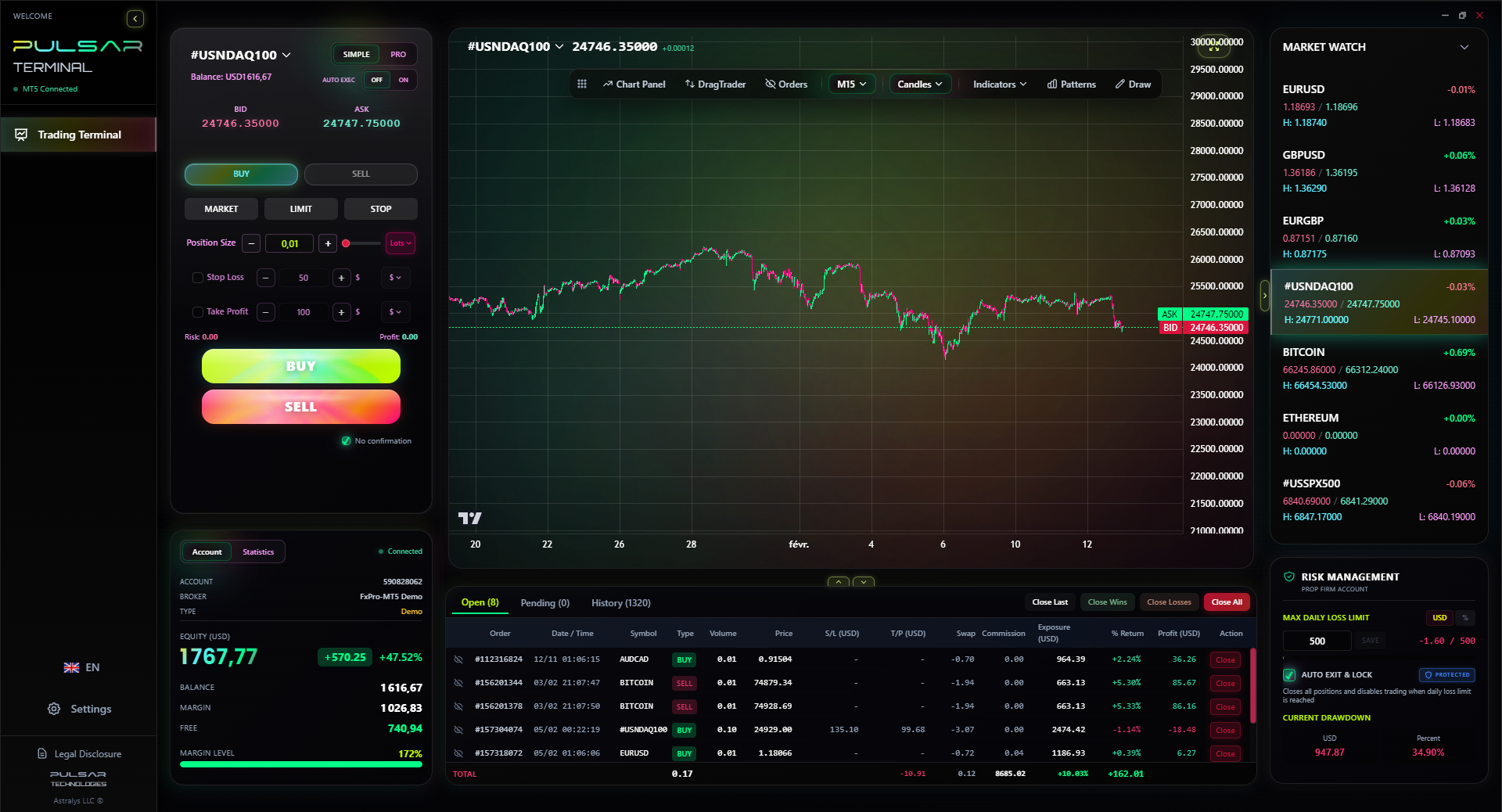
Use Stop Losses Religiously: Your stop loss is not a suggestion; it's a law. Set it the moment you place the trade. If your analysis is wrong, the stop loss saves you. Period. A tool that can help immensely with advanced order types is something like Pulsar Terminal, which integrates with MT5. It lets you set multi-level take profits and trailing stops with a drag-and-drop, which takes the emotion out of managing a winning trade.
Correlation Risk: Don't put all your money into trades that move together. If you're long EUR/USD and also long GBP/USD, you're in the same trade twice because those pairs often move in sync. You've doubled your risk without realizing it. Diversify across different currency groups or asset classes.
Here's a personal rule: If I have two losing days in a row, I cut my position size in half for the next day. If I have three losing days, I stop trading for the week and review my journal. This has saved me from every single one of my potential 'drawdown spirals'. It forces a cool-down period. Your capital is your ammunition. Protecting it is your primary job, not hitting a home run on every trade.
💡 Winston's Tip
Your first R10,000 in profits should be reinvested into your education and trading infrastructure - better data, courses, tools - not a new pair of sneakers.
Managing complex trades and protecting profits requires precise tools, which is where a platform like Pulsar Terminal, with its drag-and-drop order management and automated trailing stops for MT5, becomes indispensable for executing a disciplined strategy.
Pulsar Terminal
The all-in-one MT5 companion: drag-and-drop orders, multi-TP/SL, trailing stop, grid trading, Volume Profile, and prop firm protection. Used by 1,000+ traders daily.
“The goal in your first year isn't to get rich; it's to not blow up your account.”
Alright, let's turn this into action. Don't just read and forget.
- Verify Your Age & Documents: Make sure you have a valid SA ID and proof of residence ready. If you're not 18 yet, use this time to study on demo.
- Open a Demo Account: Pick one of the FSCA brokers from the table above. Don't touch the live markets for at least 2-3 months. Your goal on demo is to be consistently profitable for a full month, using your 1% risk rule.
- Learn One Pair: Start with EUR/USD. It's the most liquid and has the lowest spreads. Watch it every day. Learn its 'personality'.
- Paper Trade Your Simple Strategy: Use the 4H trend-following method I outlined. Write down every single trade in a journal (Google Sheets works fine).
- Study These Core Concepts: Don't get distracted. Deep dive into MACD indicator for confirming trends, understand what a pip definition really means for your P&L, and read up on different styles like swing trading.
- Join the Right Communities: Avoid the 'get rich quick' Telegram groups. Look for communities focused on education and review sharing, like discussions on broker experiences with Exness or Pepperstone.
The path for youth in forex is full of noise. Your advantage is time. You can afford to learn slowly and correctly. Build a foundation of discipline and risk management first. The profits will follow, but they are a byproduct of a good process, not the goal itself. I've been where you are. The market isn't going anywhere. Take your time.
FAQ
Q1Can I start forex trading in South Africa if I'm 17?
No. You must be 18 years old to legally enter into a contract with an FSCA-regulated broker. Any platform that lets you trade underage is operating illegally and is almost certainly a scam.
Q2What is the absolute minimum amount I need to start trading forex?
Technically, you can find brokers like XM that allow a $5 (about R90) minimum deposit. However, for practical and safe trading where you can properly manage risk, a minimum of R1,500 to R5,000 is strongly advised. Starting with too little forces you to use dangerous levels of use.
Q3Is forex trading a solution to South Africa's high youth unemployment?
No, it is not a solution. It is a high-risk, skill-based venture. While it can generate income, it should be viewed as a potential profession that requires years of dedicated study and practice, not a quick fix. Most beginners lose money. It's far more reliable to pursue formal education or skilled trades while learning trading on the side.
Q4How do I know if a forex broker is legit in South Africa?
Check the FSCA's official website for their regulatory register. Search for the broker's name or FSP number. Legitimate brokers will proudly display their FSCA license details on their website. Also, look for segregated client funds and a physical address in South Africa.
Q5What's the biggest mistake young South African traders make?
Overleveraging. Using the maximum 500:1 or 1000:1 use offered by brokers turns small market fluctuations into account-destroying events. It's the fastest way to a margin call. Successful traders use low use (e.g., 10:1 or less) to manage risk.
Q6Can I trade crypto through a forex broker in SA?
Yes, many forex brokers now offer crypto CFDs (Contracts for Difference). However, note that as of 2025/2026, crypto assets are classified as financial products and are being brought under SARB's exchange control regulations. Always ensure the broker is FSCA-licensed to offer these products.
Q7How much time do I need to dedicate to trading daily?
It depends on your style. If you're a swing trader using 4-hour charts, you might only need 30-60 minutes per day to analyse and manage trades. If you're scalping on 1-minute charts, you'll need to be glued to the screen for hours. Start with swing trading to fit it around studies or a job.
Prof. Winston's Lesson
Key Takeaways:
- ✓Legal age is 18: No exceptions with regulated brokers.
- ✓Start with at least R1,500, not R150, for sane risk management.
- ✓Never risk more than 1% of your account on a single trade.
- ✓Use use under 10:1 to survive your learning phase.
- ✓Master one simple strategy on demo for 3 months before going live.
How useful was this article?
Click a star to rate
Weekly Trading Insights
Free weekly analysis & strategies. No spam.
About the Author
David van der Merwe
Emerging Markets Trader
Johannesburg-based trader with 11 years in emerging market currencies. Specializes in ZAR pairs, FSCA-regulated trading, and South African market analysis.
Comments
Risk Disclaimer
Trading financial instruments carries significant risk and may not be suitable for all investors. Past performance does not guarantee future results. This content is for educational purposes only and should not be considered investment advice. Always conduct your own research before trading.
You Might Also Like

Cara Trading Forex Sukses: 7 Prinsip dari Trader Profesional
Cara trading forex sukses dengan 7 prinsip trader pro: manajemen modal, disiplin, journal trading, backtest. Data nyata, bukan janji profit palsu.
Jam Trading Forex Terbaik untuk Trader Indonesia: Panduan Lengkap dengan Tabel Waktu
Panduan jam trading forex untuk trader Indonesia. Tabel 4 sesi dunia, jam emas 20:00-00:00, sesi mana yang harus dihindari. Data akurat + tips dari trader berpengalaman.
Top 5 Sàn Forex Uy Tín Nhất 2026: Review Jujur dari Trader Indonesia
Top 5 sàn forex uy tín 2026 untuk trader Indonesia. Review jujur: spread, deposit, withdraw, dukungan lokal. Exness, XM, IC Markets & lebih.
Get Pulsar Terminal
All these calculators are built into Pulsar Terminal with real-time data from your MT5 account. One-click position sizing, automatic risk management, and instant calculations.
Get Pulsar Terminal