


You just passed your prop firm challenge, got funded, and now you're wondering why your account is down 6% after three days of live trading? I've seen this exact pattern destroy more promising traders than any market crash ever could.

Daniel Harrington
Senior Trading Analyst · MT5 Specialist
☕ 9 min read
What you'll learn:
- 11. Treating the Funded Account Like Free Money
- 22. Ignoring the Trailing Drawdown Trap
- 33. Over-Trading During the Evaluation Phase vs. Going Silent After Funding
- 44. Using the Wrong Position Sizing for the Account Type
- 55. Trading News Events Without Understanding the Broker's Rules
- 66. Not Scaling Down After a Losing Streak
- 7The One Mistake Nobody Talks About: Passing the Challenge with a Strategy You Can't Repeat
You just passed your prop firm challenge, got funded, and now you're wondering why your account is down 6% after three days of live trading? I've seen this exact pattern destroy more promising traders than any market crash ever could. The rules don't change when you get funded, but your psychology does, and that's where most people fall apart. These aren't abstract warnings. They're the seven mistakes I've watched traders make repeatedly, and two of them I made myself before I figured out what was actually happening.
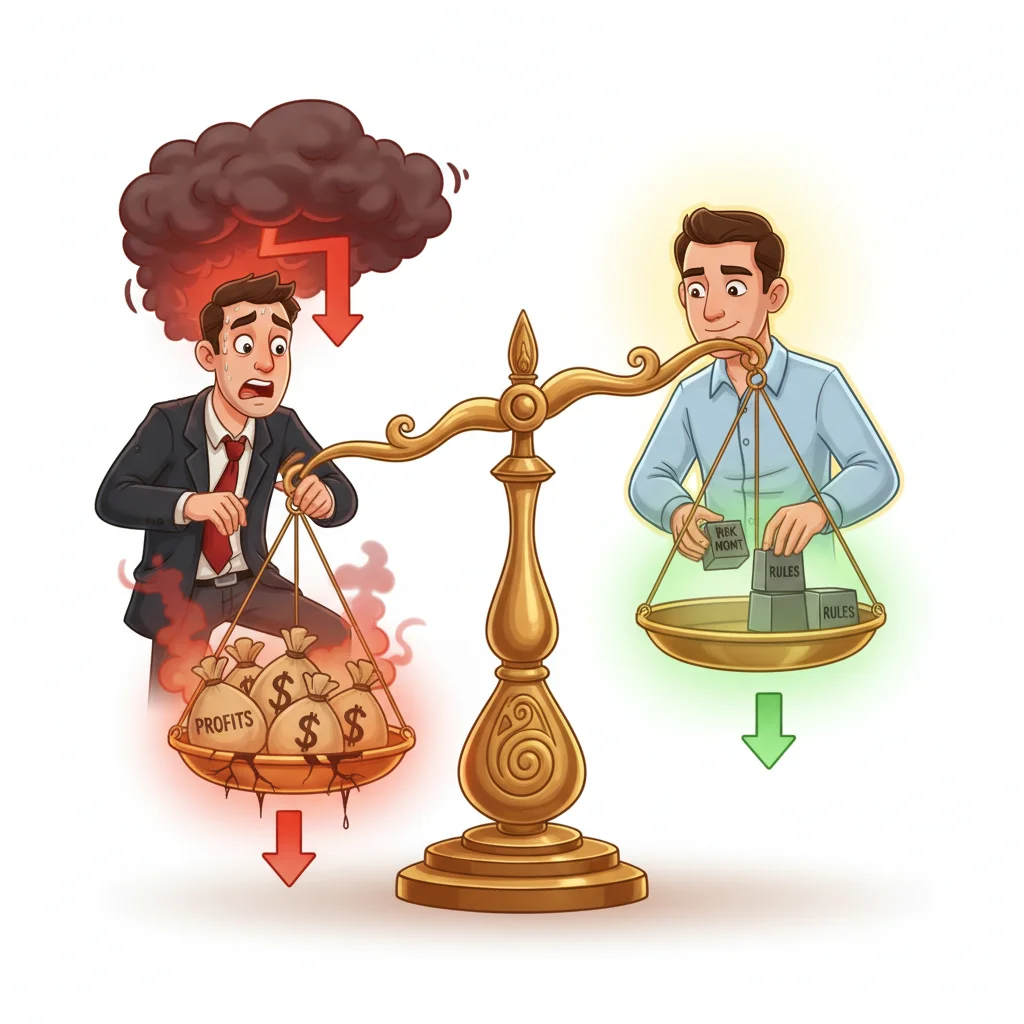
The difference between blown accounts and sustainable growth: one trader treats funded capital like it's free money and abandons discipline, while the other maintains strict position sizing and risk rules. Your psychology changes after passing the challenge—but your edge only survives if your process doesn't.
1. Treating the Funded Account Like Free Money
This is the one that kills the most accounts fastest. The moment a trader stops feeling the psychological weight of the capital, they start taking trades they'd never touch with their own money.
Here's what happens: you pay $299 for an FTMO $25,000 challenge (2025 pricing). You pass. You get funded. And somewhere in your brain, you decide the $25,000 isn't "real" because you didn't deposit it yourself. So you risk 3% on a single trade instead of your usual 1%. Then 4% on the next one because you want to "make back" the drawdown.
FTMO's maximum daily loss on a $25,000 account is $500 (2% of initial balance). MyFundedFutures runs a similar 2% daily drawdown on most challenge tiers. The Trading Firm (TFF) uses trailing drawdown on some products, which is even more punishing because it follows your peak equity, not just your starting balance.
I lost a $50,000 funded account in 2021 doing exactly this. I was up $1,800 on a Tuesday, felt invincible, and took three consecutive USD/JPY positions that all went against me. Hit the daily loss limit by Thursday. Account gone. The $399 challenge fee gone with it.
Fix this by treating the funded account like it belongs to a client. Because it does.

💡 Winston's Tip
Set your daily stop-out alert at 80% of your prop firm's daily loss limit, not 100%. That 20% buffer is the difference between a bad day and a terminated account.

Treating a funded account like free money = throwing it away. The moment you stop feeling the psychological weight of that $25,000, you start taking trades you'd never risk your own cash on.
“The funded account exposes every weakness in your process, every shortcut you took during evaluation, every assumption you made about market conditions.”
2. Ignoring the Trailing Drawdown Trap
Most traders read the rules once and miss the most dangerous clause in prop firm agreements: trailing drawdown.
Static drawdown is simple. If your account starts at $100,000 and the max drawdown is 10%, your floor is $90,000. Period.
Trailing drawdown is different. Your floor moves up as your equity moves up, but it never moves back down. So if you're on a $100,000 account with 5% trailing drawdown, and you run your account up to $108,000, your new floor is $102,600. You can't fall below that, or the account is terminated. Even if you're still technically "profitable" from your starting balance.
MyFundedFutures uses trailing drawdown on their Standard accounts. The Trading Firm applies it on specific futures products. Read every word of the account rules before you place your first trade.
The fix is straightforward but requires discipline:
- Track your equity peak manually in a spreadsheet every day
- Recalculate your real floor after any significant profit day
- Reduce position size after big wins, not just after losses
Using the ATR indicator (I run 14-period ATR on the H4 chart) to set stops that account for current volatility will keep you from accidentally violating a trailing drawdown on a volatile news day. This one detail has saved me more times than I can count.
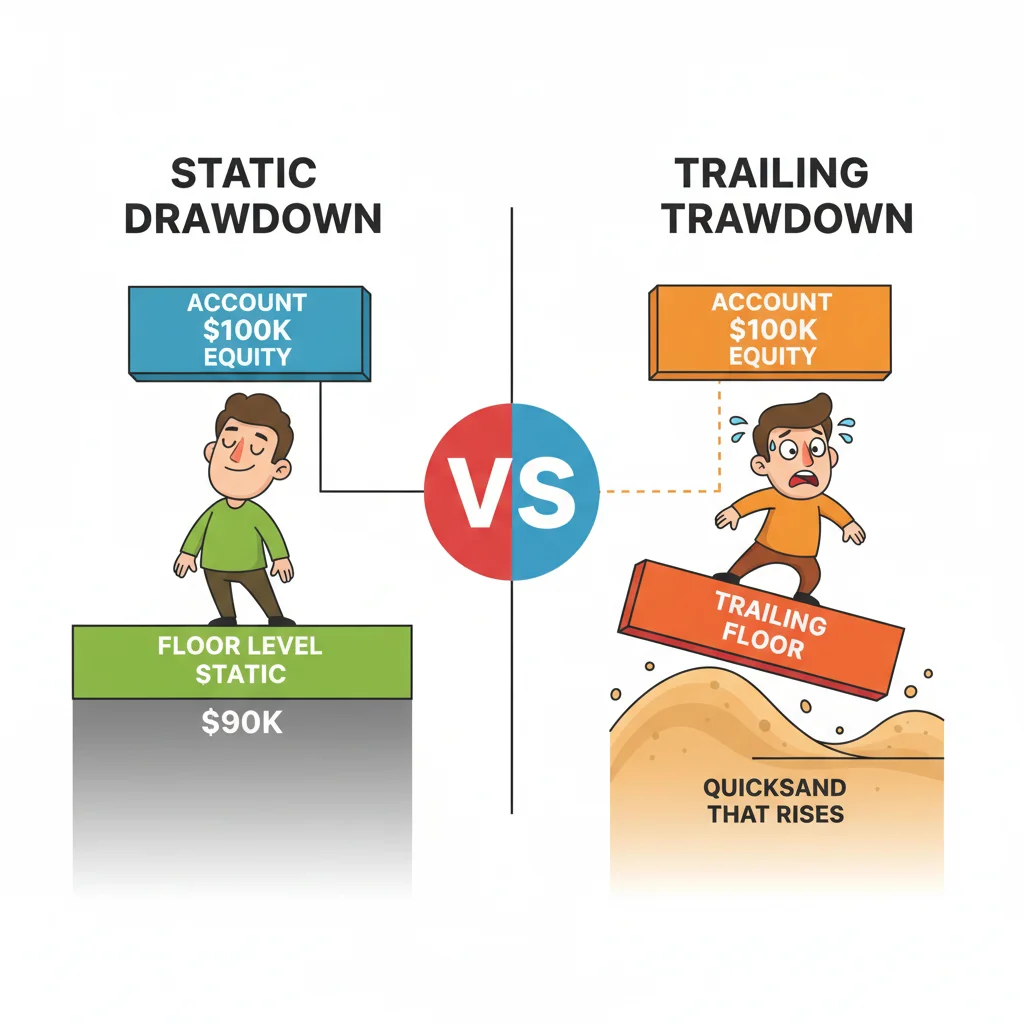
Static drawdown gives you a fixed floor, but trailing drawdown is a moving target—your risk floor rises as your equity climbs, meaning profits can vanish faster than you think if you don't understand this clause.
“After two consecutive losing trades, cut position size by 50%. After four consecutive losses, stop trading for the rest of the day. Period. No exceptions.”
3. Over-Trading During the Evaluation Phase vs. Going Silent After Funding
This one's contrarian, so pay attention.
Most articles tell you that over-trading is the problem. And it is during the challenge phase. But what I've noticed with traders I mentor is the opposite problem post-funding: they get so scared of losing the account that they stop trading altogether, or they take only micro-risk trades that can't possibly meet the profit targets.
FTMO's Phase 1 challenge requires a 10% profit target on a $25,000 account, which is $2,500. Phase 2 requires 5% ($1,250). Once you're funded, there's no minimum profit requirement on most accounts. But there is a minimum trading day requirement on FTMO: you must trade at least 4 days per month on your funded account to stay active.
The failure mode looks like this:
| Phase | Common Mistake | Result |
|---|---|---|
| Challenge Phase 1 | Over-trading to hit 10% fast | Blows daily drawdown |
| Challenge Phase 2 | Relaxing too early at 4% profit | Stagnates, misses deadline |
| Funded Phase | Under-trading out of fear | Fails minimum day requirement |
| Funded (after first payout) | Overconfidence surge | Violates drawdown in week 1 post-payout |
The payout milestone is especially dangerous. I've had three students blow their accounts within 72 hours of their first withdrawal. They felt validated, loosened their rules, and paid for it.
For a detailed look at how swing trading strategy can help you pace your funded account trading without over-committing on any single session, it's worth building a weekly trade plan before Monday open.
“After two consecutive losing trades, cut position size by 50%. After four consecutive losses, stop trading for the rest of the day. Period. No exceptions.”
4. Using the Wrong Position Sizing for the Account Type
Funded trader accounts are not your personal brokerage. The math is different, and if you're copying your retail sizing over without adjusting, you're going to blow up.
Here's the concrete problem. On your personal account with a broker like IC Markets or Pepperstone (see IC Markets review), you might risk 1.5% per trade with wide stops of 40-50 pips on EUR/USD. That works fine when your only constraint is your own risk tolerance.
On an FTMO $25,000 account with a $500 daily loss limit, a single trade with a 50-pip stop on EUR/USD at standard lot size (0.1 lot = $10/pip = $500 risk) eats your ENTIRE daily allowance in one trade. One trade. If that trade closes at a 25-pip loss and you take another one, you're gambling with your account.
The formula I use:
Max position size = (Account balance x daily loss % x 0.4) / (stop loss in pips x pip value)
The 0.4 multiplier is my personal buffer. I don't want a single trade to risk more than 40% of my daily loss limit. That leaves room for two or three trades to go wrong on a bad day without termination.
For EUR/USD specifically, pip values change with lot size. Get comfortable with the position size calculator before you ever open a position on a funded account. Eyeballing this is how accounts die.
💡 Winston's Tip
After every funded account blow-up, before you re-challenge, write down three sentences: what happened, why it happened, and what rule change prevents it from happening again. If you can't write all three, you're not ready to spend the challenge fee.
“Trailing drawdown is significantly harder to manage because strong performance days can actually tighten your effective risk tolerance.”
5. Trading News Events Without Understanding the Broker's Rules
This one is a policy violation, not just a risk management issue. And it gets accounts cancelled without appeal.
Several prop firms, including FTMO as of 2025, have specific rules around holding positions through major news events. Some prohibit it entirely on certain account types. Others allow it but won't cover any slippage beyond a threshold. MyFundedFutures has explicit guidance on their futures contracts around economic releases.
I've seen a trader blow a $200,000 funded account during the March 2024 NFP release. He was holding a 3-lot GBP/USD position, stop was set at 20 pips, but the spread blew out to 40 pips at the instant of release. His stop filled 38 pips worse than expected. The loss exceeded his daily limit, account terminated, and the prop firm declined his dispute because the account agreement excluded "abnormal market conditions."
Here's what to check before trading any news:
- Does your prop firm allow news trading on your account tier?
- What's the minimum stop distance required before news events (FTMO requires 2 minutes before high-impact news)?
- Does the firm use last look execution or guaranteed stops?
The solution for traders who want to trade news without the risk of policy violation is to either close all positions 5 minutes before a red-folder event, or to only enter after the initial spike settles (typically 3-5 minutes post-release). Not glamorous, but it keeps your account alive.
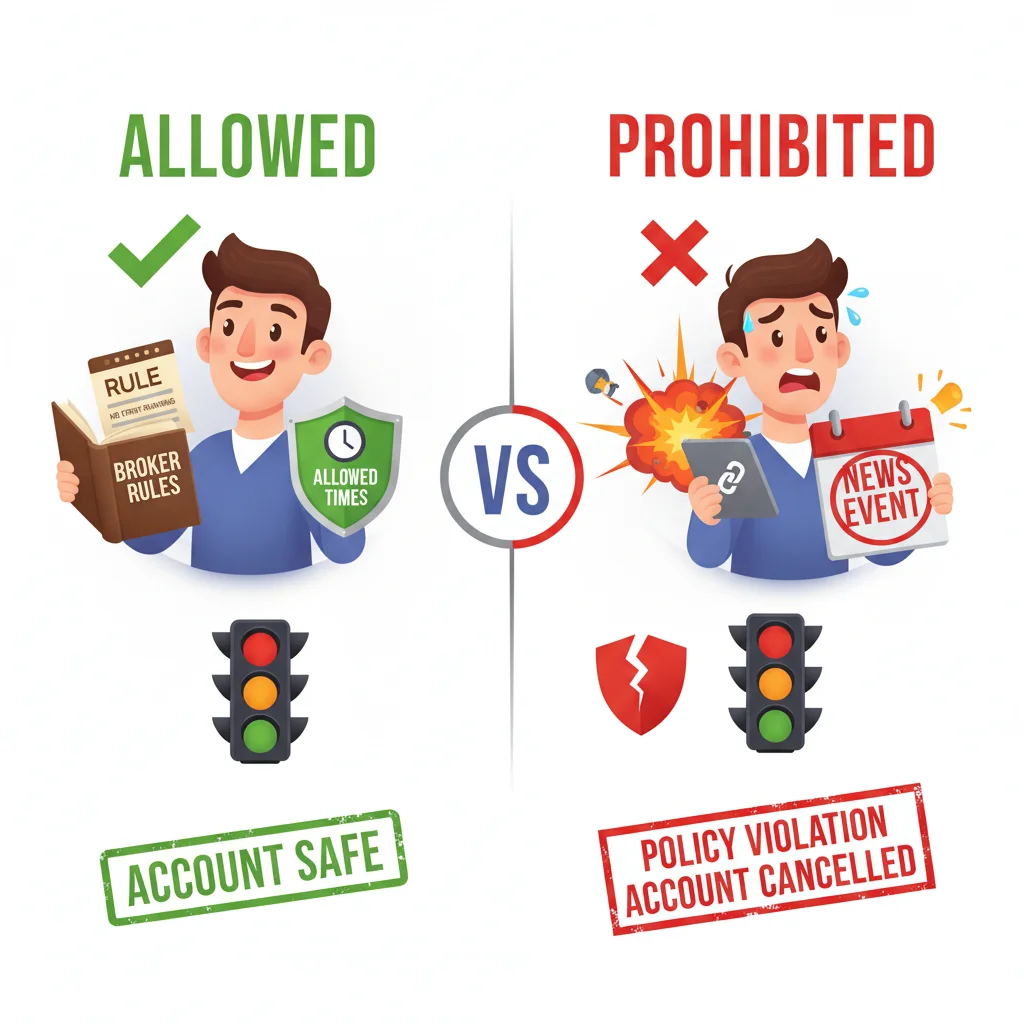
Major news events require strict compliance with your prop firm's specific rules—FTMO and others prohibit holding positions through certain announcements on specific account types. One violation triggers account cancellation with no appeal.
“Trailing drawdown is significantly harder to manage because strong performance days can actually tighten your effective risk tolerance.”
6. Not Scaling Down After a Losing Streak
Every funded trader I've ever mentored has heard this rule. Maybe 20% of them actually follow it.
Here's the psychological problem: after two or three losing trades, the natural human reaction is to want to "make it back." So you either keep trading at the same size, or worse, you increase size to recover faster. This is how a bad week becomes a blown account.
The math is brutal. If you're down 4% on a $25,000 FTMO account ($1,000), you have $1,500 left before the 10% max drawdown terminates the account. At 1% risk per trade, that's six more trades before you're out. At 2% risk per trade to "recover faster," that's only three more trades. You've just cut your runway in half.
My rule, which I've used since 2018: after two consecutive losing trades, cut position size by 50%. After four consecutive losses, stop trading for the rest of the day. Period. No exceptions.
If you're running a prop firm challenge and you're concerned about hitting your daily loss limit unexpectedly, tools like Pulsar Terminal handle this with Prop Firm Protection, which automatically closes all positions before you breach the daily limit, with a 5% safety buffer built in. It's saved me on two separate occasions when I stepped away from the screen during an active trade.
Streak-based position scaling is not weakness. It's risk management that keeps you in the game long enough to have a good week.
💡 Winston's Tip
Your challenge win rate means almost nothing. What matters is whether you can produce the same results under funded account conditions over 60+ trades. If you haven't tested that, you don't know your real edge yet.

After a losing streak, the urge to 'make it back' keeps you wired. But the funded account rules don't care about your emotions—scale down or blow up trying.
“If you can't answer what your average win rate is over 60+ trades in the last 90 days, you're not ready to fund. You're gambling on a hot streak.”
The One Mistake Nobody Talks About: Passing the Challenge with a Strategy You Can't Repeat
This might be the most important item on this list, and you almost never see it discussed.
Many traders approach the challenge phase as a separate performance, a sprint designed to hit specific numbers within a specific time window. They trade more aggressively, use strategies they've backtested for short-term edge, maybe even trade markets or sessions they don't normally touch. They pass.
Then they get funded and the strategy falls apart. Because it was designed for the challenge, not for consistent funded trading.
I had a student in 2023 who used a scalping strategy during his FTMO Phase 1 and 2. He was placing 12-15 trades per day on EUR/USD and GBP/USD using a 3-pip stop, 5-pip target model. It worked during the evaluation. When he got funded and tried to replicate it, the spreads during his usual trading hours were too wide, and the model required near-perfect execution that only held up under the pressure of a challenge. He blew the funded account in 11 days.
The rule I give every student: whatever strategy you use in the challenge must have at least 3 months of forward-tested results in a demo or personal account. Not backtested. Forward-tested.
If you can't answer "what is my average win rate over 60+ trades in the last 90 days," you're not ready to fund. You're gambling on a hot streak.
The funded account exposes every weakness in your process, every shortcut you took during evaluation, every assumption you made about market conditions. There's no hiding from it. Build the process first, pass the challenge second.
Disclaimer: This article is for educational purposes only and does not constitute investment advice. Trading forex and CFDs carries significant risk of loss. Past performance is not indicative of future results. Always do your own research and consider your financial situation before trading. Never risk money you cannot afford to lose.
Prof. Winston's Lesson
Key Takeaways:
- ✓Funded accounts demand psychological discipline: stop treating capital as free money to preserve accounts.
- ✓Trailing drawdown, not static drawdown, is the hidden account killer in prop firm agreements.
- ✓Scale down position sizing immediately after two losing trades to break the revenge trading cycle.
- ✓Pass challenges with repeatable strategies, not sprint performances designed to hit temporary numbers.

❓ Frequently Asked Questions
Q1What is the most common reason funded traders fail their prop firm accounts?
Violation of the daily loss limit is the single most common termination trigger across FTMO, MyFundedFutures, and The Trading Firm accounts. It usually happens not because of one catastrophic trade, but because of two or three losing trades on the same day that compound quickly. Traders who don't track their running daily P&L in real time are most at risk. The fix is setting a hard stop-out alert in your trading platform at 80% of your daily loss limit, giving yourself a buffer before termination.
Q2Can you actually make consistent income from prop firm trading in 2025-2026?
Yes, but the numbers require realistic expectations. FTMO's payout split is 80% to the trader (90% after scaling). On a $25,000 account, if you average 4% monthly profit ($1,000), your monthly take-home is $800. That's not a salary replacement, it's a supplement. Traders who treat it as supplemental income and scale up through multiple accounts tend to do better than those chasing a single large account as their primary income. The scaling plan matters more than the starting account size.
Q3Does FTMO allow news trading in 2025?
FTMO's 2025 rules permit news trading on most account types, but with restrictions. You cannot hold positions or place pending orders within 2 minutes before a high-impact news event on some account variations. Always check your specific account agreement because the rules differ between FTMO Swing accounts (which allow weekend holding) and standard accounts. Violating the news trading clause is a disqualification event, not just a loss.
Q4What's the difference between static and trailing drawdown at prop firms?
Static drawdown means your account floor is fixed from your starting balance and never changes. If you start at $100,000 with 10% static drawdown, your floor is always $90,000 regardless of how high your account grows. Trailing drawdown follows your equity peak. If your $100,000 account grows to $112,000, your floor moves to $102,000 (10% below peak) and never drops back down even if your equity falls. Trailing drawdown is significantly harder to manage because strong performance days can actually tighten your effective risk tolerance.
Q5How much should you risk per trade on a funded prop firm account?
The standard guidance is 0.5%-1% of account balance per trade, which is more conservative than most retail trading advice. On a $25,000 FTMO account with a $500 daily loss limit, risking 1% ($250) per trade means two losses eat your full daily allowance. I personally cap individual trade risk at 0.5% ($125) on funded accounts, which gives me four consecutive losing trades before I'm at the daily limit. This feels too conservative to most new funded traders, and then they blow their first account and suddenly it makes sense.
Q6Is it worth repeating a failed prop firm challenge, or should you switch firms?
Repeat the challenge with the same firm only if you have a clear, documented diagnosis of exactly what went wrong. Not a vague "I got unlucky" diagnosis, a specific one: "I violated the daily loss limit on day 7 because I held through NFP and my stop slipped." If you can't name the exact failure, you'll repeat it. Switching firms doesn't fix bad habits. The challenge fee at FTMO for a $25,000 account is $299, and at MyFundedFutures it varies by tier. Don't spend that money again on the same undiagnosed mistake.
How useful was this article?
Click a star to rate
Comments
Stay ahead of the markets
Get weekly market analysis, trading strategies, and MT5 tips delivered to your inbox. No spam, unsubscribe anytime.
About the Author
Daniel Harrington
Senior Trading Analyst
Daniel Harrington is a Senior Trading Analyst with a MScF (Master of Science in Finance) specializing in quantitative asset and risk management. With over 12 years of experience in forex and derivatives markets, he covers MT5 platform optimization, algorithmic trading strategies, and practical insights for retail traders.
Get Pulsar Terminal
All these calculators are built into Pulsar Terminal with real-time data from your MT5 account. One-click position sizing, automatic risk management, and instant calculations.
Get Pulsar TerminalYou Might Also Like

Risk Disclaimer
Trading financial instruments carries significant risk and may not be suitable for all investors. Past performance does not guarantee future results. This content is for educational purposes only and should not be considered investment advice. Always conduct your own research before trading.