

Leverage
/ˈliːvərɪdʒ/ (LEE-vuh-rij) or /ˈlɛvərɪdʒ/ (LEV-uh-rij)since Early 1990s interbank forex eraLeverage — like a financial magnifying glass — it lets you control a huge market position with just a tiny deposit, amplifying both your potential wins and losses.
§1So, what IS leverage anyway?
Okay, picture this: you're at a carnival and you see one of those giant claw machines. You know, the ones where you drop in a quarter and try to grab a giant stuffed animal worth twenty bucks? That quarter is your margin, the giant stuffed animal is the market position, and the mechanical claw? That's leverage. It's the tool that lets your tiny quarter control something much bigger. In trading terms, leverage is borrowing money from your broker to control a position way larger than what your own capital would normally allow. You put up a small deposit (called margin), and your broker lends you the rest. Sounds awesome, right? Well, here's the catch — just like that claw machine can drop your prize, leverage magnifies your losses just as much as your gains. I've seen traders get so excited about controlling $100,000 with just $1,000 that they forget the flip side: a 1% market move against you wipes out your entire deposit. Trust me, traders have blown accounts over this. So think of leverage as a superpower — use it wisely, or you'll end up like I did my first year, learning expensive lessons about risk.
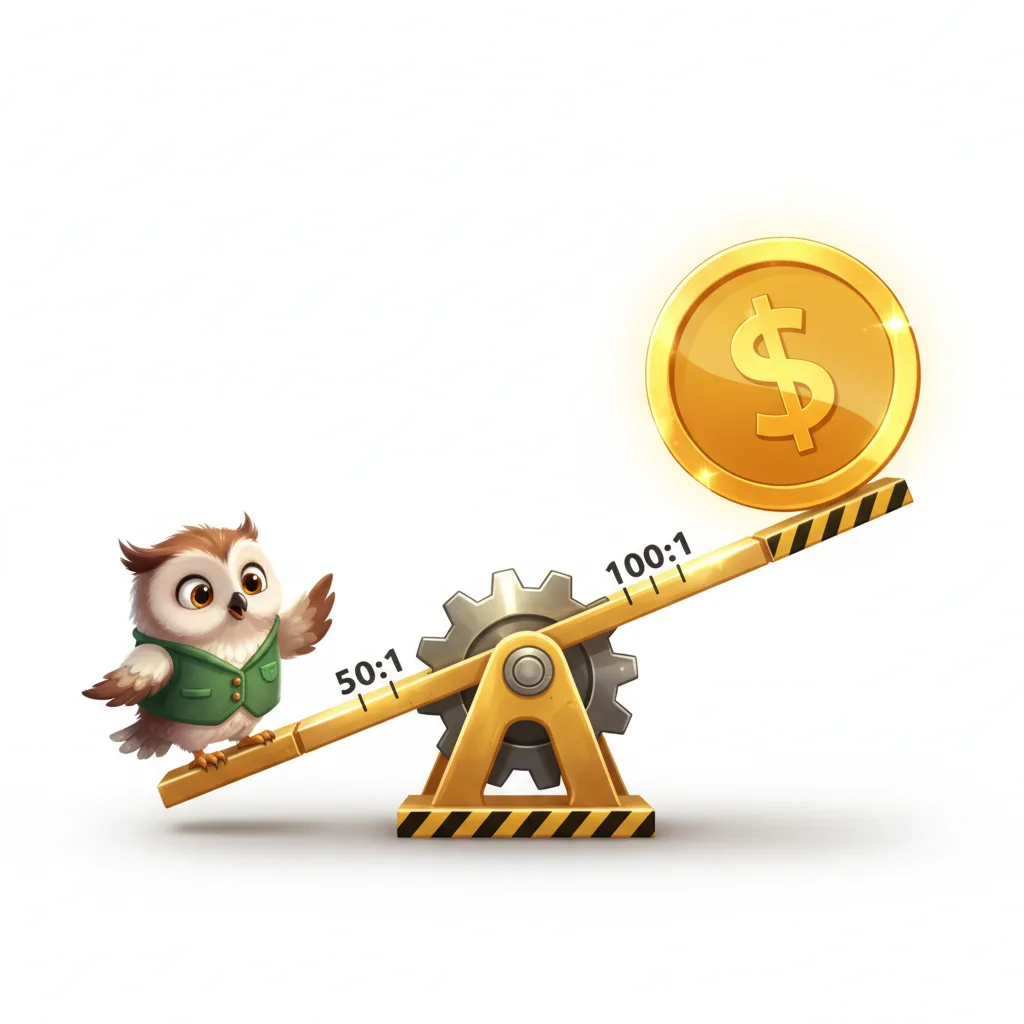
§2The math (don't run away — it's simpler than it looks!)
Alright, let's talk numbers without making your eyes glaze over. The formula is actually pretty straightforward: Leverage = Total Position Size / Margin Required. See? Not so scary! Here's how it works in practice. If your broker offers 50:1 leverage, that means for every $1 of your own money, you can control $50 in the market. Or think of it this way: the margin requirement is just 2% (because 1 divided by 50 equals 0.02, or 2%). So if you want to trade $10,000 worth of currency, you only need $200 of your own cash as collateral. The broker loans you the other $9,800. That's the amplification magic! Now, here's where it gets real: that 2% margin means your profits and losses are calculated on the full $10,000, not your $200. A 1% price move means $100 won or lost — that's 50% of your margin! That's why leverage is a double-edged sword. The math isn't complicated, but understanding what those numbers mean for your account? That's where the real learning happens.
§3Here's how it plays out in real life
Let's walk through a concrete example so you can see exactly how this works. Imagine you've got $1,000 in your trading account and you're eyeing EUR/USD at 1.0800. With 100:1 leverage (which means 1% margin), you could control one standard lot — that's 100,000 units of currency. The full position value is $108,000 (100,000 × 1.0800), but you only need to put up $1,080 as margin. See how your $1,000 just got supercharged? Now, if EUR/USD moves to 1.0810 — just 10 pips higher — your profit is $100. That's a 9.26% return on your margin in minutes! But here's the flip side: if it drops to 1.0790 instead, you lose $100. That's nearly 10% of your margin gone with a tiny market wiggle. This is why leverage demands respect. It's not just about the potential gains; it's about managing the amplified risk. Another example: with $5,000 and 20:1 leverage on the S&P 500 at 4500, you could control $45,000 worth of CFDs with just $2,250 margin. Every point move means $10 profit or loss. The mechanism is simple — small deposit controls big position — but the emotional rollercoaster? That's where experience comes in.
§4The weird exceptions nobody warns you about
Now, let's talk about the quirks. First up: JPY pairs. While most currency pairs measure pips at the fourth decimal place (like EUR/USD moving from 1.0800 to 1.0801), JPY pairs use the second decimal. So USD/JPY going from 155.00 to 155.01 is a 1-pip move. It's like the market decided Japanese Yen should be special — and honestly, it keeps us on our toes! Then there's the leverage landscape itself. If you're trading with a regulated broker in Europe, the UK, or Australia, you're probably looking at caps like 30:1 for major pairs and as low as 2:1 for cryptocurrencies. Why? Because regulators saw too many retail traders getting burned. But some offshore brokers? They might offer 500:1 or even 1000:1! Sounds tempting, right? Well, remember: higher leverage means faster account explosions if you're not careful. There's also dynamic leverage, where your ratio changes based on position size — kind of like a volume discount, but for risk. And if you qualify as a professional client, you might access higher leverage, but you lose some protective safeguards. The bottom line? Know your broker's rules, because leverage isn't one-size-fits-all.

§5Three examples that'll make it click
Let's look at some real scenarios so you can see leverage in action. I'll use a table to make it crystal clear:
| Scenario | Pair | Entry | Exit | P&L | What Happened |
|---|---|---|---|---|---|
| Bullish EUR | EUR/USD | 1.0800 | 1.0830 | +$300 | With 100:1 leverage, a 30-pip rise turned $1,080 margin into a 27.8% gain. Sweet! |
| Bearish GBP | GBP/USD | 1.2600 | 1.2550 | -$500 | Same leverage, 50-pip drop. That $500 loss wiped out nearly half of a $1,080 margin. Ouch. |
| Crypto volatility | Bitcoin | $60,000 | $57,000 | -$600 | With 2:1 leverage (50% margin) on a $6,000 position, a 5% drop meant a 20% loss on margin. |
Imagine you bought EUR/USD at 1.0800 because you thought the Euro was strengthening. With 100:1 leverage, that 30-pip move to 1.0830 gave you a $300 profit on your $1,080 margin — that's the power working for you! But if you'd bought GBP/USD at 1.2600 and it fell to 1.2550, you'd lose $500. That's why I always say: leverage doesn't change market direction, it just amplifies whatever happens. And with crypto at 2:1 leverage? A $3,000 drop in Bitcoin means a $600 loss on your $3,000 margin. These examples show why position sizing and stop-losses are your best friends when using leverage.
§6Where this thing even came from
Let's take a quick trip down memory lane. The idea of using borrowed money to amplify returns isn't new — think mortgages or business loans. But in retail trading? That's a more recent story. Back in the early days, high leverage was like the Wild West, with brokers offering ratios that could make your head spin. Then came the 2008 financial crisis. While not directly about leverage, it shone a spotlight on risk in financial markets. Fast forward to 2018, and European regulators said 'enough!' ESMA introduced caps: 30:1 for major forex pairs, lower for other assets, plus rules like negative balance protection. Why? Because they found most retail traders were losing money with crazy high leverage. The UK's FCA followed suit in 2020, and Australia's ASIC joined the party in 2021. These caps weren't about spoiling fun — they were about protecting people from wiping out their savings. It's a classic tale of innovation meeting responsibility. So today, when you see those leverage limits, remember: they're there because the market learned some hard lessons. And honestly? That's probably a good thing for beginners.
§7Key takeaways
- Leverage lets you control positions 100 times larger than your deposit — but remember, losses get amplified too!
- Beginners should stick to low leverage (like 1:20) to avoid wiping out their account while learning.
- Regulated brokers cap leverage at 30:1 for major pairs to protect retail traders from extreme risks.
- Always use stop-losses with leverage — a 10-pip move against you can mean a 10% loss on your margin.
- Margin is your deposit; leverage is the ratio that determines how much market exposure that deposit buys you.
§8Frequently asked questions
QWhat's the difference between leverage and margin?
QCan you lose more than your deposit with leverage?
QHow much leverage should a beginner use?
QWhat is a margin call?
QIs higher leverage better?
§See also
§References
- ESMA Product Intervention Measures on CFDs — European Securities and Markets Authority
- ASIC CFD Product Intervention Order — Australian Securities and Investments Commission