


Can you really start forex trading in South Africa with just R500? You see the ads promising the world with a tiny deposit, maybe even offering that magic 1:500 use.

David van der Merwe
Trader de Mercados Emergentes ·  South Africa
☕ 11 min de lectura
Lo que aprenderás:
- 1What '500 Forex Trading' Really Means (It's Not What You Think)
- 2The South African Legal Landscape: FSCA Rules & Your Money
- 3The Real Costs of Trading with Rands
- 4Building a Strategy for a Small Account
- 5Brokers and Platforms for South Africans
- 6From R500 to R5,000: A Practical Path
- 7Common Pitfalls to Avoid from Day One
Can you really start forex trading in South Africa with just R500? You see the ads promising the world with a tiny deposit, maybe even offering that magic 1:500 use. It sounds tempting, especially when you're starting out. But as someone who's traded through bull markets, crashes, and every emotion in between, I need to give you the real picture. Let's talk about what '500 forex trading' actually means for a South African trader, from the legal FSCA framework to the cold, hard numbers of making it work with our Rand.
When you hear '500 forex trading,' your mind probably jumps to two things: starting with R500, or using 1:500 use. The truth is more nuanced, and understanding this distinction is your first step to not blowing up your account.
The R500 Myth: Technically, yes, some international brokers or those with 'cent' accounts might let you open a position with a deposit that small. I tried this back in 2015 with a $50 (about R700 at the time) micro account. I traded 0.01 lots on EUR/USD. After the spread and a single small loss, my usable capital was crippled. The problem isn't the entry ticket; it's the breathing room. With R500, a 10-pip move against you on a mini lot could wipe out a huge chunk. You're not really trading; you're gambling on a single, high-stress bet.
The 1:500 use Reality: This is the more common meaning. use of 1:500 means for every R1 in your account, you can control R500 in the market. It's a powerful tool, but think of it like a supercharged sports car. In the wrong hands, it's a guaranteed crash. The FSCA limits use for retail traders to 30:1 for major pairs to protect you. However, some brokers regulated elsewhere (like offshore subsidiaries) may still offer 1:500 to South African clients. This is a major red flag if risk isn't your primary focus.

Warning: Using 1:500 use with a R500 deposit means you're controlling R250,000 in the market. A 0.2% move against you wipes your entire deposit. That's not trading; it's a coin flip with your rent money.
The real question isn't 'can I start with 500?' It's 'what's the sensible minimum to learn, survive my mistakes, and actually grow?' For that, I'd point you to R5,000 as a more realistic foundation. It allows for proper position size calculator use and lets you sleep at night.

💡 Consejo de Winston
A R500 account taught me more about risk than a R50,000 account ever did. The pressure to not lose a single cent is the best teacher you'll ever have.
“The real question isn't 'can I start with 500?' It's 'what's the sensible minimum to learn, survive my mistakes, and actually grow?'”
Trading here isn't the wild west. We have solid rules, and you need to know them to keep your money safe and stay on the right side of SARS.
The FSCA is Your Friend
The Financial Sector Conduct Authority (FSCA) is the main watchdog. Only use brokers licensed by them. You can check any broker's FSP number on the FSCA's public register. This license means they must segregate client funds (your money is kept separate from the broker's company money) and adhere to strict conduct rules. The 30:1 use cap for retail clients is one of these rules. It might feel restrictive, but it's there because the stats are brutal: between 51% and 89% of retail accounts lose money trading CFDs. The FSCA is trying to stop you from being a statistic.
Taxes and Exchange Control
This is where many new traders get a nasty surprise. Profits from forex trading are considered taxable income by SARS. You must declare them. Keep a detailed log of all your trades - entries, exits, profits, and losses. Losses can often be offset against profits.
Also, remember exchange control. You're generally not allowed to speculate against the Rand (ZAR) with the intention of harming it. While you can use your annual R1 million single discretionary allowance to fund an international broker, it's often simpler and cheaper to use an FSCA-regulated broker that offers a ZAR-denominated account. This avoids conversion fees and complexity. I learned this the hard way early on, losing a few hundred Rands on poor USD/ZAR conversion rates with an offshore broker before switching to a local entity like Exness or XM that cater to our market.
“Using 1:500 use with a R500 deposit is a coin flip with your rent money.”
Forget the 'commission-free' marketing. Trading has costs, and they eat into your profits (or amplify your losses) faster than you think. Let's break down what you're really paying.
The Spread: This is the main cost for most beginners. It's the difference between the buy (ask) and sell (bid) price. If EUR/USD is quoted at 1.0850/1.0853, the spread is 3 pips. You start your trade 3 pips in the red. On a R5,000 account trading a 0.1 lot, that's about R40 gone before the market even moves. Some brokers like IC Markets offer raw spread accounts with near-zero spreads but charge a commission per trade.
Commission: Usually quoted per lot, per side. A common structure is $3.50 per lot, per side. So, a round turn (opening and closing a 1 lot trade) costs $7. On a 0.1 lot trade, that's $0.70.
Swap Rates (Overnight Fees): If you hold a position past the daily rollover time (usually 10pm or 11pm SA time), you pay or receive interest. This is based on the interest rate differential between the two currencies. Holding a high-yielding currency against a low-yielding one can earn you a small credit. Doing the opposite costs you. For a swing trading strategy, this can add up.

Example: Let's say you buy 0.1 lots of AUD/JPY (AUD typically has a higher interest rate). You might earn R2-R5 per night per 0.1 lot. Sell it, and you'll likely pay. It's not huge, but it matters over weeks.
The Bottom Line: On a typical trade, your biggest immediate cost is the spread. On a R5,000 account, if your average trade risk is 1% (R50), a 3-pip spread on a major pair like EUR/USD (check our EUR/USD guide for specifics) might consume 20-30% of your risk budget before you see a profit. This is why chasing tiny, scalping strategy profits with a small account and high spreads is so difficult. You need the market to move significantly just to break even.
“Using 1:500 use with a R500 deposit is a coin flip with your rent money.”
Starting with a modest amount like R5,000 to R20,000 forces discipline. You can't afford fancy techniques; you need rock-solid fundamentals.
The Mindset: Preservation, Not Get-Rich-Quick
Your primary goal with a small account is to preserve it while you learn. Aim for consistent, small gains. A 2-5% return per month is phenomenal and sustainable. Trying to double your account in a week is a recipe for a margin call.
Risk Management is Non-Negotiable
This is your holy grail. Never, ever risk more than 1-2% of your account on a single trade. On a R5,000 account, that's R50 to R100 per trade. Use a stop-loss on EVERY trade. Calculate your position size based on the distance to your stop-loss. If your stop is 20 pips away, and you can only risk R50, you can only afford to trade a very small position (like 0.02 or 0.03 lots). Our position size calculator is essential for this.
Keep Your Strategy Simple
Pick one or two currency pairs and learn their personality. USD/ZAR is volatile and news-driven. EUR/USD is more liquid and technical. Gold (XAU/USD) acts as a safe haven. Don't jump between 10 pairs.
Use one or two reliable indicators to confirm your ideas, not to generate them. I've had the most success using price action (support/resistance, candlestick patterns) confirmed by a basic RSI indicator for overbought/oversold conditions or the MACD indicator for trend momentum. More indicators just lead to confusion and paralysis.

Pro Tip: Paper trade your strategy for at least two months. Note every trade, the reason for entry, and the outcome. If you can't be profitable on a demo account with no emotions, you won't be with real money. I paper traded for 3 months before my first live trade, and it was the best education I never paid for.
💡 Consejo de Winston
Your first R5,000 isn't for making money. It's for buying experience. Budget it as tuition fees, not investment capital.
“Your primary goal with a small account is to preserve it while you learn. A 2-5% return per month is phenomenal.”
Choosing where to trade is critical. You need a reliable partner, not just the one with the flashiest ads.
FSCA-Regulated Brokers: This is your safest bet. They offer ZAR accounts, local customer support, and adherence to our laws. Examples include the South African entities of global brokers. Pepperstone, for instance, has a strong reputation for tight spreads and good execution, though their local entity operates under FSCA rules (30:1 use). XM and Exness also have FSCA licenses and cater well to the local market with low minimum deposits.
The Platform: MetaTrader 4 (MT4) or MetaTrader 5 (MT5) are the industry standards. They're reliable, have countless free indicators, and are supported by almost every broker. MT5 is more modern and offers more timeframes and built-in indicators. Don't get distracted by fancy platforms until you've mastered the basics on MT4/5.
Minimum Deposits: These vary. You can find brokers with minimums as low as $5 (≈R70), but as discussed, that's not advisable. Look for brokers where a R1,500 to R5,000 deposit gives you access to all account features and reasonable costs. Always check the typical spreads for EUR/USD during the London session - this is your benchmark for cost.
A Word on 'High use' Brokers: Some offshore brokers will offer South Africans 1:500 use. Ask yourself: why would they offer something 16 times higher than what our regulator deems safe for me? The answer is they make more money when you lose. If you go this route, have the discipline to use only a tiny fraction of that available use. I once used a 1:500 account but never used more than 1:50 of it. The temptation is a killer.
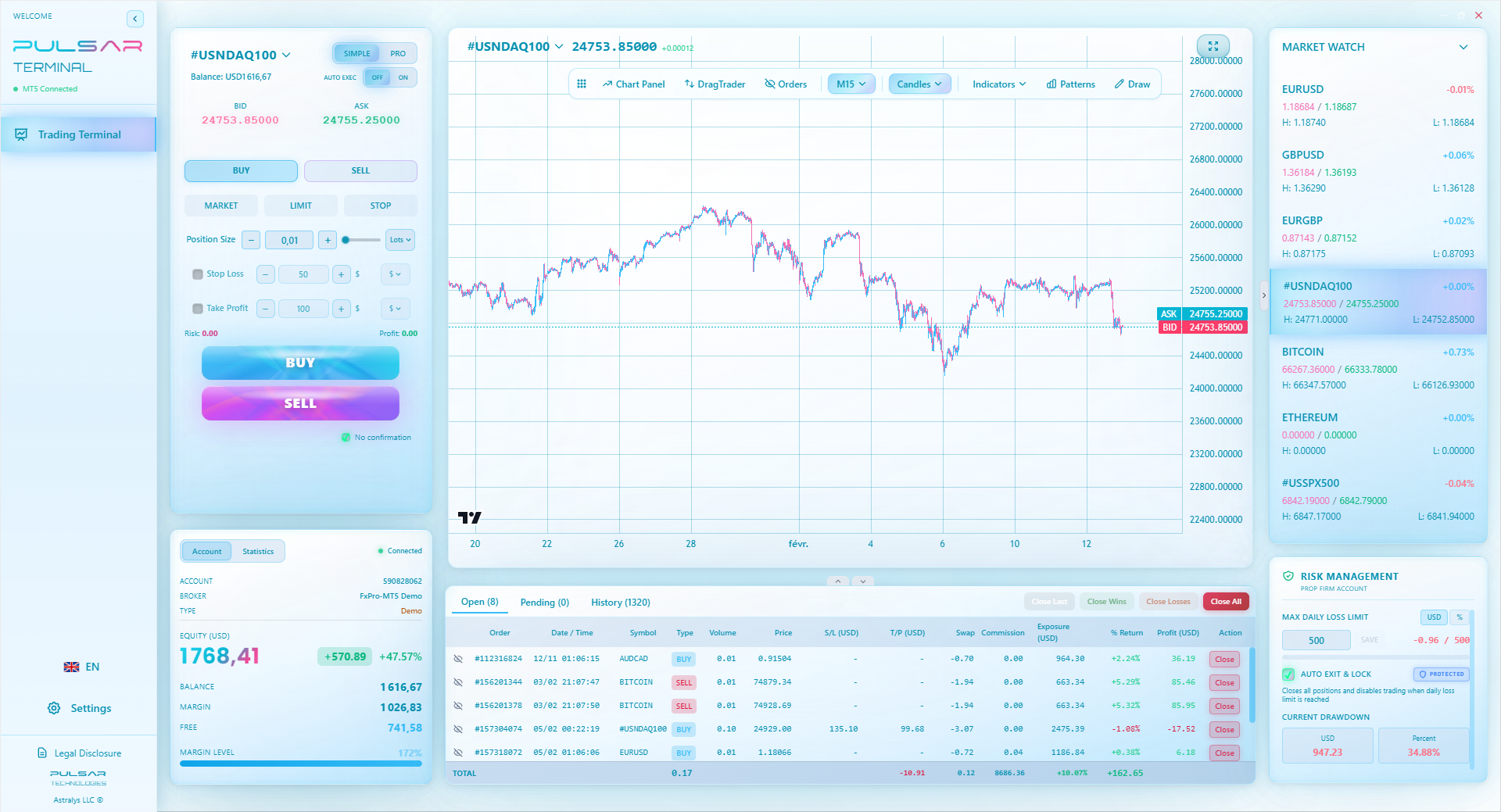
Managing multiple trades and setting precise stop-losses on MT5 is much easier with a tool that lets you drag and drop orders directly on the chart.
Pulsar Terminal
La herramienta MT5 todo-en-uno: órdenes drag-and-drop, multi-TP/SL, trailing stop, grid trading, Volume Profile y protección prop firm. Usado por más de 1.000 traders diariamente.
“Your primary goal with a small account is to preserve it while you learn. A 2-5% return per month is phenomenal.”
So, you're keen but only have a few hundred Rand to start? Here's a phased approach I wish someone had given me.
Phase 1: The R500 Learning Fund (3-6 Months) Deposit R500 into a demo account. Treat it as real. Follow all the rules: 1% risk per trade, use stops, keep a journal. Your goal is not to grow it to R5,000 (though that would be great). Your goal is to not blow it up for three consecutive months. If you can preserve and slowly grow a virtual R500 through different market conditions, you're learning the right habits.
Phase 2: The R2,000 Live Test (3 Months) Once you've proven consistency on demo, fund a live account with an amount you can afford to lose completely - R2,000 is a good test. The psychology changes with real money. You'll feel fear and greed. Trade the same strategy as on demo. Your sole objective here is to handle the emotions. If you can apply your rules with real money on the line for 3 months, you're ready for more serious capital.
Phase 3: The R5,000+ Foundation Now, you can fund your account with a more substantial amount. This R5,000 allows for sensible position sizing. A 1% risk is R50, which gives you room to place stops 20-30 pips away on a 0.1 lot trade, which is realistic. You can now focus on refining your strategy and aiming for that steady 2-5% monthly growth.
Remember, the path from R500 to R5,000 in capital is less about a magical trade and more about the slow, boring accumulation of skill and discipline. I turned R8,000 into about R12,000 in my first year of proper, disciplined trading. It wasn't glamorous, but it proved the system worked.
“The path from R500 to R5,000 in capital is less about a magical trade and more about the slow, boring accumulation of skill.”
Let me save you some pain and money by sharing the mistakes I made so you don't have to.
Chasing Losses: You lose R100 on a trade. The instinct is to immediately jump into another trade with a R200 risk to 'make it back fast.' This is how R500 accounts die in an afternoon. After a loss, walk away. The market will still be there tomorrow.
Over-trading: Boredom is not a trading signal. Just because you're sitting at the screen doesn't mean you need to be in a trade. Sometimes the best trade is no trade. I used to force trades on quiet afternoons just to feel involved, and I paid for it.
Ignoring the News: South African traders must pay attention to local and global events. SARB interest rate announcements, budget speeches, and US Non-Farm Payrolls can cause massive volatility. If you don't know what's scheduled, you're flying blind. I once got stopped out of a good USD/ZAR trade in 30 seconds because I forgot it was MPC day.
Not Understanding a pip definition and spread definition: This is basic, but crucial. Know exactly how much each pip movement is worth in Rands for your position size. Know that the spread is a direct cost. If you don't, you can't manage risk.
Using Too Much use: This is the big one. With a R5,000 account and 30:1 use (FSCA max), you can control R150,000. That's more than enough power to hurt yourself. You don't need to use it all. Start by using only what's necessary to take a 1% risk trade with a sensible stop-loss. The available use is a ceiling, not a target.
💡 Consejo de Winston
The spread isn't a fee you see on a statement, but it's the most consistent winner in the market. Never forget you're trading against it.
FAQ
Q1Is it legal to forex trade with R500 in South Africa?
Yes, it's legal to start trading with any amount, provided you use a broker regulated by the Financial Sector Conduct Authority (FSCA). The legality isn't about the amount, but about using a licensed provider and declaring any profits to SARS.
Q2Can I get 1:500 use with an FSCA broker?
No. The FSCA limits use for retail traders to a maximum of 30:1 for major currency pairs. Any broker offering 1:500 to a South African resident is likely not operating under the FSCA's local license but through an offshore entity. This comes with higher risk and less regulatory protection.
Q3What is the realistic minimum to start forex trading in SA?
While you can technically deposit less, a realistic minimum to trade safely and apply proper risk management is between R5,000 and R10,000. This allows you to risk 1% (R50-R100) per trade and survive the inevitable losing streaks while you learn.
Q4Do I pay tax on my forex trading profits?
Yes. The South African Revenue Service (SARS) views profits from forex trading as taxable income. You must keep detailed records of all your trades and declare the net profit (profits minus losses) in your annual tax return.
Q5What's the biggest mistake new traders make with a small account?
Using excessive use and risking too much per trade. With a R500 account, the temptation is to use huge use to make it feel meaningful. This almost guarantees a quick loss. The key is to risk a tiny percentage (1-2%) and focus on consistency over huge wins.
Q6Which trading platform is best for beginners in South Africa?
MetaTrader 4 (MT4) is the most common and beginner-friendly. It's stable, widely supported by FSCA brokers, and has a huge library of free educational resources and indicators. Master MT4 before considering anything else.
Lección del Prof. Winston
Puntos clave:
- ✓Treat your first R5,000 as tuition, not treasure.
- ✓Risk 1% per trade, no exceptions, even with R500.
- ✓The FSCA's 30:1 use limit is a protective shield, not a barrier.
- ✓A profitable demo month means nothing. Do it for three.
¿Te resultó útil este artículo?
Haz clic en una estrella
Análisis Trading Semanal
Análisis y estrategias semanales gratis. Sin spam.
Sobre el autor
David van der Merwe
Trader de Mercados Emergentes
Trader con sede en Johannesburgo con 11 años en divisas de mercados emergentes. Especialista en pares ZAR, trading regulado por la FSCA y análisis del mercado sudafricano.
Comentarios
Aviso de riesgo
El trading de instrumentos financieros conlleva un riesgo significativo y puede no ser adecuado para todos los inversores. El rendimiento pasado no garantiza resultados futuros. Este contenido tiene fines educativos únicamente y no debe considerarse asesoramiento de inversión. Siempre realice su propia investigación antes de operar.
También te puede interesar

Cara Trading Forex Sukses: 7 Prinsip dari Trader Profesional
Cara trading forex sukses dengan 7 prinsip trader pro: manajemen modal, disiplin, journal trading, backtest. Data nyata, bukan janji profit palsu.
Jam Trading Forex Terbaik untuk Trader Indonesia: Panduan Lengkap dengan Tabel Waktu
Panduan jam trading forex untuk trader Indonesia. Tabel 4 sesi dunia, jam emas 20:00-00:00, sesi mana yang harus dihindari. Data akurat + tips dari trader berpengalaman.
Top 5 Sàn Forex Uy Tín Nhất 2026: Review Jujur dari Trader Indonesia
Top 5 sàn forex uy tín 2026 untuk trader Indonesia. Review jujur: spread, deposit, withdraw, dukungan lokal. Exness, XM, IC Markets & lebih.
Obtener Pulsar Terminal
Todas estas calculadoras están integradas en Pulsar Terminal con datos en tiempo real de su cuenta MT5.
Obtener Pulsar Terminal