


I lost 75,000 NGN on a single EUR/USD trade because I blindly trusted a pivot point signal.

Olumide Adeyemi
Pionero del Trading en África Occidental ·  Nigeria
☕ 9 min de lectura
Lo que aprenderás:
- 1What Are Action Forex Pivot Points, Really?
- 2Setting Them Up for the Nigerian Trader
- 3Pivot Trading Strategies That Actually Work Here
- 4Mistakes I See Every Day (And Made Myself)
- 5A Special Note on Naira Pairs (USD/NGN, etc.)
- 6Fitting Pivots Into Your Overall Trading Plan
- 7Advanced Tactics & The Final Word on Risk
I lost 75,000 NGN on a single EUR/USD trade because I blindly trusted a pivot point signal. It was early 2023, and the daily pivot from Action Forex showed strong support at 1.0725. Price tapped it, bounced a few pips, and I went all in. No other confirmation, just pure faith in that line. The market sliced straight through it like a hot knife through butter, triggering my stop loss and leaving me staring at a blown account. That painful lesson taught me that pivot points aren't magic lines. They're tools, and in Nigeria's volatile market, using them wrong is a fast track to the poor house. Let's talk about how to use them right.
Forget the fancy jargon. Action Forex pivot points are just calculated price levels that tell you where the market might pause, reverse, or accelerate, based on where it was yesterday. They're not a crystal ball, but a map of yesterday's battle lines.
The classic formula is simple: Pivot Point (PP) = (High + Low + Close) / 3. From that PP, they calculate support levels (S1, S2, S3) and resistance levels (R1, R2, R3). Action Forex publishes these levels daily for all the major pairs. The idea is that if price approaches these levels today, traders who were active yesterday will remember them and potentially act.
Here's the thing most new traders miss: these are floor trader pivots, based on the New York close (5 PM EST). If you're trading on your MT4 platform with a broker like Exness or XM, your daily candle might close at a different time (like midnight server time). This tiny mismatch can throw the levels off by a few pips. It doesn't make them useless, but it means you shouldn't worship them.

Warning: Pivot points are lagging indicators. They're calculated from past price action. A strong news event from the CBN or a sudden oil price move can obliterate these levels in seconds. Never risk more than 1-2% of your capital on a pivot trade alone.

💡 Consejo de Winston
The pivot point (PP) is the day's fair value price. If the market opens far above it, there's often a pullback. Far below it, a bounce. Trade that mean reversion first.
“Pivot points aren't magic lines. They're a map of yesterday's battle lines.”
You don't need to calculate these by hand. Most platforms do it for you, but you have to set them up correctly.
On MT4/MT5
Go to Insert -> Indicators -> Custom -> Pivot Points. You'll see different types: Classic, Fibonacci, Camarilla. Start with Classic. The critical setting is the "Shift" or time zone. Since Action Forex uses the New York close, you need to align your platform. If your broker's server is in London (GMT), you might need to shift the indicator. Honestly, I gave up on this years ago. I just pull the daily levels from the Action Forex website each morning. It takes 30 seconds and eliminates platform errors.
Using the Action Forex Website
Bookmark it. Every day, they list the PP, R1, R2, R3, S1, S2, S3 for majors, minors, and even gold (XAU/USD). I have these levels scribbled on a notepad next to my screen. For trading instruments like XAU/USD, these pivots are especially useful as gold often respects technical levels.
Local Broker Quirks
If you're with a broker like IC Markets or Pepperstone, their raw spreads are fantastic, but their server times might be GMT+2 or GMT+3. Your chart's "daily" candle might close at 11 PM or midnight Nigerian time. This means the High, Low, and Close on your chart are different from what Action Forex used. Don't panic. The psychology around the levels is more important than the exact pip. If price is hovering around the published R1, it doesn't matter if your chart shows it at 1.0850 and Action Forex says 1.0852. The market is reacting to the zone.
“A failed pivot trade should cost you 1% of your account, not 20%.”
Throwing money at the S1 level because it's there is a strategy... for losing money. Here’s how I use them now.
The Bounce Trade (My Go-To)
I look for price to approach a major pivot (PP, S1, R1) alongside another confluence signal. For example, if EUR/USD is falling into the daily S1 and the 1-hour chart shows the RSI indicator dipping into oversold territory (below 30), that's a potential buy signal. I enter on a small bullish candlestick pattern after the touch. My stop loss goes just below the S1 level (or S2 if I'm feeling conservative).
Real trade from last month: GBP/USD at daily R1 (1.2630). The 4-hour MACD indicator showed bearish divergence. Price made a bearish pin bar at 1.2632. I sold. Took profit at the PP (1.2585). Risk: 25 pips. Reward: 45 pips. Not a home run, but solid.
The Breakout Trade
Sometimes, a pivot level breaks with serious momentum. If price slices through S1 with a big red candle on high volume, I don't fight it. I wait for a small pullback to the broken S1 (which now acts as resistance) and then enter a sell trade, targeting S2. This is more aggressive and works better for a scalping strategy on lower timeframes.
The Pivot Zone as a Filter
This is my favorite use. I use the central Pivot Point (PP) to gauge overall bias. If price is trading above the daily PP, I only look for buy setups on minor pullbacks. If it's below, I focus on sells. It keeps me on the right side of the day's average momentum. For longer-term plays, this concept aligns well with a swing trading approach, using weekly pivots for direction.

Pro Tip: The PP is the most important level. Major trends often start when price consolidates around the PP and then breaks away. Watch it like a hawk.
“A failed pivot trade should cost you 1% of your account, not 20%.”
Let's get honest about where we go wrong.
1. Treating Pivots as Holy Orders. A level is broken when price closes beyond it on your chosen timeframe, not just when it wicks past. That 1.0850 R1 level isn't "broken" because price spiked to 1.0853 for two seconds. Wait for the candle to close.
2. Ignoring Confluence. Trading a pivot in a vacuum is gambling. Is it aligned with a key moving average? A previous support/resistance zone? A 50% Fibonacci retracement? If not, your odds drop dramatically. Always use a position size calculator to ensure you're not over-leveraging on a weak signal.
3. Using Them on the Wrong Timeframe. Daily pivots are meaningless if you're a 5-minute scalper. The noise will eat you alive. If you're day trading, use yesterday's daily pivots on your 1-hour or 15-minute chart for context, but don't base your 5-minute entries on them.
4. Forgetting About Spreads. If S1 is at 1.0800 and the sell stop orders are at 1.0795, your broker's spread might be 1.2 pips on EUR/USD. Your market buy order could fill at 1.0801.2, putting you in immediate drawdown. Factor in the cost of trading, especially with exotic pairs involving the Naira.
5. Revenge Trading After a Pivot Fail. This was my biggest flaw. A level breaks, you take a loss, and you immediately jump back in trying to "catch" the move, abandoning all rules. One failed pivot trade should cost you 1% of your account, not 20%.
💡 Consejo de Winston
Never place your stop loss *exactly* at a pivot level. That's where everyone else's stops are. Place it 5-10 pips beyond to avoid the market's 'stop hunt'.
“Your edge in Naira pairs comes from fundamental awareness, not clean pivot bounces.”
Trading Naira pairs is a different beast. The official and parallel market rates create chaos, and CBN interventions can come out of nowhere.
Action Forex provides pivot points for USD/NGN, but you must be extremely careful. These levels are far less reliable due to the market's thin liquidity and frequent government manipulation. I avoid using standard technical pivots on USD/NGN altogether.
If you must trade it, use the pivots as very broad zones of interest, not precise entries. A move through a pivot level on USD/NGN is more likely to be driven by a CBN circular or a sudden change in oil prices than by technical trader psychology. The spreads are also usually much wider, so a pip definition movement costs more.
Your edge in Naira pairs comes from fundamental awareness, not clean pivot bounces. Watch for CBN announcements, EFEMS turnover data (that $350 million daily figure is key), and BDC licensing news. A technical level might give you a general area, but the fundamental catalyst will be the trigger.
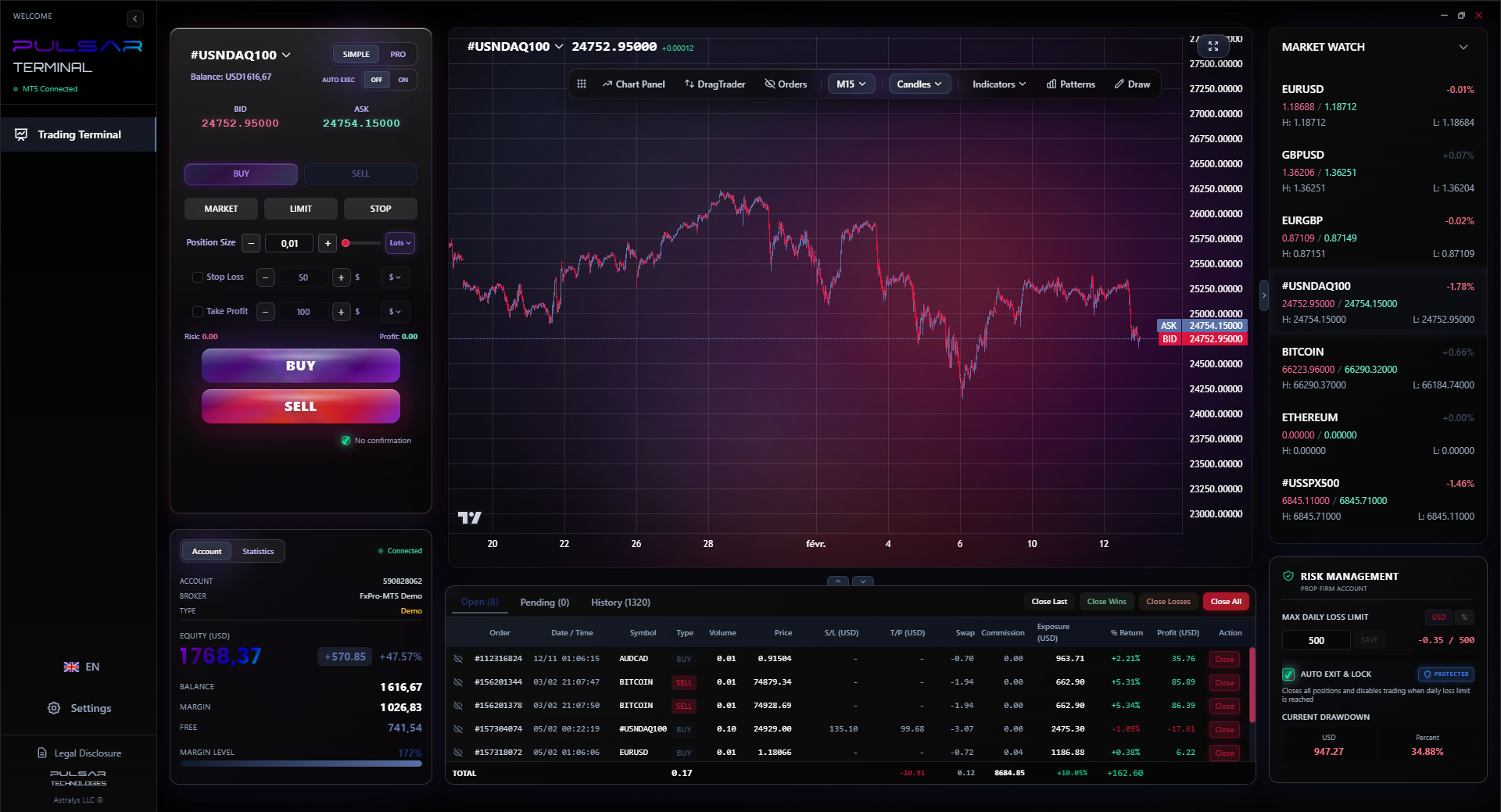
Managing multiple trades around pivot levels is easier with tools that let you set partial take-profits and trailing stops directly on your MT5 chart.
Pulsar Terminal
La herramienta MT5 todo-en-uno: órdenes drag-and-drop, multi-TP/SL, trailing stop, grid trading, Volume Profile y protección prop firm. Usado por más de 1.000 traders diariamente.
“Your edge in Naira pairs comes from fundamental awareness, not clean pivot bounces.”
Pivot points are one tool in the box. They are not the box.
Step 1: Market Bias. Check price vs. Daily PP. Above = cautiously bullish bias. Below = cautiously bearish.
Step 2: Key Levels. Mark the R1, S1, and PP on your chart. These are your potential profit targets and stop loss zones for the day.
Step 3: Wait for Confluence. Don't even think about a trade until price is at one of these levels AND you have a second reason to enter (candlestick pattern, indicator signal, order flow).
Step 4: Execute with Discipline. Use your position size calculator. Place your stop loss beyond the pivot level (allowing for a small overshoot). Set a realistic target at the next pivot level. Then walk away.
Step 5: The Tax Man Cometh. Remember, any profit you make is subject to a 10% Capital Gains Tax by the FIRS. Factor that into your profit targets. A 50,000 NGN win is really a 45,000 NGN win after tax. Keep records.
This structured approach turns pivot points from a guessing game into a professional framework. It prevents the emotional, reactive trading that kills accounts.
💡 Consejo de Winston
If price spends more than 3 consecutive candles consolidating *at* the PP (not bouncing), it's building energy for a big move. Be ready for a breakout and don't get caught fading it.
“The biggest risk isn't a failed trade. It's a margin call from over-leveraging on a 'sure thing'.”
Once you're comfortable, you can explore.
Multiple Timeframe Analysis: Use weekly pivots for the broad trend (published every Monday). Use daily pivots for intraday swings. If weekly R1 aligns with daily R2, you have a massive resistance zone.
Session Pivots: Some traders calculate pivots for specific trading sessions (London Open, NY Open). This is overkill for most, but if you're a session-based scalper, it can add an edge.
The Ultimate Risk: The biggest risk isn't a failed trade. It's a margin call from over-leveraging on a "sure thing" pivot bounce. Nigerian brokers, especially international ones serving us, offer high use (1:500, 1:1000). That use will magnify your losses faster than your gains if you're not careful with position sizing.
My final advice? Paper trade the Action Forex pivot points for a month. Note how price reacts at different levels during different market conditions (ranging vs. trending). See how many would have been winners, how many losers. Then, and only then, risk real money. These levels have served floor traders for decades because they represent collective memory. Used wisely, they can give you a slight edge. Used stupidly, they'll just show you the quickest path to a zero balance.
FAQ
Q1Are Action Forex pivot points free to use?
Yes, completely free. You can find them daily on the Action Forex website. You don't need to pay for any service or indicator to access the standard Classic pivot point levels.
Q2What's the best timeframe to use with daily pivot points?
The 1-hour and 4-hour charts are the sweet spot. Daily pivots provide context for these intraday timeframes. Using them on the 5-minute chart is too noisy, and on the weekly chart, they're too slow to be useful for entry.
Q3Why did the price blow straight through my pivot support level?
Usually one of three reasons: 1) A major news event (like CBN policy change or US NFP) overwhelmed technicals. 2) You were trading a low-liquidity pair or session. 3) The level lacked confluence - no other traders were watching it. Pivots work best when the market collectively believes in them.
Q4Do I need to adjust pivots for Nigerian broker server time?
It's ideal but not critical for the reason I stated earlier. The psychological zone matters more than the exact pip. If it's a huge concern, just use the published Action Forex levels directly instead of a platform indicator.
Q5How do I calculate profit targets using pivot points?
The most common method is to target the next pivot level. If you buy at S1, your first profit target is the Pivot Point (PP). If you sell at R1, your first target is also the PP. You can take partial profits there and let the rest run to R2 or S2.
Q6Are pivot points good for crypto trading?
They can be, but crypto's 24/7 market means there's no official 'daily close.' Most traders use UTC midnight or a time that matches major exchange activity. They're less established in crypto, so expect more false breaks.
Q7What is the 10% tax on forex profits in Nigeria?
It's a Capital Gains Tax (CGT) enforced by the Federal Inland Revenue Service (FIRS). You are legally required to declare your net annual trading profits and pay 10% on them. Keep detailed records of all trades, deposits, and withdrawals.
Lección del Prof. Winston
Puntos clave:
- ✓Always wait for a second confirmation signal at a pivot level.
- ✓Use the PP to define your daily bias: above=bullish, below=bearish.
- ✓Factor in the 10% Capital Gains Tax on all Nigerian profits.
- ✓Place stops 5-10 pips beyond pivot levels to avoid stop hunts.
¿Te resultó útil este artículo?
Haz clic en una estrella
Análisis Trading Semanal
Análisis y estrategias semanales gratis. Sin spam.
Sobre el autor
Olumide Adeyemi
Pionero del Trading en África Occidental
Uno de los educadores de trading forex más activos de Nigeria. 8 años de experiencia operando desde Lagos. Especialista en estrategias de bajo capital y desafíos de prop firms para traders africanos.
Comentarios
Aviso de riesgo
El trading de instrumentos financieros conlleva un riesgo significativo y puede no ser adecuado para todos los inversores. El rendimiento pasado no garantiza resultados futuros. Este contenido tiene fines educativos únicamente y no debe considerarse asesoramiento de inversión. Siempre realice su propia investigación antes de operar.
También te puede interesar

Cara Trading Forex Sukses: 7 Prinsip dari Trader Profesional
Cara trading forex sukses dengan 7 prinsip trader pro: manajemen modal, disiplin, journal trading, backtest. Data nyata, bukan janji profit palsu.
Jam Trading Forex Terbaik untuk Trader Indonesia: Panduan Lengkap dengan Tabel Waktu
Panduan jam trading forex untuk trader Indonesia. Tabel 4 sesi dunia, jam emas 20:00-00:00, sesi mana yang harus dihindari. Data akurat + tips dari trader berpengalaman.
Top 5 Sàn Forex Uy Tín Nhất 2026: Review Jujur dari Trader Indonesia
Top 5 sàn forex uy tín 2026 untuk trader Indonesia. Review jujur: spread, deposit, withdraw, dukungan lokal. Exness, XM, IC Markets & lebih.
Obtener Pulsar Terminal
Todas estas calculadoras están integradas en Pulsar Terminal con datos en tiempo real de su cuenta MT5.
Obtener Pulsar Terminal