


If you're a South African trader named Andile, or just feel like one, you're probably being sold a dream.

David van der Merwe
Trader de Mercados Emergentes ·  South Africa
☕ 8 min de lectura
Lo que aprenderás:
- 1The South African Trading Reality: It's Not What You See on Instagram
- 2Your Biggest Enemy Isn't The Market
- 3Building a Strategy That Works for *You* (Not Andile in the Ad)
- 4Tools and Brokers: Cutting Through the Noise
- 5The Prop Firm Trap (And Real Funding Paths)
- 6Putting It All Together: A Routine, Not a Hustle
If you're a South African trader named Andile, or just feel like one, you're probably being sold a dream. The stats are brutal: around 80% of retail traders lose money. In South Africa, that number might be higher when you factor in rand volatility and the sheer number of unregulated 'opportunities' pushed on social media. This isn't about getting rich quick. It's a guide on how not to get poor fast. We'll cut through the hype and look at what it really takes to trade from Johannesburg, Cape Town, or Durban without handing your hard-earned rands over to the market.
Let's be blunt. The image of the forex trader chilling on Clifton Beach with a laptop is a marketing fantasy for 99.9% of people. The real environment for a South African trader is tough. You're trading global markets from a different time zone, often with a currency (the ZAR) that's more volatile than the majors you're probably trading. Your internet can be shaky during loadshedding, and your biggest enemy isn't the market - it's the guy on YouTube selling a 'secret system' for R4,999.
I remember my first major mistake back in 2015. I got a tip on a USD/ZAR move from a forum. I threw R20,000 into a position without a stop loss, convinced it was a sure thing. Two days later, a surprise SARB announcement wiped me out. I lost R18,500 in 48 hours. That was a brutal, expensive lesson that no Instagram post will ever show you.
The real work happens in the quiet hours. It's checking economic calendars for US Non-Farm Payrolls at 3:30 PM SA time. It's understanding how spreads widen on exotic pairs involving the rand. It's knowing which brokers are actually accessible and properly regulated for South Africans, not just the ones with the flashiest ads.
It's Your Psychology (And Your Broker's Spread)
Markets don't care about you. They're not out to get you. But your brain is wired to make terrible trading decisions. Fear of missing out (FOMO) will make you chase a move. The pain of a loss will make you hold a losing trade hoping it turns around - a surefire path to a margin call. Greed will stop you from taking good profits.
Here's a personal rule I developed after blowing up that first account: If I feel a strong emotion - excitement, panic, frustration - I'm not allowed to touch the trade button. I have to walk away for 10 minutes. This simple habit has saved me more money than any indicator.
The Hidden Costs That Eat Your Rands
You think you just need the price to move in your direction? Think again. Every trade starts in a hole because of the spread. On EUR/USD, it might be 0.8 pips with a good broker. On something like USD/ZAR, it can be 50 pips or more. That means the market needs to move 50 pips just for you to break even. Then there's swap fees (overnight financing), which can be steep on certain pairs. If you're scalping, these costs are your nemesis. A strategy that looks profitable on a free charting platform can be a total loser once real trading costs are factored in.

Warning: If a 'guru' shows you a backtested strategy but never talks about the exact spreads and commissions they used, that strategy is worthless. They're probably hiding the fact that costs would turn the profit into a loss.

💡 Consejo de Winston
The market's job is to prove you wrong. Your job is to have a plan for when it does. That plan is your stop loss.
“If I feel a strong emotion - excitement, panic, frustration - I'm not allowed to touch the trade button. This simple habit has saved me more money than any indicator.”
Forget finding a 'holy grail'. Your strategy needs to fit your life. Are you a full-time accountant in Sandton? Then 5-minute chart scalping is impossible. You need a swing trading approach where you check charts once a day, in the evening.
Start with one instrument. I mean it. Just one. Master EUR/USD or XAU/USD (gold). Learn how it reacts to news, its average daily range, and its personality. My most consistent year came when I traded only the EUR/USD for 12 months. I knew it better than I knew my own schedule.
Your strategy must have three non-negotiable parts:
- A clear trigger for entry. (e.g., Price pulls back to the 50-day EMA AND the RSI indicator is above 30).
- A defined stop loss. ALWAYS. Use our position size calculator to figure this out based on how much of your account you're willing to risk (never more than 1-2% per trade).
- A clear take-profit target or a trailing stop rule.
Here’s a comparison of two common, simple approaches:
| Approach | Time Commitment | Best For | Major Risk |
|---|---|---|---|
| Swing Trading | 30-60 mins/day | Full-time job holders | Weekend gaps, missing slow turns |
| Day Trading | 4-8 hours/day | Flexible schedule, disciplined | Overtrading, cost accumulation |

Example: You have a R50,000 account. You decide to risk 1% per trade (R500). Your strategy on USD/CAD says place a stop loss 25 pips away. How much can you trade? R500 / (25 pips * ZAR per pip value) = Your position size. If you don't do this math, you're gambling.
The platform you use matters. Most South Africans end up on MetaTrader 4 or 5. It's the industry standard for a reason. But the raw MT5 platform is pretty basic. This is where companion tools come in. Having a tool that lets you drag and drop orders, set multiple take-profit levels, and automate a trailing stop is a game-saver. It takes emotion out of the execution.
When choosing a broker, regulation is your first filter. Yes, offshore brokers might offer crazy use like 1:2000. That's not a benefit, it's a death trap. Look for brokers with a solid reputation and clear regulation, even if use is capped lower. Check out our deep dives on brokers like IC Markets, Pepperstone, and XM to see how they stack up for South African clients in terms of deposits, withdrawals in ZAR, and customer support.
Your toolkit should also include:
- A reliable economic calendar (like Forex Factory).
- A journal. I use a simple Google Sheet to log every trade: entry, exit, reason, emotion, screenshot. Reviewing this weekly is more valuable than any new indicator.
- A fast, stable internet connection with a UPS for loadshedding. A disconnection during a trade is not an excuse your broker will accept.
💡 Consejo de Winston
If you can't explain your trade setup in one simple sentence, you don't have a setup. You have a hope.
“The goal is to make the process boring. The excitement should be in the analysis and the discipline, not in the P&L flashing green and red.”
This is a huge topic for the modern Andile forex trader. Prop trading firms promise you the chance to trade with 'their' capital after you pass a challenge. It sounds perfect: prove your skill, get funded, keep a share of the profits.
Here's the cold truth. Most of these firms make their money from the challenge fees, not from your trading profits. They set rules that are psychologically brutal: a strict daily loss limit, a maximum drawdown, and a profit target - all on a ticking clock. The structure almost encourages overtrading and insane risk-taking to hit the target.
I tried one in 2023. I paid a $300 fee for a $100,000 challenge. The rule was a 5% max drawdown and a 10% profit target in 30 days. I was up 8% in two weeks, feeling great. Then I had one bad day, a 2.5% loss. The pressure to make it back before the deadline made me force trades. I broke my own rules, took a stupid setup, and hit the 5% max loss. $300 gone. The firm won. I learned that these challenges test your ability to pass a specific, stressful exam, not your ability to be a consistent trader in the real world.
If you want to pursue this path, you need a strategy built for consistency, not speed. You need a tool that can automatically enforce the prop firm's daily loss rules for you, so one emotional mistake doesn't blow the entire account. The real path to growing capital is slow: preserve what you have, compound small gains from a small personal account, and only trade with money you can truly afford to lose.
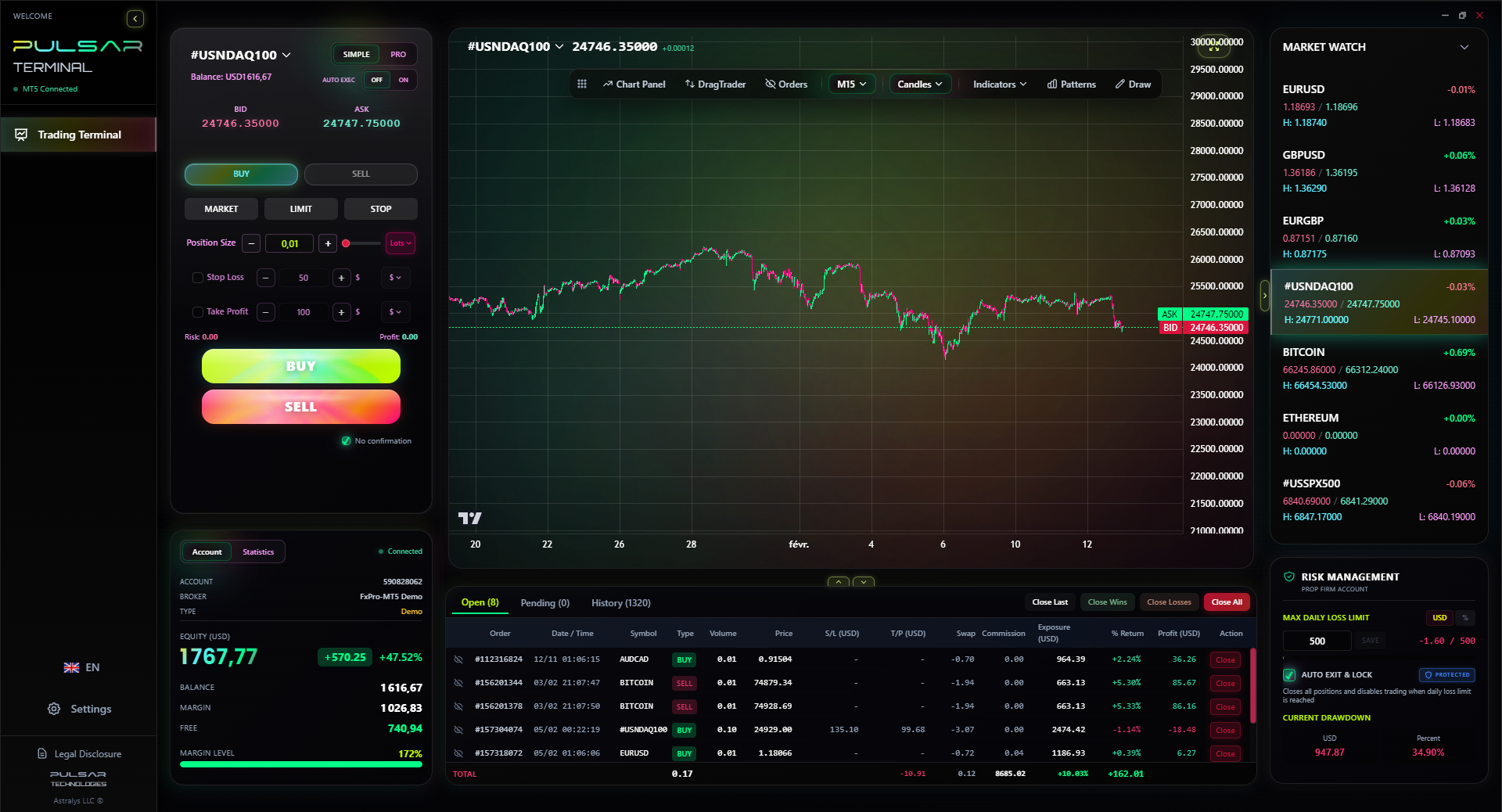
Managing the complex rules of a prop firm challenge requires robotic discipline, which is exactly what automation tools in Pulsar Terminal are built for.
Pulsar Terminal
La herramienta MT5 todo-en-uno: órdenes drag-and-drop, multi-TP/SL, trailing stop, grid trading, Volume Profile y protección prop firm. Usado por más de 1.000 traders diariamente.
Trading isn't a side hustle. It's a skilled profession that requires routine and discipline. Here’s what a realistic evening might look for a swing trader in SA:
6:00 PM: Review the day. Check your journal. Did you have a trade setup? Did you follow your plan? 6:15 PM: Scan the economic calendar for the next 24 hours. Big events? Plan around them. No new trades right before major news. 6:30 PM: Analyze your one or two chosen charts. Look for setups that match your strategy's rules. No setup? Do nothing. That's a valid outcome. 7:00 PM: If a setup exists, calculate your position size, set your orders with stop loss and take profit. Then walk away.
The goal is to make the process boring. The excitement should be in the analysis and the discipline, not in the P&L flashing green and red. When you stop chasing the adrenaline and start treating it like a business of risk management, you've crossed the biggest hurdle. You're no longer just another Andile forex trader dreaming on social media. You're a risk manager with a chance.
💡 Consejo de Winston
Your first profit target should always be to get your risk off the table. Move your stop to breakeven as soon as possible.
FAQ
Q1How much money do I need to start forex trading in South Africa?
Technically, some brokers let you start with a few hundred rands. Realistically, you need enough to survive the learning curve without blowing up. I'd say a minimum of R10,000 in risk capital - money you can afford to lose completely - is a more serious starting point. This allows for proper position sizing without over-leveraging on a tiny account.
Q2Is forex trading taxable in South Africa?
Yes. SARS views trading profits as income if you're trading regularly (not as a long-term investment). You need to declare your net profit (profits minus losses and expenses) in your annual tax return. Keep careful records of all your trades, deposits, and withdrawals. Consult a tax professional who understands trading.
Q3What's the best time to trade forex from South Africa?
The most liquid and volatile sessions are the London overlap (10:00 AM - 1:00 PM SAST) and the London/New York overlap (3:00 PM - 5:00 PM SAST). This is when you'll see the most movement. Asian session (early morning SA time) is typically quieter. Align your strategy with the market's activity.
Q4Can I use my South African bank account to fund a forex broker?
Yes, but it's not always straightforward. Many international brokers accept bank wire transfers in ZAR, but your bank may charge high fees and the exchange rate might be poor. Alternatives like credit/debit cards or e-wallets (Skrill, Neteller) are often faster and cheaper. Always check your specific broker's deposit options for South Africa.
Q5How do I know if a forex broker or educator is a scam?
Red flags: They promise guaranteed profits or extremely high returns with no risk. They pressure you to deposit money quickly. They're not transparent about fees. They operate without any verifiable regulation. For educators, if they're selling a dream lifestyle more than a concrete education process, be wary. Real educators talk about risk, psychology, and losses.
Q6Is high use good for a beginner?
Absolutely not. High use (like 1:500 or 1:1000) magnifies both profits AND losses. For a beginner, it's a shortcut to losing your entire deposit very quickly. Start with low use (1:10 or 1:20) to learn how to manage positions and risk properly. use is a tool, not a strategy.
Lección del Prof. Winston
Puntos clave:
- ✓Risk a maximum of 1-2% of your account on any single trade.
- ✓Master one instrument before even looking at a second.
- ✓Your stop loss is not a suggestion; it's an insurance policy.
- ✓Prop firm challenges are designed to be failed; trade them like a robot, not a human.
¿Te resultó útil este artículo?
Haz clic en una estrella
Análisis Trading Semanal
Análisis y estrategias semanales gratis. Sin spam.
Sobre el autor
David van der Merwe
Trader de Mercados Emergentes
Trader con sede en Johannesburgo con 11 años en divisas de mercados emergentes. Especialista en pares ZAR, trading regulado por la FSCA y análisis del mercado sudafricano.
Comentarios
Aviso de riesgo
El trading de instrumentos financieros conlleva un riesgo significativo y puede no ser adecuado para todos los inversores. El rendimiento pasado no garantiza resultados futuros. Este contenido tiene fines educativos únicamente y no debe considerarse asesoramiento de inversión. Siempre realice su propia investigación antes de operar.
También te puede interesar

Cara Trading Forex Sukses: 7 Prinsip dari Trader Profesional
Cara trading forex sukses dengan 7 prinsip trader pro: manajemen modal, disiplin, journal trading, backtest. Data nyata, bukan janji profit palsu.
Jam Trading Forex Terbaik untuk Trader Indonesia: Panduan Lengkap dengan Tabel Waktu
Panduan jam trading forex untuk trader Indonesia. Tabel 4 sesi dunia, jam emas 20:00-00:00, sesi mana yang harus dihindari. Data akurat + tips dari trader berpengalaman.
Top 5 Sàn Forex Uy Tín Nhất 2026: Review Jujur dari Trader Indonesia
Top 5 sàn forex uy tín 2026 untuk trader Indonesia. Review jujur: spread, deposit, withdraw, dukungan lokal. Exness, XM, IC Markets & lebih.
Obtener Pulsar Terminal
Todas estas calculadoras están integradas en Pulsar Terminal con datos en tiempo real de su cuenta MT5.
Obtener Pulsar Terminal