


Let me be straight with you: most forex trading courses are a complete waste of money.
James Mitchell
Analista de Trading Sénior
☕ 10 min de lectura
Lo que aprenderás:
- 1Why Trading Forex in California is a Different Beast
- 2What Actually Makes a Forex Course Worth the Money?
- 3A Real Trader's Review of Top California-Based Resources
- 4The Absolute Best Free Foundation (Do This First)
- 5Real Costs and What You Should Realistically Expect
- 6How to Actually Integrate Course Knowledge into Your Trading
- 7My Personal Advice for New California Traders

Let me be straight with you: most forex trading courses are a complete waste of money. They're filled with recycled YouTube strategies and empty promises. But after 12 years trading from LA to San Diego, I've found a handful of California-based resources that actually deliver real value. This isn't about finding a magic bullet - it's about finding education that respects the brutal reality of the US-regulated market. I'll show you what to look for, what to avoid, and share the few programs that helped me turn the corner.
Trading from California isn't just about surfing and sunshine. You're operating under the strictest regulatory environment in the world, and most generic courses don't prepare you for that. The CFTC and NFA rules change the game completely.
First, the use cap. You get 50:1 on majors and 20:1 on minors. Compare that to the 500:1 or even 1000:1 offered by offshore brokers like Exness or IC Markets, and your strategy needs a major adjustment. You can't rely on huge use to bail out small account sizes. Your position size calculator becomes your most important tool.
Then there's the FIFO rule (First-In, First-Out) and the no-hedging rule. You can't just open opposing positions on the same pair to 'lock in' a price. This kills a lot of common risk management techniques taught elsewhere. I learned this the hard way in 2015. I had a losing EUR/USD trade and tried to open a small opposite position as a hedge, thinking I was being clever. My platform wouldn't let me. The trade kept going against me for another 80 pips because my only option was to close it for a loss or add to it (which was even riskier).
A proper course for a Californian trader must drill these rules into you from day one. If it doesn't, it's teaching you for a market you can't legally access.
Forget the flashy sales pages with Lamborghinis. A worthwhile course provides structure, accountability, and most importantly, focuses on psychology and risk management over secret indicators.
The Non-Negotiables
A credible course must cover US-specific mechanics: how to manage trades with FIFO, how to calculate position size with limited use, and how to navigate the platforms offered by US brokers like OANDA or FOREX.com. It should spend as much time on losing as it does on winning.
The Red Flags
Run if you see: 'guaranteed profits,' 'passive income,' or 'get rich quick.' Any course charging $5,000 for a 'mastermind' is selling a dream, not an education. I once paid $2,700 for a 'prop firm accelerator' course that was just a guy reading slides about basic support and resistance. The only thing it accelerated was my regret.

Warning: Be extremely wary of courses that teach strategies requiring high use (like 200:1 or more) or hedging techniques. These strategies are illegal for you to execute with a US-regulated broker and will set you up for immediate failure.
A good course feels boring in parts. It makes you practice on a demo account for months. It forces you to journal every trade, especially the losers. The value isn't in a secret, it's in the disciplined framework.

💡 Consejo de Winston
The most expensive course is the one that teaches you to break rules you're legally required to follow. Always vet the strategy against CFTC regulations before buying.

“A worthwhile course feels boring in parts. It makes you practice on a demo account for months.”
Here’s my take on some well-known and lesser-known options. Remember, 'best' is subjective. It depends on your learning style and budget.
1. Online University Extensions (e.g., UC Irvine, UCLA Extension) These are the sleepers. They offer finance and trading courses through their continuing education departments. The focus is academic and foundational - think macroeconomics, monetary policy, and market structure. There's no hype. I took a 'Global Financial Markets' course at UCLA Extension early on. Cost was about $700. It gave me a solid understanding of why currencies move, which is more valuable than any indicator. Perfect for the beginner who wants a serious, no-nonsense foundation.
2. Specialized Trading Academies with Physical Presence A few firms in Los Angeles and San Francisco offer in-person or live online workshops. The key here is to vet the head trader. Do they have a verifiable, long-term track record? Are they currently trading with their own money? Ask for a sample of their trade journal (blurred for privacy). One in San Diego I respect focuses purely on swing trading the daily chart, which suits the US use limits well. Their 8-week program runs around $1,500, but they offer a massive amount of live Q&A.
3. The 'Mentorship' Model This is high-risk, high-reward. You're paying for direct access. I did a 3-month mentorship with a trader in Newport Beach for $3,000. We had two video calls a week where we reviewed my charts and his live trades. The single best lesson? He made me watch him place a trade, set a stop-loss, and then lose the full amount. He showed me his P&L for the month, which was still positive. It normalized losing for me. That psychological shift was worth the price.

Example: Let's break down the value. A $1,500 course that prevents one major $1,500 mistake pays for itself. But a $3,000 course that only teaches you what's in a free YouTube video is a catastrophe. Always calculate the 'mistake prevention' ROI.
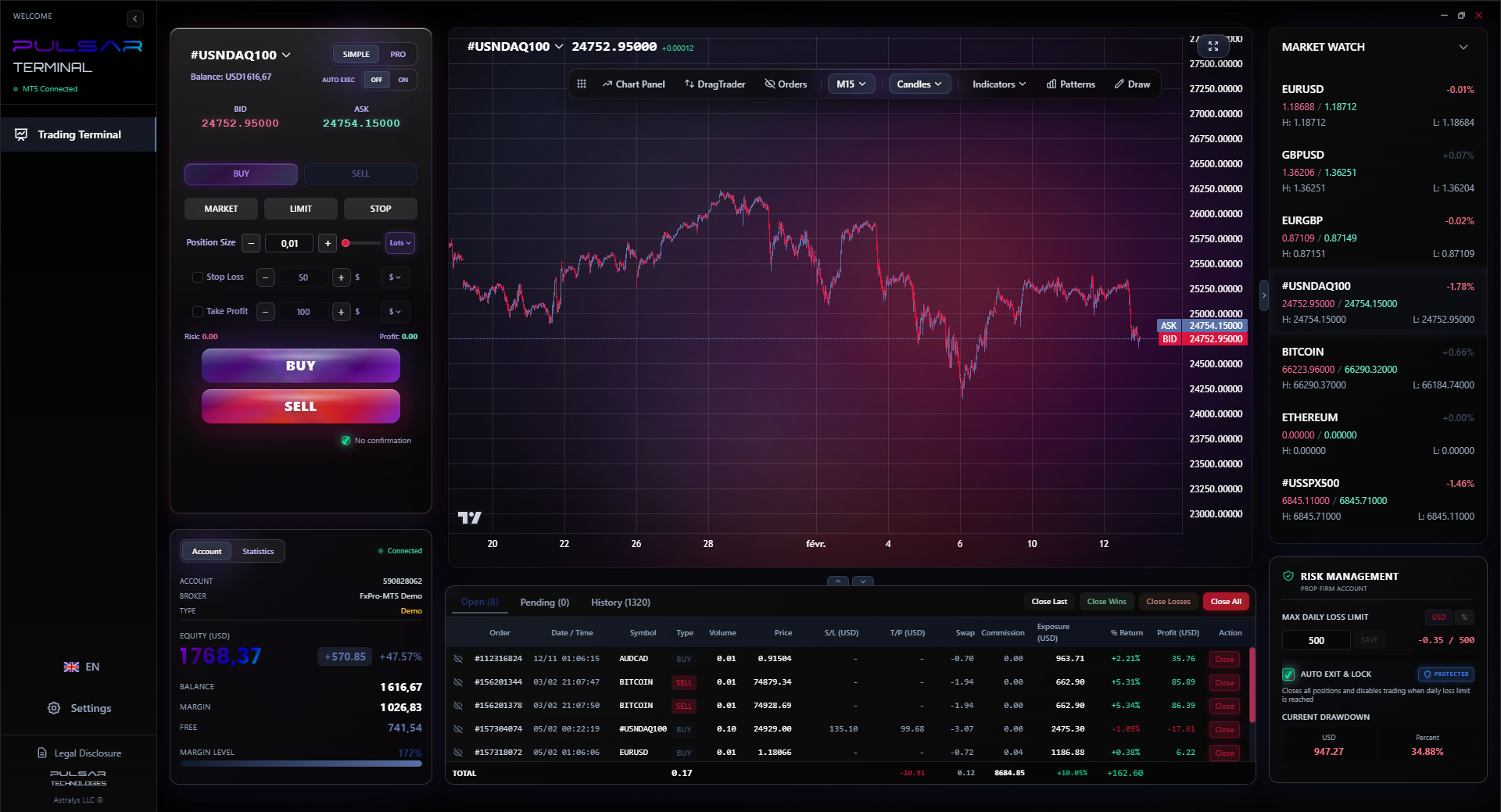
4. Professional Platform Training This is often overlooked. Some educators specialize in training you to use professional tools like TradingView or advanced MT5 features. Given that tools like Pulsar Terminal add powerful functions like automated trailing stop and multi-TP/SL management to MT5, knowing how to use them efficiently is a force multiplier. This type of course is highly practical and directly impacts your execution speed and accuracy.

Before you spend a single dollar, exhaust these free resources. They form 80% of the knowledge you need.
- The NFA and CFTC Websites: Seriously. Read the BASIC pamphlets for retail forex traders. They are dry but contain life-saving information about your rights and the rules of the game. Understanding what a margin call really means under US rules is crucial.
- Broker Education Centers: US brokers like FOREX.com have extensive, regulation-compliant education libraries. Their webinars on position sizing and risk management are tailored to the 50:1 use environment.
- Market Replay & Demo Trading: Every course will tell you to practice. Almost none will make you do it for long enough. Commit to 100 hours of demo trading on a US broker platform before even considering a paid course. Track your results. If you can't be profitable on demo with pretend money, you will be destroyed with real money.
- Master the Core Concepts: Use free resources to deeply understand pips, spreads, and the economic calendar. Learn one simple strategy, like using the RSI indicator or MACD indicator on a higher time frame, and test it to death.
I built my first profitable year of trading on almost entirely free knowledge. I spent money later to refine and fix my psychological gaps.
💡 Consejo de Winston
Your education ROI isn't measured in course profits, but in the losses it prevents. A $500 course that stops you from making a $5,000 mistake is a 10x return.
“The path here is slower because of our regulations. Accept that.”
Let's talk numbers, because this is where dreams get priced.
| Resource Type | Typical Cost Range | What You're Really Paying For | Success Rate Boost (If You Do the Work) |
|---|---|---|---|
| Free Broker Resources | $0 | Regulatory basics, platform how-tos, simple strategy outlines. | 10-15% - It gets you started safely. |
| Online Video Course | $200 - $800 | Structured curriculum, pre-recorded lessons, basic community access. | 20-30% - Provides a clear learning path. |
| Live Workshop/Webinar Series | $500 - $2,000 | Real-time interaction, current market analysis, Q&A. | 25-40% - Good for solving specific, immediate problems. |
| 1-on-1 Mentorship | $2,000 - $10,000+ | Personalized feedback, accountability, psychological coaching. | 40-60% - This addresses the individual flaws that kill most traders. |
Notice I said 'Success Rate Boost,' not 'Guaranteed Profit.' That boost comes from reducing stupid errors and improving discipline. It moves you from a 90% chance of blowing your account to a 70% chance. It's still hard.
Your total education budget should be a fraction of your trading capital. If you have a $5,000 account, spending $4,000 on a course is insane. I recommend your total education spend (courses, books, software) not exceed 20% of your initial trading capital. That $5,000 account? Keep course costs under $1,000.

Pro Tip: Many paid courses offer a 30-day money-back guarantee. Use it. Devour the content in the first week, apply it on demo for two weeks, and if you see zero value or it's just rehashed basics, ask for a refund. This filters out the scammers.

When testing strategies from a course, precise trade management is key, and Pulsar Terminal's drag-and-drop orders and multi-TP/SL tools on MT5 let you execute complex plans exactly as you practiced.
Pulsar Terminal
La herramienta MT5 todo-en-uno: órdenes drag-and-drop, multi-TP/SL, trailing stop, grid trading, Volume Profile y protección prop firm. Usado por más de 1.000 traders diariamente.
Buying a course is the easy part. Implementing it is where 95% of people fail. Here's my integration blueprint.
Phase 1: The Isolated Test (2-4 Weeks) Take ONE concept or strategy from the course. Just one. If it's a scalping strategy, test only that on demo. Don't mix it with your old ideas. Isolate the variable to see if it works. When I learned a specific price action set-up from my mentor, I traded only that set-up for 100 demo trades. The win rate was 52%. Not amazing, but the risk-to-reward was solid, so it worked.
Phase 2: The Systems Integration (1-2 Months) Now, slowly add this new tool to your existing plan. How does this new indicator work with your existing trend analysis? Does the new risk management rule conflict with FIFO? This is where you adapt generic advice to the US market. You'll need to tweak everything.
Phase 3: The Live Micro-Test (1 Month) Go live with tiny, tiny size. We're talking risking $5 per trade. The goal isn't profit; it's to see if your psychology holds up when real money is on the line. Do you still follow the rules from the course, or do you panic and deviate? This phase is the ultimate test of the course's value.
Most courses don't give you this integration roadmap. They just dump information on you. The best courses of forex trading California has will include some form of this - homework, trade reviews, or accountability check-ins to force you through these phases.
💡 Consejo de Winston
The mark of a great course isn't a complex strategy, but how it simplifies the chaos. If it adds more confusion than clarity, walk away.

“If you can't be profitable on demo with pretend money, you will be destroyed with real money.”
If you're in LA, San Francisco, San Diego, or anywhere in the Golden State and want to start trading, here's my direct advice, based on my own costly mistakes.
Start with the free, official stuff from the NFA. It's boring, but it's your rulebook. Then, pick one major pair like EUR/USD or a classic safe-haven like XAU/USD and just watch it. Don't trade. Just watch how it moves during the London open (1 AM our time), the US open (5 AM PT), and after.
Open a demo account with a major US broker. Not an offshore one. Get used to the feel of a platform that enforces FIFO. Practice calculating your position size with 50:1 use until it's second nature.
Only then consider paying for education. And when you do, pay for specificity. Need to master a platform? Take a platform course. Struggling with psychology? Find a mentor who focuses on that. Don't buy the 'everything' package.
Finally, connect with other local traders. Meetup groups in tech hubs often have finance subgroups. Talking to someone who also trades at 5 AM Pacific Time and deals with the same broker limitations is useful. Your friends in other countries trading with 500:1 use simply don't have the same problems you do.
The path here is slower because of our regulations. Accept that. The best courses of forex trading California can offer are the ones that teach you how to win the slow, steady, regulated game, not the reckless offshore casino game.
FAQ
Q1Are there any completely free, high-quality forex trading courses in California?
Yes, but they're not branded as 'courses.' The highest quality free education comes from the NFA's learning center and the detailed webinars/guides offered by US-regulated brokers like OANDA and FOREX.com. These are tailored to the rules you must follow and provide a solid, scam-free foundation.
Q2What is the biggest mistake California traders make when choosing a course?
The biggest mistake is buying a course designed for an unregulated, high-use environment. If the course teaches strategies that rely on 200:1 use, hedging, or uses a broker platform not available in the US (like many MT4/MT5 add-ons from offshore brokers), it's worse than useless - it will actively teach you methods that are illegal or impossible to execute here, setting you up for immediate failure.
Q3How much should I expect to pay for a good forex trading course?
Anywhere from $0 to $2,000 for the core education. Beyond $2,000, you're typically paying for prolonged personal mentorship or exclusive community access, not core knowledge. Never spend a large percentage of your trading capital on education. A good rule is to keep total education costs below 20% of your starting account size.
Q4Do I need to learn how to code or use advanced software?
Not at all. While automated trading is popular, you can be highly successful with manual trading. However, learning to use professional charting tools efficiently is a huge advantage. Understanding how to use a platform's built-in tools for risk management - like setting multiple take-profit levels or automated trailing stops - is more important than coding for most retail traders.
Q5Can I take a course from a trader in another state or country?
You can, but you must be vigilant. The course content must be applicable to a US-regulated account. Many excellent international traders teach universal concepts like price action or market psychology, which are valid anywhere. Just be prepared to adapt any specific trade management or use techniques to fit the 50:1 and FIFO rules on your own.
Q6Is in-person training in California worth the extra cost?
It can be, but only for the right person. The value isn't in the information - you can get that online. The value is in the networking, the immediate Q&A, and the accountability. If you're a social learner who needs structure and direct feedback, a local workshop can be a great jumpstart. If you're self-motivated, you can save the money and find the same core content online.
Lección del Prof. Winston
Puntos clave:
- ✓US rules (50:1 use, FIFO) dictate your entire strategy.
- ✓Free broker & NFA resources provide 80% of needed knowledge.
- ✓Never let education costs exceed 20% of trading capital.
- ✓Value is in mistake prevention, not profit promises.
¿Te resultó útil este artículo?
Haz clic en una estrella
Análisis Trading Semanal
Análisis y estrategias semanales gratis. Sin spam.
Sobre el autor
James Mitchell
Analista de Trading Sénior
Con sede en Nueva York y más de 9 años de experiencia en trading. Se enfoca en pares USD principales, desafíos de prop firms y el panorama regulatorio estadounidense.
Comentarios
Aviso de riesgo
El trading de instrumentos financieros conlleva un riesgo significativo y puede no ser adecuado para todos los inversores. El rendimiento pasado no garantiza resultados futuros. Este contenido tiene fines educativos únicamente y no debe considerarse asesoramiento de inversión. Siempre realice su propia investigación antes de operar.
También te puede interesar

Cara Trading Forex Sukses: 7 Prinsip dari Trader Profesional
Cara trading forex sukses dengan 7 prinsip trader pro: manajemen modal, disiplin, journal trading, backtest. Data nyata, bukan janji profit palsu.
Jam Trading Forex Terbaik untuk Trader Indonesia: Panduan Lengkap dengan Tabel Waktu
Panduan jam trading forex untuk trader Indonesia. Tabel 4 sesi dunia, jam emas 20:00-00:00, sesi mana yang harus dihindari. Data akurat + tips dari trader berpengalaman.
Top 5 Sàn Forex Uy Tín Nhất 2026: Review Jujur dari Trader Indonesia
Top 5 sàn forex uy tín 2026 untuk trader Indonesia. Review jujur: spread, deposit, withdraw, dukungan lokal. Exness, XM, IC Markets & lebih.
Obtener Pulsar Terminal
Todas estas calculadoras están integradas en Pulsar Terminal con datos en tiempo real de su cuenta MT5.
Obtener Pulsar Terminal