


Let's cut through the nonsense.

Daniel Harrington
Director de Contenidos
☕ 11 min de lectura
Lo que aprenderás:

Let's cut through the nonsense. Half the websites telling you the 'best forex broker in Bangladesh' are just pushing affiliate links for brokers that don't care if you get your money out. The other half ignore the massive, glaring elephant in the room: the legal grey zone you're operating in. I've seen too many traders from Dhaka and Chittagong get burned by this. This isn't a fluffy list. It's a survival guide. I'll show you how to evaluate brokers for safety when you can't rely on local regulation, how to fund your account without getting your transaction blocked, and the real costs you need to watch.
First, let's be brutally honest. The Bangladesh Bank does not license international retail forex brokers. Their primary job is to protect foreign exchange reserves and maintain monetary stability. Letting capital flow freely to speculative forex trading? That's the opposite of their goal.
This creates a grey area. You, as an individual, are not legally prohibited from opening an account with an overseas broker. However, funding that account by converting Bangladeshi Taka (BDT) to USD or EUR and sending it abroad? That's where you can run into serious roadblocks. Banks are instructed to prevent such transactions for 'speculative purposes.'
I had a student in Sylhet who tried to deposit $500. His bank flagged it, froze the transfer for two weeks, and subjected him to a lengthy interrogation about the purpose. He got his money back, but the stress wasn't worth it. You are navigating a system that isn't designed for what you want to do. Your first job isn't finding the best trading platform, it's finding a broker you can actually pay.

Warning: Trading with an unregulated or poorly regulated offshore broker from Bangladesh is an extreme risk. If they decide not to process your withdrawal, you have precisely zero legal recourse with the Bangladesh Bank or any local authority. Your safety depends entirely on the broker's internal policies and the regulatory strength of their licensing jurisdiction.
Since local regulation is off the table, your criteria shift dramatically. Forget fancy trading contests or sign-up bonuses. Those are marketing fluff. Your checklist needs to be about survival and access.
The Non-Negotiables: Regulation Elsewhere
Your broker must be tightly regulated by a top-tier authority. This is your only shield. Look for:
- ASIC (Australia): The gold standard. Extremely strict on client fund segregation and conduct.
- FCA (UK): Similarly rigorous, with strong investor protection schemes (though these may not apply to non-UK residents).
- CySEC (Cyprus): A common EU license, decent but a step below ASIC/FCA.
A broker like Pepperstone review holds an ASIC license, which is a strong positive signal. Never, ever use a broker licensed only in offshore havens like St. Vincent and the Grenadines or Vanuatu. That's a red flag the size of the Padma Bridge.
The Practical Must-Haves: Funding & Support
Payment Methods: The broker must support payment methods that work from Bangladesh. This is your make-or-break.
- Skrill & Neteller: These are often the most reliable. They act as an intermediary, so your bank sees a transfer to Skrill (often allowed), not directly to a forex broker.
- Cryptocurrency (USDT): Increasingly the best option. You buy USDT from a local crypto peer-to-peer (P2P) platform, then send it to the broker's crypto wallet. It bypasses the banking system entirely. Transaction fees are low.
- Local Bank Transfer? Almost never works for international brokers. Don't waste your time.
Customer Support: Test their live chat. Ask a specific question like, "Do you accept clients from Bangladesh and what is the best deposit method?" If the answer is vague or slow, move on. You need responsive support when you're 8,000 km away.
Platform & Spreads: This comes after safety and funding. You want tight spreads on major pairs like EUR/USD guide and reliable execution. MetaTrader 4/5 is almost universal, which is good. Some brokers offer raw spread accounts with a commission, which can be cheaper for active traders. Use a position size calculator to understand how the spread impacts your trade cost on every single entry.

💡 Consejo de Winston
Your first profit target should be a successful withdrawal. If you can't get your money out, nothing else matters.
“Your safety depends entirely on the broker's internal policies and the regulatory strength of their licensing jurisdiction.”
Here’s a look at how some major international brokers stack up for a trader based in Bangladesh. Remember, this is about their suitability for your specific situation.
| Broker | Key Regulation | Min. Deposit (USD) | Key Funding Methods for BD | Raw Spread (EUR/USD) | Good For... |
|---|---|---|---|---|---|
| IC Markets | ASIC, CySEC | $200 | Skrill, Neteller, Crypto (USDT) | 0.0 - 0.1 pips | Scalping strategy, low latency. High trust factor. |
| Exness | FCA, CySEC | $10 | Skrill, Neteller, Crypto (multiple) | 0.0 - 0.3 pips | Very low minimums, excellent crypto funding. Read our Exness review. |
| Pepperstone | ASIC, FCA | $200 | Skrill, Neteller, Crypto | 0.0 - 0.2 pips | All-around quality, great research. |
| XM | ASIC, CySEC | $5 | Skrill, Neteller, Local Bank Transfer* | 0.6 - 1.0 pips | Beginners due to low minimums and educational focus. XM review. |
*XM's 'Local Bank Transfer' may work in some cases, but don't count on it with BD banks. Crypto or e-wallets are safer bets.
My personal experience? I funded an IC Markets review account for a demo student using USDT. The transfer from a local P2P platform to IC's crypto address took 12 minutes and cost $1 in network fees. The funds were trading in under an hour. Contrast that with another student's 3-week bank transfer nightmare. The choice is obvious.

Pro Tip: When testing a broker, make a small deposit first - just the minimum. Then immediately request a withdrawal of that same amount. If the withdrawal is processed smoothly and quickly back to your Skrill or crypto wallet, you've passed the first major test of broker integrity.
Theory is useless without practice. Here's the current (2026) playbook.
Method 1: Cryptocurrency (Recommended)
- Create an account on a local P2P platform (Binance P2P, LocalBitcoins, etc.). Complete their verification (NID required).
- Use your local bank (bKash, Nagad, bank transfer) to buy USDT (Tether) from a seller on the P2P platform. The seller releases USDT to your Binance wallet.
- In your forex broker's deposit section, select 'Cryptocurrency' or 'USDT'. They will provide a wallet address and network (e.g., Tron TRC-20).
- From your Binance wallet, withdraw USDT to the broker's address using the specified network. Double-check the address.
- Funds typically arrive in 5-30 minutes. The broker converts USDT to USD at their rate.
Method 2: Skrill/Neteller
- Create a Skrill account. Verify it with your NID and a utility bill.
- Fund your Skrill wallet using your Bangladeshi debit/credit card. This often works as it's seen as a digital goods purchase.
- Go to your broker, select 'Skrill' as the deposit method, enter the amount, and you'll be redirected to log into Skrill to confirm.
- Funds are instant.
The crypto method has lower fees overall and is more reliable. Skrill/Neteller fees can be higher (2-4%), but it's more familiar to some.
💡 Consejo de Winston
The spread isn't a fee, it's a toll. You pay it on the bridge to enter the trade and again to leave. Choose bridges with low tolls.

“The crypto method has lower fees overall and is more reliable. Skrill/Neteller fees can be higher, but it's more familiar.”
You think the spread is your only cost? Think again. When you trade from a country like Bangladesh, other fees eat into your profits.
1. The Spread & Commission: This is the main cost. A raw spread account with a $3.50 commission per lot is often cheaper than a standard account with a 1.5 pip spread. Do the math: 1.5 pips on EUR/USD guide is $15 per standard lot. The commission model costs $7 ($3.50 in, $3.50 out). You save $8. For a scalping strategy, this difference is massive.
2. Currency Conversion Fees: Your broker account is in USD. Your money is in BDT. Every conversion costs you.
- Bank Card to Skrill: Your bank may charge a 2-3% foreign transaction fee + give you a poor exchange rate.
- Skrill to Broker: Skrill charges a currency conversion fee if your wallet isn't in USD.
- P2P Crypto: The seller's rate includes their margin. It's usually 1-2% above the market rate.
I tracked this for a month. On a $1000 deposit via Skrill, I lost about $28 just in various conversion markups before I even placed a trade.
3. Inactivity Fees: If you stop trading for 6-12 months, many brokers charge a monthly fee ($5-$15). Read the terms.
4. Withdrawal Fees: Some brokers charge to send money back to you. Skrill/Neteller might charge to receive it. Crypto network fees are minimal. Always check the broker's withdrawal policy page.

Example: You make a 50 pip profit on a 1-lot EUR/USD trade ($500). Your costs: Spread/Commission ($7), Deposit Conversion Loss ($15), Withdrawal Fee ($0 if using crypto). Real profit: ~$478. That's a 4.4% drag on your gross profit. You must account for this in your risk management.
The grey market attracts predators. Here’s what to watch for.
The 'Local' Broker/IB Scam: Someone on Facebook or in a Dhaka coffee shop offers you a "local" forex account. They're usually an Introducing Broker (IB) for an unregulated offshore broker. They get a kickback on your losses (a conflict of interest called 'B-Book'). Your money goes straight to a shady company. If you profit, good luck withdrawing. If you lose, they get paid. Avoid any "broker" that isn't a globally recognized, ASIC/FCA-regulated name.
The Signal Seller/Account Manager: "Give me your login, I'll trade for you and make you 20% a month!" This is a guaranteed way to lose everything. They'll churn your account with excessive trades to generate commissions (if they're the IB) or just blow it up with reckless bets. No legitimate, profitable trader wants to manage your $500 account.
The Withdrawal Block: You profit, you request a withdrawal, and suddenly you need to "verify" your address with a document you've already submitted. Or they claim your trading strategy was "arbitrage" and violates their terms. This is why regulation matters. A broker like Pepperstone or IC Markets, under ASIC's watch, is far less likely to pull this nonsense.
use Trap: Brokers might offer you 1:1000 use. This is a weapon that will destroy you. I don't care how confident you are. Start with 1:10 or 1:20 max. A 100-pip move against you at 1:1000 use is a 100% loss. It's not a tool, it's a margin call waiting to happen. Manage your own risk; don't let the broker's offered use dictate it.
💡 Consejo de Winston
In a grey market, your reputation is your collateral. Use brokers with a decade-long global reputation, not a flashy new one.

“Start with a micro account. Your goal for the first 6 months is not to make money. It's to not lose money.”
Finding the broker is just step one. Building a career from Bangladesh requires a fortress-like plan.
Start with a Micro Account: Don't deposit $5,000. Deposit the minimum ($200 or less). Your goal for the first 6 months is not to make money. It's to not lose money while you learn the platform, test execution, practice withdrawals, and develop a strategy. Treat this initial deposit as tuition fees.
Document Everything: Keep records of every deposit (screenshots of transactions, P2P chat logs), every trade, and every communication with support. If there's ever a dispute, you have a paper trail.
Develop an Edge, Not a Guess: Don't just stare at candles. Learn one strategy inside out. Maybe it's a simple RSI indicator divergence on the 4-hour chart, or a MACD indicator crossover combined with price action. Backtest it. Then trade it with tiny size for 100 trades. Record the results. Is your win rate above 55%? Is your average win bigger than your average loss? If not, you don't have an edge, you have a hope. Go back to the demo.
Withdraw Profits Regularly: This is the most important psychological rule. Once your account grows 20-30% from its baseline, withdraw the profit. Send it back to your bKash or bank. This does three things: 1) It proves the system works end-to-end, 2) It takes money off the risky table, and 3) It gives you real-world rewards for your discipline. It turns abstract pips into tangible Taka.
This journey is harder for you than for a trader in London or Sydney. The barriers are higher. But that also means the ones who succeed are tougher, smarter, and more disciplined. Focus on that. The broker is just your tool. You are the craftsman.

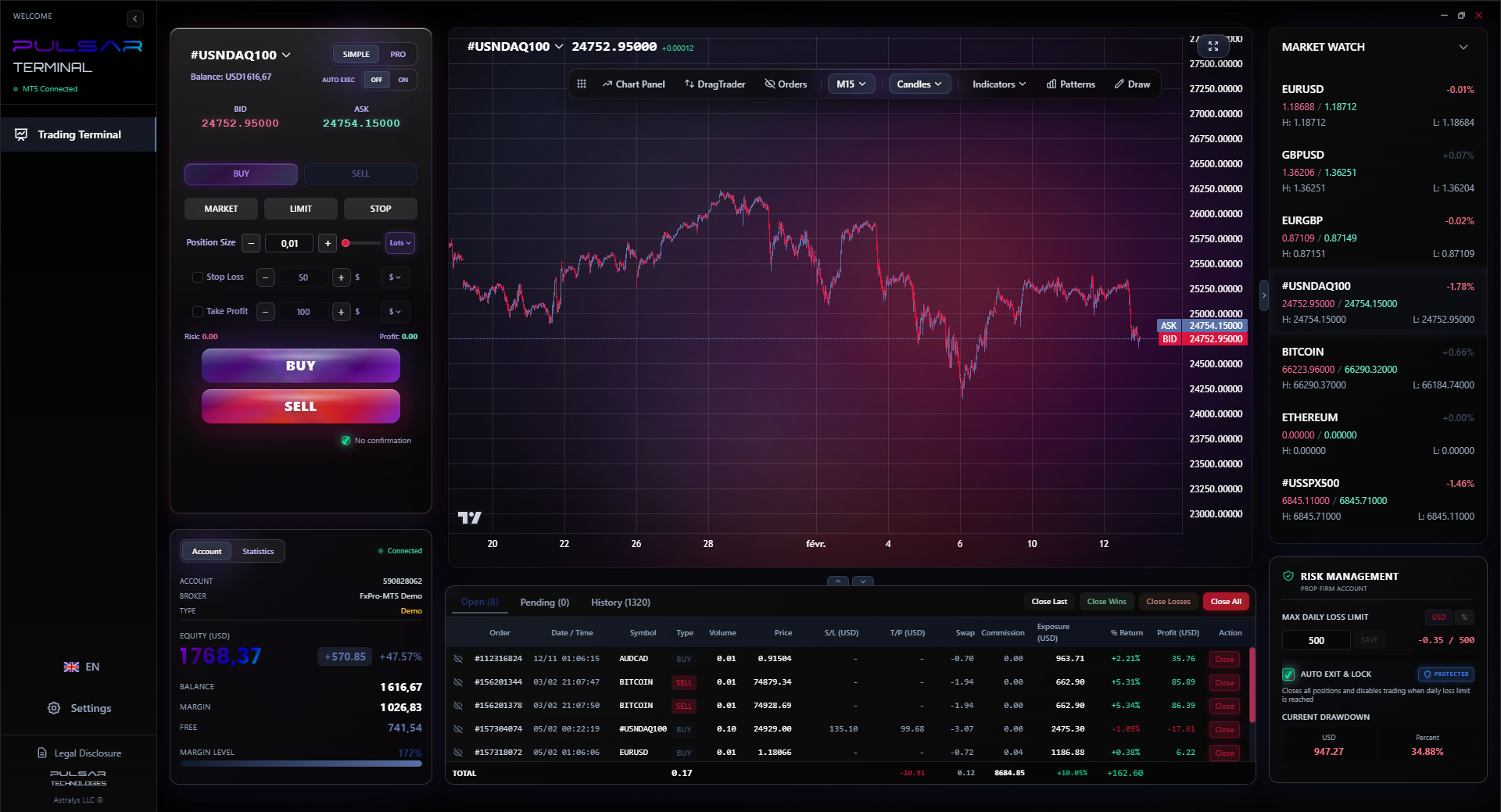
Once you have a reliable broker, managing complex trades and risk becomes your next challenge, which is where a tool like Pulsar Terminal for MT5 can automate your strategy and protect your capital.
Pulsar Terminal
La herramienta MT5 todo-en-uno: órdenes drag-and-drop, multi-TP/SL, trailing stop, grid trading, Volume Profile y protección prop firm. Usado por más de 1.000 traders diariamente.
FAQ
Q1Is forex trading legal in Bangladesh?
It exists in a grey area. There are no laws specifically making it illegal for an individual to trade with an international broker. However, the Bangladesh Bank's strict controls on foreign exchange make it very difficult to legally send money abroad for this purpose. You are navigating a system that discourages the activity, so your operational risk is high.
Q2What is the safest way to fund my forex account from Bangladesh?
Using cryptocurrency (USDT) via a peer-to-peer (P2P) platform is currently the most reliable and lowest-cost method. It bypasses the banking restrictions entirely. E-wallets like Skrill are the second-best option, but your bank may still block the card transaction to fund the e-wallet.
Q3Can I use a Bangladeshi bank account directly with a forex broker?
Almost never. International brokers do not have local Bangladeshi Taka (BDT) accounts. Any attempt to send a wire transfer in BDT will fail. Even if they list 'Local Bank Transfer,' it typically only works for specific regions. Do not rely on this.
Q4What minimum deposit should I start with?
Start with the absolute minimum the broker allows ($5, $10, $200). This first deposit is not for trading to profit. It's a test deposit to verify you can fund the account and, more importantly, withdraw from it smoothly. Consider this money a operational test fee, not trading capital.
Q5How do I know if a broker will accept clients from Bangladesh?
Check the broker's website terms or country list. A quicker way is to contact their customer support via live chat before signing up and ask directly: "Do you accept clients residing in Bangladesh, and what is the recommended deposit method?" Their answer will tell you everything.
Q6What use should I use?
Ignore the maximum use the broker offers (e.g., 1:500). That's a trap. For beginners, start with 1:10. Even with experience, I rarely recommend above 1:30 for a standard swing trading account. High use is the fastest way to a margin call.
Q7Are there any good locally regulated forex brokers in Bangladesh?
No. The Bangladesh Bank does not issue licenses to retail forex brokers for speculative trading. Any company claiming to be a 'locally licensed' forex broker for individual traders is almost certainly misrepresenting itself or operating a scam.
Lección del Prof. Winston
Puntos clave:
- ✓Local regulation is absent; rely only on ASIC/FCA licensed brokers.
- ✓Fund via Crypto (USDT) or Skrill; avoid direct bank transfers.
- ✓Start with the broker's minimum deposit as a 'system test'.
- ✓Your real cost includes spread, commission, and 2-4% in conversion fees.
- ✓Withdraw profits regularly to confirm the entire loop works.
¿Te resultó útil este artículo?
Haz clic en una estrella
Análisis Trading Semanal
Análisis y estrategias semanales gratis. Sin spam.
Sobre el autor
Daniel Harrington
Director de Contenidos
Director de contenido en The Trading Mentor. Trader veterano apasionado por hacer accesibles los conceptos complejos de trading. Cubre temas globales, estrategias y guías de plataformas.
Comentarios
Aviso de riesgo
El trading de instrumentos financieros conlleva un riesgo significativo y puede no ser adecuado para todos los inversores. El rendimiento pasado no garantiza resultados futuros. Este contenido tiene fines educativos únicamente y no debe considerarse asesoramiento de inversión. Siempre realice su propia investigación antes de operar.
También te puede interesar

Cara Trading Forex Sukses: 7 Prinsip dari Trader Profesional
Cara trading forex sukses dengan 7 prinsip trader pro: manajemen modal, disiplin, journal trading, backtest. Data nyata, bukan janji profit palsu.
Jam Trading Forex Terbaik untuk Trader Indonesia: Panduan Lengkap dengan Tabel Waktu
Panduan jam trading forex untuk trader Indonesia. Tabel 4 sesi dunia, jam emas 20:00-00:00, sesi mana yang harus dihindari. Data akurat + tips dari trader berpengalaman.
Top 5 Sàn Forex Uy Tín Nhất 2026: Review Jujur dari Trader Indonesia
Top 5 sàn forex uy tín 2026 untuk trader Indonesia. Review jujur: spread, deposit, withdraw, dukungan lokal. Exness, XM, IC Markets & lebih.
Obtener Pulsar Terminal
Todas estas calculadoras están integradas en Pulsar Terminal con datos en tiempo real de su cuenta MT5.
Obtener Pulsar Terminal