


I lost ₹47,000 in 90 minutes.

Rajesh Sharma
Analista Forex Sénior ·  India
India
☕ 11 min de lectura
Lo que aprenderás:
- 1The Indicator Trap: Why Most Intraday Traders Fail
- 2Building a Core Toolkit: Less is More
- 3The Real Game-Changer: Your Risk Indicator
- 4Indian Market Realities: Rules, Costs & Psychology
- 5Putting It All Together: A Sample Framework
- 6Brokers and Platforms: Where to Trade
- 7Final Word: The Only Edge You Have

I lost ₹47,000 in 90 minutes. It was 2021, and I was convinced I'd found the holy grail. I had a chart packed with a 9 EMA, a 20 EMA, Bollinger Bands, and the RSI. They all aligned for a perfect buy signal on Reliance. I went all in. The stock moved 3 points in my favor, then reversed and didn't stop. Every indicator turned bearish too late. My problem wasn't the signal. It was my position size. I'd risked 8% of my capital on a single intraday trade, ignoring every rule I'd written for myself. That's the dirty secret: the best indicator for intraday trading isn't on your chart. It's the one that tells you when to stop.
Let's get this out of the way. You're searching for the best indicator for intraday trading because you believe it will give you an edge. It won't. Not by itself. SEBI's own data from 2024 shows 7 out of 10 individual traders in the equity cash segment lose money. For folks under 30, that number jumps to 76%. They all have access to the same charts, the same free indicators on Zerodha Kite or Upstox.
The failure isn't a lack of tools. It's a misunderstanding of their purpose. Indicators are rear-view mirrors. They tell you what has happened, with a mathematical lag. Price action is the car moving forward. Relying solely on a lagging indicator for intraday moves is like driving using only your mirrors.
I see traders stack five, six, even seven indicators on one chart. A moving average crossover, the MACD, the Stochastic, the CCI. When they all line up, they feel invincible. But here's what happens: by the time all those lagging tools agree, the move is often halfway done. You enter late, the market chops, and you get stopped out. This overcomplication is a form of self-sabotage. It creates the illusion of certainty where none exists.

Warning: More indicators don't mean more clarity. They mean more confusion and more opportunities for conflicting signals. Your job is to simplify, not complicate.

“The best indicator for intraday trading isn't on your chart. It's the one that tells you when to stop.”
Forget finding a single best indicator. Your goal is to build a simple, repeatable system using 2, maybe 3, complementary tools. You need one for trend, one for momentum/overextension, and, crucially, one for context. Here’s the combo that actually works on Indian markets, from Nifty to banknifty to individual stocks.
The Universal Favorite: VWAP
The Volume Weighted Average Price is, in my opinion, the closest thing to a non-negotiable tool for intraday trading. It's not a crystal ball, but a benchmark. It tells you the day's average traded price, weighted by volume. Think of it as the market's consensus on fair value for that specific day.
My rule is simple: price above VWAP suggests bullish intraday bias, price below suggests bearish. But the magic is in the reactions. A pullback to the VWAP in an uptrend often acts as support. A rally to the VWAP in a downtrend often acts as resistance. I've built countless profitable scalping strategy entries around VWAP tests. It provides a dynamic level that everyone with a professional chart is watching.
The Momentum Gauge: RSI
The RSI indicator is wildly popular for a reason. It measures the speed and change of price movements. For intraday, I use it not for absolute overbought/oversold calls (like 70/30), but for momentum shifts. An RSI reading above 50 hints at bullish momentum, below 50 at bearish. My key setup? Looking for bullish momentum when price is above VWAP and RSI is holding above 50, or bearish momentum when price is below VWAP and RSI is stuck under 50.
The Trend Filter: Exponential Moving Averages
A fast EMA, like the 9-period, helps smooth out the noise. I don't use it for precise entries. I use it to answer one question: what is the very short-term trend on my chosen timeframe? On a 5-minute chart, if price is consistently above the 9 EMA, I'm only looking for long setups. It keeps me on the right side of the market's immediate flow. Combining this with VWAP alignment is powerful.

Example: You're watching HDFC Bank on a 5-min chart. Price is above the VWAP and the 9 EMA. RSI pulls back to 55 from above. That's a potential long setup on the next bullish candle, with a stop loss below the recent swing low and the VWAP. You're using trend (EMA), context (VWAP), and momentum (RSI) together.

💡 Consejo de Winston
A chart cluttered with indicators is a mind cluttered with doubt. Pick two: one for trend context (VWAP), one for momentum (RSI). Master their conversation.

“More indicators don't mean more clarity. They mean more confusion and more opportunities for conflicting signals.”
This is the most important section. Your profitability isn't determined by your entry indicator. It's determined by your exit strategy and your position size. These are your true indicators of success.
Let's talk numbers. Say you have a ₹2 lakh trading capital. A common amateur mistake is to risk 5% (₹10,000) on a trade because "the setup looks perfect." Do that, and two consecutive losses put you down 10%. The psychology becomes desperate.
Professional risk management dictates risking no more than 1-2% of your capital on any single trade. For a ₹2 lakh account, that's ₹2,000 to ₹4,000 max. This number dictates your position size. You must calculate it before every trade. Don't guess. Use a position size calculator.
Here’s a real example from last month. I saw a setup on Tata Motors. My entry was at ₹985, my stop loss was at ₹978 (a 7-point risk). My capital was ₹3,00,000, and my max risk per trade was 1% (₹3,000).
Position Size Calculation: ₹3,000 risk / 7 points risk per share = ~428 shares. 428 shares x ₹985 entry price = ₹4,21,580 position value.
That's a big position. But notice: my risk was capped at ₹3,000. The broker's margin allowed it (roughly 20% of ₹4.21L is ~₹84,300, which I had). The trade worked, hit my target, and made ₹4,280. The key wasn't the entry. It was knowing my exact risk before I clicked buy.
Your stop loss is your most important indicator. It tells the market, "I am wrong here." Not using one is how you get a margin call or worse. A trailing stop, which automatically moves your stop loss to lock in profits as a trade moves in your favor, is a powerful tool for letting winners run. Managing this manually is tough, which is why many traders look for tools that can automate it.

“More indicators don't mean more clarity. They mean more confusion and more opportunities for conflicting signals.”
Trading in India isn't just about charts. It's about navigating a specific set of rules that directly impact your intraday strategy.
The 3:30 PM Gun: All intraday positions MUST be squared off before the market closes. Brokers will auto-square you, often for a fee (like ₹50 + GST). This forces a discipline but also creates frantic last-hour volatility. You cannot hold a losing position overnight hoping it recovers.
The Cost of Doing Business: Your indicator might be right, but can you still profit after costs? Let's break down a ₹1,00,000 intraday trade (buy and sell):
- Brokerage: Say ₹20 per order (₹40 total)
- STT: 0.025% on sell side = ₹25
- Exchange Charge: ~0.003% of turnover = ₹6
- SEBI Fee: 0.0002% = ₹0.40
- Stamp Duty: 0.003% on buy = ₹3
- GST: 18% on brokerage + exchange charges
Your total cost is roughly ₹75-₹80. That means your trade needs to move at least 0.08% just to break even. On a ₹1,00,000 trade, that's 80 points on a single share priced at ₹100? No. It's an 80 paisa move on a ₹100 stock. But you get the point. Small, scratch trades get eaten by costs.
use & Margin: SEBI mandates a minimum 20% margin for equity intraday. That's 5x use. It sounds great, but it amplifies losses just as fast as gains. A 2% move against you wipes out 10% of your margin. This is why the 1-2% risk rule is non-negotiable.
The Tax Hit: Intraday profits are taxed as "Speculative Business Income" at your income tax slab rate. There's no benefit of long-term capital gains. You keep what's left after a potentially 30%+ tax. This changes your profit calculus significantly.
💡 Consejo de Winston
Your pre-trade calculation sheet is your most important document. If 'Position Size' isn't the first thing you write down, you're not trading, you're gambling.

“Your profitability isn't determined by your entry indicator. It's determined by your exit strategy and your position size.”
Here’s a simplified, mechanical framework for an intraday long trade. This isn't a guaranteed system, but an example of how to structure your process.
Step 1: Market Context (9:15 AM - 10:00 AM) Don't trade the first candle. Let the market settle. Plot the VWAP. Is price above or below it? Where is the 9 EMA? This defines your initial bias.
Step 2: The Setup (Wait for it) For a LONG bias (price > VWAP & 9 EMA):
- Wait for a pullback towards the VWAP or the 9 EMA.
- Watch the RSI indicator. Does it find support near 50 or bounce from a higher low?
- Look for a price action signal: a bullish engulfing candle, a pin bar, or a simple strong green candle closing above the pullback's high.
Step 3: The Entry & Risk
- Entry: On a break of the high of the triggering candle.
- Stop Loss: Place it 1-2 ticks below the recent swing low of the pullback. This is where your setup is invalidated.
- Calculate Position Size: Use your pre-determined risk (e.g., 1% of capital) and the distance between entry and stop loss. This is your most critical step.
Step 4: The Exit
- Target 1: Aim for a 1:1.5 or 1:2 risk-to-reward ratio. If you risk 7 points, aim for 10-14 points.
- Management: As price moves in your favor, you can trail your stop loss to breakeven, then below subsequent swing lows. This turns a risky trade into a risk-free one.
Step 5: The Review At 3:30 PM, win or lose, review. Did you follow your rules? Was your position size correct? Journal the trade, not just the P&L.

Pro Tip: The first 90 minutes and the last 90 minutes of the Indian market often have the highest volume and clearest trends. The midday period (11:30 - 2:00) is often choppy and range-bound. Adjust your strategy accordingly. Consider a swing trading mindset for longer holds if intraday chop frustrates you.
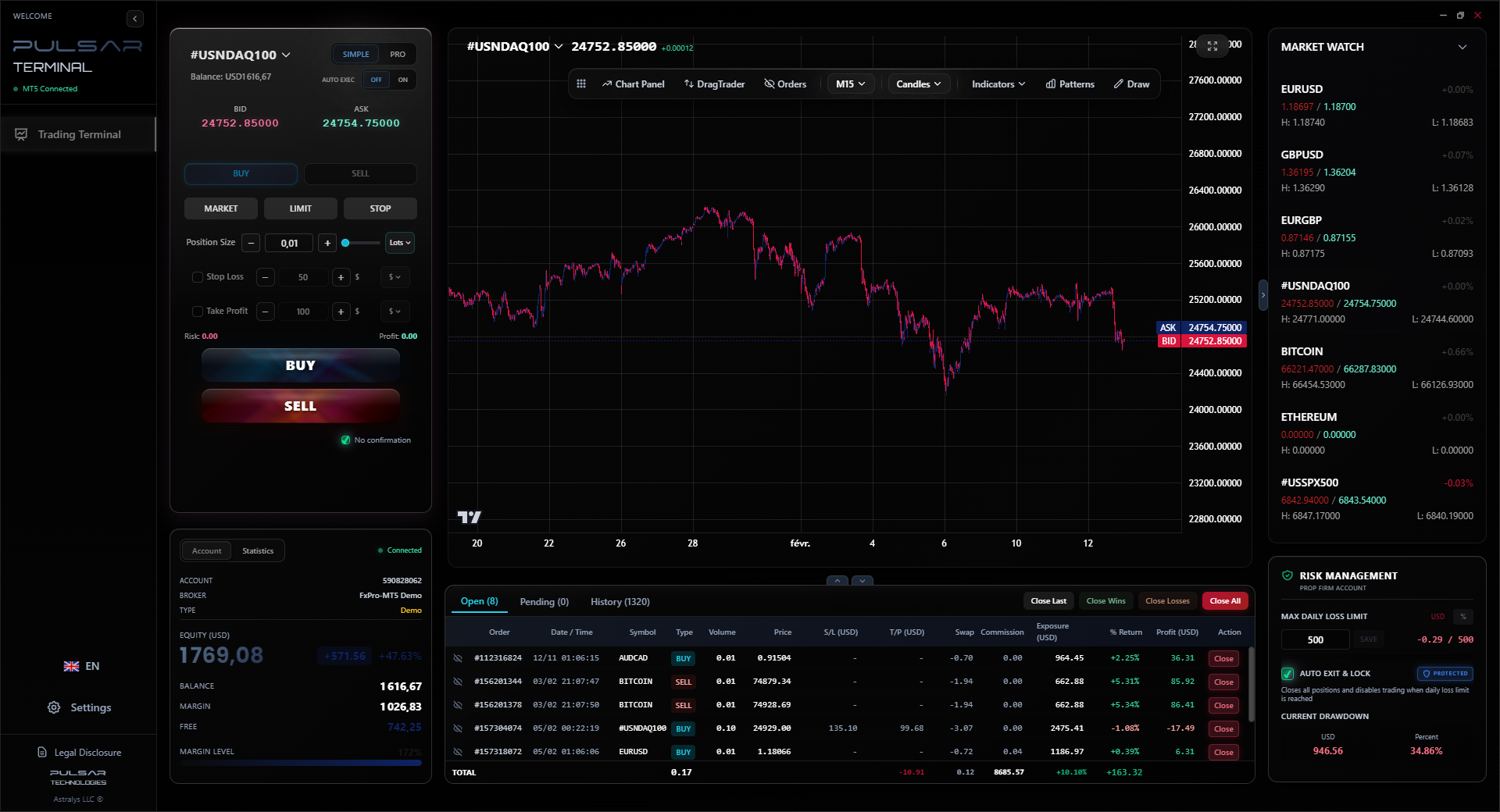
Manually trailing stops and managing multiple targets is stressful and error-prone; Pulsar Terminal automates this directly on your MT5 platform, turning your trading plan into disciplined, hands-off execution.
Pulsar Terminal
La herramienta MT5 todo-en-uno: órdenes drag-and-drop, multi-TP/SL, trailing stop, grid trading, Volume Profile y protección prop firm. Usado por más de 1.000 traders diariamente.
“Your profitability isn't determined by your entry indicator. It's determined by your exit strategy and your position size.”
Your broker is your gateway. The platform's reliability, charting tools, and costs matter. For Indian intraday traders focusing on equities and indices, domestic brokers are usually the best fit.
Discount Brokers (Low Cost, Self-Directed):
- Zerodha (Kite): The market leader. Clean interface, reliable, good basic charting with indicators like VWAP, RSI, MACD. Brokerage: ₹20/order or 0.03% for intraday.
- Upstox: Very similar to Zerodha, competitive pricing. Excellent for execution speed.
- Angel One: Offers advanced charting and good research tools. Their platform has improved significantly.
- Groww: Super user-friendly, great for absolute beginners getting their feet wet.
Full-Service Brokers (Higher Cost, More Hand-Holding):
- ICICI Direct, HDFC Securities, Kotak Securities: Integrated with your banking, offer research and advisory. Brokerage is typically a percentage of turnover, which can be costly for active intraday trading.
For Forex & Global Markets: If you're looking beyond Indian equities at instruments like EUR/USD or XAU/USD, you'll need an international broker. Do your due diligence. Some reputable, globally accessible options with good track records include IC Markets, Pepperstone, and XM. Remember, trading complex instruments like gold (XAU/USD) with high use requires even stricter risk controls.
The platform matters, but don't get lost in features. You need clean charts, VWAP, RSI, EMAs, and reliable order execution. Everything else is a distraction until you've mastered the basics.
💡 Consejo de Winston
The market's job is to take your money. Your job is to not give it to them. A tight, automated trailing stop is the best bouncer you can hire for your capital.

“The only thing you can control is your own behavior: your risk per trade, your adherence to a plan, your ability to take a loss and move on.”
After 12 years, I can tell you the single biggest difference between those who survive and those who blow up. It's not a secret indicator. It's discipline.
The market doesn't care about your ego, your monthly bills, or your "sure thing" tip from a Telegram group. It will humble you. The only thing you can control is your own behavior: your risk per trade, your adherence to a plan, your ability to take a loss and move on.
The best indicator for intraday trading is your own trading journal. It's the record that shows you're risking 1%, not 5%. It's the log that proves you waited for VWAP alignment instead of chasing. It's the cold, hard data that tells you your win rate and average profit/loss.
Start simple. Master VWAP and RSI. Pair them with ruthless risk management. Trade small until your process is automatic. The fancy indicators, the MACD indicator crossovers, the complex strategies... they can come later. First, build the foundation that keeps you in the game. Because in intraday trading, the primary goal isn't to get rich quick. It's to survive long enough to let your edge play out over hundreds of trades. That's how you become part of the 30% who don't lose.
FAQ
Q1Is VWAP really the best indicator for intraday trading in India?
It's one of the most important, not necessarily the 'best.' Its strength is that it's a universal benchmark used by most professional traders and algorithms. It combines price and volume, giving you a dynamic view of the day's fair value. For Indian markets, where institutional activity is high, trading in relation to VWAP is a crucial skill.
Q2What is a good risk-to-reward ratio for intraday?
Aim for a minimum of 1:1.5. If you're risking ₹1,000, your target should be at least ₹1,500. This means you can be wrong more than you're right and still be profitable. For example, a 40% win rate with a 1:1.5 ratio is profitable. A 50% win rate with a 1:1 ratio just covers costs.
Q3Why do I need to square off intraday trades by 3:30 PM?
It's an SEBI and exchange rule for cash market intraday trades. These are settled on a 'T+0' basis, meaning the transaction is completed the same day. If you don't square off, your broker will automatically do it for you, usually at market price between 3:20-3:25 PM, and may charge an extra fee.
Q4Can I use the same indicators for Bank Nifty and stocks?
The principles are the same (VWAP, RSI, EMAs), but their behavior differs. Bank Nifty, being an index future, often has clearer trends and reacts more sharply to news. Individual stocks can be more erratic and influenced by stock-specific factors. Always adjust your position size for the instrument's volatility.
Q5How much capital do I need to start intraday trading?
Legally, you can start with a few thousand rupees. Practically, start with an amount you are 100% prepared to lose while you learn. Given SEBI's 20% margin rule, with ₹25,000 you can take a position worth ₹1,25,000. But this is dangerous without experience. Start small - use a fraction of that buying power to practice risk management first.
Q6What's the difference between a stop loss and a trailing stop loss?
A stop loss is static. You place it at a fixed price where you'll exit a losing trade. A trailing stop loss is dynamic. It follows the price at a set distance (in points or percentage) as the trade moves in your favor. It locks in profits and lets winners run, which is critical for achieving good risk-to-reward ratios.
Q7Are auto-charting or trade management tools worth it?
Once you have a solid, disciplined strategy, they can be incredibly valuable. They remove emotion and manual error from trade execution. For example, a tool that automatically moves your stop loss to breakeven at a specified profit level ensures you never turn a winner into a loser - a common psychological trap.
Lección del Prof. Winston
Puntos clave:
- ✓VWAP + RSI provides a stronger edge than 7 complex indicators.
- ✓Never risk more than 1-2% of capital on a single trade.
- ✓Intraday costs require a minimum 0.5% move to break even.
- ✓The 3:30 PM auto-square-off is non-negotiable. Plan your exit.
- ✓Your trading journal is your true performance indicator.
¿Te resultó útil este artículo?
Haz clic en una estrella
Análisis Trading Semanal
Análisis y estrategias semanales gratis. Sin spam.
Sobre el autor
Rajesh Sharma
Analista Forex Sénior
Más de 10 años operando en mercados indios y del sur de Asia. Comenzó con derivados de divisas en el NSE antes de pasar al forex internacional. Especialista en USD/INR y pares de mercados emergentes.
Comentarios
Aviso de riesgo
El trading de instrumentos financieros conlleva un riesgo significativo y puede no ser adecuado para todos los inversores. El rendimiento pasado no garantiza resultados futuros. Este contenido tiene fines educativos únicamente y no debe considerarse asesoramiento de inversión. Siempre realice su propia investigación antes de operar.
También te puede interesar

Cara Trading Forex Sukses: 7 Prinsip dari Trader Profesional
Cara trading forex sukses dengan 7 prinsip trader pro: manajemen modal, disiplin, journal trading, backtest. Data nyata, bukan janji profit palsu.
Jam Trading Forex Terbaik untuk Trader Indonesia: Panduan Lengkap dengan Tabel Waktu
Panduan jam trading forex untuk trader Indonesia. Tabel 4 sesi dunia, jam emas 20:00-00:00, sesi mana yang harus dihindari. Data akurat + tips dari trader berpengalaman.
Top 5 Sàn Forex Uy Tín Nhất 2026: Review Jujur dari Trader Indonesia
Top 5 sàn forex uy tín 2026 untuk trader Indonesia. Review jujur: spread, deposit, withdraw, dukungan lokal. Exness, XM, IC Markets & lebih.
Obtener Pulsar Terminal
Todas estas calculadoras están integradas en Pulsar Terminal con datos en tiempo real de su cuenta MT5.
Obtener Pulsar Terminal