


I remember staring at my screen in late 2023, watching USD/ZAR spike from 18.50 to 19.20 in a single session.

David van der Merwe
Trader de Mercados Emergentes ·  South Africa
☕ 12 min de lectura
Lo que aprenderás:
I remember staring at my screen in late 2023, watching USD/ZAR spike from 18.50 to 19.20 in a single session. My broker's platform froze for a full minute during the volatility. That's when I realized the platform and the broker behind it weren't just tools, they were my lifeline. Choosing the right international broker isn't about fancy ads, it's about execution when the South African Reserve Bank makes a surprise announcement and the rand goes haywire. Let me walk you through what I've learned after a decade of trading from Johannesburg, through loadshedding and all.
When I first started, I chased the lowest spreads like everyone else. Big mistake. A cheap spread means nothing if your deposit takes a week to clear or your withdrawal gets stuck. For South African traders, specific things make or break the experience.
FSCA Regulation vs. International Licenses: This is the big one. The Financial Sector Conduct Authority (FSCA) is our local watchdog. A broker with an FSCA license (like AvaTrade or Tickmill) has a physical presence here and must follow local rules, including the 30:1 use cap for retail clients. But many top-tier international brokers (regulated in places like the UK, Australia, or Cyprus) also accept South African clients perfectly legally. The key difference? If something goes wrong with an FSCA-regulated broker, you have a local recourse. With an international one, you're dealing with a foreign regulator. I use both types, but I never keep all my capital with one entity.
ZAR-Based Accounts & Payment Ease: This saves you real money. If your broker offers a ZAR-denominated account (Exness and a few others do), you fund and withdraw in rands. No sneaky 2-3% bank conversion fees eating into your profits. Look for brokers that support Instant EFTs from major South African banks. That funding should hit your trading account in minutes, not days. I once missed a perfect setup on Gold because my international wire took 4 business days to arrive.

Warning: Using an unregulated "bucket shop" broker might promise crazy use like 1:1000. It's a trap. Your funds aren't safe, and the FSCA can't help you when they vanish. Stick to regulated entities, full stop.
Platform Stability & Data: We have enough instability with our power grid. Your trading platform shouldn't add to it. MetaTrader 4 (MT4) and MetaTrader 5 (MT5) are the universal standards here for a reason. They're strong. During periods of high ZAR volatility (like when load-shedding forecasts change), you need a broker with reliable servers and fast execution. A 200ms delay can turn a winning trade into a loser. Test their demo server during South African market hours (8am-5pm SAST).
My checklist now is: 1) Strong regulation (FSCA or equivalent Tier-1), 2) ZAR account/cheap ZAR deposits, 3) MT4/MT5 with stable local servers, 4) Transparent fee structure. The spread definition is just one part of that last point.

💡 Consejo de Winston
A broker is a utility, not a strategy. Pay for reliability and execution speed, not for gimmicks. The flashiest platform won't save a bad trade, but a reliable fill might.
“Choosing the right international broker isn't about fancy ads, it's about execution when the South African Reserve Bank makes a surprise announcement.”
Let's talk numbers. The advertised 'spread from 0.0 pips!' is a headline. The real cost is in the details. Here’s what I track on every trade.
Spreads on Majors vs. ZAR Pairs: On EUR/USD, a good raw spread is 0.1-0.3 pips on an ECN account. But you're paying a commission on top, usually $3-$7 per standard lot (100k units) per side. So your all-in cost might be 0.7 pips. On a standard, commission-free account, expect 1.0-1.5 pips. Now, for our home pairs: USD/ZAR, EUR/ZAR. These are exotic pairs. Liquidity is lower, so spreads are wider. Don't be shocked by a 5-15 pip spread on USD/ZAR. It's normal. You have to factor this into your position size calculator. A 10-pip stop-loss on USD/ZAR is much more expensive than on EUR/USD.
Overnight Financing (Swap Rates): This is the interest paid or received for holding a position past the daily rollover time (usually 10pm GMT/12am SAST). It's crucial for swing trading. If you're long a high-interest rate currency against a low one, you might earn a small daily credit. But if you're on the wrong side, it's a debit that slowly bleeds your account. I got burned early on holding a long GBP/ZAR position for weeks; the negative swap ate nearly 30% of my paper profits. Always check the broker's swap rate table.
The Hidden Killer: Currency Conversion. If your trading account is in USD but you fund it in ZAR, your bank or payment processor will convert it at a poor rate, often with a 2% fee. A R10,000 deposit loses R200 before you even place a trade. Withdrawals work the same way. This is why a ZAR account is a massive advantage.

Example: Let's say you trade 1 standard lot of EUR/USD.
- Broker A (ECN): Spread = 0.2 pips, Commission = $7 round turn. Total cost = 0.2 pips + (approx. 0.7 pip equivalent) = 0.9 pips cost.
- Broker B (Standard): Spread = 1.5 pips, No commission. Total cost = 1.5 pips cost. Broker A is cheaper for active traders. Broker B is simpler for beginners. But this ignores the ZAR deposit fee for Broker A if they don't offer local currency accounts.
“A cheap spread means nothing if your deposit takes a week to clear or your withdrawal gets stuck.”
I've funded accounts with over a dozen brokers from SA. These are the ones that have earned my trust (and my capital) based on real use. Remember, your choice depends on your style - a scalper needs different things than a long-term swing trader.
For the Active Trader (Scalpers, Day Traders)
IC Markets: My primary go-to for raw spreads. Regulated in Australia (ASIC) and accepts SA clients. Their raw spread account on MT5 consistently gives me EUR/USD spreads under 0.1 pips with a $7 commission. Execution is lightning-fast, which is non-negotiable for my scalping strategy. They don't have an FSCA license, but their ASIC regulation is top-tier. Funding via Credit Card (ZAR converted by your bank) is instant. The downside? No ZAR accounts, so you eat the conversion fee.
Tickmill (FSCA Regulated): If you want local regulation with excellent pricing, Tickmill is stellar. Their FSCA entity offers the same tight spreads as their global brand. I've used them as a secondary account for years. The IC Markets review and Tickmill are often compared, but for South Africans, Tickmill's local license is a significant plus.
For the Beginner & Swing Trader
Exness (FSCA Regulated): This is my top recommendation for most South Africans starting out. Why? They offer genuine ZAR accounts. You deposit and withdraw in rands via Instant EFT with zero fees from their side. The Standard account has no commission and reasonable spreads. Their minimum deposit can be as low as $10 (or the ZAR equivalent), which is perfect for learning without risk. I've tested their withdrawals multiple times; money hits my FNB account within a few hours.
XM Group (FSCA Regulated): Another solid, beginner-friendly option with an FSCA license. Tiny minimum deposit ($5), huge variety of instruments, and they run frequent educational webinars relevant to our timezone. Their spreads on the standard account are a bit higher, but for a new trader who values education and stability, they're excellent. Check the full XM review for more details.
The Platform-Focused Trader
Pepperstone: Another Australian powerhouse. I rate their cTrader platform access highly if you're into advanced charting and depth of market. They accept SA clients and have razor-sharp spreads. Like IC Markets, you're dealing with international regulation. Their Pepperstone review highlights their award-winning execution, which I've found to be reliable during SA market hours.
A quick comparison based on my journal entries:
| Broker | Best For | Key SA Advantage | My Avg. EUR/USD Cost |
|---|---|---|---|
| Exness | Beginners, ZAR Focus | True ZAR accounts, Instant EFT | ~1.2 pips (Std Acc) |
| IC Markets | Active/Day Trading | Rawest spreads, fast execution | ~0.8 pips all-in |
| Tickmill | Balance of Reg & Price | FSCA License + Low Cost | ~0.9 pips all-in |
| XM | Education & Starting Out | FSCA, Micro Lots, Low Minimum | ~1.6 pips (Std Acc) |
💡 Consejo de Winston
Always do a 'withdrawal test' with a small amount before committing significant capital to any broker. If getting your money out is difficult, the rest doesn't matter.
“I stuck with a mediocre broker for too long because I loved their custom charting tools. But their execution was slow and spreads widened massively on news.”
This isn't the fun part, but ignoring it can ruin you.
The 30:1 use Cap: Since 2021, the FSCA has capped use at 30:1 for retail clients. If you open an account with an FSCA-regulated broker, that's your maximum. So, for a $10,000 position (1 mini lot on EUR/USD), you need at least $333.33 in margin. This is a good thing. It prevents the insane risk I took early on with 1:500 use, where a 20-pip move could wipe my account. International brokers not under FSCA might offer you 1:500. My advice? Don't use it. Stick to 30:1 or even less. It forces proper position size calculator use and saves you from a margin call.
Tax (SARS): Here's the straightforward truth: your net trading profits are taxable income in South Africa. You must declare them to SARS. Keep careful records of all your trades (profits and losses), deposits, and withdrawals. The tax rate depends on your total income bracket. I'm not an accountant, but I pay one who understands trading. It's worth the fee. A common mistake is only looking at withdrawals; SARS looks at annual profit/loss.
Is It Legal to Use International Brokers? Yes. South African regulations don't prohibit you from using a broker regulated overseas. However, you are choosing to be governed by that foreign country's financial rules and investor protection schemes. Do your homework on that regulator. The FSCA's warning is clear: if your international broker goes under or scams you, they likely cannot assist.

Pro Tip: Open a separate bank account just for trading. Fund your broker from this account and withdraw only to it. It makes tracking your profit/loss for SARS dramatically easier and separates your trading capital from your living expenses.
“I stuck with a mediocre broker for too long because I loved their custom charting tools. But their execution was slow and spreads widened massively on news.”
I wish I had this list when I started. Learning is expensive on a live account.
Chasing Bonuses: Early on, I signed up with a dodgy offshore broker offering a 100% deposit bonus. Seemed like free money. The catch? Bonuses usually come with insane volume requirements (trade 10,000 lots before withdrawal) or terms that let them void your profits. I traded aggressively to meet the target, blew my account, and the bonus vanished. Reputable best international forex brokers don't need to bait you with bonuses.
Ignoring the Withdrawal Process: I once spent weeks picking a broker based on spreads, funded my account, and traded successfully. When I went to withdraw my R15,000 profit, they demanded notarized copies of my ID, a utility bill, and my bank statement. The process took 3 weeks. Now, I always test a small withdrawal on a new broker before committing serious capital. If it's not smooth on the way out, it's not the right broker.
Trading Exotics Without Adjusting: My first big loss on USD/ZAR happened because I used the same position size as I did for EUR/USD. The spread was 8 pips instead of 1, and the volatility was wilder. I was stopped out almost immediately. Exotic pairs require wider stops and smaller positions. If you're interested in commodities, our XAU/USD guide is a better starting point than jumping into ZAR pairs.
Platform Loyalty Over Broker Substance: I stuck with a mediocre broker for too long because I loved their custom charting tools. But their execution was slow and spreads widened massively on news. The tools didn't matter if the trade entry was poor. Choose the broker first for reliability and cost, then see what platforms they offer. Most offer MT4/MT5 anyway.
💡 Consejo de Winston
The FSCA's 30:1 use cap feels restrictive, but it's a guardrail, not a barrier. True use comes from compounding consistent, small gains, not from a massive margin multiplier.
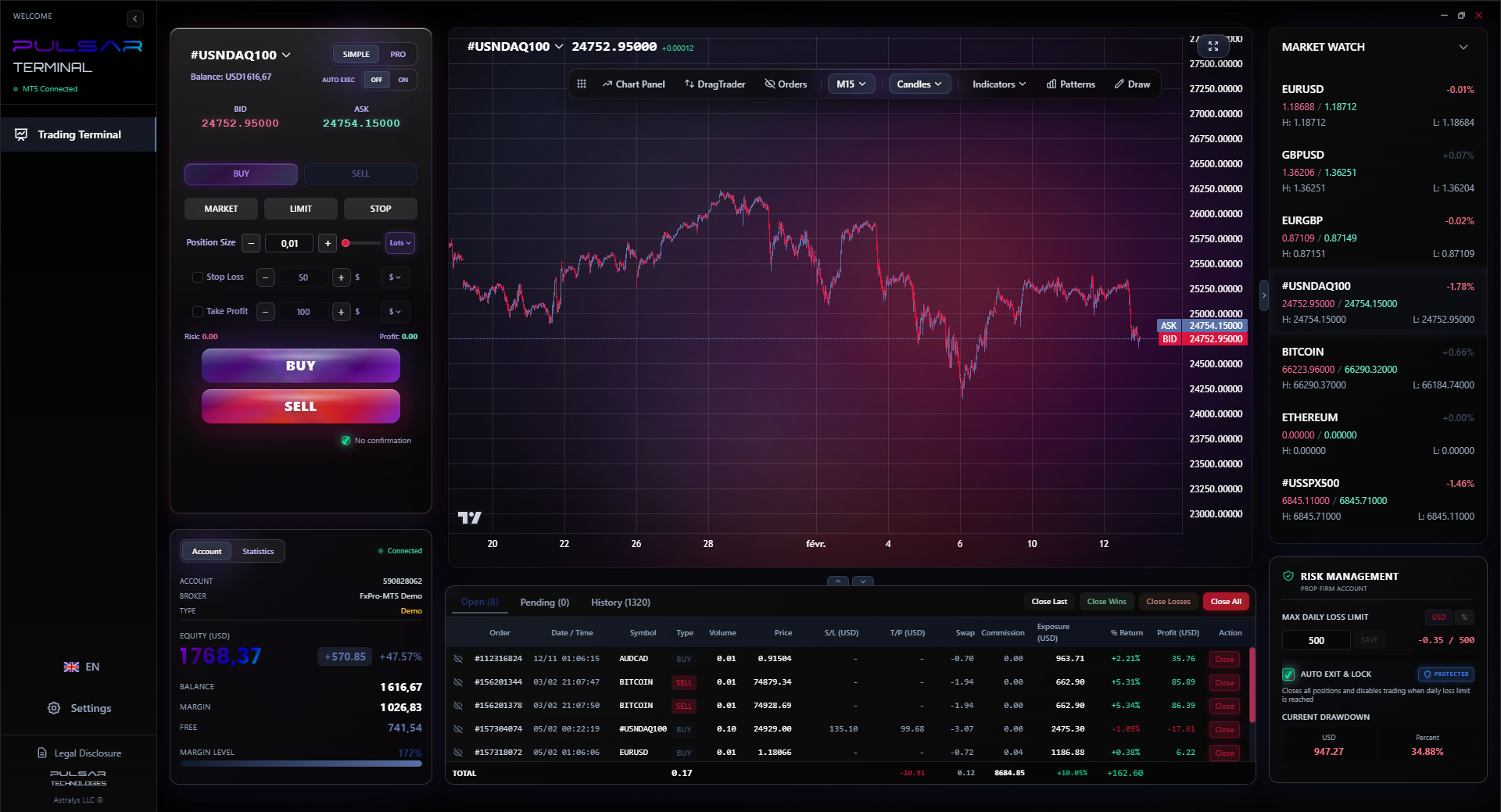
Managing risk on volatile pairs like USD/ZAR requires precise tools, and Pulsar Terminal's drag-and-drop order management on MT5 lets you set multi-level take-profits and stop-losses in seconds.
Pulsar Terminal
La herramienta MT5 todo-en-uno: órdenes drag-and-drop, multi-TP/SL, trailing stop, grid trading, Volume Profile y protección prop firm. Usado por más de 1.000 traders diariamente.
“The FSCA's 30:1 use cap feels restrictive, but it's a guardrail, not a barrier.”
Okay, let's put this all together. Here's the step-by-step process I'd follow if I were starting today in South Africa.
- Define Your Profile: Are you a beginner testing the waters? A serious day trader? Your answer points you to different broker categories above. Be honest.
- Shortlist 2-3 Brokers: Based on your profile, pick 2-3 from the list above. Mix one FSCA-regulated and one top international (like Exness + IC Markets).
- Open Demo Accounts: Don't even think about real money yet. Open a demo with each. Test them for at least two weeks. Trade during SA hours. See how the platform feels. Check the spreads on the pairs you care about, especially at market open (8am SAST) and during major news.
- Test the Funding & Withdrawal: For your top choice, make a minimum real deposit. Maybe R500 or $30. Then, immediately request a withdrawal of that amount (or most of it). This tests the entire financial pipeline. If it's slow or complicated, walk away.
- Start Small & Journal: Once you're happy, fund your account with an amount you can afford to lose completely. Start trading micro or nano lots. Every single trade goes in a journal: entry, exit, reason, emotion. This is how you learn, not by chasing the next EUR/USD guide hot tip.
- Plan Your Risk Management: Before your first real trade, decide your rules. Will you risk 1% per trade? 2%? Use a position size calculator. Set your stop-loss immediately when you enter. This is non-negotiable.
The market will always be here. There's no rush. A good broker is a partner in your journey, not a hurdle. Take your time to choose wisely. Your future self, staring at a volatile USD/ZAR chart with a calm heart, will thank you.
FAQ
Q1Is forex trading legal in South Africa?
Yes, absolutely. It's legal and regulated by the Financial Sector Conduct Authority (FSCA). You can trade with both FSCA-licensed brokers and reputable international brokers that accept South African clients.
Q2What is the maximum use I can get as a South African trader?
If you open an account with an FSCA-regulated broker, the maximum retail use is capped at 30:1. Some international brokers not under FSCA jurisdiction may offer higher use (like 1:500), but using it is extremely risky and not recommended for most traders.
Q3Do I pay tax on my forex trading profits in South Africa?
Yes. The South African Revenue Service (SARS) considers net profits from forex trading as taxable income. You must declare these profits in your annual tax return. Keep detailed records of all your trades, including losses which can offset profits.
Q4Which is better: an FSCA-regulated broker or an international one?
There's no single 'better' option. FSCA-regulated brokers offer local investor protection and easier dispute resolution. Top international brokers often provide tighter spreads and more advanced platforms. Many experienced South African traders use a combination of both to spread risk. The key is to choose a well-regulated entity from either category.
Q5What's the cheapest way to fund my international trading account?
The cheapest way is to use a broker that offers a ZAR-denominated account and supports Instant EFT. This avoids international wire fees and poor bank conversion rates. If your broker only has USD accounts, funding via credit/debit card is usually faster and cheaper than a bank wire, but you'll still pay a currency conversion fee.
Q6Can I use MetaTrader 4/5 in South Africa?
Yes, MT4 and MT5 are the most popular trading platforms used by South African traders. The vast majority of international and local brokers offer them. They are stable, reliable, and support a huge range of custom indicators and automated trading systems (Expert Advisors).
Q7Why are spreads on USD/ZAR so much wider than on EUR/USD?
USD/ZAR is an exotic currency pair. It has lower trading volume and liquidity compared to major pairs like EUR/USD. Wider spreads (often 5-15 pips) compensate market makers for the higher risk and cost of facilitating trades in a less liquid market. You must account for this in your position sizing and stop-loss placement.
Lección del Prof. Winston
Puntos clave:
- ✓Test withdrawals before large deposits.
- ✓ZAR accounts save ~2% on conversion fees.
- ✓30:1 use is a protective limit, not a target.
- ✓Wider stops are needed for ZAR pairs (5-15 pip spreads).
¿Te resultó útil este artículo?
Haz clic en una estrella
Análisis Trading Semanal
Análisis y estrategias semanales gratis. Sin spam.
Sobre el autor
David van der Merwe
Trader de Mercados Emergentes
Trader con sede en Johannesburgo con 11 años en divisas de mercados emergentes. Especialista en pares ZAR, trading regulado por la FSCA y análisis del mercado sudafricano.
Comentarios
Aviso de riesgo
El trading de instrumentos financieros conlleva un riesgo significativo y puede no ser adecuado para todos los inversores. El rendimiento pasado no garantiza resultados futuros. Este contenido tiene fines educativos únicamente y no debe considerarse asesoramiento de inversión. Siempre realice su propia investigación antes de operar.
También te puede interesar

Cara Trading Forex Sukses: 7 Prinsip dari Trader Profesional
Cara trading forex sukses dengan 7 prinsip trader pro: manajemen modal, disiplin, journal trading, backtest. Data nyata, bukan janji profit palsu.
Jam Trading Forex Terbaik untuk Trader Indonesia: Panduan Lengkap dengan Tabel Waktu
Panduan jam trading forex untuk trader Indonesia. Tabel 4 sesi dunia, jam emas 20:00-00:00, sesi mana yang harus dihindari. Data akurat + tips dari trader berpengalaman.
Top 5 Sàn Forex Uy Tín Nhất 2026: Review Jujur dari Trader Indonesia
Top 5 sàn forex uy tín 2026 untuk trader Indonesia. Review jujur: spread, deposit, withdraw, dukungan lokal. Exness, XM, IC Markets & lebih.
Obtener Pulsar Terminal
Todas estas calculadoras están integradas en Pulsar Terminal con datos en tiempo real de su cuenta MT5.
Obtener Pulsar Terminal