


Everyone's searching for the 'best' price action strategy, and most of what you'll find is theoretical garbage that loses money once you factor in Indian taxes and brokerage.

Rajesh Sharma
Analista Forex Sénior ·  India
India
☕ 11 min de lectura
Lo que aprenderás:
Everyone's searching for the 'best' price action strategy, and most of what you'll find is theoretical garbage that loses money once you factor in Indian taxes and brokerage. The truth is, the best strategy is the one you can execute consistently without getting wrecked by SEBI's new rules or your own psychology. I've traded Nifty and Bank Nifty for over a decade, and I'll show you the only price action framework that's survived regulatory changes, tax hikes, and my own stupid mistakes. Forget fancy indicators; we're talking about reading the tape and managing risk in a market that's getting more complex by the day.
You can watch all the YouTube videos you want about pin bars and engulfing candles on the EUR/USD chart. Try applying that directly to the Nifty 50 and you'll get a rude awakening. The context is completely different.
Our market has unique friction. Let's talk about the 2026 STT hike first. Selling an options premium now carries a 0.15% STT, up from 0.1%. For futures, it's 0.05% on sell-side turnover. This isn't just a line item; it directly attacks the profitability of high-frequency price action methods like scalping. A strategy that generates 20 small trades a day might have shown a paper profit, but after STT, exchange charges, and GST on brokerage, you're often just funding the government.
Then there's the intraday rule: you must square off by 3:20 PM. This forces a specific rhythm. Many classic swing trade setups that rely on a 'close' to confirm simply don't have time to develop. You're playing a different game with a hard stop clock. I learned this the hard way in 2019, holding a beautiful bullish flag pattern in Reliance, hoping for a breakout after 3:30 PM. My broker's auto-square-off triggered at 3:25 PM at a 1.2% loss. The stock then rallied 3% the next morning. The setup was right, but my understanding of the market's rules was wrong.

Warning: Ignoring STT and brokerage in your backtesting is a surefire way to blow up a live account. A 'winning' trade netting ₹500 might only leave you ₹300 after all statutory costs. Your risk-reward math must start from this reality.
The final killer is SEBI's 2026 algorithmic trading framework. Thinking of automating your price action strategy? If it places more than 10 orders per second, it's considered an algo and needs formal exchange approval. Your broker is now fully responsible for your code. This has made many third-party tools and APIs a compliance nightmare overnight. Pure, discretionary price action reading is becoming one of the last bastions for the retail trader who doesn't want to deal with algo registration.
Strip everything back. The best price action trading strategy isn't a secret pattern. It's a consistent process for identifying market structure and supply/demand zones on a clean chart. Indicators are just noise here. You need to see where the price has reversed with force before.
Market Structure: Highs, Lows, and Shifts
This is basic but poorly executed. An uptrend is a series of higher highs (HH) and higher lows (HL). A downtrend is lower lows (LL) and lower highs (LH). Your job is to spot when this structure breaks - a break of structure (BOS). For example, in an uptrend, if price makes a lower low (breaks the prior HL), the trend is potentially over. I only look for trades in the direction of the overarching structure. Trading against it is gambling, not strategy.
Identifying Key Supply and Demand Zones
Forget horizontal lines everywhere. A true zone is where you see a strong, impulsive candle (a big green or red bar) followed by a clear reversal or consolidation. The base of that impulsive move is your zone. Price should return to this area quickly after leaving it. These zones are where institutional orders likely sit. My most consistent trades come from price reacting to these areas on the Nifty 15-minute chart.

Example: On April 5th, Bank Nifty formed a strong bullish candle from 48,200 to 48,600. It then pulled back. That 48,200-48,250 area became a demand zone. Two days later, price dipped back to 48,230, stalled, and rallied 350 points. That was the zone doing its work.
This framework works because it's based on auction market theory, not lagging formulas. It adapts to any timeframe, crucial for aligning with India's intraday constraints. For a deeper dive on applying this to specific instruments, our XAU/USD guide uses the same core principles, though the volatility is different.

💡 Consejo de Winston
The market's primary job is to transfer money from the impatient to the patient. Your best price action signal is often the courage to do nothing.
“Your 135-point win is effectively a 126-point win after costs. Your stop loss calculation must be based on the net risk, not the points.”
Here are two high-probability setups I use weekly. I'm including real cost math because if you skip that, you're not trading, you're fantasizing.
1. The Pullback to a Key Zone in a Trend This is my bread and butter. Identify a clear trend on the 30-minute chart. Wait for a pullback into a previously established demand (in uptrend) or supply (in downtrend) zone. Enter on the first sign of rejection (a pin bar or a small bullish/bearish engulfing) at the zone.
- Trade Example: Nifty Futures in an uptrend. Demand zone at 22,400. Price pulls back to 22,410 and forms a 5-minute bullish pin bar.
- Action: Buy at 22,415. Stop loss at 22,380 (just below the zone). Target: previous swing high at 22,550.
- Risk: 35 points.
- Reward: 135 points. Risk/Reward > 1:3.
- Cost Reality: Assume 1 lot (75 units). Profit = 135 pts * 75 = ₹10,125. Now deduct: STT (0.025% on sell turnover: 22,550750.00025) ≈ ₹423. Brokerage (₹20/trade, two legs) = ₹40. Exchange charges ≈ ₹150. GST @18% on brokerage+charges ≈ ₹34. Stamp duty ≈ ₹10. Net Profit: ~ ₹9,468. Your 135-point win is effectively a 126-point win after costs. Your stop loss calculation must be based on the net risk, not the points.
2. The False Break (or 'Stop Hunt') Price makes a sharp move above a recent high (or below a low), triggering stops, then immediately reverses back into the range. This often creates a wick on the chart. You enter in the direction of the reversal, betting the break won't sustain.
This setup requires patience and is excellent for swing trading longer-term positions in stocks, but can be adapted for index futures. The key is waiting for the close of the candle that shows the rejection. Never enter while the false break is still happening.
Your strategy is meaningless without iron-clad risk rules. This is where 90% of Indian traders fail. They focus on the entry and ignore the exit.
- Never Risk More Than 1% Per Trade: This is gospel. On a ₹500,000 capital, your max loss per trade is ₹5,000. Use a position size calculator religiously. If your stop loss is 50 points away on Nifty, your position size must be calculated to lose only ₹5,000 if that stop is hit. This often means trading fewer lots than your greed tells you to.
- Your Stop Loss is Sacred: It goes below the demand zone (for longs) or above the supply zone (for longs). Not based on a random rupee amount. If the zone is violated, your trade thesis is wrong. Period. Moving your stop loss is admitting your analysis was a guess. I've blown two months of profits in one afternoon by shifting a stop 'just a little'.
- Daily Loss Limit: If you lose 3% of your capital in a day, shut down the terminal. Walk away. The market will be there tomorrow. This single rule saved my account during the 2020 March crash.
- Understand Margin & use: Brokers offer up to 5x intraday use. This is a trap for the undisciplined. Using full use on a single trade is a fast track to a margin call. I never use more than 2-3x, and that's spread across potential trades.

Pro Tip: Your profit target should be based on a logical technical level (like the next supply zone), not a random number. If the risk to get to that target is not at least 1.5 times your stop loss, skip the trade. The costs will eat you alive otherwise.
💡 Consejo de Winston
If you can't immediately articulate why your stop loss is where it is, you don't have a trade. You have a hope.
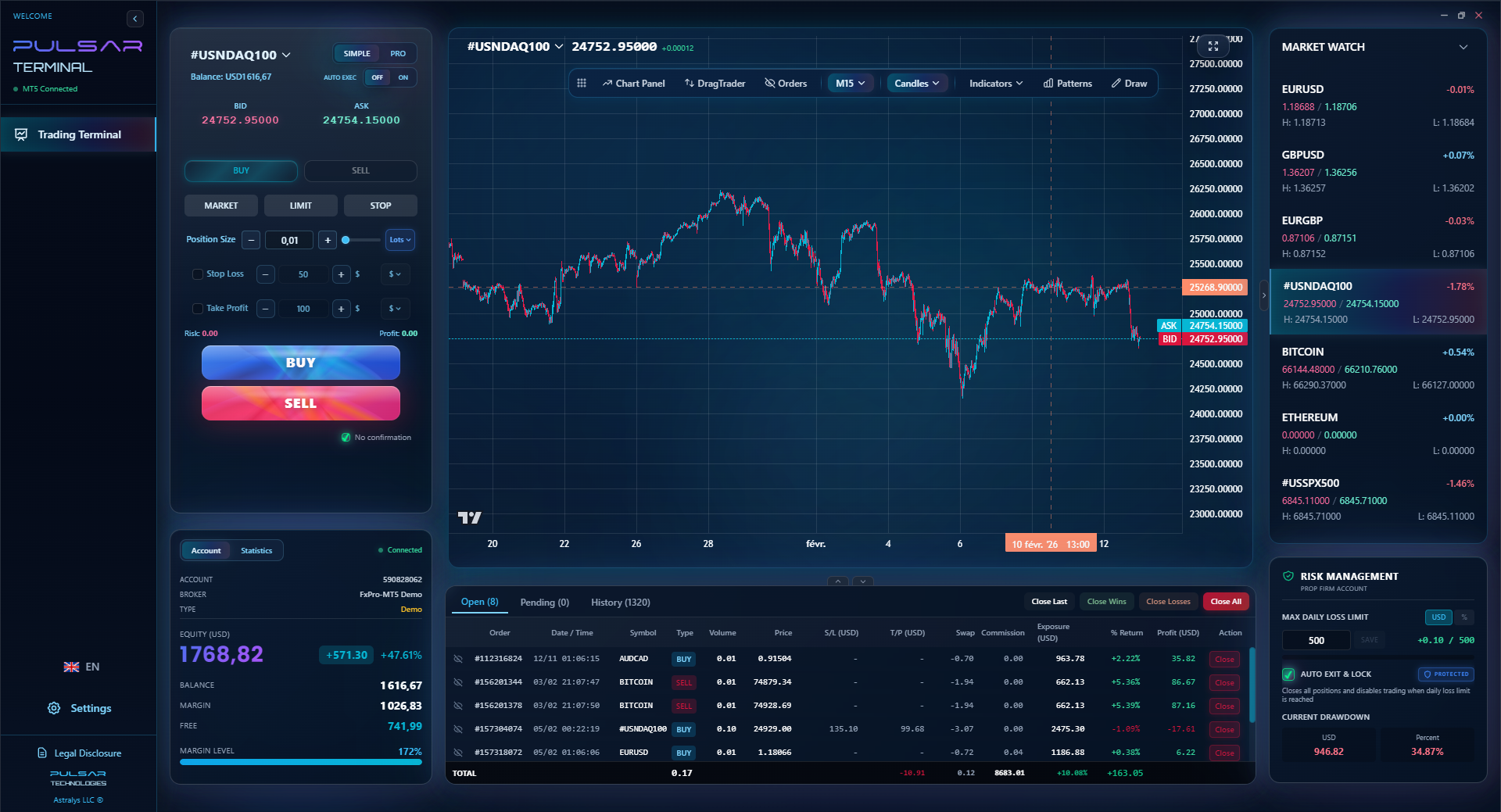
Managing multiple trades and moving stops to breakeven manually is a hassle; Pulsar Terminal automates this and advanced order types directly within your MT5 platform.
Pulsar Terminal
La herramienta MT5 todo-en-uno: órdenes drag-and-drop, multi-TP/SL, trailing stop, grid trading, Volume Profile y protección prop firm. Usado por más de 1.000 traders diariamente.
“Moving your stop loss is admitting your analysis was a guess. I've blown two months of profits in one afternoon by shifting a stop 'just a little'.”
Your broker is your lifeline. For price action, you need two things: excellent, reliable charts and fast, cheap execution.
Charting: Most Indian discount brokers (Zerodha Kite, Upstox) now integrate with TradingView. This is a game-changer. You get professional drawing tools and clean charts. Don't settle for a broker's proprietary charting if it's clunky.
Execution & Costs: You're making intraday moves. Every tick matters. Compare:
| Broker Type | Pros for Price Action | Cons |
|---|---|---|
| Discount (Zerodha, Upstox) | Ultra-low flat fees (₹20/order). Clean platforms. Good API (post-SEBI 2026 rules). | Research is self-service. No hand-holding. |
| Full-Service (ICICI Direct, HDFC Sec) | Might offer proprietary research flows. | Brokerage can be 10x higher (0.05%-0.5%). Eats into frequent trading profits. |
For pure price action, a discount broker is the only sensible choice. That ₹20 per trade is predictable. A percentage-based fee on a large Nifty trade can be hundreds of rupees. If you're exploring international brokers for practice or other instruments, always check their regulatory standing. Our reviews of Exness, IC Markets, and Pepperstone detail their offerings, but remember, trading complex derivatives offshore carries significant risk.
Funding: Use UPI. It's instant and seamless. The days of waiting for NEFT are gone. This lets you move money in and out of your trading account as needed.
Let me save you some money and pain.
- Overtrading: This is the #1 killer. You see a few small wins and start taking every minor signal. Remember, STT and brokerage are per trade. 10 trades a day at ₹20 brokerage + STT is ₹200+ in fixed costs. You need to win just to cover fees. I once made 47 trades in a week, won on 60% of them, and still ended the week down ₹8,000 purely due to costs. Quality over quantity.
- Ignoring the Overall Market (Nifty Trend): Trading a stock that's in a nice uptrend while the Nifty is crashing is like swimming against a tsunami. Most stocks correlate with the index. Check the Nifty trend on the hourly chart before placing any stock trade. Your stock setup might be perfect, but if the index is selling off, probability drops.
- Revenge Trading: You take a loss. You're angry. You jump right back in with a bigger size to 'make it back.' This is how you lose 10% in an hour. After a loss, follow your daily limit rule. If you're emotional, you're not analyzing price action, you're reacting to your P&L.
- Chasing Moves: You see a stock rocket 5%. FOMO hits. You buy at the top. This is not price action trading; it's emotional gambling. A true price action entry is at a predefined zone, not in the middle of a parabolic move. Wait for the pullback or miss it. There's always another trade.
Many traders try to complicate things with indicators to avoid these psychological traps. They'll slap on an RSI indicator or MACD indicator for 'confirmation.' By the time these lagging tools give a signal, the best part of the price move is often over. Discipline beats a dozen indicators every time.
💡 Consejo de Winston
Your trading journal is more important than your strategy. The strategy tells you what to do. The journal tells you who you are when you're doing it.
“The best price action trading strategy isn't a secret pattern. It's a consistent process for identifying market structure and supply/demand zones on a clean chart.”
This isn't theoretical. Here's a simplified version of my plan.
Timeframe Focus: 30-minute chart for trend and zone identification. 5-minute chart for precise entry. Markets: Primarily Nifty Futures, Bank Nifty Futures. Select large-cap stocks for swing trades. Session Focus: First 90 minutes (9:15-10:45) and last 90 minutes (1:30-3:15). Avoid the mid-day chop. Daily Routine:
- Pre-Market (9:00 AM): Identify Nifty's overall structure on the 30-minute chart from previous day. Mark clear supply/demand zones.
- Market Open: Observe. Don't trade the first 15-minute volatility.
- Execution: Only look for trades that align with the 30-minute trend, at a key zone, with a clear entry signal on the 5-minute chart.
- Trade Management: Place stop loss immediately. Set a logical profit target. Do not micromanage. If the trade goes 1.5x in your favor, consider moving stop loss to breakeven.
- Review: Post-market, journal every trade. Screenshot the chart. Note why you entered, your emotion, and the outcome.
Weekly Goal: 2-3 high-quality setups. Not 2-3 trades per day. A 60% win rate with a 1:2 risk-reward, after costs, compounds beautifully.
This plan forces discipline. It filters out noise. It respects costs. It's boring. And boring is profitable. For those interested in a much faster-paced style, understand that scalping strategy in India is a different beast entirely, with cost structures that make it a professional's game.
FAQ
Q1Is price action trading still profitable after the 2026 STT increase?
Yes, but you must be more selective. The higher STT on derivatives directly reduces net profit per trade. This makes high-frequency, low-reward strategies much harder. The profitability now hinges on capturing larger moves (better risk-reward ratios) and trading less frequently to minimize cumulative transaction costs. Your edge must be clearer than before.
Q2Can I automate my price action strategy under SEBI's new algo rules?
It's complicated. If your automation places more than 10 orders per second, it's classified as an algorithmic trade and requires formal exchange approval and a unique Algo-ID. For most retail traders using simple price-action based conditional orders, you're likely under the threshold. However, using any third-party software or API now comes with stricter broker oversight and security protocols (whitelisted IPs, 2FA). Check directly with your broker's compliance team before attempting any automation.
Q3What's the best chart timeframe for price action in Indian markets?
There's no single 'best,' but a multi-timeframe approach is key. Use the 30-minute or 1-hour chart to establish the overall trend and identify major support/resistance zones. Then, use the 5-minute or 15-minute chart for your precise entry trigger. This aligns well with the intraday nature of the market, giving setups time to develop without forcing you to hold through the close.
Q4How do I calculate my position size accurately for Indian markets?
First, determine your max risk per trade (e.g., 1% of capital). Then, for your specific trade, calculate the difference between your entry and stop loss in rupees (points * lot size). Your position size should be such that this rupee loss equals your max risk. Always use a position size calculator. Crucially, remember to account for the approximate costs (STT, brokerage) in your potential reward calculation to ensure your risk-reward ratio is still valid net of fees.
Q5Do I need to pay GST on my trading losses?
No, you do not pay GST on trading losses. GST (18%) is levied only on the fees you pay: brokerage, transaction charges, and SEBI turnover fee. It's a cost of doing business, not a tax on your P&L. However, your net trading profits (after all costs) are subject to income tax as per your slab rate.
Q6What is a 'pip' in the context of Nifty futures?
In forex, a pip is a standardized move. In Indian indices, we talk about 'points.' For Nifty futures, the minimum price movement is 0.05 points, but traders generally refer to whole points (e.g., a move from 22,400 to 22,401 is a 1-point move). The value of 1 point is ₹50 for the standard Nifty futures lot. Understanding this is fundamental for calculating your pip definition equivalent, risk, and reward.
Lección del Prof. Winston
Puntos clave:
- ✓Costs are part of your strategy. STT can turn a winning system into a loser.
- ✓Never risk more than 1% of capital on a single trade. Ever.
- ✓Trade with the Nifty trend, not against it. Context is everything.
- ✓10 high-quality trades a month beat 100 rushed ones.
¿Te resultó útil este artículo?
Haz clic en una estrella
Análisis Trading Semanal
Análisis y estrategias semanales gratis. Sin spam.
Sobre el autor
Rajesh Sharma
Analista Forex Sénior
Más de 10 años operando en mercados indios y del sur de Asia. Comenzó con derivados de divisas en el NSE antes de pasar al forex internacional. Especialista en USD/INR y pares de mercados emergentes.
Comentarios
Aviso de riesgo
El trading de instrumentos financieros conlleva un riesgo significativo y puede no ser adecuado para todos los inversores. El rendimiento pasado no garantiza resultados futuros. Este contenido tiene fines educativos únicamente y no debe considerarse asesoramiento de inversión. Siempre realice su propia investigación antes de operar.
También te puede interesar

Cara Trading Forex Sukses: 7 Prinsip dari Trader Profesional
Cara trading forex sukses dengan 7 prinsip trader pro: manajemen modal, disiplin, journal trading, backtest. Data nyata, bukan janji profit palsu.
Jam Trading Forex Terbaik untuk Trader Indonesia: Panduan Lengkap dengan Tabel Waktu
Panduan jam trading forex untuk trader Indonesia. Tabel 4 sesi dunia, jam emas 20:00-00:00, sesi mana yang harus dihindari. Data akurat + tips dari trader berpengalaman.
Top 5 Sàn Forex Uy Tín Nhất 2026: Review Jujur dari Trader Indonesia
Top 5 sàn forex uy tín 2026 untuk trader Indonesia. Review jujur: spread, deposit, withdraw, dukungan lokal. Exness, XM, IC Markets & lebih.
Obtener Pulsar Terminal
Todas estas calculadoras están integradas en Pulsar Terminal con datos en tiempo real de su cuenta MT5.
Obtener Pulsar Terminal